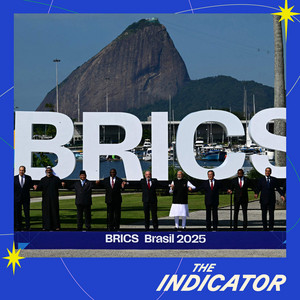
N .P .R. Earlier this month, ten men in formal wear held hands by the shores of Rio de Janeiro.
Behind were plunging mountains and enormous white letters spelling BRICS, B -R -I -C -S.
These men were leaders and representatives of Brazil, Russia, India, China, and South Africa, plus several other countries.
They were there for the 2025 BRICS summit.
Yeah, Indian Prime Minister Modi was there.
Brazilian President Lula in a red tie, looking very chipper.
The summit produced lofty words, of course.
Nice words about global health and international law.
And stern words for Israel and the U .S. for their attacks on Iran.
Iran and condemnation for Israel over the war in Gaza.
Back in the U .S., President Trump was seething.
At a cabinet meeting, he threatened members with an additional 10 percent tariff.
Because BRICS was set up to hurt us.
BRICS was set up to degenerate our dollar and take our dollar as the standard, take it off as the standard. So was BRICS set up as an anti -American project to replace the dollar in global reserves?
Jim O 'Neill says that's a misunderstanding.
To me now, it's just idiotically blatantly obvious.
How can you solve truly global issues if you don't have the countries that are driving global growth sitting at the table?
Jim is a British economist, and actually the guy who came up with the BRICS acronym back in 2001.
But his original vision has morphed into something quite different.
This is The Indicator from Planet Money.
I'm Adrian Ma. And I'm Darian Woods.
Today on the show, the brick house that Jim built, or at least named.
We ask why international economic organizations are so Western -dominated and whether the world is moving on.
This message comes from Dell Technologies.
Supercharge your studies during Dell's back -to -school event with AIPCs starting at $749 .99, like the Dell 14 Plus featuring an Intel Core Ultra processor.
Shop now at dell .com slash deals.
This message comes from NPR sponsor U .S. Bank.
With U .S. Bank Business Essentials, you get more than just a bank.
You get a dedicated partner that provides you a powerful combo of checking and card payment processing with quick quick access to the money you've earned, proving that there is nothing as powerful as the power of us.
Visit usbank .com today to learn more.
Member FDIC. Copyright 2025 U .S. Bank.
This message comes from NPR sponsor Holiday Inn by IHG.
It's a new day for a new stay at Holiday Inn for business travelers.
With modern spaces for meeting and working, plus delicious dining from breakfast to happy hour and dinner, you have everything you need to get work done.
Give your everyday business travel an upgrade.
Book your next business trip at Holiday Inn by IHG.
Visit HolidayInn .com to book your stay.
BRICS stands for Brazil, Russia, India, China, and South Africa.
Somewhat confusingly, the group also now includes Egypt, Ethiopia, Indonesia, Iran, and the United Arab Emirates.
Which, I guess if you added all those, it would make Brick -u -we -z -z -z?
Brickies? Yeah. Brick -u -we -z?
In any case, BRICS is just one of the latest incarnations of countries building forums to try to solve international issues, things like war, trade and disease.
What makes this one different is that, with the exception of Russia, this one spans the globe but isn't dominated by World War II powers like the US or Germany.
The closest analogy to what BRICS is and what it's trying to achieve would be the G7.
The G7 is this group of rich countries that also value democracy, and it includes Canada, France, Germany, Italy, Japan, the UK, and the US.
And the G7 meets once a year.
Sometimes it's been the G8 with Russia.
Sometimes it's been the G5.
But from now on, we'll just call it the G7.
It started in the mid -1970s.
Back then, the world was wrestling with the consequences of the first oil crisis.
Unemployment and inflation were high, so the heads of the largest democratic economies convened in a French chateau and declared that they're all doing their best to stabilize their countries.
And also that they wanted to accelerate trade talks to reduce tariffs and encourage trade.
Jim O 'Neill is the economist who coined the acronym BRICS, and he says when he was working in banking in the 1980s, the G7 was really important.
People in business and certainly finance, you know, you would want to be really watchful of what was going on at a G7 meeting because they would normally do something that was relevant.
Take the Plaza Accord in 1985.
That's an agreement that other countries would sell their U .S. dollar reserves so the U .S. dollar could be weakened and actually help U .S. exporters, with a weaker dollar an American factory could sell more overseas.
The G7 kick -started this agreement.
They would deal with major macroeconomic imbalances, which of course in those days were dominated just by those seven countries.
But that changed in 1997, a financial crisis spread throughout Southeast Asia.
Jim O 'Neill was working for Goldman Sachs at the time.
I was very impressed in the role that China played to try and bring that to an end.
Among other things, China contributed over $4 billion to help bail out other Asian countries.
I read that as, actually, the US isn't the only guys on the block.
At the time, Jim is the co -head of global economic research for Goldman Sachs.
But a couple of years later, he wants to buff up his credentials to become the sole head.
And so I try to think, if it were me, how would I identify the world going forward until I could sort of stamp my mark and influence?
The year is 2001, and his thinking is shaped by another event in early September.
So Jim goes to a conference in New York for the National Association for Business Economics.
It's in the World Trade Center.
And there, Jim sees seminars, swaps cards with people, and leaves the conference early to head back to the U .K. And then we all know what happens next.
On September 11th, two planes strike the World Trade Center's Twin Towers.
I was badly mentally affected by it for a few days.
as you can imagine.
However, crucially to this story, a few days later, I came to the strange conclusion perhaps that maybe the world had sort of had enough of American domination and Americanization of every part of the world.
Jim starts extrapolating the economic growth trajectory of Brazil, of Russia, of India and China.
Back in 2000, these countries made up only about 23 % of the world economy, accounting for differences in purchasing power.
Jim's calculations show that this share would grow to 27 % over the next 10 years.
And so based on this growth path, he thinks these countries should have more of a place at the table of global governance.
And it seemed to me somewhat crazy.
What is the point of having Germany, France, and Italy continuously, singly represented as nations in all these structures that were developed 50 -odd years earlier.
He writes his research note titled, The World Needs Better Economic BRICS.
I get it. Very clever.
And he proposes changing the G7.
He wants to consolidate the European countries and add China and other BRIC countries.
So the counter -argument is often, well, these countries are authoritarian in the case of China.
and Russia, less so India and Brazil.
And the values of these countries in the post -World War II institutions are important.
Well, I'm very aware of that, and that's what many people have said to me for a long time.
And this sort of very, to be honest, almost patronizing but certainly simplistic view, you can only run the world with people that think exactly like us, is partly why we're in the mess that we're in.
Does that mean we shouldn't try and solve global issues because it's slightly trickier, because we're having to negotiate with people that don't think like us?
I mean, it's quite a limiting way of thinking.
The BRIC acronym takes the world by storm.
So much so that Brazil, Russia, India, and China say, yeah, we should have our say on world events.
I mean, it's kind of amazing what effect an acronym from one economist can have on the world.
Yeah, and building off other similar forums developed in the 1990s, the first BRIC meeting happens in New York in 2006 alongside the UN Assembly with the first formal summit in Russia in 2009.
Since then, BRIC's countries have proposed building alternative bank payment systems. They've also investigated potentially creating a common currency or some way to settle international trade without using the dollar so much. This is one of the things that got Donald Trump so worked up.
Do you see BRICS as an anti -American project?
So I find it hilarious when I observe Donald Trump making comments about the BRICS.
And I think simply by making these comments as the president of the United States, effectively he is boosting the importance of the BRICS Alliance.
Ultimately, though, a separate BRICS forum was not what Jim was aiming for.
I wish that wouldn't have happened because you have the G7 and the BRICS sort of doing their own thing in parallel, but sort of speaking at cross purposes and both trying to sort of project their images about how they can solve all these issues, which neither of them is important enough on their own to do so.
This episode was produced by Corey Bridges with engineering by Jimmy Keeley.
It was fact -checked by Sierra Juarez.
Kate Concandon edits the show and The Indicator is a production of NPR.