WBUR Podcasts, Boston.
An old proverb from Africa says, Truth is like oil.
No matter how much water you pour on it, it will always float.
In other words, no matter how much you try to hide the truth, it will eventually reveal itself.
As we'll hear in today's story, when one tricky character tries covering up the truth, an even trickier character blows his cover.
I'm Rebecca Shear, and welcome to Circle Round, where story time happens all the time.
Today our story is called Hot Potatoes.
It was inspired by tales from the Tonga, a Bantu ethnic group who are part of the Sanga people of South Africa, Zimbabwe, and Mozambique.
Some really great people came together to bring you our adaptation of this tale, including Arlen Escarpita, who stars as Zeke Wallace on the NBC series Found.
So, circle around, everyone, for Hot Potatoes.
It was a blisteringly hot day on the savannah And Hare was desperate for a drink Oh, I'm so thirsty If I don't find water soon, I'll dry up into a husk From the tips of my long, pointy ears to the back of my short, bushy tail.
Under a blazing sun, Hare bounded across the grasslands in search of a waterhole.
When he finally found one, who should he find standing beside it, her horned, brown head raised high and alert, but Antelope.
Hey there, Antelope.
What you doing? Antelope narrowed her eyes.
she knew hair was a tricky one, with a notorious reputation for pulling pranks.
What am I doing, you ask?
What does it look like I'm doing, hair?
I'm guarding over this waterhole I found.
I spent hours looking for it.
And in this sweltering weather, I'm not letting one drop go to waste.
I see. Hair put on his most winning grin.
Tell me something, Antelope.
What do you think of melons?
Melons? Antelope's face lit up.
I love melons. They're so sweet, so juicy.
They'd be especially refreshing in this heat.
Why do you ask? Well, I'm with you.
Melons would be refreshing in this heat, and that's why I was going to grow some.
Grow some? Sure. Care to help me do some farming?
We can split the melons 50 -50.
At the thought of chomping down a sweet, juicy melon, Antelope lowered her guard.
You can count me in, Hare.
Well, what do we do first?
First, we have to plow.
Plowing loosens up the earth and makes it ready for planting seeds.
See that? Hare motioned toward a fallen tree branch.
That hefty branch will make for an ideal plow.
So how about I go grab some melon seeds while you drag the branch across the ground?
You're so big and strong, we'll be ready for planting in no time.
Antelope's face tightened with worry.
But that branch is much too big to hold in my mouth, Hare.
And I can't exactly grasp it with my hooves.
I won't be able to balance.
Hare was well aware of this fact, but he pretended to think.
Gosh, Antelope, you're right.
So I'll tell you what.
How about if I tie the stick to your middle, then you'll have no problem plowing.
Quick as a wink, Hare grabbed a long vine, wrapped it around Antelope's belly, and tied it to the branch.
He jammed one end of the branch deep into the earth, and Antelope immediately began to struggle.
Hair! Now I can't move.
The branch is stuck in the ground.
Is it? Hair shrugged.
That's your problem, Antelope, not mine.
And now this is my water hole, not yours.
And with that, he drank up every last drop in the water hole and bounded away.
You'll pay for this, Hair.
One of these days, he'll pay for this.
You hear? But Hare did not hear.
He had already hopped over to another waterhole.
This one watched over by Lizard.
Hey there, Lizard. What you doing?
Lizard gave Hare a sideways glance.
He too was well aware of Hare's reputation as a trickster.
Don't even try it, Hare.
This is my waterhole.
You can't dupe me into sparing a drop.
I see. Hare gave his whiskers a wiggle.
Actually, to tell you the truth, I wasn't even interested in your water, Lizard.
I was looking for someone to help me do some farming and plant some luscious succulent melons.
We would split the harvest, of course.
At the thought of biting into a luscious succulent melon, Lizard forgot all about Hare's schemes.
It just so happens I adore melons.
You can count me in here.
What do we do first?
First, we have to plow.
You see that big stick over there?
How about I go grab some melon seeds while you drag the stick across the ground?
You're so nimble and quick, we'll be ready for planting in no time.
Lizard's forehead creased with concern.
My legs are too short to hold that stick, Hare.
And my mouth is too small to clamp it in my teeth.
Hare, of course, was well aware of this fact.
But again, he pretended to think.
Gee, Lizard, you're right.
So I'll tell you what.
How about if I tie the stick to your strong tail?
Then you'll have no problem plowing.
Quick as a wink, Hare seized another long vine and tied the stick to Lizard's tail.
Then he lodged one end of the stick deep into the ground.
But Hare, now I can't move.
The stick is stuck.
Is it? Hare laughed.
That's your problem, Lizard, not mine.
And now this is my waterhole, not yours.
And with that, he guzzled down every last drop in the waterhole and scampered away.
You're going to get what's coming to you, Hare Any time now, you're going to get what's coming here But Hare did not hear He had already sprung over to another water hole This one guarded by Tortoise But when Hare came sauntering over Offering to split his melon harvest with her I think I'll pass, Hare Much
as I'd love to do some farming with you, I'll just sit here and drink my water.
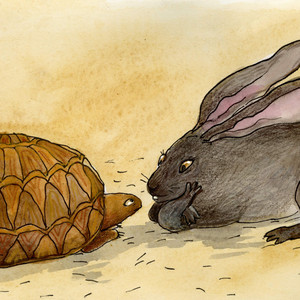
I see. Now, you might assume that hair was disappointed by Tortoise's answer, but let's just say the crafty fellow had more than one trick up his sleeve.
Fine, Tortoise, fine.
I get it. Farming is hard work, and who wants to work hard in this weather?
So I'll tell you what.
Boar has been doing some farming of his own.
He's been growing a big patch of sweet potatoes.
What do you say you and I go steal some?
Uh, steal some? Tortoise shot Hare a disapproving look.
Stealing is wrong, Hare.
Not when you're stealing from a bully like Boar.
Come on, Tortoise. You know how mean and blustery that wild pig can be.
It was true. Boar was a bully, always pushing the other animals around.
But Tortoise still had doubts.
Look, even if we did try and steal Boar's sweet potatoes, aren't you worried about getting caught?
Getting caught? Hare rolled his eyes.
Come now, Tortoise.
A smooth, sly fella like me is never worried about getting caught After all, you know what everyone says I am, by far, the cleverest critter on the savanna Tortoise felt a wave of annoyance Because she had a reputation for cleverness as well And she knew she could outwit and outsmart hair any day So
now she decided to prove it You know what, Hare?
Since you're certain your wily ways will keep us safe Then sure, count me in We'll steal some sweet potatoes from Boar That's the spirit?
Hare flashed tortoise a triumphant grin Then took off for the sweet potato patch Tortoise followed, a smile growing across her face with each shuffling step My round, stubby feet may not be as quick as Hare's But my sharp, shrewd mind is even quicker And if my plan works, Hare will not be eating sweet
potatoes at the end of the day He'll be eating humble pie!
What do you think our sharp, shrewd, shell -wearing friend is plotting?
We'll find out after a quick break.
www .indeed .com com slash circle round just go to indeed .com slash circle round right now and support the show by saying you heard about indeed on this podcast indeed .com slash circle round terms and conditions apply hiring indeed is all you need circle round super fans have been raving about the circle
Round Club, an exciting way to support our public radio podcast and get ad -free episodes, exclusive swag, early access to events, and bonus bedtime stories.
Check out this rave review.
One thing I like about Circle Round Club is all the bedtime stories.
It's really fun, and they're almost like a mini sort of Circle Round story, except they're much shorter.
Grownups get your Circle Round super fans signed up today at WBUR .org slash Circle Round Club.
Welcome back to Circle Round.
I'm Rebecca Shear. Today our story is called Hot Potatoes.
Before the break, Hare tricked antelope and lizard and drank up all their water.
But Tortoise wasn't so easily deceived.
The slow, steady creature knew she could outwit a trickster -like Hare.
So when he suggested the two of them steal from Boar's sweet potato patch, Tortoise agreed.
All right, Tortoise.
Boar's sweet potato patch is right over there.
I'm pretty sure he takes his afternoon nap right around this time.
So while he's snoozing away, let's scurry on over and swipe some spuds.
Tortoise and Hare dug up dozens and dozens of potatoes from the patch, enough to fill two large sacks.
Then they lit a small fire behind a nearby tree and emptied their sacks into the flames.
Before long, the air was filled with the irresistible aroma of roasting tubers.
Mmm, mmm, mmm. These sweet potatoes smell good.
Mmm, they sure do. What do you say we eat some right now?
Right now? Hair shook his head.
No, we just roasted them.
Have you ever had the roof of your mouth burned by a hot potato?
It is no fun. I say we divide the potatoes first, then we eat them later.
Hare began picking up the hot potatoes and dividing them into the two sacks.
Okay, one for you, one for me, one for you, one for me, one for you, one for me.
But the moment he was done...
What was that? Hare's body went stiff.
His long, pointy ears swiveled this way and that.
Is that a grunting sound I hear?
Kind of a... kind of a snuffle?
Tortoise cocked her head to the side.
I don't know, Hare.
I'm not hearing a grunt or a snuffle.
I think I am. And grunts and snuffles are precisely the kind of sounds that Boar makes, especially when he's angry, like, say, when he's been rudely awakened from a nap.
Wait. Are you saying that we woke Boar up?
Maybe. And if we did, it won't be long before he comes after us.
Tortoise, how about I watch over the potatoes while you go see if boar's sleeping or not?
Tortoise paused. She knew full well that Hare hadn't heard a thing.
It was all a ruse. He was hoping that while Tortoise went to check on boar, he could sneak off with both sacks of potatoes, leaving none for her.
Hmm, I don't know, Hare.
If I leave you alone and Boar is awake, that brutish bully might sneak up on you from behind and I won't be here to protect you.
Better for us both to go see what's up.
You go left, I'll go right, and we'll meet behind this tree when the coast is clear.
Sure, Tortoise. Whatever you say.
Hare smiled to himself He knew how slow Tortoise was So he figured he'd give it a few minutes Then he'd go back and pilfer the potatoes Once Little Miss Slowpoke was out of sight But Tortoise had a plan of her own The moment Hare leaped off to the left She started to shuffle to the right But then she
stopped Turned around And crawled inside Hare's sack Of stolen sweet potatoes Once she was all comfy and cozy, she opened her mouth and began sucking the potatoes right out of their skins Mmm, delicious!
And not too hot at all Moments later, Hare came hurrying back When he caught neither Hyde nor Hare of his rival, he did exactly what Tortoise had predicted He dumped all the potatoes from her sack into his Now I can get all the bounty And little Miss Slowpoke can get all the blame Hare took a breath
Then cupped his paws around his mouth and called out You better stop stealing those sweet potatoes, tortoise Boar is bound to catch you And you know how big and strong he is And with that, he hoisted his sack over his shoulder and took off, running as fast and as far as he could.
But he realized he was quickly losing steam.
Oh, gosh, this sack is heavier than I expected, and all this running has made me so hungry.
I think I'll stop for a snack.
Hare paused beside a thicket of bushes.
Then he stuck a paw into the sack and pulled out a potato skin.
That's odd. The skin must have slipped off one of the potatoes somehow.
Hare tried again. He stuck his paw back into the sack and pulled out another potato skin.
What's going on? This sack is so heavy, there have got to be some actual potatoes in here.
So Hare tried again.
Another potato skin?
And again. Another potato skin?
And again. Another potato skin?
This happened over and over, until finally, Hare stuck his paw into the sack and did not pull out another potato skin.
Instead, his furry paw struck something hard and rough.
And when he yanked open the sack and peeked inside...
Surprise! There was Tortoise, her hard, rough shell strewn with empty potato skins.
Thanks for the ride, Hare.
and for the meal. Oh, and thanks for reminding me who the cleverest critter on the savannah really is.
And with that, she shimmied out of the sack and crawled away with a stomach full of potatoes and a smile on her face.
Now it's your turn.
Turtle may be a slow mover, but she has the superpower ability to think fast.
What's one of your superpowers?
An ability that helps you in the world.
It could be as simple as the ability to tolerate really spicy foods or stay super calm at the dentist.
Perhaps your superpower is your sense of humor or your ability to practice patience.
Find a grown -up and tell them all about your superpower, then ask them to share one of theirs.
Something tells me that after you talk, you both will feel super.
This week's episode, Hot Potatoes, was adapted by me, Rebecca Scheer.
It was edited by Dean Russell.
Our original music and sound design is by Eric Schimelonis.
Eric's featured instrument this week was the bollophone.
You can learn more about this ancestor of the marimba, xylophone, and vibraphone, and see a photo of Eric playing one on our website, wbur .org slash circle round.
Circle Round's artist is Sabina Han, who's created a black and white coloring page for every Circle Round story, and you can print them out and color them in.
Ask your grownups to visit our website, wbur .org slash circle round, and click on coloring pages.
Special thanks to this week's actors, Ryan Dallison, Jessica Rao, Erica Rose, and Arlen Escarpeta.
Arlen stars in the NBC series Found, now streaming on Peacock.
Want to circle round with us in even more ways?
Join the Circle Round Club and get ad -free episodes, a monthly newsletter, super fun swag, plus early access to our live events.
You can also add on cool perks like our snuggly Circle Round lion and a personalized birthday message from me.
Sign up today and support the public radio podcast you love on our website.
Once more, that's WBUR .org slash Circle Round.
For now, when you're done listening to this episode, please leave us a five -star review on whatever podcast app you're using.
It helps other listeners find the show so we can make the Circle Round circle even bigger.
Circle Round is a production of WBUR, Boston's NPR news station.
I'm Rebecca Shear. Thanks for circling round with us.
now that you've made it to the end of this circle round episode we want to know what's your favorite circle round story thousands of fans just like you have been telling us about the circle round stories they like best take a listen maybe one of their favorites is one of yours too Hello, my name is Lucia,
I live in Belgium and my favorite circle round story is Coyote's Flame because I like the part when coyote, squirrel, chipmunk and frog create the sun.
My name is Lucas and I live in Bellevue, Washington and my favorite circle round story is the the laughing bird.
I like the part where the kookaburra keeps waking up the other animals.
My name is Noah. I'm from Portland, Oregon.
And my favorite circle round is the snow eater.
My name is Morgan. I live in Mobile, Alabama.
I love all the circle round stories, but my most favorite is the three -legged paw.
My favorite paw is when the three -legged part.
It's time to skip and skip.
Whee! My name is Abby and I'm from Maryland and my favorite circle round story is The Laughing Bird and my favorite part is when Hockaburra gets to join the Sky People.
My name is Adele and my favorite circle round podcast is The Polkadotted pigeon because I like the part when the king sees two pigeons in the cage.
My name is Odette and I live in Framingham, Massachusetts.
And my favorite circle around story is donkey business because I like the part when she plays a trick on Enzo.
I'm Luna Pearl and I come from Los Angeles.
My favorite story is Granny Snowstorm.
Did someone mention a story you've missed?
Not to worry. Grownups, you can find all of our Circle Round stories, plus links to the Circle Round Club, picture books, coloring pages, and oh so much more on our website, wbur .org.