This BBC podcast is supported by ads outside the UK.
I've spent the last three decades trying to better understand money across the boardroom, the newsroom and the trading floor.
That's longer than most podcast hosts have been alive.
But even I've got questions.
Join me, Meryn Somerset Webb, every week for my show.
Meryn Talks Money from Bloomberg Podcasts, where I have in-depth conversations with fund managers, strategists and experts about how markets really work.
And join me for a separate episode where I answer listener questions on how to make those markets work for you.
Follow Maren Talks Money on Apple Podcasts, Spotify, or wherever you listen.
I'm Celia Hatton, and it's 1600 GMT on Monday, the 9th of February.
These are our main stories.
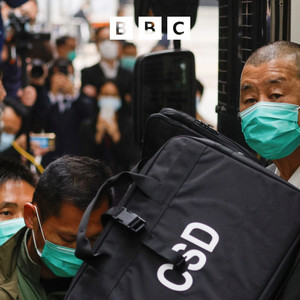
Jimmy Lai, the billionaire who once stood at the heart of Hong Kong's push for democracy, is slated to spend the next 20 years in prison.
We'll bring you reaction from the Chinese territory and beyond.
Plus, we'll go to Tokyo.
Fresh after her landslide election win, what does Sanae Takeuchi have planned for Japan?
Also in this podcast, a murder trial in France that's been complicated by identical twin brothers having nearly the same DNA.
And have you ever gone to work with a hangover?
What alcohol does to our brains?
Effectively.
It takes at least a clear day and another night of sleep because your brain struggles with the dehydration.
First, he's an entrepreneur who founded a fashion empire and made billions.
But then Jimmy Lai turned to politics, building a major media conglomerate that supported the idea that Hong Kong, a Chinese territory, could transform itself into a democracy.
For years, Jimmy Lai was at the heart of youth-driven push for democracy there.
And then Beijing wiped out that movement, asserting its rule by imposing tough national security regulations on Hong Kong.
Jimmy Lai's media network was shut down and in December he was found guilty of violating those national security laws.
Today, the 78-year-old was sentenced to 20 years in prison.
The leadership in Beijing defended the sentence, saying it was legitimate.
Chinese state media called the sentence a stern warning to others.
The British government responded to the sentence by expanding its visa scheme to more people living in Hong Kong, saying it showed that the territory's national security law had criminalized dissent and prompted many to leave.
But Jimmy Lai's son, Sebastian, said any more time in prison would endanger his father's life.
We kind of expected this would happen, but we didn't expect that it would take five years.
I mean, he's been in solitary confinement for the last five years in a maximum security prison.
His health has horrendously suffered.
And as you would have heard from Human Rights Watch, in 20 years, he's 100.
But even if he got another two, three years, given his health, given that he has heart issues, given that he's lost 10 kilos of last year alone, that's basically a death sentence.
The pro-democracy politician Ted Hui, who's gone into exile from Hong Kong, gave his reaction to Rob Young.
It is a textbook political verdict, and it is very, very harsh.
I think the target of the regime is not genuine criminal conduct not at all but voices that stood for democracy, freedom and pluralism.
So to think that Apple Daily operated legally in Hong Kong for 26 years without issues and suddenly now he's a criminal.
So the world knows what's happening.
The real offence it was influence and credibility beyond control of those in power.
Now, the Hong Kong and Chinese authorities say that Mr Lai has been given a fair trial.
His children though, have said that this is a dark day for anyone who believes in truth, freedom and justice.
What would you say is the state of the justice system of freedoms in Hong Kong today?
To say that he's been given a fair trial is laughable.
So we all know it's the collapse of justice in Hong Kong, because it marks the complete collapse of what was once understood as justice in Hong Kong.
To think about in the early stage when bail was rejected, there was no presumption of innocence.
And in the middle stage, when there was no jury trial allowed And also he's not allowed to choose his own lawyer.
And you call this fair trial.
I think this is laughable.
This is just a collapse of justice in Hong Kong.
The campaigning organisation Human Rights Watch have described the sentence both as cruel and profoundly unjust.
They've also described it as effectively a death sentence.
Do you see any legal avenue which could see Jimmy Lai being able to appeal this sentence, perhaps to set foot outside of prison at any point in the rest of his life?
With a saddened heart, I really do not.
So Jimmy Lai is an elderly man, is now at almost 80s.
And to me and to many, we all know that it's a death sentence to him.
And given the fact that he's been serving his time already in solitary confinement, and I believe that will continue to be the case
So this is way more than judicial punishment.
This is political punishment. torture and which is unacceptable internationally.
Now you are one of many former pro-democracy legislators in Hong Kong who have had to leave the country, and that there is a bounty on your head, isn't there?
China would pay large sums of money for information that might lead to you being returned to Hong Kong to face a trial in the way that Jimmy Lai did.
So how do you feel personally about the news from Hong Kong over the past few hours?
And what steps do you take to ensure that you don't end up in a Hong Kong courtroom?
I feel I can put myself into his shoes because we are basically on one boat.
We both fought for democracy.
We both spoke up for freedom of Hong Kong.
And now we are targeted.
But I'm the lucky one.
I got out of the country, but not so lucky for Jamie.
So I can relate very much.
If I am to return to Hong Kong, I will face exactly the same consequence.
So, yes, I feel terrible about this happening to my home country, my homeland in Hong Kong.
And I urge international communities not to turn a blind eye, not to not speak up, because the case is now closed.
But think about this old man who would stay in prison, who choose to stay in Hong Kong, and choose to stay in prison just for Hong Kong's freedom.
And how noble is that?
Ted Hui, a former member of the Hong Kong Legislature.
Well, for more on the story, that sentence faced by Jimmy Lai, you can go on YouTube, search for BBC News, click on the logo, then choose Podcasts and Global News Podcast.
There's a new story available every weekday.
In our earlier podcast, we brought you news of the big election victory by the Japanese Prime Minister, Sanae Takeuchi.
A few hours ago she gave a news conference in Tokyo where she was talking about an urgent need for major policy shifts.
Sanae Takeuchi says the voters have endorsed bold reform on everything from government spending to security, mentioning increased defense spending in particular.
We will move up the timetable for revising the three strategic documents and fundamentally strengthen our national security policy.
A nation must defend itself with its own hands.
No one will come to the aid of a country that lacks such determination.
We will steadfastly protect our nation's peace and independence, its territory, territorial waters and airspace, and the lives and safety of all of our citizens.
A country that does not take on challenges has no future.
But what exactly do those bold plans mean in practice?
That's a question I asked our correspondent in Tokyo, Shrema Khalil.
If you were to give them two big headlines, it was spending, big government spending.
And now that she's got this mandate that she wanted, these results give her party near total control legislatively.
She can go into Parliament and say look, I want to cut consumption tax to zero for two years, which is what she's planning to do.
I want to give tax relief to businesses.
I want higher spending for households.
And she can go unopposed almost.
Now, this will be good news in the short term.
It will be good news for Japanese families, whom we've spoken to during the elections and who've said the one big thing they want is relief on inflation, on their budget, on rising prices.
And so that is going to help.
I think markets are going to be a little bit jittery because where is that money going to come from?
And I think another bit of money that she wants to spend a huge chunk of money is on defense.
She wants to boost the Japanese defense budget.
She wants the Japanese military to be much more assertive, much better equipped.
And it's something that Donald Trump himself, when he was here, also alluded to.
He wants Japan to spend more money on defense.
I thought what was really interesting is, after she addressed the Japanese people, she spoke to her party and her governing coalition and said look, you know, we have no time to bask in the glory of this victory.
Just making a fine point.
We need to get on with convening parliament and passing the budget, which is going to be really the cornerstone of her leadership.
It's interesting, isn't it?
Because just in the past few hours we've heard some quite strong pushback from Beijing against these defence plans.
So, Sanaya Takechi, she's walking a bit of a fine line, isn't she, when it comes to China?
I think so.
I think she's walking a fine line when it comes to China and the United States actually, because if you look at it right now, they look like polar opposites in the way that she's been received.
Donald Trump has endorsed her.
He He congratulated her on her win.
He praised the bold move that she took when she announced the snap election.
She's due in Washington in March.
But I also think that in the back of her mind and in the back of her team's mind, they know that Donald Trump can be a very unpredictable ally, even if he's on your side.
And of course, America is Japan's biggest defense ally.
On the other hand, she faces a very angry Beijing.
I don't think they've forgiven her for what she said, alluding to the fact that Japan could get involved militarily.
If China attacked Taiwan back in November, that has crossed all sorts of red lines for them.
And even in their response today to her mandate and to her resounding victory, they again said we once again urge the Japanese side to withdraw Sanae.
Takeuchi's erroneous remarks is how they described it.
But they remain Japan's biggest trading partner.
And so I think the fine line here is that will this tension and diplomacy continue and then, in a parallel existence, trade and business move on.
Or is there going to be a long-term consequence of how angry China is?
Shama Khalil in Tokyo.
Two identical twins on trial for murder in France have confounded attempts to determine which one pulled the trigger because they have nearly the same DNA.
The 33-year-old brothers are among five defendants on trial near Paris.
They're accused of a double murder in addition to several attempted killings in 2020.
Forensic scientist Lorna Dawson told Tim Franks why it's so difficult to differentiate between identical twins.
The investigators can conclude that they can include both, but they can rarely exclude one, unless they get a finger mark, for example, because individual twins have different fingerprints because it's developed in the womb in different environmental conditions.
So that could, if it's available, be able to discriminate rather than using the DNA.
And is it just the case that it's the sort of DNA tests that are currently available to police forces?
Or is there some sort of ultra-sophisticated DNA test which could, if it were used and it might be more cumbersome, more expensive, but that, if it were used, it could differentiate between these identical twins?
As you can imagine, science moves at pace in developing and testing new methods.
And indeed in a project that I'm involved in looking at single cell sequencing and looking at, for example, the mitochondrial DNA and changes in the DNA over time.
The methylation, for example, then that could discriminate between twins with half the same DNA, because you get a change over time slight, subtle changes which can be picked up in that mitochondrial DNA and also microbiome shift so that any individual will have a different microbial profile on their skin, for example.
So that could be used.
But usually the DNA would be used along with other evidence, such as soil pollen, fibres or timing, or digital evidence or witness evidence.
It's in combination with other evidence that would include or exclude one of the two individuals concerned.
Right.
So in that case, I mean before these new tests are available to police forces, they will just have to rely on what we might consider to be rather more old fashioned types of evidence.
Well, one of the main issues is that to have to combine evidence together, to put together, work out who did what and when you know the sequence of activity that's happened at a crime scene.
So it should be used in combination.
But these new methods, they are being published so that hopefully it will move from that being used as intelligence for police operations actually being used in evidence.
But we must be very cautious because in using any new types of evidence it has to be properly peer-reviewed and tested before it's used in a court of law.
Lorna Dawson, Head of Forensic Science at the James Hutton Research Institute in Scotland.
Still to come in this podcast... We are talking about a colossus of Ghanaian music.
A legend, an icon who did all he could to project Ghanaian music on the global stage.
Tributes are paid to the Ghanaian guitarist and composer Ebo Taylor, who's died at the age of 90.
I've spent the last three decades trying to better understand money across the boardroom, the newsroom and the trading floor.
That's longer than most podcast hosts have been alive.
But even I've got questions.
Join me, Maren Subset-Webb, every week for my show Maren Talks Money from Bloomberg Podcasts, where I have in-depth conversations with fund managers, strategists and experts about how markets really work.
And join me for a separate episode where I answer listener questions on how to make those markets work for you.
Follow Merrin Talks Money on Apple Podcasts, Spotify, or wherever you listen.
This is the Global News Podcast.
To South Korea now.
It has one of the lowest birth rates in the world.
And a proposal by one official for how to change that has sparked an international argument.
Kim Hee-soo, the mayor of Jindo County, suggested that young women should be imported from overseas to marry South Korean men.
Our correspondent in Seoul, Jake Kwan, told us more.
About a week ago, this mayor, Kim Hee-soo, was in a televised live event, a town hall, and he was asked the question what is his solution that the rural regions in the country are losing people fast to the cities, the chronic low birth rate that the whole country is really suffering from?
And this comment was immediately met with big outrage, as well as a formal complaint from the Vietnamese embassy here in South Korea.
And then the next day, Mr. Kim and the local government issued an apology.
In the apology, they said that the comment really deeply hurts the Vietnamese women and its people.
And that it was something that reduced women to mere tools.
You know what he said.
Saying that you know we need to import really seemed to suggest that women could be a commodity that South Korea needs to really resolve its low birth rate crisis.
And what we heard today is that his own party, the Democratic Party of Korea, had removed him from its membership.
Jake, I know this is going to be a bit of a complex question to ask, but what's responsible for South Korea's low birth rate?
Well, how much time do you have?
Because this is one of those issues that's still poorly understood.
And there are an unlimited number of theories why this is happening.
But for South Koreans this is really an existential issue, because everything we have here in the society, including the pensions and labor issues, Everything is built around this idea that population is something that grows and there will always be a younger labor force that is ready to make the money and then take care of the older generation.
Now, South Korea is quickly becoming a society where there is a lot of old people.
What we're seeing is really a big problem that South Korea is contending with, as we've seen from this problem,
Our Seoul correspondent, Jake Kwan.
The civil war between the Sudanese army and its rival, the paramilitary group the Rapid Support Forces, or RSF, continues unabated.
This battle, which started in April 2023, has resulted in the deaths of more than 150000 people, with millions of Sudanese displaced in and out of the country.
According to the United Nations, the war is responsible for the world's worst humanitarian crisis and has led to over 13 million children in Sudan being forced out of school.
The charity Save the Children has been looking at the impact of the civil war on the education sector.
The charity's CEO, Inger Asching, recently returned from Sudan and told us more about the situation there.
There is a crisis within the crisis.
After nearly three years of war, so many children are still out of school.
Education is often seen as something that can wait, but for children, education is not a luxury, it is a lifeline.
One third of the population are displaced and two thirds of the population need humanitarian assistance.
With so many people being displaced, and many of them being displaced many times.
It means that nearly half of Sudan's 70 million school-aged children have spent nearly 500 days without entering a classroom.
And that is 10 more time out of school than the worst case scenario during the COVID lockdowns, just to put this in perspective.
And the ongoing conflict is stopping children from going to school.
One example, and I met a number of children from Darfur and in North Darfur state, where the conflict is still ongoing, only 3 of over 1100 schools are still open.
Many teachers are not being paid.
And having gone months without salaries, they were forced to abandon teaching to find other ways to feed their families.
And without teachers, schools simply cannot function.
We need to get children back into school now.
And we need funds to restore and expand education services, including rehabilitating damaged schools, etc.
But one of the things that we are doing, we have been in Sudan since 1983, over 40 years now.
We run inclusive education programs in nine of the 18 states across Sudan, supporting over 400 schools to help children continue learning despite the crisis.
And what we bring is school meals, essential items like notebooks, school supplies, uniforms.
We ensure that we give teachers incentives and training, technical and psychosocial support.
Because children need education, but they also need support to cope with the trauma of conflict and displacement.
But the needs are enormous.
We are doing everything we can, but we need more funding.
We need more support and more attention to this crisis right now.
CEO of the charity Save the Children, Inger Asching.
Now, here's a question.
Have you ever been hungover at work?
According to a new study, at least one in five people are coping with the after effects of alcohol while on the job every single week here in the UK.
For those who don't call in sick, the researchers found that productivity dropped by a third, leaving some people making mistakes and even falling asleep at their desk.
So what happens to our brains when we're hungover?
Rachel Burden put that question to Professor Hal Sosabowski, a lecturer in medicinal chemistry.
When you have too much to drink the night before, two things are happening.
The first thing is dehydration.
So the, in quotes, myth of having a pint of water before you sleep isn't actually a myth.
It's actually quite good advice.
And that's because alcohol switches off the antidiuretic hormone in the pituitary gland.
It's called vasopressin.
And that means you produce urine at the maximum rate.
So if you drink five pints, you effectively wee out about six or seven and so forth.
So your brain gets literally dehydrated.
Plus, of course, if you're eating all those salty snacks in the pub, it makes it worse.
But also in alcoholic drinks, there's chemical clutter called congeners.
And the darker the drink, the more the congeners.
So something like whiskey or red wine, which we'll come back to in a minute.
They've got lots and lots of congeners that irritate the brain.
And so the assault you put on the brain with the dehydration is then exacerbated by these congeners.
Certain drinks like red wine have things in them called amines.
And in red wine, it's called phenylethylamine, which is a vasoconstrictor.
And so that horrible red wine throbbing headache you get is particular to red wine because of those congeners.
But I also know I can see and feel how slow our responses are when we're hung over.
And that can last for hours after the event, can't it?
It absolutely can.
Alcohol is a depressant.
And the reality is on paper, you can drink yourself to death if you drink enough.
All your body's reflex arcs are switched off.
And there's a huge window between, of course, running down the road with a traffic cone on your head, thinking you're very funny, and dying.
But the reality is that's what can absolutely happen.
And it does.
It slows you down.
It's cold, hard fact that alcohol slows you down.
So this sort of meme of oh I'm fine driving, if I've had a few, is absolutely not true because you slow down.
And how long does it last?
How long does that impact on our systems last for us?
I mean, for my students, a couple of back of the envelope calculations.
If you drank a bottle of wine in an evening, you can get rid of about 12 to 15 grams of alcohol per hour, depending on your metabolism.
So likely as not, you're still going to be on the cusp of the limit in the morning before.
If you drink two bottles of wine, which is a dubious achievement in itself, then you're almost certainly going to be over the limit.
I mean effectively.
It takes at least a clear day after the event and another night of sleep to clear that, because your brain struggles with the dehydration.
And also it struggles to evict the congeners, which have quite a long half-life.
Professor Hal Sosabowski.
If you're into West African music, the name Ibo Taylor is probably familiar to you.
And now the news that the Ghanaian guitarist, composer and bandleader has died at the age of 90.
His work helped define the high life genre. and influenced generations of African musicians.
Ebo Taylor's musical career took off in the 1950s and early 60s as high life became popular.
He played with leading bands at the time, including the Stargazers and the Broadway dance band.
Felix Kwakiofusu, Ghanaian government spokesman and minister for communications, spoke to Anne Soy about Ebo Taylor and his importance to Ghana's music.
His was a life defined by music.
We are talking about a colossus of Ghanaian music, a legend, an icon who did all he could to project Ghanaian music on the global stage.
And the government and people of Ghana are deeply saddened by his loss.
His loss constitutes a void that will be very difficult to fill.
Because we are talking about someone who was exceptionally talented and who was unique in the way that he went about his craft and how, for many, many years, he enthralled Ghanaians with musical genius.
So we are really, really saddened about his loss, musical genius and he is credited for his contributions to the High Life genre.
How did it originate and how does Ebo Taylor fit into that story?
Well, High Life is the flagship musical genre of Ghana and many parts of West Africa.
Of course, in more recent times, it's been overtaken by other genres.
But for many, many years, through the pre- and post-colonial era, It was a number one musical genre.
And Ebutela is someone who actually studied music.
He schooled in the London School of Music.
His contemporaries included Fela and Nicola Pukuti and others.
So this was a man who dedicated his entire life to deepening understanding about high life, who was behind many, many great compositions that captivated Ghanaian and global audiences.
So his life essentially was music.
He famously said that he, I think I've had my day, though it came much later.
You know talking about, you know going global in his 70s.
But some of the younger musicians have also been talking about him and you know how he would sit with them, eat with them, drink and chill with them.
Some of them being like 50 years his junior and they call him Uncle Ebole.
Just talk about the influence that he has had on the different generations, different genres and musicians in your country.
In more recent years, High Life has taken a backstitch and other genres have sprung to the forefront.
However, they all take inspiration from the works of greats like Ebo Taylor.
So it was little surprise that many of them How will he be remembered in the country?
He will be remembered as a man who strove to put Ghanaian music on the global map at a time when other genres of music were prominent.
He will be remembered for dedicating his entire life to ensure that highlight music carried on, no matter what challenges emerged.
And he will be greatly missed.
Felix Kwakia of Futhu, speaking about Ghana's musical legend, Ibute.
That's all from us for now.
And don't forget our sister podcast, The Global Story, which goes in-depth and beyond the headlines on one big story, available wherever you get your podcasts.
This edition of the Global News Podcast was mixed by Zebihula Kurush and the producer was Stephen Jensen.
The editor is Karen Martin.
I'm Celia Hatton.
Until next time, goodbye.
I've spent the last three decades trying to better understand money across the boardroom, the newsroom and the trading floor.
That's longer than most podcast hosts have been alive.
But even I've got questions.
Join me, Merrin Somerset Webb, every week for my show.
Merrin Talks Money from Bloomberg Podcasts, where I have in-depth conversations with fund managers, strategists and experts about how markets really work.
And join me for a separate episode where I answer listener questions on how to make those markets work for you.
Follow Merrin Talks Money on Apple Podcasts, Spotify or wherever you listen.