Welcome to Spotlight.
I'm Liz Waid.
And I'm Ryan Geertsma.
Spotlight uses a special English method of broadcasting.
It is easier for people to understand, no matter where in the world they live.
A man climbs on the rocky side of a mountain.
He holds on to a thin rope.
He has covered his head and shoulders with a cloth.
The man raises a long stick with a sharp point.
He is a hunter.
But he is not hunting an animal.
The man on the mountainside is hunting honey.
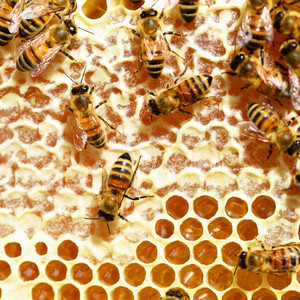
This sweet food is made by flying insects called bees.
The bees fly all around the man.
If they sting him, it would be very painful.
If he falls down the mountain, he will most likely die.
But if he succeeds, he will bring valuable honey home.
The honey hunter is taking a big risk.
Today's Spotlight is on honey hunters.
If you walk through an area with many plants, you may see and hear bees.
These yellow and black insects fly from flower to flower.
They are collecting a liquid called nectar.
The bees take the nectar back to their home, called a beehive.
Bees make their hives out of wax.
The wax hive hangs down from a tree or high rock.
And thousands of bees sit on it.
All these bees were born in the hive.
They live and eat there.
The wax of the hive has many holes in it.
The bees put the nectar in these holes.
Soon, the water evaporates from the nectar, leaving a thick liquid.
This liquid is light brown or yellow in colour.
It tastes very sweet.
It is honey.
Bees make honey to eat as food.
But many other animals like to eat honey too, including people.
People have used honey as food and medicine for thousands of years.
It is a special food in many cultures.
People eat honey to help with sickness such as a cough or throat pain.
In many cultures, people also put honey on their skin.
It keeps skin soft.
Honey breaks down bad bacteria and helps to heal wounds.
But to use honey, people must first collect it.
Some people take care of a bee hive.
But in some places, people collect honey from wild bees.
This is common in many parts of the world, especially South Asia.
Honey hunting is a local tradition in southern India.
But this traditional custom is not easy.
The bees in southern India are large.
They can grow up to the size of the smallest adult human finger.
And these giant honey bees build their hives on the sides of mountains.
It takes many years for a honey hunter to learn to collect honey from these hives.
From a young age, the honey hunter learns everything about bees.
He practices climbing hundreds of meters above the ground.
Then the honey season arrives.
The honey hunter prepares for many days.
He does not eat meat.
He does not sleep with his wife.
He stays by himself.
The honey hunter must be calm and full of courage.
The day of the honey hunt arrives.
Early in the morning the villagers say prayers.
And then the honey hunter goes to the edge of the mountain.
He climbs down with a rope made from small tree branches.
He lights some dry branches on fire.
The smoke makes the bees leave the hive.
They fly around the honey hunter.
He reaches a long, sharp stick over to the hive.
He gently cuts off pieces of the wax filled with honey.
He takes them back to the village in a container made of bamboo.
When the honey hunter returns, the village celebrates.
The honey is important to them for many reasons.
Simone Gee works for the organization Slow Food International.
She writes about the importance of honey.
Tribes have been honey hunting in this way for generations.
Rock paintings in the area show honey hunters more than 2,000 years ago.
Honey was once a valuable resource in the trading system between tribes.
It still is an important part of their diet, cooking, and medicine.
The hunter takes some honey.
But he always leaves some of the hive on the mountainside.
He does not take the part of the hive with the baby bees in it.
He does not want to destroy the home of the bees.
There are also areas of the mountain and forest that are considered holy.
These places are important for the religion of the tribe.
The hunters are careful not to take honey from the holy places.
But this traditional system may not be enough to protect the bees in the future.
The forests where the tribes live are changing.
People are planting huge tea farms throughout the area.
They are spraying chemicals and cutting down trees.
This is not good for the plants and animals in the forest.
It can kill the bees and destroy their hives.
It is also dangerous for the people who live there.
The Keystone Foundation is a local organization in southern India.
It has worked with the honey hunters for 15 years.
They aim to protect the environment and local culture.
Robert Leo works for the Keystone Foundation.
He tells the organization Slow Food International, In the past few years we have seen many people coming back to forest honey gathering, particularly young people.
One of the reasons is that it is now possible to make enough money this way.
Many young people in South India leave the tribal areas.
They can make more money working in the city.
But for the tribe to continue and grow, they must have young people.
So the honey hunters have made a few changes.
They found ways for young people to make money in the village.
The tribe still uses traditional tools and skills to harvest honey.
But they have a new production center.
Here they clean the honey.
Then they put it in bottles.
This way, the tribe can sell their honey for a higher price.
The Keystone Foundation also helped set up some hives for people to keep.
People can harvest honey from these hives at any time of year.
Then the honey hunters can make money even when it is not the season for wild honey.
They can continue their traditions.
This provides a future for the honey hunters.
And it protects the creatures that make the valuable honey.
The giant honey bees.
The writer and producer of this program was Rena Dam.
The voices you heard were from the United States.
All quotes were adapted for this programme and voiced by Spotlight.
You can listen to this programme again, and read it, on the internet at www.radioenglish.net.
This programme is called, Honey Hunters.
You can also leave your comments on our website.
Or you can email us at radio at radioenglish.net.
And you can find us on Facebook.
Just search for Spotlight Radio.
We hope you can join us again for the next Spotlight program.
Goodbye.