Discussion keeps the world turning.
This is Roundtable.
You're listening to Roundtable with myself He Young.
I'm joined by Steve Hatherley and Ding Heng in the studio.
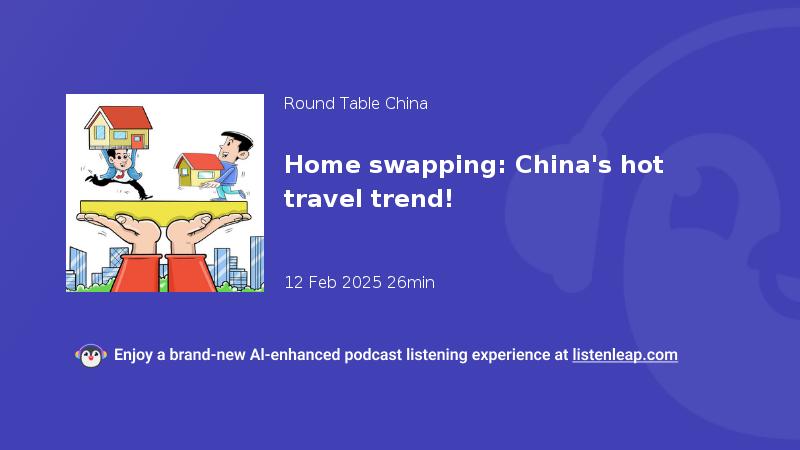
Coming up, as hotel prices skyrocket and holiday flights fill up, many young Chinese travelers have turned to home swapping as a way to save money while exploring new places.
but it comes with risks my biggest concerns the safety aspect ensuring that strangers will treat my home with respect and making sure that these are real people so I don't show up at a strange province or foreign country with no place to stay can home swapping truly live up to the hype and your voice
matters and would be great to hear it in our heart -to -heart segment got a question something you're itching to share fire up that voice memo and hit us up at roundtablepodcast at qq .com.
Our podcast listeners can find us at Roundtable China on Apple Podcast.
Now let's switch gears.
Made popular by the 2006 Hollywood movie The Holiday, the idea of home swapping as a low -cost vacation option has since garnered traction among travelers almost everywhere.
In the film, Cameron Diaz and Kate Winslet play two lovesick strangers who swap houses for a few weeks.
Not only do they save on lodging costs, but they also find love by the end of the holiday.
And that's one of my favorite rom -coms of all time, by the way.
Well, fast forward nearly 20 years and real life home swapping is finally catching on in China with With hotel prices soaring and flights filling up fast during the holiday season, savvy young travelers are opting to swap homes as a way to save.
The appeal? The chance to step into someone else's world and experience a new city like a true local.
But here's the catch.
Can you really trust a stranger with your home?
Internationally, house swapping is nothing new with established platforms such as Home Exchange and Kindred leading the way.
So how has it picked up steam in China recently?
Do you have some information for us, Ding Hung?
Well, I guess when we talk about this, just the past spring festival, we are talking about an estimated 9 billion, a total of 9 billion passenger trips made across this country.
And really, it has been one of the busiest travel seasons throughout the year here in China.
And because of that, accommodation prices are surging or surging dramatically in some major tourist destinations in China, like Harbing in northeastern part of China or Sanya in the southernmost Chinese island of Hainan, where winter tourism is booming.
Even some budget, some so -called budget hotels can often charge you like thousands of yuan or hundreds of US dollars for a single night stay.
So we are talking about price increases of some 200 % or even more.
So therefore, for travelers who are really conscious about the money, conscious about budget, home swapping is a solution they have come up with to try to avoid these inflated costs.
Yeah, it's more cost -effective.
And you're right. As you mentioned, Hooyoung, in the West, it's not a new concept.
It's been around for decades, as a matter of fact, and it's still really popular.
You don't hear about it that much.
I think that 2006 movie with Cameron Diaz and Kate Winslet, also Jack Black, one of my favorites, he's in that film, and Jude Law's in there as well.
Anyway, that really brought house swapping to the attention of a lot of people that didn't really know that it existed before.
And now, as you mentioned, it's gaining popularity in China.
And now it's kind of the same concept.
Users can browse listings from various platforms.
They can contact potential partners.
They can agree on terms.
Oftentimes they'll pay a deposit like a security deposit.
They'll sign also a three party agreement before exchanging their homes.
And then after the stay, utility fees are settled and the deposit is refunded if no damage occurs.
There's also security measures like identity verification and property certificates so that you can feel comfortable that they're not renting out someone else's home or swapping someone else's home.
They offer insurance coverages on certain platforms as well.
And then on another platform, users, this one's called House Swapping Travel, Users can earn what they call house -swapping beans by listing their properties.
So those beans or those credits can then be used to offset accommodation costs when booking other homes, and that kind of further incentivizes participation in this home exchange system.
It's really kind of a cool, more community -feeling -based system.
Do you like this idea, Ding Hong?
Uh, yeah, yeah, I definitely likes it.
But when I was looking at this new phenomenon, there was actually a question mark on my mind.
How do I differentiate this kind of booming phenomenon was what we have experienced and witnessed from platforms like Airbnb?
That's a big question mark on my mind.
So but after doing some research, I feel like it's I have an Airbnb and you have an Airbnb and we exchange.
That's the basic idea.
Well, no, it's different from Airbnb in this in a few different senses.
Number one, when you go to an Airbnb, there is no clothing in the closets.
It's like a furnished, empty, fully empty apartment.
Right. But here, when you exchange homes with someone, you know, you'll find the bicycle in the garage.
or the winter clothes are packed away in the closet, something like that.
That's one difference.
Another difference is that Airbnb feels more transactional in the sense that it feels like a business deal, kind of like a hotel in a sense.
But with this, it's more of a community feel because oftentimes these people will become friends.
With Airbnb, if I stay at Ding Hong's Airbnb, he's not staying at my place, right?
I'm renting his place.
But this is a difference where Ding Hung would be in my house and I would be in his house.
And then we're probably communicating with each other the whole time like, oh, this is great.
Or, oh, do you mind if I use this?
Or do you mind if I borrow that?
Because, again, these homes have everything still inside, right?
So there's a difference there.
Another difference, too, is that there's often online communities where people will stay friends with each other.
And then you have your listings up there.
And this is how people feel comfortable because they'll get reviewed by people who stayed there.
So you gain a reputation online as well.
It's really interesting how we've seen this kind of arrangement, now business model, have evolved throughout the years.
Initially, it was about just two people online and chatting about this.
But now there are established platforms, third party platforms that require you to put down a deposit.
Yeah. Like an annual membership.
Yeah. Something like that.
And maybe and also even charge a commission fee.
So it's initially when I looked at this and after watching that movie two decades ago, I cannot believe that.
I realized, oh, this is not completely free, you know, because initially back in the day it was supposed to be free.
We just swap houses.
And I thought about this.
How can we deter the other person from, let's say, going through my stuff if I'm a house swapper or let's say if that person, I don't know, took something away from me or maybe like saw my Chanel handbag and wanted to take it with her.
Right. Or anyhow. So I went and I thought about that.
Oh, then it made me think of the political concept of nuclear deterrence.
If you have nuclear power and I have nuclear power at the same time, since we're at each other's houses.
And if you break something of mine, I could break something of yours as well.
Then am I going too far with this?
yes i think you are well again trust is an issue and you have you know um people who can verify that you were a good guest when you stayed at someone else's home but sure sure you're still gonna have to deal with that maybe a little bit of anxiety when you're dealing with this but this is really popular
with young travelers and also budget conscious travelers you're right maybe it's not 100 free it can be that's for sure um but when you compare it to the cost of hotels particularly during peak seasons, you're saving a lot of money here.
People who are looking for affordable travel options also looking for perhaps just a little bit more of a unique experience.
They're loving this.
There was a 2023 news article from 36KR that said 70 % of travelers during one holiday period were born after 1990 who were budget conscious.
So that shows that it might be more popular with a younger crowd.
younger travelers they're looking for trains over flights with the number of 18 to 24 year olds choosing air travel air travel dropping significantly there was another study that indicated that nearly 83 percent of university students prefer to keep their travel expenses under 70 for about two to three
days that's about what 14 to 25 dollars a day roughly so So for people who are looking for, number one, a different type of experience and number two, looking to save a little bit of money, this really is a wonderful option.
And in the meantime, because of the rise of social media platforms, in particular, Xiao Hong Shu, they have really made this kind of home swapping practices easier than ever before.
like people post their homes, less their preferred destinations, and they connect with potential exchange partners, home exchange partners.
And online interaction can really build interpersonal trust as well.
It's more than just lies or camouflage, this kind of thing, right which in return fuels this new form of travel now think about this some people saw others on social media exchanging homes and having a good experience so they want to try this as well when they travel to another city during a holiday
their homes will be empty so they might think about why not share why not do it it does not hurt me to say the least so we're seeing many people with second homes or those with vacant properties for example they are beginning to swarm their homes to make use of the space um yeah yeah so you wouldn't
store your chanel handbag at the vacant second property yeah don't leave it on the front step of your house you're just being invited to be taken away take it with you i don't know there are ways around that i guess um i can speak to this because you're you're right dingham there are similarities with Airbnb
for sure, because Airbnb is someone's space, right?
That's someone's home as well, someone's apartment.
When I went to Los Angeles, I stayed downtown, and I decided to do Airbnb instead of a hotel, which was right down the street.
I could have opted for that.
But it gives you a different feeling.
It gives you more of I'm a local here too vibe.
And I think that might be a part of the attraction as well, particularly for homes.
cities with tourist destinations.
There was a report here in China where it talked about the popular tourist cities are the main focus of home swapping.
There were posts about home exchanges in other areas, but they didn't get as much attention.
If you're looking at bigger cities or places with popular tourist areas, and people go stay at somebody's house in those areas, even though you're playing the role of a tourist, you still feel like you live in that city, even though it's only for a short time yeah so basically you you're you use a regular
key that's given to you or left by you uh by the home swapper instead of having you know with the hotel key and going into a hotel it feels more cold right it really does it really does but also i'm wondering this is not necessarily a new concept but why now in china like what's changed people's minds
in wanting to opt for home swapping and also does it not bother you at all that some stranger is going to be sleeping in your bed and you sleeping in theirs yeah that concept is on everyone's mind but I think the people that are comfortable I think everybody who goes through this initially they do have those
fears but when you become part of a community an online community where you're posting regularly, other people are as well.
You kind of get over that fear rather quickly.
I read some blog posts, and that's what they said.
Yeah. I think in China, maybe home ownership was once seen as a kind of investment, given the fact that property values have seen significant increases over the past few decades or so.
So many Chinese individuals, especially the older generation, have this deep rooted concern about letting a stranger, letting an outsider into their private homes.
That's the idea. And also house in China is or was used to be seen as a symbol of status and a reflection of personal success.
So people tend to view their homes as an extension of themselves.
and this idea of allowing a stranger to stay in your home can be culturally unsetting.
I think that was one of the reasons why it was not formed into the mainstream arena in the past.
But now maybe things are changing.
People's mindsets, mentalities are evolving.
Maybe if you store your valuables...
You're still worried about your bag.
And other stuff. And also I like my place clean without the fingerprints of strangers.
Well, that's part of the deal.
Because I've never done this, so I was curious too.
So I was reading about people's experiences and the etiquette.
And there is etiquette here, right?
And part of the etiquette is it's going to be clean when you arrive.
Make sure it's clean when you leave.
And also, if you do use some things, maybe some, I don't know, some canned food that was in the cupboards or something like that, just leave a $50 bill.
That's what one person did.
Oh, I messaged them and let them know, oh, I had this, I ate this, and I just left some money on the counter for you.
That's all part of the etiquette.
Yeah, I mean, if you're doing this, if you're a part of this, if you don't do what you're supposed to do etiquette -wise, you're going to get a bad review as a customer.
If you don't do what you're supposed to do as the owner of the home, you're going to get a bad review as well.
So that keeps people on the right track, I guess.
They keep their reputation good, and that allows them to do it again in the future.
Yeah. Well, most home swappers say that using common sense, instincts and of course, finding swappers through trusted platforms with good reviews is the key to successful home exchanges.
Coming up next, let's have a moment of Heart to Heart.
You ask, we answer.
Roundtable, Heart to Heart.
Who's got a question for Roundtable?
people. Hear the thing, I'm majoring in philosophy and I'm currently in my second year of PhD, but now there is a disagreement with my supervisor.
We are very different in terms of personality and values.
However, you know it's very hard to change supervisors.
I don't know what to do anymore.
Please tell me something as much as you can.
I really need your help.
Thank you. Thank you so much, lovely listener, for recording a voice memo and reaching out to us.
And you forgot to tell us your name or your location.
Yeah. But it's okay.
We will try our best in answering your question.
And thank you for calling us smart people.
We are only trying our best here.
So, Steve, why don't you go first?
Yeah, this one's pretty easy, I think.
Yeah. Let's take the emotion out of this 100 percent, because that's what you need to do here.
You said that there's a personality difference with your supervisor and a difference in personal values.
We don't need to care about that.
You're going to know this person for a very short period of time in your life, maybe a year, maybe two or something like that.
Here's what you need to do.
You need to think, what do I want from this person?
You don't need to care about if you like them or not.
You don't need to care about if they're a good person or not.
You need to think, what do I want from them?
And then how do I get it from them?
Now, that might be a little bit of personal sacrifice on your side.
You might have to think, oh, my gosh, I really don't want to talk to them today.
Or I really don't want to agree with them on this.
But remember, your goal is to get through this PhD process as smoothly as possible.
And you want to be successful in this particular endeavor.
So think to yourself, how can I get through this smoothly?
What can I do to make this person get along with me so that I can achieve my goal?
That's the ultimate thing here is your goal.
How do you get it from them?
I don't know this person, you know this person, so you're going to have to figure out the answer to that question, but that's my advice.
Take the emotion out of this situation, inject more logic and more reason, and just get what you want, and then you'll never have to deal with them again.
Well, I have a slightly different perspective.
I feel like it's what this listener have raised is indeed a very difficult question.
To me, it's pretty difficult because when you're trying to get something down in the process of doing something, your perception, your feeling matters.
It matters a lot to a very large degree.
And several years ago, I noticed after doing some research, a post -graduate student with East China Normal University in Shanghai.
He or she wrote a thesis on how to switch mentors during a lot of social attention at the time.
And remember, that was a serious academic thesis, not in not a layman's article, you know.
So this conflict or a lack of harmony between postgraduate students and their professors, their mentors, are indeed a common problem in universities today.
I think that occurrence I mentioned earlier was a direct reflection of the situation.
And really, I think addressing this problem will require universities to embrace more flexible mentorship mechanism.
Currently, there are even widespread complaints about the system being too rigid.
But in the meantime, I agree with Steve in the sense that from an individual perspective, I would really advise these PhD students, these listeners, to be as open -minded as possible and be willing to talk, to communicate.
OK, you need to talk to your professor, your mentor about the things that you think are a problem.
You also need to talk to people who are in charge of PhD student affairs in your university about your problem.
If you refuse to talk and refuse to communicate and keep all your unhappiness and grievances out to yourself, then things will only get worse.
Yeah. And that's why I said inject more logic and reason and remove the emotion.
If this were a family member that you were living with for many, many, many years, my answer would be very different.
But your goal is to get that Ph .D.
degree and being stubborn or having your feelings hurt.
I understand how difficult that would be, but just try to remember your goal.
Try to remember that there's light at the end of the tunnel when you get that degree, and that might make it hopefully a little bit easier.
Well, before making any big decisions, it might be worthwhile reflecting on whether the issues are more related to communication styles or maybe expectations.
Sometimes these differences can be worked through by a lot of communication efforts and also be more logical about your end goal here.
But I also totally get the temptation to consider getting rid of that person or just switching paths or something like that since you don't get along with this person.
But I have a friend who went through maybe you can say something similar and her experience might offer some valuable insight.
She was unhappy with her previous boss.
And even though in the workplace, in the workplace, because when you're doing a PhD, it's kind of like the workplace as well.
Yeah. And yeah. So my friend was unhappy with her previous boss and even considered quitting.
But when she switched to a new team, she found that her new boss was even more challenging to work with than the first.
And she used these phrases out of the frying pan into the fire.
from bad to worse trading one devil for another and then she realized that actually her previous boss wasn't as bad and she was so un - and it turned out that while the personalities weren't a perfect match the real lesson was learning how to navigate and manage different types of personalities in the workplace
and in life in general and also I think sometimes it's just really difficult to have a neutral assessment on what's really wrong here.
Is it something that's more emotional?
Or is it something that, you know, there's like, maybe abuse in the system or in the workplace or whatnot, then I don't think that's negotiable.
But there are other times when when we got to learn how to deal with these personalities in life.
100%. And for our listener, this is case number one for you.
You're going to encounter this type of person again in your life.
So you could consider this good practice.
And again, the goal and if you're dealing with a difficult boss or a difficult coworker, if you're dealing with your child and they don't want to do what you want them to do again, the goal is always how can I get this person to do what I want so that I can achieve my goal?
sometimes it's standing up and fighting with that person and yelling and whatever other times it requires a softer approach analyze that see which approach will help you achieve your goal and then go with that approach yeah and i guess in interpersonal relationship if you don't like certain aspects
of a person but find it impossible to sever ties with him then probably you need to learn to pay more attention to the aspects to your liking in this particular relationship focus on effective communication find common ground try to stay professional and calm like what Steve just said are some of the tips small advices that we can offer you in such short notice
and time and if you like what you hear please send us a voice memo to roundtable podcast at QQ .com.
Thank you, Steve and Ding Heng for joining the discussion.
I'm He Young. We'll see you next time.