This past year I unlocked a major life dream, which was to build my own home gym.
I gotta tell you, it's the greatest thing ever.
Just this gift that keeps giving to be able to wake up before the sun, walk just a few feet, and have my own space to get right into my morning fitness routine.
When it came to selecting the equipment for my gym, which is this customized 40 -foot shipping container, I looked at a lot of stuff.
And home fitness, it's come a long way, and I really wanted to outfit my limited space with the smartest, most immersive gear that actually enhances the way that I could train.
And what came out on top was NordaTrac, not only because they led the at -home fitness space for like 50 years at this point, but because what they're doing right now is truly next level, exemplified by my favorite piece of kit, their commercial X32i treadmill, which simulates real world terrain with an incredible 40 % incline and 6 % decline.
The S27i Studio Bike mimics road conditions with a 20 % incline and a minus 10 % decline.
And the RW900 Rower, it's smooth, it's fluid, and built to keep momentum effortless.
But what really sets us apart is Ifit Pro.
Their new AI coach builds personal plans, schedules workouts, and keeps you accountable all through simple text exchanges.
I'm even training with my buddies, friends of the pod, people like Tommy Rives, Knox Robinson and Dan Churchill with the machines that automatically adjust to match their workouts in real time.
So stop stalling your progress because you don't know what to do next with NordaTrack and iFit.
All you have to do is press start and the trainers and tech take care of the rest. Get 10 % off with any purchase of $999 plus with the code rich roll.
Hey, everybody over here, I need your full attention because today's episode is brought to you by ON.
Now listen, confession here.
I'm somebody who has spent many decades obsessed with hard metrics, actually measuring the value of my life against the number of seconds I could shave off my splits or the distances I could run and even the number of people my words and my voice could reach, but age and wisdom hard earned had actually taught me a lesson.
And that lesson is that the hardness required to do hard things is only going to get you so far.
The best of what movement and even life has on offer is so much more about soft wins because the victories that stick with you, I can tell you, never have anything to do with to stop watch. So what is this idea of soft wins?
Well, it might be that perfect trail moment where maybe you're moving slow, but you're in the zone where time dissolves and you're purely present and so connected with nature that you're overwhelmed with gratitude.
Or it could be that soul -filling feeling that you get when you share a deep conversation with a running buddy, or perhaps it's just the way you feel restored after that group jog following a stressful day at work.
This, SoftWins, is what On is all about and why partnering with them feels like partnering with myself.
Because not only is On best in class when it comes to premium sports wear with gear that's battle -tested by world -class athletes, they're also innovating what it means to be active and, more importantly, why we move in the first place, which is what I care about and talk about all the time here on the podcast. Find out what all the fuss is about by maybe starting with their new Cloud Surfer 2, which is this beautiful, effortless shoe that embodies the soft winds philosophy by reconnecting you with this very wide.
So whether you're finding joy in your pace or rediscovering your love for running, if it fills your cup, that is a soft wind we're celebrating.
To explore your own soft winds and check out the new Cloud Surfer 2, head to on .com, slash, ritual.
All of you who have been alongside me for this podcast, A Coaster Ride know that I am and have been for quite some time an avid user of and a partner with AG1.
But this is not just another version of the shout out you've come to expect.
This is actually sort of breaking news because AG1 has just launched their new next generation nutritional formula.
It's the same single scoop, you know, but now it's been significantly upgraded with more vitamins, minerals and upgraded probiotics.
It's an upgrade that's of significant proportions based upon four human clinical trials that go above and beyond the industry standard and testing to make a great product even better.
More specifically, the new formula has been optimized to improve absorption, new vitamins and new minerals have been added.
And AG1 has enhanced their probiotic blend, all part of their ongoing commitment to producing the best foundational nutritional supplement designed to support overall wellness.
Now clinically backed with an advanced formula, this is the perfect time to try AG1 if you haven't yet.
I've been drinking AG1 for many years now, as I mentioned and I'm so happy to be partnering with them.
So subscribe today to try the Next Gen of AG1.
If you use my link, you'll also get a free bottle of AG D3K2, an AG1 welcome kit and five of the upgraded AG1 travel packs with your first order.
So make sure to check out www .DrinkAG1 .com to get started with AG1's Next Gen and notice the benefits for yourself.
That's www .tracheag1 .com slash Rich Roll.
Quick announcement, before we dive in.
By the time you hear this episode, I will be healing up in the aftermath of undergoing a pretty extensive back surgery procedure.
And something that in retrospect, perhaps I have too long delayed.
The recovery period is gonna be extensive.
I'll be sharing more on that later.
But for now, I just wanna say that I'll be laid up and away from the mic for what I've been told will likely be at least three weeks, perhaps more.
The show will go on, of course, but thanks to spending more and more time focused on writing a book, our stash of banked episodes is a little bit lower than usual.
So for the next handful of weeks, our every other Thursday midweek episodes will be rereleases of some of the best past episodes, which hopefully you'll enjoy, especially if you're fairly new to the show as some of these are from way, way back.
And also, hopefully you will receive in the spirit in which they are shared.
Anyway, the surgery is, or I should say it was on May 8th, I'm a little bit nervous.
I've never had surgery before, but I'm also looking forward to it.
So knock on wood, it all goes, or it went well.
And even though the recovery will be long and extensive, I'm pretty excited to rebuild and eventually get back to being able to move my body in a way that I haven't been able to for quite some time and really get back out there and back to doing the things that I love.
So that's it for now.
Love you and hope you love the episode.
You were built with the DNA for joy.
It is literally built into your DNA, but you just forgot how to access it.
For those with high functioning depression, they have the symptoms of depression, but they're not stopping they're overdoing.
You can still access those moments of joy and tell yourself you're worthy of it.
That's where you begin.
Understand the science of your happiness.
When we know what we're working with, when we know why we are the way we are we're able to make better decisions and we are less stressed.
We cope by busying ourselves, just acknowledging it and being aware of it allows you to change.
I'm not saying you have to stop.
I'm saying to slow down.
Hey everybody, welcome to the podcast. So I think I wanna start this one by saying that I would consider myself a high achiever and a pretty high functioning one at that.
This is something that I've always prided myself on, this drive that I have that I think I developed that I worked pretty early in life and have deployed to great effect over the course of my life, this commitment that I have to, you know, kind of outwork my talent deficits and this engine that I think really deserves credit for much of my success as an athlete, as a student back in the day as a writer and now as a podcaster.
But I also now the dark side of this disposition, and the unhealthy fear -based scarcity mindset part of it that develops, I think, as a response to some unhealed past traumas from childhood that leave me a little bit vulnerable to overlooking many other important aspects of life, to my detriment and the detriment of those around me.
And when this goes unchecked, I've noticed in myself that I can become more irritable, more withdrawn, I can get riddled with anxiety, my sleep becomes impaired.
And there's also this numbness to it.
It kinda sneaks up on you and it makes it difficult to feel things, especially joy, which then all becomes very weird and confusing and really like guilt inducing because I have so much to be grateful for and such a fantastic life.
So in the past when I've flirted with this, I basically chalked it up to burnout or something like burnout or something nearing burnout at the least. It's only more recently that I discovered that this is actually something different, something that has a name and that name is high functioning depression, which is super weird because A, it doesn't seem like these two things go together, high functioning and depression, and B, I'm not depressed, not at all, at least not in any traditional sense of the word. But apparently this is a thing.
And it's something that is only recently getting attention and being researched and also much more widespread than you might suspect.
So today we're gonna talk all about it, this thing called high functioning depression, what it is, what it isn't, how to know if you have it, what to do to avoid it or overcome it.
and why it's so vital for all of us to better understand it.
And we're gonna do it with the world's leading expert on it.
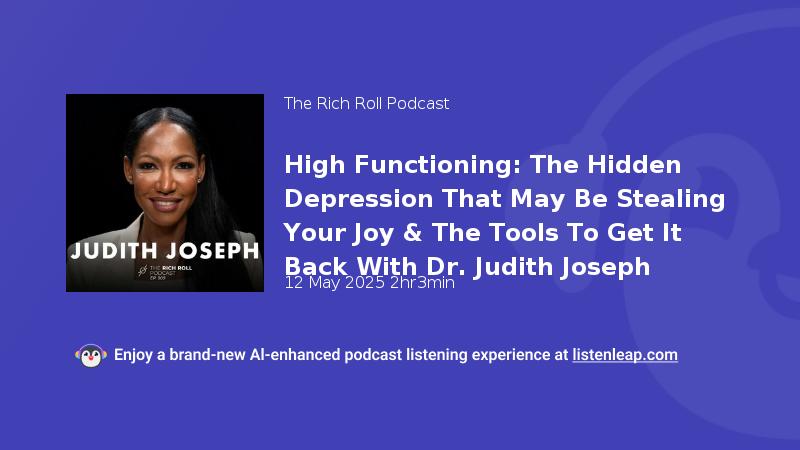
Her name is Dr. Judith Joseph, and she is fantastic.
Judith is a psychiatrist and professor of psychiatry at NYU Medical School.
She also runs a research lab where she conducts clinical trials as chief investigator and serves other institutions in various capacities, including Columbia University Medical School.
Her credentials and accolades are many, too lengthy to list here.
But suffice it to say that she's super legit as is her vital due book titled High Functioning, which if you relate at all to any of the things that I've just shared, I strongly suggest you immediately pick it up.
So if you are a high achiever or perhaps you know somebody who is, I think this one is for you as Judith does quite an amazing job of dissecting this idea of a high functioning and putting it to the test. Judith, welcome.
Thank you for having me.
I'm delighted to have you here today.
Your work and your book is speaking to me in a very profound way at a very particular moment in my life.
And I feel like the universe must have conspired to arrange this meeting for a very good reason at this exact specific time because I am experiencing currently a version of the condition that you talk about in this book, I would say that I'm somebody who gets high on high function and it's proving to be an urge that is of diminishing returns right now.
So I'm in a situation where I'm struggling to sleep, I'm waking up in the middle of the night and then I'll come in here at a ridiculous hour.
or I'm working on a book, I've got all these podcasts, I have back surgery in two weeks, so I have to get all these things done and I'm not gonna let anything get in the way of that.
And so if there's one thing I can do, it's focus, execute, be productive, and this has been my modus operandi for as long as I can remember, right?
It's a superpower, but it's also an Achilles' heel and I'm at a particular inflection point with it today.
I literally woke up at like 1 .30 in the morning and started like cycling through all these things that I have to do and ratcheting up my anxiety.
And I was like, oh, this is perfect.
Well, it's terrible in that I wish I had slept more for this interview, but actually kind of amazing that you're here today to talk about this subject matter that is I think vitally important.
Well, I truly believe in destiny and I believe in faith.
and I'm a scientist and I own a lab, but my dad's a pastor, and for many years I thought you couldn't believe in the things that you couldn't prove, right?
Because if you're a scientist, then you're a scientist, and you shouldn't have that conflict.
Science is science, numbers are numbers, but I have been learning over the past couple of years that there are circumstances that bring people together, and part of it is spiritual, and another part of it is I really believe in destiny.
And I think that I came here for you at this point in time because you needed this message.
Well, I believe in that as well, I'm vibrating on that frequency, I have another frequency that's a little off kilter at the moment.
So why don't we unpack this a little bit?
You know, on its face, like this idea of being high functioning, while it also being this version of depression, these are antithetical ideas.
Like, isn't somebody who is high functioning somebody you should aspire to become, like to be productive, to get out there and crush it.
These are all like goals that we all inspire to better inhabit ourselves.
So, explain this interesting kind of phenomenon and, or not phenomenon, like diagnosis that is central to the work that you're now doing.
Well, it's interesting because as you're talking about this upcoming surgery that you have, it put me right back in time when I was about to give birth to my first and only child.
And I own a lab, I have a private practice, I was a professor at NYU teaching doctors, all of these wonderful things happening.
But probably the most important thing that could ever happen to me becoming a mother was a thing that I was like kind of dreading.
And so leading up to giving birth, I was doing so much work, and I couldn't sit still, and I was so busy.
And some people would say that's nesting, but I wasn't nesting in the way most mothers nested.
I was taking care of my research, trying to line things up so that, you know, if I had to be god forbid out of commission for a week, things would run smoothly, you know?
I remember having this baby on my chest and having to nurse.
And then I had all these lab charts around me.
I'm like, what was I thinking?
Right? But I do think many of us who are busy, who have our identity and our self worth so closely tied to this role, we cannot sit still.
And it's different than burnout.
You know, with burnout, by definition, it's an occupational hazard. So if you take the person out of the workplace, they should technically get better.
Not with people like us.
You know, you take us out of work, we will still find more work who will still find another project.
we know that we have to slow down in two or three weeks, but we just can't accept it.
So we wake up in the middle of the night, we're up doing things, working on things, there's no end to it, we cannot sit still.
When we sit still, we feel empty, when we're not busy, we feel restless.
And that's what I was finding with high functioning depression.
We don't check that bottom box, like most others with depression, who has all the symptoms of depression, we don't check that bottom box of are you low functioning or have you stopped functioning, or are you in crisis?
It's the opposite. We cope by busying ourselves.
We try to outrun our problems. We try to outrun our trauma and our pain.
We cannot sit still.
So you have this quiz in the book, and I got almost a perfect score on this, in which you basically ask these questions to try to help self -diagnose people as to whether they're suffering from this.
Can you just walk us through the day in a life of somebody who might be a candidate for this so that people can orient themselves and relate their own behavior patterns to what you're talking about?
Yeah, it's interesting because my office is in a very busy part of Manhattan.
So I see a lot of people coming in and they're not coming in with the typical breakdowns, they're coming in with something called anhedonia.
And it is a lack of pleasure and interest in things that used to light you up, and it's not a crisis, right?
If you go to a doctor, you're like, oh, I don't have joy, they're gonna say, well, are you working?
Are you showing up for others?
Are you, you know, still able to function?
And if you say yes, they'll say, well, come back when you break down.
But anhedonia, I think, is a crisis.
It's a lack of joy, which is a crisis for human beings, because human beings were built with the DNA for joy.
This is our birthright, but many of us are walking around with the meh, the bleh.
So anhedonia is one of the key signs.
It's the first sign that I ask about.
But the other things are, you know, when you do sit still, do you feel restless?
Is it hard for you to just be alone with yourself?
And I think that's important because we don't realize that this is a part of our fight or flight.
This is our trauma response.
We cannot just be. We have to do, and I joke, I say, you're a human doing, not a human being because you're trying to outrun something that you haven't fully resolved.
For many of us, it's something early in childhood, but for others, there's something that happened in adulthood that is so painful that we just avoid it.
And avoiding the pain, avoiding the trauma is a form of busyness.
So when you think of combat veterans, I do a lot of research with PTSD, post traumatic stress disorder.
Many of them will avoid a place that triggers them or they'll avoid a person that triggers them.
For those of us with high function depression, we are avoiding our pain by working, by pushing it down, pushing it down.
But what happens is that you push it down so much that you stop feeling.
And that's where the anhedonia comes in, the lack of pleasure and joy.
So anhedonia, trauma, we're gonna get into that.
Big trauma, small traumas.
but I think just on a top level, just the idea that this would be categorized under depression as opposed to an anxiety disorder is the leap that is challenging for me.
Like I wouldn't consider myself depressed by any stretch of how I think about that.
I certainly have spells of high anxiety or I'm always revving and I definitely suffer from anhedonia.
I remember saying to somebody recently, I mean, I have an incredible life.
It's beyond anything I could have imagined for myself.
And I've worked very hard for it.
And some of those impulses that led me here were healthy and some were not.
But joy and being present in it and actually feeling gratitude for it are very elusive things for me.
And there are things that I will then sort of push to the side and say, well, that's okay because I'm on a mission and those things are less important and kind of moving forward and doing this thing that I do that on some level is an act of service but I also rationalize it as such, like, it's for me too.
Like it nourishes me and it's meaningful for other people and that's great but it's almost as if joy, happiness, Those things are secondary, or they're just lower on the hierarchy of priorities and something I can get to later, which is super ironic because I sit across from people all the time talking about happiness.
And it's like, self -awareness will avail you nothing.
Like I'm briefed on everything and yet I struggle to actually put some of those tools into practice to move my life towards these things that I want more of.
And it reminds me of something that's often said in recovery, like I'm a 12 step person.
It's like, well, the brain that created the problem struggles to solve it.
Like you're relying on the brain that created the problem to solve it.
And when you're in this state of anhedonia or high functioning depression, as you call it, which I clearly feel like I have on some level, that's a situation in which you don't really wanna solve it.
Like you can read the book, but then it becomes very difficult to actually like break out of it through action.
Because you're getting rewarded by the system.
The more productive you are, the more you give, the more rewards you get, the feedback, or you're doing a great job externally, but something inside does not feel satisfied and that's why you continue to go.
I'm glad you brought up anxiety because in depression research, when we're adding up how we know whether or not you're getting better or worse or staying the same, we're literally adding up points.
And one of the points that I think many people don't know that we add up is the point of stress, the point of relaxation, the point of tension.
So one of the questions I'll ask that's on that questionnaire is are you able to self -soothe?
Are you able to relax when you're anxious, when you're tense?
And you would think, isn't that anxiety?
Why are you talking about tension with relation to depression?
But let me ask you something.
Do you think it's even possible to be joyful if you're anxious, if you're worried all the time, if you're tense?
No, tense people don't enjoy even the simple pleasures in life.
That's why when talking about depression we have to incorporate anxiety.
And it's interesting because it used to be thought that with depression research, it was just three chemicals, dopamine, norepinephrine, serotonin.
But now we're learning about other chemicals in the brain that are important.
you know, look at the glutamate model and the GABA model.
GABA is one of those really important neurotransmitters that calms your brain.
So, you would think, well, why are we talking about calming in depression?
Because it's really hard to be joyful and to access the things in life that bring you pleasure when you're tense.
So, we have to talk about anxiety and depression together.
And you know, I mentioned that in my research, which I found a high correlation between trauma and pain and high functioning depression, well if you're constantly revved up, one of the questions in my questionnaire is the psychomotor agitation, that's the restlessness, then how can you even sit still to enjoy a basic meal?
You're just in default mode, you're thinking, you're worrying, you're not even staying present.
And that's why when we travel to other countries and we see these thought leaders, these gurus, they just seem so joyful because they're so peaceful.
it is really difficult to find joy, to access joy when you're not at peace.
The AA version of that is sobriety is being happy, joyous and free.
And the kind of dry drunk is restless, irritable and discontent.
Well, there's a lot of anedonia and chemical dependency, a lot of it because people think that, oh, you just wanna get dependent on something because it gives you joy.
It's the opposite, once you're at a point where your brain is dependent on a substance, the lack of that substance makes you so irritable and feel so unpleasant physiologically that it's not even about accessing joy anymore.
You just wanna get rid of that pain.
And that's why I think a lot of people don't really understand what happens with someone who's struggling with addictions.
They see it as like, oh, you're just a heathen.
You're just hedonistic, you just want pleasure.
No, they're trying to get rid of that pain.
Sure, and when you remove the substance and aren't utilizing the tools, you have the emotional pain that is still there, right?
Needing to be addressed.
I mean, that's like the real work.
And in terms of the anhedonia piece, like it's more than just a lack of being able to feel joy, it's also just a general kind of numbness to all experiences.
Yeah, it's a coping mechanism.
I think for many of us, we avoid dealing with these feelings in general, and it could be cultural.
It could be something we're taught, but it also could be something that was defense mechanism in childhood, that if we didn't feel, we walled it off, then we'd be safe, and initially, that's helpful, but over time, it robs us of our birthright of joy.
And it sounds so granolary, but we have to start feeling again.
We have to start processing and stop outrunning so that we can feel all those emotions, because that's when the healing begins and that's when we can actually start to access the joy.
Let's talk about the trauma piece.
Let's parse this out between the big traumas and the little T traumas.
So in PTSD research, there's an assessment called the CAPS -5, and many people probably heard about it during the Johnny Depp Amber Heard trial because one of the clinicians pulled it out and wanted to measure whether or not any of the individuals in the case had real trauma.
But it's a very powerful gold standard tool that's used in psychiatry research. And it was developed out of the veterans' hospital to look at whether or not combat veterans had a certain level of trauma.
And so some of the criteria for trauma with PTSD, you have to meet criteria based on it being life threatening or something physically painful happening to you or to someone that you witnessed this happening with someone else.
So the traumas have to be major, like an assault or near death.
However, what I was saying, since 2020, people come into my office saying, I lost my business or I went through a divorce and they want it to be in these PTSD studies because they were experiencing that fight or flight.
but I had to tell them like you don't meet criteria.
Do you know how disheartening that is for people and validating it is?
So I have to tell them your trauma does not meet textbook criteria.
But off the record, I'd say I believe you because trauma is anything that is so emotionally significant, psychologically significant that it shapes the way that you view yourself and the way that you interact with the world.
And I say that because one of the most common trauma responses that I see is internalizing self -blame, shame, and guilt.
That's important, you know, it's not as, you know, sexy or flamboyant as a nightmare or flashback, but it's really important because if you have unresolved trauma and you don't feel worthy without doing for others or having a role or showing up even when you're in pain, then you continued busying yourself.
You never process that pain, you cope by just showing up and being the rock.
And many people in positions like yours, you know, the thought leaders, the entrepreneurs, the fathers, that's how they cope.
They don't ever process those wounds.
They continue busying themselves because there's this inner self worth that isn't there, that they believe unworthy because they believe that they are somehow at fault for what happened to them.
They feel shame if they talk about it, they don't wanna burden others.
So they just keep doing, they keep busying themselves and they don't ever process it.
And so I think that it sounds like very, I think emotional for some people who are not accustomed to facing their problems, but it's important to acknowledge this.
This is how you start to change.
If you don't acknowledge it, if you don't validate it, it's very difficult to start changing.
What you resist persists and actually grows.
I think it was Carl Jung who said that.
Under that umbrella of trauma, like if you define it broadly enough, it seems as if everybody would fall under that category.
I mean it's like, we've all had stuff that's happened, right?
And some people have had to weather and suffer through enormous traumatic experiences, others mild, emotional experiences, but I suppose it's about how our brain processes it.
And whether we move towards it and try to work through it or whether we compartmentalize it and try to consistently outpace it.
Well, we've all had painful things happen to us, but some of them didn't necessarily shape the way that we view ourselves.
Some of us will say, oh yeah, my grandma died, it was sad.
But it didn't significantly alter the way that we view ourselves and the way that we see ourselves in the world.
But for others, we are different.
These instances do shape us.
Divorce is a trauma that many people experience, but they don't talk about it.
Why? Because of the shame.
People think that somehow they were at blame, and they may have been at blame, you know, but others, it just happens.
It's something that happens in relationships, relationships fall apart.
For me, personally, when I was going through a divorce, there was a lot of that guilt and shame, even though on a conscious level, I'm a psychiatrist, I know that this happens, people grow apart, but on a deeper level, I felt, well, there should have been something I could've done or maybe I did something wrong.
You know, we all experience this, But because I have tools to acknowledge it, I know how to work my way back and say, okay, this is something I have to challenge as a core negative belief that I have to challenge.
But many people, they don't have that.
They don't even have the acknowledgement that this is something that can happen due to a trauma that people don't even acknowledge because they say everybody goes through that, right?
Something that is a common trauma that people don't acknowledge is birth trauma.
You know, we'll say that many mothers, You know, they have typical births, but some have very painful births where they don't want to talk about it because every mother gives birth.
It's something all mothers do, why are you complaining about it?
But for some, it was very painful, it was very traumatizing, they could have lost their lives, but they don't talk about it because that's what mothers do.
You know, there are these things that happen to us as human beings that we just believe that, okay, many humans go through this, so it's okay.
Why are we trying to call it a trauma?
But for so many of the people I've worked with, these instances have shaped the way that they behave, the way that they view themselves, and the way that they interact in the world.
So it needs to be acknowledged.
And only when we acknowledge it and validate it can we work our way back to see how it impacts the way that their relationships are, the way that they work in the workplace, the way that they interact with their children.
And these are all areas where they're losing their joy because they haven't even acknowledged how these traumas have impacted them.
The word trauma is such a loaded word though.
I almost feel as if we might be better off if there was something else in the nomenclature because when you say trauma, it's like, it wasn't a trauma.
Like, yeah, it was bad and I had to get through this, but this is a common experience that many people have to your point.
But because the word trauma gets associated with it, It's like, yeah, no, I'm not gonna, we're not doing that, right?
I'm cool. Yeah, it's like the word trigger.
It rubs people the wrong way.
The trauma trigger is a triggering word. Yeah, because it's been overused.
But I do think that, you know, for some, these painful instances are not traumas for them, it doesn't lead to this response, and in others, it does.
And it's validating to name that for the person because what it tells them is that this thing happened to them, it wasn't their fault, it impacted you in ways that you were not even aware of and that's why you were coping in ways that you probably wouldn't have if you had known better, right, if you've known a different way of coping and this is why you can't access joy.
And I think that's powerful for some individuals because that allows them to take that shame and guilt off of themselves so that they can actually start to change.
So let's go back to this idea of the day in the life.
Like walk me through, like if somebody is suffering from this, how are they waking up in the morning and making decisions throughout their day?
Well, everyone's different.
But what I find with my high functioning folks is that they do have a lot of anxious energy, so they end up waking up before their alarm.
They don't have a sense of self worth, so they don't nourish their bodies or take the time to eat properly.
So a lot of them are just, you know, eating unhealthy foods, or not eating at all.
They're revved up on caffeine, drinking a lot of coffee so that they can keep doing because that's what's important to them.
Or when they do decide to have a meal, they're sitting at their desk, they're working, they're not actually savoring their food.
They're just kind of cram it in in their face and they're ending up with acid reflux.
They're not going to the bathroom door today because they invalidate their basic needs.
So they come home and they have to go straight to the restroom.
They're with their kids and they're not present, because their mind is still at work.
They can't slow down, or their mind is thinking about something else.
So they're leaving the basic joys of connection, this family that they have. They're leaving that joy on the table because they're not even looking at their child.
Their mind is somewhere else.
And then when it's time to go to bed, they're thinking about what they have to do the next day, so it's hard for them to relax.
So what do they do?
They doom squirrel, because that's their way of controlling the outcome.
Let me just keep looking at all this news, and maybe if I keep looking at it, something will change.
Well, we know the news won't change, it's always going to be there, and it's always going to be bad news.
And then the day starts again, and they're leaving out the points of joy.
The simple things, such as your dog is at your leg during dinner and trying to get your attention, you're ignoring that dog, because you're not present.
You know, your loved one just wants you to notice them, but you're not, you are taking them for granted.
Your food, which you used to enjoy, doesn't give you the same pleasure because you're so busy thinking about other things, you're not even engaging in, oh this tastes really good.
Like I like that flavor, you know.
You're not being present.
And, you know, I said that a lot of other countries will have gurus and monks who seem so peaceful and joyful, well, that's it.
You're not at peace.
So you can't even sit still to access things such as a meal, enjoying and savoring a meal.
Or if you have access to nature, you're not looking outside, you're looking at your phone or you're looking at your work or you're focusing on something else.
You're leaving the basic joy on the table.
What is the difference between somebody who is suffering from high functioning depression and somebody who just, by dint of their circumstances and environment simply has a very challenging life.
Like if you are economically, you're a single mom, you've got two jobs and you gotta take the bus and you're on food stamps.
I mean, it's like, it's environmental also like approaching it from a holistic perspective.
There are many vectors and variables at play.
Certainly, it could be a trauma response And then symptomatically you have anhedonia and these other kind of outward manifestations of it.
But is there a qualitative difference between somebody who is just doing the best they can and this more striver driven, runner and gunner?
Yeah, I love that question because in my lab I see people who are very, very wealthy and people who don't have very much. And in research, especially the line of work that I do with novel medications.
Depression does not discriminate.
It doesn't care whether or not you are rich or you have nothing.
And there's a model that I think that is very helpful to understand, you know, because there are many ways that you can be robbed of joy.
It's a simple model, it's called the biopsychosocial model.
And every medical student knows about it.
So biologically, what are the things that get in the way of your joy?
So what are your medical conditions?
For me, I have a low thyroid.
So if I don't check my thyroid, I have to be very careful about feeling anxious or depressed.
But for others, it could be something else.
It could be, they have really bad asthma or they have an autoimmune condition, they have chronic back pain.
Psychologically, what's happening in terms of their past?
So do they have attachment styles that are not helping them to have healthy relationships?
Do they have unprocessed past traumas know or ADHD or other conditions.
And then socially what is their life like?
So what you're talking about with the woman who is a single mom who works hard who doesn't have resources, she's going to have a lot of social stressors that are different than someone let's say who's upper middle class.
You know she's worrying about finances, she probably is dealing with some you know aggressions in the workplace, she's worrying about her kids, she probably doesn't have the support and she probably doesn't have access to foods that are not processed or access to nature or has the ability to move around and get activity, right, those are all the things in the social context.
And we also know that people from lower socioeconomic brackets, they have other things to do with, their environments may not be clean, they may have toxins in the environment.
So, those are all areas where absolutely they make major contributions to whether or not you have depression or anxiety.
But what I found interesting, is that even when I travel to countries where people don't even have running water, right, people are in dire straits of poverty.
You can still find joy, right?
You still see people laughing, dancing, communing.
So it has, it's not all about what you have, right?
And when I talk about joy, I talk about these moments of pleasure.
So when you're sitting still and you put your feet up, do you feel rested?
When you're hungry and you eat, does it satisfy you?
You know, these are these moments of joy.
These are the experiences of joy versus the idea, which you know of, of happiness.
When I finally pay off my debt, I'll be happy.
When I finally find a partner that I love, I'll be happy.
When I finally have this clout that I desire, I'll be happy.
that's the difference.
So you can still access those moments of joy that give you hope versus this idea of finally being happy.
So when you think of that single mom, because I've worked with many of them, some of them have severe mental illness like schizophrenia, but you'll still see them connecting with their kid.
You know, like one of the stories I tell often is working in the clinics, I'd work with these moms who had severe mental health issues.
And some of the workers in the hospital will say, well, let's not offer this program to them because it's a lot of paperwork and they may not be able to do it and we're just gonna overwhelm them.
And I would say, don't underestimate a mother who comes from nothing, who's not well educated, who has a severe mental health issue because she's still raising her kids, she's still bringing them to school every day, she's still bringing them to her appointments, don't underestimate her.
So even if you have these challenges, you can still access that joy.
it is a mindset, it's a mind shift, you know, if you're willing to.
We're brought to you today by One Skin.
I can tell you that as you get older, as I am doing right now, you just can't get away with the things that you're used to, and you start to care about things you just always previously took for granted, like skincare, something I admit to having completely overlooked for decades, spent under the sun in chlorinated pools, and basically baking myself shirtless on hot summer trial runs.
Now, I'm not somebody who obsesses over appearances, but I am fascinated by the science of cellular aging, which now has matured to a point where we have so much more agency to protect ourselves against what we previously took for being inevitable, all of which has led me to OneSkin.
Here's something wild.
Your body starts to accumulate these things called zombie cells as early as your twenties.
These senescent cells stop producing collagen and instead begin pumping out inflammatory compounds that wreak havoc on healthy cells, accelerating skin aging.
And this is where OneSkins OS01 peptide comes in.
Developed by an all women team of scientists who tested over 900 compounds, It's the first ingredient scientifically proven to target cellular senescence.
It's not really about looking younger, it's about your skin actually functioning better at the cellular level.
I've been using it consistently and I am genuinely impressed with the results, which isn't something I say lightly about skincare products.
One Skin is the world's first skin longevity company.
By focusing on the cellular aspects of aging, One Skin keeps your skin looking and acting younger for longer.
Get started today with 15 % off using code richroll at OneSkin .co.
That's 15 % off at OneSkin .co with the code richroll.
Hey everybody, pay attention because this episode is sponsored by Squarespace.
Now I'm somebody who spends a lot of time thinking about the transformative power of storytelling.
how sharing our authentic journey can inspire others.
But it's one thing to construct a story, it's another thing to tell it, and another thing, altogether, to actually turn that into a digital reality that allows you to share your vision broadly, and, importantly, to create impact.
And to do that, you need a great platform.
And to do that, you need Squarespace, because it's so much more than a website builder.
With Squarespace's new Blueprint AI, it's actually like having a design partner who reads your mind.
And look, I know there's a lot of hype out there, a lot of slinging when it comes to emerging AI tools, but Blueprint really delivers.
For example, you could share a few goals and then it just automatically generates all this personalized content that actually feels authentically you.
And for tech challenge creators like myself, they've got this drag and drop editing feature that makes the whole process surprisingly intuitive.
I also appreciate how Squarespace has continued to evolve to support creatives in new and bespoke ways.
For example, they've got this sell content feature.
So for example, if you're creating online courses or exclusive videos or maybe membership content, Squarespace makes it super easy to set up a professional paywall and generate a sustainable revenue stream for your passion.
So check it out, head to squarespace .com for a free trial.
And when you're ready to launch, go to squarespace .com slash rich roll to save 10 % off your first purchase of a website or domain.
I've been banging the drum about recovery for years now.
And after all of my endurance escapades, I've learned the hard way that how well you bounce back is really just as important as how hard you push, because if you don't recover, you don't improve.
That's why the brand new and all new whoop sensor is my constant companion.
And it's seriously impressive, 7 % smaller with a ridiculous 14 plus days of battery life.
I haven't taken my whoop off my wrist in something like five and a half years at this point.
And I love it because it's the only wearable that turns your health and fitness data into personalized guidance.
All those metrics matter, sleep quality, HRV, resting heart rate, stress, strain.
And WHOOP tracks them constantly and then actually tells you what to do with that information.
Should I go hard today or should I take it easy?
Well, WHOOP knows. And the new heart screener feature with on -demand ECG readings is just a game changer because it allows you to check in on your heart whenever you want to and share those results with your doctor, which is pretty powerful stuff.
Their health span feature shows you how your daily habits are influencing your biological age, and the hormonal insights provide personalized guidance throughout your cycle or pregnancy.
Whoop is not just another gadget.
It's really the only wearable that gives you a truly comprehensive view of your body, helping you to make smarter decisions about when to push and when to rest. So check it out.
Go to join .whoop .com slash That's join .whoop .com slash roll.
The high functioning person generally in my experience has a pretty powerful motor.
Like they have this drive, they're trying to make their imprint on the world for better or worse, right?
And trauma may be the kind of cause of why they are that way, or at least in a related way.
But the fuel for that drive is essentially fear of one form or another, and that fear is linked obviously to the trauma or to some other root cause or source, but it is a fear response, right?
This fear could be if I don't do it, like everything's gonna fall apart or my identity is so wrapped up in what I do.
And if I don't show up for it, then who am I?
I'm scared of you know how other people will perceive me in treating people who suffer from this.
I suspect you have to identify the locus of that fear and try to deconstruct it.
Yeah, I do and you're absolutely right.
That fear is what we would call anxiety, right?
Fear of the not being loved, fear of the running out of money.
For me, I have done this deep dive into my own past because I came to this country with very little and, from the Caribbean, and I didn't even realize how this chasing accolades, not just having one lab, but three labs, having all these roles was tied to this fear of running out of resources.
On a conscious level, I knew, okay, there's no, I'm gonna run out, the money's in the bank, I'm good.
But the inner restlessness came from this unprocessed fear of running out, and many people, they may not have come from the similar background that I have, but the generations before them, that could've been passed down.
Let's say if your grandparents came from a war -torn country where they were oppressed and they came here and they lived in ways that you're not supposed to take risks, you're supposed to hoard. Don't waste food.
Some of your behaviors are out of this scarcity trauma that was never processed.
And that's why it is important to sit still and to trace yourself back to that moment.
It could have been in your past, in your family history.
It could have been in your personal history but it's important to sit down and reflect on it.
It's validating. If you take your foot off the gas, it's all gonna collapse, right?
Like it's all gonna go away whether that's an imposter syndrome thing or a scarcity mindset or trauma, unless I'm there doing it all the time, it's all gonna break down.
Which is a fear response, it's also there's a layer of narcissism on top of that.
It's as if like, I'm so powerful.
I'm so afraid of being not in control, but I'm also all powerful and I will be able to solve it.
And beneath that is a discomfort with uncertainty because this scarcity mindset is really a discomfort with not knowing what's going to happen.
And so what can I control?
Well, I can control my output and my work and that will solve it.
But of course the world is uncertain and no amount of work or effort is going to allow you to transcend that.
I love that you said narcissism because one of my professors in training at Columbia once told us to look out for people who have, they're like the flip coin.
One side is narcissism and the other side is masochism.
And narcissists, what we think of narcissists, we think of people who are full of themselves, who like empathy, who are prideful and boastful, but we don't think about the masochistic narcissist who bends over backwards, is constantly working, is delaying pleasure because they believe that they're the only ones who can do it, right.
Only they could do it right.
And I think many people with high functioning depression have these narcissistic, masochistic tendencies.
And it's not because they're a bad person, it's just because they didn't process that pain, and what they end up doing is finding their self worth in that role.
So they, it looks very narcissistic, I'm the only one who could do it, but it is masochistic because they're bending over backwards.
But it's still validating also.
And then you look at the world through that lens like see, when I did it, it worked and when you didn't, it didn't work.
It's constantly being reinforced that way.
But they're not happy.
They're leaving joy on the table.
They are miserable.
I want to talk more about the Masochism piece because I watched and listened to a bunch of your interviews and there's a lot of talk about the anhedonia and the trauma stuff.
But less so when it comes to the masochism piece, and that's another kind of loaded word, right?
It is. But I think it's super interesting and because, at least to me, it seems like this is a less discussed pillar in this, that we could take the opportunity to kind of dig a little bit deeper into that.
Well, the reason I don't talk about masochism is because the algorithm will block you.
Oh, really? The algorithm thinks that you're talking about sex. So, and I teach media at NYU, so I know that.
That's interesting, I hadn't even thought about that.
Well, if you look at, I mean, for someone who does so much high -functioning depression content, it's hard to find me under high -functioning depression because I have to like change the S to like $1 sign because the algorithm will block the word depression, it'll block the word anxiety, things like that.
So I have to be creative to get the word out about this stuff, I have to like disguise it.
But masochism is one of those words that most people think of like sex, but there's actually masochistic personality disorder that was in the DSM, the Bible of psychiatry for years.
And then around the 80s or 90s was taken out because it was thought to be victim blaming.
And so typically masochistic people would be people who somehow incited others to treat them poorly, right?
It does sound victim blaming.
Or, and additional to that, they don't believe that they're worthy of praise.
They don't believe that they're worthy of pleasure.
They bend over backwards for people, even though those people are takers.
And so the more modern version of masochism is people pleasing, a little different than being a martyr because martyrs kind of wear that as a badge.
People pleasers are usually miserable but they can't stop.
But the masochistic tendencies that we see with high functioning depression rob people of joy.
They end up doing so much, They end up believing wholeheartedly that if they don't do, they're not lovable.
If they don't say yes, they'll be rejected or abandoned, and so they don't know how to stop.
They're not realizing that if they do say no, if they do set boundaries, people will actually love them more.
So I felt that it had to be in there.
No, I think it's important the idea that you have to not necessarily be a martyr, but you are kind of wearing a hair shirt and flogging yourself, but there's also that narcissistic piece, like it is doing something for you, right?
You have to recognize that all of these errant behavior patterns are serving you in a certain way, and when you combine that with that conditional love piece, like my value is only in so far as I can go out into the world and bring home the bacon or achieve this thing, right?
you're on this habit trail with that.
And you're gonna perpetuate that even as your experience of anhedenia is going to increase.
And then it becomes difficult to get off of it because you have been that person who said, I'm the only one who can do it.
And so everybody said, well, okay.
And then you're kind of left with yourself, right.
And you're in this lonely, isolated place as a consequence.
Yeah, the takers will continue to take.
they will take as long as you're giving, it's human nature.
It doesn't mean that the people in your life are bad, but we learn, you know, you know, I said that trauma shapes the way that you see yourself and the way you interact in the world.
Well, if you're going to keep giving because you believe that that's the only way you're valuable, then people will continue to take.
And then you will end up feeling depleted and without joy.
You don't set boundaries with others, but also with yourself, right?
Yeah. Yeah, that's not a great situation to be in, is it?
It's not, the great thing about it is that when you start realizing it, you start to change.
I remember when my very first therapist said to me, Judith, what you have is contagious.
And I was like, what are you talking about?
And this is from someone who resisted therapy because I came from a very Caribbean religious background, I didn't think I needed therapy.
I was like, that's for people who have severe mental health issues.
But training at Columbia, they offered us free therapy with some of the greatest psychiatrists in the world.
And I remember my first therapist saying to me, what you have is contagious because it's masochism.
You don't believe that you're worthy enough to do this very special type of therapy where you're getting these resources at a very small amount of money.
You don't think you're worthy so you're coming late to all your appointments.
But what you're doing is you're making me late for the next guy, you know, the guy who's waiting in the waiting area, it spreads.
There's a selfishness to it.
There is and it is contagious, this unhappiness, this masochism, it spreads.
And there have been bouts in my life when I've looked around, when I was going through my masochistic tendencies and everyone in the lab, they were overworked too.
When I'm busy, when I'm masochistic, my team is, but when I slow down and I start to tap into joy, they start to be joyful too.
So just to put a finer point on it, how is this masochism root or why is it so important to really understand in terms of overcoming this disorder?
Just acknowledging it and being aware of it allows you to change.
There's something called affic labeling in psychology.
If you acknowledge the issue, If you acknowledge the feeling or the experience, then that decreases uncertainty and it allows you to create change.
So I often liken it to let's say you're in this very dark room and you can't see and you hear a loud crash.
You know, some of us would start running, some of us start swinging, some of us would start screaming, but if you turn the light on and you saw that oh, it was a vase that broke, then you're more at ease.
Knowing what you're working with, knowing that, okay, I tend to be a masochistic people pleaser, that explains so much for many people.
And knowing that it's related to unresolved trauma or low self -worth, that decreases the uncertainty for the human brain.
Right, if you are able to identify the behavior, then that becomes a window into perhaps the trauma that gave rise to it in the first place.
And it just allows you to feel that there are things that are more certain.
Uncertainty is not great for the human brain.
Look at 2020. None of us knew it was gonna happen.
And many of us became depressed and anxious.
When we don't know what we're working with, we are tense, we are anxious, we make terrible decisions.
When we know what we're working with, when we know why we are the way we are, we're able to make better decisions and we are less stressed.
How long did it take you to recognize this within yourself?
Like, I'm just imagining, the young version of you coming from the family of origin that you did and your background and circumstances to be this A student, top of the class, Columbia, like you're the classic striver, right and your upward mobility is skyward. So at some point, what was the inflection point or the crisis or what kind of intervened to make you more reflective about this in your own life.
Well, there are many of those times, but there was one that really, I think created a change and a shift for me.
It was, I was at my desk in 2020 and I was given this talk to this large hospital system and they were frantic.
Some of the questions coming through were like, am I going to even survive?
I was like, how do I get through this?
I'm seeing so much death.
And I was supposed to be the healing voice.
And halfway through the talk, I was just like, I think I am depressed.
It just hit me. And it wasn't the first time I'd been depressed because I couldn't go back in my life and see these moments where I just wasn't even acknowledging it.
I was high functioning AF.
You know? But that moment I was like, wow, I just felt so much anhedonia.
And I was like, what am I doing here?
You know, I'm helping this hospital system, but my lab is still going.
You know, it's full throttle.
We can't shut down these FDA monitored studies.
The city is quiet. It looked like, you know, Zombieland.
And here I am, this young mother at the time, still married, and having to stick to this role of leader, this voice of reason.
You know, this healer when I'm unhealed, you know, so that is a moment in time where I I just thought, wow, if I'm like this, how many people are like this?
There's gotta be someone else like this.
And there've been times after that where I find myself experiencing anhedonia and being masochistic.
But now that I know what this is, I tell myself, I just gotta do more of the things that I really love.
I need to go back to the basics, I have to understand the science of my happiness.
Because the science of my happiness is gonna be different than yours.
For me, I know that points of joy that really make me feel spiritually full and fed have to do with being close to my family, being able to see my daughter frequently and not overworking, being connected to my team.
So I know now that when I'm feeling masochistic and anhedotic, I just gotta be more connected.
But it could be different for you, right?
You're gonna be different than me.
The science of your happiness is different than mine.
And that's why I want this information available in my book.
I want people to understand that there's only one you and there will only ever be one you.
So understand the signs of your happiness.
What are the things that are taking away from your points of joy?
And when you understand that, then when you're feeling this anhedonia and you're feeling this masochism, you know where to add those points back because you finally understand you.
There's a boldness to taking action on this that I would imagine is not always well -received.
Like if you're in the medical profession, You know I have stories about this from being a lawyer or you come from a family that has, you know, established certain expectations around like how you behave and suddenly you decide you're gonna do something different.
That's not necessarily gonna be well received at your place of work or at home, right?
And so it takes a lot of courage, I think to take a stand for yourself and say, I'm not gonna be this people pleaser anymore and I'm gonna set my own trajectory that's gonna be a little bit different.
You're gonna ruffle some feathers.
I know like this has happened with my family, but also I'm remembering being a corporate lawyer and there was one weekend where I was working on a Sunday and a partner came in and he had just come from his wife having given birth.
Like he literally left the hospital and went to go finish a brief, right?
and you're in this environment that's reinforcing that behavior.
So to your point of contagion, like there's an expectation and a sort of pridefulness around this behavior.
And if you were to say, yeah, I'm not gonna do that anymore, they're like, hold on, no, this is how we do things here.
You're going against the grain.
Lawyers, medicine, it's very similar that you're in the trenches kind of culture, like what makes you so special that you get to slow down.
You know, and I used to be an anesthesiologist before I was a psychiatrist, and I had to leave that field because, wow, like talk about trauma and unprocessed trauma, there's a lot of that in medicine.
You know, I remember one of my first months as an intern and giving chest compressions to someone who ultimately passed, and then there was no like, oh, let's sit and talk about this, it was like, well, who's got the next shift?
You know, there's just so much of this culture of like, Man up.
This is part of the job, get over it.
So the healers are really unhealed.
And I see this in fields like the lawyers, attorneys, the legal fields, you get shamed if you show feelings, come on.
Talk about unprocessed trauma.
I think it's important to talk about these things now, not to say that everyone should just stop what they're doing and stop working.
People with high functioning depression have something called all or nothing thinking.
When we hear you gotta slow down, And we think, I can't stop.
Slowing down is not the same as stopping.
We automatically go to, well, people need me.
No, I'm not saying to stop everything.
Slowing down can just look like, okay, during lunch today for one day of the week, I'm going to make an intentional decision to close my screen and eat my lunch and take the time to chew it and notice the flavors and enjoy it, have pleasure in a basic thing.
That's what slowing down looks like.
It doesn't mean that you're gonna miss the board meeting because you're sitting there eating your salad.
It means you're gonna treat yourself like a human being.
How is HFD different, maybe it's not, from what Arthur Brooks talks about, the striver's dilemma.
Have you heard this?
This is basically like you can't get off the treadmill, like the happiness and the joy and all these things that you're seeking, and seeing whether unconsciously or consciously are always on the other, right around the bend on the other side of like the next promotion or accolade.
Well, that's different because the strivers dilemma is someone who delays happiness, right?
They're saying that they still have to do this one thing and then it's not enough.
They get the one thing done, they continue going, it's not enough, and they're constantly on the go, right?
High -function depression, you know, when you look at depression and criteria, there are specific checklists in there.
There are symptoms like poor sleep, you can't focus, low energy, feeling shame and guilt, anhedonia.
But then you're different than people with the clinical depression because you're actually overdoing, you're not stopping functioning, right?
That's very different.
And then the Stryver's Dilemma, maybe he does talk a bit about the lack of joy, the anhedonia.
But for those with high functioning, depression, they have the symptoms of depression, but they're not stopping, they're overdoing.
How has all this discourse in the book and your work in this area been received by your peers?
Well, I get so many doctors coming up to me saying, thank you for doing this, this is me.
I would never say that I had this, but it's me, you know?
On the flip side, I get people saying, well, clinical depression is more important.
And you know, it's not a competition.
There's enough depression for everybody, right?
I think what people wanna focus on specifically in psychiatry is people who have broken down.
And you know what? They do deserve support, right?
People in crisis deserve support.
But my whole philosophy is why are we waiting for people to break down?
We're seeing this boom in longevity where people are saying, don't wait for the cancer to spread.
Let's teach people how to identify the signs and avoid the risks.
And with a menopause, you're seeing Don't wait for the osteoporosis and the heart disease, let's try to prevent it.
In psychiatry, we're in the dark ages, we're still saying, well, let's wait for that box of let's break down, and then - When you can't get out of bed, call me.
Yeah, I mean, there's a prophylactic, you know, sort of preventative angle to all of this.
But I also know there's people out there who think you're minimizing depression by characterizing it in this way.
Well, you know what?
But I'm saying that two things can be true.
Why do we wait? Why are we waiting for people to be in crisis to break down?
Let's teach people the tools that we learn in medical school.
Let's teach them about the bio psychosocial model.
Let's teach them about trauma, even if it's not like major traumas, let's teach them about how they cope negatively by pushing down these emotions rather than processing them.
Because if we don't, we are just not going to have the mental health professionals to deal with what we're seeing now.
And you know, look at 2020.
They were asking out -of -work psychiatrists to come back into the field.
Why? We just didn't have enough.
We didn't have enough professionals to address the crisis.
We still don't have enough.
If you go to most major cities, you'll still be on a wait list to see a psychiatrist for six to eight weeks, you know.
In other rural areas, there's one psychiatrist for every 30 ,000 folks.
we're not being proactive, we're being reactive.
This is a proactive approach. Giving people the tools, letting them recognize the symptoms and the science of mental health issues before they break down.
Let's not wait for them to check that box.
Let's teach them about ways to prevent that box from being checked in the first place.
I wanna get into the tools but before we do that, I think it's important to spend a few minutes talking about the people who are at risk because it's not just these type A ambitious people.
It's not, you know, I mentioned the single mom who can't slow down, who maybe doesn't have a partner to support her, right?
Like who doesn't have the financial resources.
It's not just the high powered lawyer or doctor.
It's someone who like me has come from scarcity trauma, who didn't grow up with much, maybe they have an immigrant background too.
and they don't know how to stop working because they're always afraid of running out.
It could be the educator, the teacher who doesn't even eat lunch because she's so busy trying to help her students and she neglects her own needs, the entrepreneur who doesn't wanna be bankrupt again so doesn't stop working, in fact, can't even enjoy vacations.
This is different than burnout.
When you remove them from the work, they're still busy.
So think about the everyday people in your life who are the rock, you know, who can't say no, who do for others, who give, they can't slow down and they don't acknowledge their pain.
Eventually it could lead to a clinical depression, or eventually it could lead to a physical breakdown or it eventually leads to coping in ways are unhealthy like excessive substance use, being on your phone too much, gambling, things like that.
What's happening in the brain?
So depression, what we used to think in the brain had to do with three neurotransmitters.
It used to be thought that there was a depletion with dopamine, norepinephrine, serotonin, but now what we're learning is that this was a old model.
For example, if it were just about those neurotransmitters, then we could just put everyone on a pill and everyone would get better, right?
We'd all be happy, there'd be no depression, but it's not that simple.
And what we're learning now that it's about a lack of healthy connectivity, neuroplasticity, which is a fancy way of saying that our brain cells are not being connected in ways that they should be so that we can feel a sense of joy.
And the reason that we know that is because when we look at brains using functional MRIs, we know that depressed brains are not as connected as brains that are not depressed, and that it's not just about these three chemicals.
I mentioned earlier that there are other chemicals involved, glutamate, GABA, the GABA, the one for anxiety and stress, that all play in a role together to work together to make sure the brain is connected in ways that is healthy.
And I wish I could say that you could just image your brain and say, this is what's happening, but we're not there yet.
But we are learning that experiences can change your brain.
For example, meditating, things like being still and present, mindfulness.
Sometimes we see that with the brain, the way that a brain that is mindful and meditating, It looks as if the brain is being treated for a depression.
Because we're able to open up these pathways by utilizing skills to help us to have more emotional regulation.
I imagine that the patient who suffers from this may be more treatment resistant than the average person who's suffering because despite the anhedonia and the kind of isolation that that produces, there is something self -affirming about being high functioning and for good reason, like it feels good to like be productive and get things done.
And irrespective of the symptoms that you're experiencing, what you're proposing is we untie this knot and that's sort of like a threat, right?
Like, oh, you're telling me that all these things that I need to do and have done forever that have propelled me throughout my life.
I now have to put the brakes on or set aside, like, no, thank you, that's too scary because then my whole life is gonna collapse.
Like your whole worldview has to be rewired.
It's that all or nothing thinking with my clients that I see, it's like what do you mean?
In order to access joy I can't be the person I was.
You're not able to access joy because you are the person that you are.
It is a complete different mindset for these people.
I'm not saying you have to stop.
I'm saying to slow down, just a little.
Try it just one day.
You know, it could be that one day that you say, rather than waking up and going straight to the coffee and then going straight to work, waking up, sitting and journaling.
Or, you know, instead of going from meeting to meeting, you literally pencil in a bathroom break so you can go and relieve yourself.
It's really hard to feel pleasure when your belly is distended with urine.
You know, pain is - Does it get that bad?
Like people won't go to the bathroom?
They will not. I actually gave a talk recently to a room full of high -powered executive women, and I asked them, how many of you have worked straight through a day and you really had to pee and you didn't?
And they just like started laughing.
It was like this human experience that they all had together, you know?
Because we invalidate our bodies all the time in the way that we invalidate what has happened to us in the past, in the way that we invalidate our emotions, we invalidate our bodily sensations all the time.
You know, when you think of athletes who they're in pain and they don't stop and the doctor says, you have to stop.
You're gonna really hurt yourself, but they don't, they're like, nope, no pain, no gain.
And then they finally have this incredible, really serious injury and it stops them.
Their body says no. And when your body says, no, you have to, you have to stop, you know, it's the same thing.
They don't invalidate how they feel physically or emotionally or psychologically.
It's weird how the human brain is so resistant to these ideas until you hit the wall in crash and burn.
And then it's like, okay, now I'll look at this and do something about it.
But obviously the course correction was available all along, right?
It's just that we have to, despite however many books we read, We have to crash the car before we're actually willing to entertain it.
Yeah, as thought leaders, you have to constantly slow down and practice the things that you learn and the things that you preach. And it doesn't mean that you're not intelligent, it just means that as humans we go back into our defaults.
This is who we are.
Is it, in your experience, more acute with women and women of color who are in the workplace because there is this very real thing that, but look, I've got to show up and go above and beyond to distinguish myself in a male -dominated environment, for example.
Well, with women for sure, women are twice as likely to have depression and anxiety compared to men, twice.
And so there's some real science to that.
When you look at the science of your happiness as a woman, you know, biologically, you are dealing with hormonal changes once a month, and that could be related to either your period or perimenopause or menopause, right?
And then if it's perimenopause and menopause, that's more frequent than once a month.
And then when you look at, psychologically, women tend to have a lot of personal traumas that sometimes don't even get addressed.
They have attachment styles that maybe they're partnered with the wrong person.
And then socially, they have pressures that men don't have. They have to be career moms. They tend to be people that are caregivers.
And then you know, the other aggressions that happen.
And then when you look at black women, black women have high rates of trauma.
PTSD is really high in the black community.
And then they have other aggressions socially that others don't have to deal with.
So absolutely, women and women of color, they constantly have to wear a mask of pathological productivity.
If they slow down and if they say something's wrong, someone else will take their job.
Or you're called emotional.
You know, or people say that you're complaining.
you should be grateful to be where you are.
So I definitely see that in women and women of color.
Let's get to that. I spent my life challenging conventional narratives about fitness, about nutrition, about what's possible now and in the future as we age, something that I'm increasingly focused on as I inch closer to my sixth decade.
And with that, there's a conversation that's becoming increasingly urgent, and that is, how do we reimagine midlife, not as a period of decline, but as this profound season of growth and possibility?
Well, on June 5th, my friend Chip Conley and I are bringing that conversation to life and in -person with an event called Wise and Wild, a midlife journey into longevity, purpose, and peak living, which is this really beautiful one day immersive experience that's taking place in LA and is about breaking free from outdated scripts.
I'll bring the endurance mindset, the relentless curiosity about human potential, and Chip's gonna bring decades of wisdom about emotional intelligence and purposeful living.
June 5, LA, this isn't just an event, it's an invitation to reconnect with your deepest self, to design a next chapter that's driven by intention, not fear.
So if you're 40 or older, feeling that relentless call to go deeper, to challenge your own limitations, this is your moment.
Early bird pricing is available through May 20th.
Go to meawisdom .com slash Rich Roll to learn more and reserve your spot.
Five Es. Yes. Let's start to solve this problem, right?
what's your sort of introduction to orienting us around the tools that we can all use to begin to take a different direction if you're somebody who is suffering from this.
So the reason that I thought of the five Vs was because I've traveled the world looking at different cultures and there are certain numbers that pop up across different countries.
The number three, the number seven, the number five.
and I thought about five because most of us have five fingers, you know.
So there's something about five that connects us as human beings.
And I wanted to have with my clients something that they could readily access when they're feeling empty and they're having anhedonia.
I want them to look at their hands and say to yourself, you were built with the DNA for joy.
It is literally built into your DNA, but you just forgot how to access it and just imagine tapping into one of the five Vs and reclaiming your points of joy.
And the reason I say points of joy is because I don't want people to think, oh, I'm gonna be happy once I do the five Vs. It's not about happy.
It's not about this idea of my problem's being solved and I'm fixed for good.
It's about getting those small points every day and saying, today I have a point, tomorrow maybe I'll have two.
It's not about a state.
It's about just getting those pleasurable moments.
So the first fee is validation.
Validating yourself looks like accepting how you feel and acknowledging it.
And I talked about how if you're not able to acknowledge how you feel, there's a great deal of uncertainty and a great deal of anxiety because you don't even know what emotion you're feeling.
And so that's really important because people with high functioning depression tend to push down their emotions.
It feels indulgent to do that.
Hmm, it does. Trust me, I know.
When I started validating and self -validating, I would be like, you're just being lazy, or like, you just gotta get over it.
It takes a lot of practice.
And also, how is this related to happiness?
The uncertainty of not knowing how you feel creates anxiety.
One of the points that is measured in happiness is that tension, that uncertainty, and so if you're able to decrease points of uncertainty that in itself is bringing you joy.
When you think about being happy people think it's just one emotion like in the smile.
But adding up all of the sensations that bring joy, it's not just a smile, it's when I'm tense I feel relaxed.
When I'm tired I can get rest. When I'm hungry, I feel satisfied.
These are all the points that we add up to measure happiness.
So knowing how you feel and naming it and having that certainty decreases that anxiety, and that's how it relates to joy.
It also feels like a tool to rewrite a story that isn't working anymore.
And by that, I mean we all have a story about who we are and why we do what we do, but if your story is like, this is how I do it.
And I'm like, I'm not the most talented, but I'm gonna out all of that, right?
By understanding what's beneath it and putting a word to it, you can reframe the story and start telling a different one, I think.
I think a lot about how the stories we tell ourselves inform our behavior and what we do.
And we're so locked into them, we rarely ever even put them under a microscope and analyze whether they're actually true or not.
Well, I mean, I used myself as an example.
I recently had to go to this really important intense meeting with these world leaders.
And I was just feeling so like, Yeah.
I didn't know how I was feeling.
I was like, just jumpy.
And then I had to tell myself, like, Judith you're nervous.
And then I had to trace back and be like, well, why are you nervous?
well, it's because you don't feel like you're enough.
And why don't you feel like you're enough?
Well, because all these people are older than you.
But why is that? Well, because they've been doing this a long time.
It's like, oh, but Judith, remember, you're the expert in this and you're gonna be there helping them.
And I'm like, oh, that helped.
And it sounds so indulgent, right, like sitting there and acknowledging my feelings and tracing back.
But knowing why I felt that way allowed me to then self -soothe and feel more joyful.
and then I was actually able to relish in the experience.
I was chatting and joking and I walked away with a very different experience than I would have five years ago.
Five years ago, I would have still had my stomach in knots and probably would have ruminating and analyzing every interaction, but now I can access joy of like being in other people's presence, learning from others.
I walk away feeling as if I got some points from that interaction versus leaving the points on the table.
It also allows you to change the memories you select, right?
Like if you have that good experience.
Like if you're somebody who's like, well, I'm anxious because your brain will point to a variety of memories in which you were in a similar situation and maybe you didn't go so well, but now you have these new memories and experiences that can inform that new story.
It's really changing a narrative, I do talk about that in my book.
Fuck. What about the venting part?
The venting. Well, venting, from a scientific perspective, venting in physics is when you, let's say you have a balloon and you're letting the air out, so the air is escaping and you're releasing pressure.
Venting from a psychological perspective is expressing negative emotions.
And for many people, they believe that venting is the same as trauma dumping.
Like I feel a certain way, I'm going to go and talk to someone and just like, let them have it, but it's not the same.
Healthy venting is doing so with intention.
So when you're going to talk to someone about something, you are going to have this intention of, okay, I want a resolution, I want feedback, I want to solve this problem.
It's just not for me to feel good, letting out how I feel because there are recent studies that show that if you're just trauma dumping, you're just like telling people how you feel, good or bad, and we're not really being empathic in the intervention, you're not asking them how they feel about it, if they're ready, you're not getting that emotional consent from them, then you're essentially making yourself feel worse.
The research paper says that it's like pouring gas into a fire.
So when you do decide to verbally vent and talk to someone, make sure that you first self validate, you walk through your emotions and why you're feeling that way, that you've self vent yourself maybe talk to yourself.
There's recent data showing that people who talk to themselves actually get to better resolutions and they feel better when they vent, and that you're not just picking random people to vent to.
So many of us, unfortunately, we vent to our kids.
And we have to think about that power dynamic.
Your child is not going to say no. They wanna feel attached.
They wanna feel accepted by you.
So they're just gonna listen, but they're gonna worry about you.
Think about who you're talking to in your workplace.
If the person reports to you and you're venting to them, they're not gonna wanna piss off the boss, right?
So really think about who you want to talk to and vent with intention and ask for emotional consent.
The vomit version of that is making it somebody else's problem as opposed to being a collaborator in looking for a solution.
Yeah, because then that person will just go ahead and vent to someone at home and it just becomes a cycle.
It's the contagious part.
And then there's the values, which is basically just being clear on like who you are and what's important to you and having a compass.
It's important. I do believe that over time, our values do change, the things that give us purpose and meaning.
I remember when I was younger, I really loved reading and it wasn't about the prize, the gold sticker.
It was about having this experience of escaping these situations where I didn't have much and just being able to fantasize and imagine myself in a world.
And just reading gave me so much pleasure.
But then over time, reading became, oh, you're the fastest reader in the class.
You're gonna get this award and then you're gonna go into these schools.
And over time, reading was a way to not fail.
You had to read the organic chemistry or you should fail the exam.
And I just stopped really enjoying learning and reading.
It was just something to do to avoid failure.
So I do think over time, our values change and it's helpful to again, sit still and reflect and to go back in time and figure out what was it that lit you up?
Why is it that I feel meh or bleh?
At what point did I lose that?
I'm curious in your own life if this is an issue for you now because you're in this new chapter of your life.
You've strived, you've got to a certain place, you had to reconcile all of these issues within yourself so you could be more joyful and happy, et cetera.
But then you write this book about this thing and suddenly you're on the today show and you're traveling here and I'm sure you're in high demand as a speaker, et cetera.
Those are very, like activating for that disposition to be high -functioning in an unhealthy way.
So it's almost as if the universe delivered you, like, okay, you're going to write the book about this?
Let's see if you can practice it in the most intense set of circumstances in which you're going to be given opportunities to be lured right back into that way of being.
Yes, and that's why I have to constantly go back to the science of my own happiness.
I was just talking to a friend of mine who has a very successful podcast earlier this week.
And she told me, she was like, make sure you're taking it all in.
Make sure you're doing the things that bring you joy.
So I am intentional on my travels.
When I see someone in the audience who I can tell that they're really impacted by my work, I will make it a point to talk to that person.
And they may cry, you know, they may laugh, they may hug.
But again, I understand for me it's connection.
Connection makes me feel joyful.
And so if I'm going from place to place and I don't have time to even connect with anyone, then I know that this is a problem.
I'm going to end up with anhedonia.
And not to say that you're going to be completely healed, I think it's important to know I don't want you to tap into all five Vs all the time.
Don't be high -functioning like that.
Really focus on one or two that you need in the moment.
And when you do understand yourself and you understand the science of your happiness, it becomes very clear what are the things that you need to do to stay joyful.
And you will be intentional about protecting those things.
And that's where the values really come in.
What are the things that anchor you?
The next one is vitals.
This is the one that's.
This is basically lifestyle.
Yes, it's the mind body, you only get one body and brain, you have to take care of them.
You know, I won't bore you with the traditional ones, sleep and movement and diet, But there are those nontraditional ones that we don't acknowledge.
Our relationship with technology is a huge one.
I'm on socials and I teach social media to doctors, so I have to be up on that, but I have to be very careful not to spend too much time on my phone because it is literally draining your joy.
Talk about anhedonia.
When you're on your phone all the time and you're not out in the world and you're not talking with people and you're not engaging in the physical sensations of being a human being.
That is how you become anhedonic.
For sure. Yes. What do we know or not know about the incidents of this in our current moment?
It feels like we're in a situation in which we're just rife for this being kind of epidemic in proportion.
Is that the case? And if so, beyond just get off your phone, like how do you make sense of that?
Like forensically like what's going on in our culture that is fueling and contributing to this?
Well, there was a recent study that came out of one of the Texas universities where they took adults out, you know, it was in a lab setting, but essentially they changed the settings on their smartphones so that instead of having the capacity to go online seamlessly.
Their phones became kind of like the old flip phones where you couldn't be on social media.
You could use your phone to stay connected and call people, but you couldn't constantly be online.
And what they found is that when they limited this for these individuals for two weeks, the amount of joy that they started to experience was similar to as if they had gotten a treatment for a depression.
And the reason that they found that this worked is because these people were spending less time on a device and more time connecting or walking in nature or moving or sleeping, right?
All of the things that I said, when we add up points of joy, this is what we measure happiness with, right?
So all of those human sensations were being accessed more when you weren't on your screen.
I don't think there's a way to measure anhedonia across the country in the nation yet, but we all have smartphones, most of us do.
So imagine if we just knew that this science was out there, we would probably be more intentional about how much time we spend on our phones.
There's a lot of focus on kids, a lot of focus on children, but not enough on adults.
And these are the studies that we need because this is showing us and validating for us what we're already experiencing.
Those who are listening were like, how did I get this way?
Why am I so anodontic?
These studies are important because they're not just explain and validate, But they give us solutions.
COVID harkened in this Zoom culture work from home as a normal thing, even among young people.
So I suspect that drives disconnection and loneliness and more screen time.
But it's not just the screens, it's the combative antagonistic nature of what the algorithms are increasingly serving us up, as well as the comparison aspect of it where everybody's living a better life than you.
That's fueling on some level depression perhaps, but also might be catalytic for this particular condition of high functioning depression because it's reinforcing this idea like you've gotta get out there, like you have to do something with your life and you can't take a break and all of that.
And that you're not good enough.
Does that track with, yeah, yeah, yeah.
That you're not good enough.
And you're never going to be, because every night you look at your phone and you realize like there's people much better, like oh, it's like an incessant reinforcement vehicle that is just creating more and more of this sense of depression, right?
Of unworthiness, yeah.
You're looking at your phone and seeing what other people are doing.
it further reinforces that idea that you're unworthy.
And then what do you do?
Then you have to do more.
And then you have to continue people pleasing.
And then you're depleting yourself of joy, right?
It all ties together.
It's interesting that you brought up Zoom because - Which is its own masochism.
It's a masochistic thing.
You know, the Zoom fatigue is real.
There's a entire study center at Stanford called the Zoom Fatigue Center.
Really? An entire center.
Oh my God. I had to learn about it because I do these corporate talks and many people are feeling blah, blah, and they're like, well, how did I get this win?
I'm like, you know, seeing yourself all day long is not healthy.
I've had an image of myself behind you right now.
I would be so distracted.
I'd probably be like, oh, my gosh, are my allergies, you know, flaring up?
I would not - It is weird that they show, like that should, they should get rid of that part.
Completely unnatural, the same with our kids.
Because everybody's looking at themselves the whole time.
They're looking at themselves and there's this phenomenon in psychiatry which we call the autoscopic phenomenon.
And with people who have psychosis or hallucinations, like some people with schizophrenia, some people with bipolar psychosis, they may have these hallucinations where they see themselves, and it is really stressful for them.
Some of them become very depressed, some of them become so anxious that they don't want to leave their rooms. So imagine we are walking around, we don't have psychosis, but we're giving ourselves that autoscopic phenomenon on by looking at ourselves all the time.
We're not supposed to look at ourselves while looking at other people.
I'm supposed to be talking to you and seeing whether or not you agree or disagree or whether or not you're harmful or safe.
We were made to look at others and to get information from others because we're social creatures.
Once in a while, looking at yourself in the mirror or in a reflection is okay, but looking at yourself all day long is a natural.
Yeah and on Zoom, if you turn off the camera then people just assume you've left the room or you're just pretending to pay, you're stuck, you have to, right?
Yeah. They should have an option though to have it on, but allow you to not have to look at it.
They do, but the problem is that culturally, we're taught, and you see this with the generations, older generations think that that's you being rude, right?
So there's this peer pressure, this culture that everyone has to be on Zoom.
And if you're off camera or if you don't see yourself, if you're considered rude.
So there's that pressure from the cultural side of work.
What kind of studies is this center in Stanford running on this?
Oh wow, they have an entire Zoom fatigue survey.
When I first started talking about it, I would encourage people to go to that website and take their surveys.
But the other things they found was that when you're on Zoom, you're not moving as much. Again, we weren't made to sit at a desk all day long.
and so some of the things that they suggest is getting a standing desk or taking calls while walking, getting an external camera so that it forces you to pivot a little bit.
There are all these tools that they have and also encouraging others to, let's all be off camera, let's all give ourselves a break so that it's a part of the work culture and you're not staying at your screen because what that is doing is that you're forcing yourself to not just look at yourself, but you're also looking at all these faces at once.
Again, if you were in a board meeting, you wouldn't be looking at everyone like this all the time.
You'd be looking at one person, another person.
So there's something very unnatural about it.
And it's harming our brains.
I can sit in my desk and work or write and be very focused and calm.
But the minute I get on a Zoom call, I feel like I'm like agitated.
Like I feel like I need to get up and move around or whatever.
It's a very different experience.
There's a lot of pressure involved.
It's unnatural. It's very different than if you were saying, let's all meet in person.
You don't get the same angst. But when you have to be on a Zoom and there's all this pressure to be presenting yourself all the time, you're causing your brain to go into overdrive.
It's unnecessary work.
Again, one of the points of joy is releasing and decreasing stress.
And you're not able to access that if you're in this state of I have to perform.
The final V is vision.
So what is that all about?
Well, this V is very important for me because if I don't plan joy, it is not going to happen.
For many of us who are busy and we get into these patterns of doing, we often don't plan the joy and it doesn't have to be big joy.
It could be the small joys like, after I speak with you today, I'm gonna go and sit and have a nice meal and I'm gonna taste it and not rush it, but for others it could be something like, you know, if I get my kid to school on time, I'm gonna sit in my living room and have a cup of coffee in silence and I'm going to acknowledge this win, you know?
So planning joy is important because there's a large body of research in fantasy, right?
When we can imagine things and we look forward to things, we're more hopeful, we are less stressed.
You know, we experience these points of joy more.
So it's important to plan things in the future so that you don't get stuck in the past so that you keep moving forward. What about pharmacological interventions?
We all know about the challenges or in kind of ineffectiveness overall of SSRIs.
Is there an appropriate intervention in that way for something like this?
Or is it just the five Vs and this is what we should focus on?
Well, many of my patients to have high -function depression.
They've also had clinical depressions, or they can slip into a clinical depression.
And these medications, antidepressants, they are FDA approved for major depressive disorder.
And some people will need medications, and that's okay, right?
We all have a unique bio -psychosocial, just like we all have a unique fingerprint.
And so, for some people, I will need to prescribe medications, especially if they have a major depressive disorder.
For others who have, you know, in the biosec homeowners, the psychology part, some people have comorbid ADHD, you know, and sometimes I have to prescribe stimulants because it's really hard to get things done if you can't focus.
And if you don't get things done, you feel bad about yourself and that can create a depression.
And for others, their traumas are severe enough that they're physiologically in fight or flight.
So I may have to prescribe things that dampen the fight or flight so that they can actually do the work and feel safe.
Everyone's different.
And when you look at the biological, some people have medical conditions like an auto -immune condition that makes it really difficult to access joy so they may need support there or thyroid issues like myself.
Everyone's going to be different and it's a case -by -case scenario but I am not against medication for the treatment and relief of symptoms but it's not the only thing that's important.
Are there other conditions that have a high correlation with this like ADHD or something like that, that commonly you see?
ADHD for sure, a lot of folks who are neurodivergent, they feel as if they have to put in so much more effort you know, to show up.
And again, if you believe that you know, you're not anything without your role, then you're working overtime.
Many of my patients with ADHD, they're constantly masking, they're constantly trying to be something to be loved, to be accepted, and it's draining.
And that's why there's a high correlation between ADHD and depression, they travel together, and so does anxiety.
If you have to use so much of your mental energy to get things done, then that, again, it increases stress and having stress detracts from joy.
Tell me about your lab.
So, you run this all women lab.
What are you looking at?
What are you studying at?
And what are some of the interesting findings that are coming out of your lab?
Well, we just hired our first man in years.
You can't make that claim anymore.
It's okay. It was never intentional to be all women.
It just happened to be that way.
At one point it was all mostly men.
So, things work out how they work out.
We have a great team.
He's awesome. But we are, it's interesting, I have this lab where I do a lot of research that is cutting edge.
Right now, one of our biggest studies is looking at psilocybin and postpartum depression.
And in order to do these types of studies, you have to have a certain license with the DEA because it's not legal for use in New York.
I believe it's only legal in Oregon, I think, but even then it's not federally legal.
But we're looking at approaching depression differently in postpartum brains compared to other avenues.
And you know how I talked about how depression isn't just those three neurotransmitters, serotonin, dopamine, norepinephrine.
With a lot of postpartum brains, they are highly anxious and that's why a lot of women will say, I keep checking on my child to make sure they're breathing and I can't stop.
There's so much anxiety around giving birth.
and it takes away from the joy of connecting with your child.
You're not getting that bonding that is so important for you as a mother and for your child.
And with depression in mothers, we are looking for solutions that are quicker because we want these moms to be able to have that attachment with their child.
So I'm really excited about some of the studies that we're doing in this area because I don't know if it's gonna work or not, it's double blind placebo controlled so we don't have access to knowing who's on what, but the goal is that we provide options that help you to recover more quickly.
Yeah, there's an immediacy to it, like an immediate effectiveness with also the possibility that it is more persistent and long lasting.
I mean, that's the hope, right?
But you have to go into this.
You can't have that preconceived attachment to the outcome.
The interesting thing about this work is that it's not just about this exposure to this drug.
A lot of the work, the sustained work has to do with continuing your meditative and mindfulness practices going forward. So it's not enough just to dose people.
You have to train them in how to meditate, how to practice mindfulness throughout this exposure, and to continue that work afterwards, which I think is part of that whole spirituality In my early years I felt like I had to choose either my faith or science.
And this type of work is so validating because you see aspects of both.
I talked about with monks when they meditate and you see the changes in their brains similar to what you would see when you're treating depression.
Well this type of research validates that because you have to do a lot of the meditative work while you're going through these dosing sessions and then you have to continue the work afterwards?
Happiness requires a relationship with faith on some level, like a relationship with something transcendent.
And we're in this highly secular world in which the rational mind has domain over these ideas which are sort of thought of in a lesser way, I suppose.
But I think that that is a cross purposes with the happiness that we seek and on some level is fueling the happiness crisis that we're experiencing.
I 100 % agree. You don't have to be religious.
You don't have to believe in God, but when you walk out in nature and you see these incredible landscapes, you just realize, wow, I'm here for a reason.
The chances of me existing are so small to begin with, so I am here for a reason.
And that just creates that sense of awe.
And the research on that.
So, I would challenge you to not to just go beyond the things that you can read in a paper, you know, we don't know everything.
And I think we are losing sight of that faith aspect, you know, believing in things that we can't prove or see.
I think being on phones has a lot to do with that, you know, when you're constantly on a device, you're not thinking about others, you're not practicing compassion.
And there's this, I think, void of compassion education in our systems. Unless you go to a religious school, you're not learning about empathy and compassion.
So you're not thinking about who you are in relation to others in the world and how to connect to others in the world.
What's the most difficult aspect of this for you to practice?
Like what comes up for you where you're like, nah, I don't wanna do that.
Yeah, I wanna go back to my old ways.
Yes. Oh, my goodness.
If there's a great opportunity, I have to lean on my team to be like, please help me say no. You can partner to say no, right?
The opportunities are cooler, more fun and pay more.
The more you kind of ascend this hill that you're on.
But then they take me away from the things that bring me the most joy.
For me, it's my daughter.
So, if I, right now, if I'm like, I could get make a lot of money and I could meet these cool people, but I will miss out on time with her.
And I'm like, no, I won't do that.
Go to the values V for that one.
Yes, yes, and that's what really makes me feel joyful because I can go and do these great things and I get a sense of purpose.
But if I'm sacrificing too much of my connection with the people that I love, then it is not worth it.
I wanna take a turn here and spend a few minutes talking about public health communication.
You've been teaching media training for over 10 years now right, at NYU.
Yes. So I wanna hear how that even came together.
But we were talking before the podcast, like, I think a lot about the importance of the public facing scientist, medical doctor, psychiatrist, who understands how to communicate their expertise in a public facing way.
And I think there is a real need right now for people who are skilled at that.
You're certainly one of those people, but we need more of them.
And it is a skill that has to be taught and learned and practiced.
And I think a lot of people in your profession and related professions are very good at what they do and they understand it completely, but they don't exactly know how to communicate it in a way that is impactful to the public.
And I think because of that, we have a lot of confusion out there across the board on a number of issues.
And that void is filled by people who don't understand the science as well, but are very effective at communicating whatever perspective it is that they feel compelled to share.
Yeah, I mean, when I first started this media road, it was by accident, really.
I was in training at NYU and I was in the ER at the time.
Bellevue just opened the first major psychiatric emergency room for children.
I did adult psychiatry first and then I did child psychiatry.
The head of the hospital system, she wasn't seeing patients anymore, so she asked me, you know, can you do this interview with me with this reporter, they want to learn about the ER.
I said, sure, because I'm working in the ER, she's not.
After I saw the interview published, I was like oh my gosh we need media training because was I was terrible.
So I went to the director and I said we need media training.
And he was like well you create the training.
And that was the solution.
It was like a very Socratic method of teaching.
And I developed this course.
And early on in the course I worked with NYU undergrads in the film school because it was almost like a barter system.
They got credit. They would help me to film these grand rounds and make them digestible for the public.
And in return I would help them with their scripts because they would put a lot of psychological themes into their script.
So it was really interesting.
And then it evolved into teaching young doctors how to give press interviews.
And it started off with traditional press like television, radio, print.
And then after the pandemic they wanted more information as to how to provide this news online using social media.
And they found it challenging because their patients would come to them and say, I saw this TikTok.
I think this is what I have. and they'd be like, no, you don't have it.
And they were like, we need help.
We need to be able to talk about this in a way that's entertaining and also evidence -based, which is really difficult to do in 60 seconds or less, right?
Now, 40 seconds because of the short attention span.
And so, I helped these doctors to number one, get over their fears, because many times in medicine, you are so worried about how people perceive you that you're careful.
So, you say things like, I got to say this right and say the study right.
And by the time you're done saying what you're saying, no one can understand it.
And they've already turned the channel.
I work with them to say, it's okay to make mistakes.
You're not gonna get sued.
Just stick to what you know and what you know to be true, like have an agenda and have a story.
People connect to stories.
And so now when they're in front of the cameras or they're doing TikToks, they're bringing all of these medical terms into a story that a patient can understand So that hope, the hope is that the patient will look at their TikTok or their reel and follow them versus, you know, some of the other people online who are not experts, they were never trained, but they're really good storytellers.
What is the perspective writ large like big med, like in terms of medical doctors being, you know, information and content creators, like is it more receptive than it used to be?
because I can only imagine not that long ago where it was like, no, you're here to do this, not do this, do that when you're home.
Like that's a distraction from your core job.
And it is kind of, I mean, it is taking you away from the thing, right?
You'd be surprised doctors are so efficient with their time.
Most of the creators I know, they create all their content in a batch because they're high functioning.
Like myself you shoot for three hours a day, That's three hours a week and that's it, or two hours a week in your own time.
But initially, when I was doing this work, people were saying things like, oh, what are you trying to be an actress?
Or why are you online?
Aren't you worried that people won't take you seriously?
The opposite happened.
The more that I gave information online, the more people wanted this information.
And larger institutions were saying, can you teach us?
So now I create these courses for larger hospitals.
I've been to multiple hospitals teaching this because the doctors wanna know how to do this.
They understand that their patients are getting this information online, so it's best to come from them and not an influencer.
I told you I'm getting back surgery soon.
So I had my first appointment a while back with the surgeon.
And of course, there's the resident, right?
So the resident comes in and sees me first and we go over a bunch of stuff and he goes away.
And then the surgeon comes in with the resident, but I had an opportunity to really talk with a resident for quite a bit of time and I really liked him.
That was like several weeks ago.
And then I'm on my, I'm scrolling Instagram like a video comes up and I'm like, wait, I know that.
I was like, that's my, that's the resident.
And he has 100 ,000 followers.
And he's posting these incredible videos where he's talking about neurosurgery in the brain and he's showing these diagrams and he's doing it, this is what it's, You know, here's a day in my life and I'm, you know, UCLA is a teaching hospital and here's how it works.
And I was like, this is kind of incredible.
It is. And I thought it was really cool, but obviously, there's more and more of this going on.
And I think that's a good thing, you know, as I said earlier, like it's like free education.
Like in 60 seconds, I learned something about the way the brain work that I didn't know.
Well, it is and it's actually being studied now at Harvard teaching school of public health, because they partnered with the WHO, and the WHO, the World Health Organization, has doctors all over the world trying to use this new research to educate people and also entertain people.
Because when you're doing it on your own as a physician, you can feel so lonely, and you may stop doing it because maybe some people in your circles don't approve, or you just don't feel encouraged.
And the WHO has partnered with Harvard and other platforms like TikTok and other social media platforms, to create this community of content creators who are physicians and healthcare professionals so that we can combat this misinformation in a fun way, an entertaining way.
There's a great need for it.
But I've found in the course that I teach, the doctors will say, it hasn't just helped me to create more joy in my life, but it's also allowed me to communicate better with my patients in real life because you're learning how to communicate in such a short amount of time and to be entertaining online, you're actually improving your skills of patient communication in person.
So I think this is only going to spread and become more relevant.
There's more research happening in this field and more support.
And so I think this is going to be the future of medicine.
Beyond the short form aspect of it, I think orienting people around how to be effective on a podcast in long form.
I mean, you're very good at it.
This has been fantastic.
but not all scientists and medical doctors are because they're in their own world and they have less objectivity about what's landing with an audience and what isn't and how to communicate their expertise in the context of a story or something relatable for an audience that engages them such that they remember it.
Well, I told you already, I think you're gonna be Professor Rich. We're gonna need you.
This is my future. Yeah, all right, so my future.
My future life I would love to come and talk to your students, but not on Zoom.
Can I do it in person?
Absolutely. Or is it only online?
All right, well, next time I come to New York.
Final thing, so, I come into your office, I'm suffering, anhedinia, I can't sleep, anxiety ridden, but I got to keep going cause I've got this thing and I've got that thing and whatever.
What is the prescription that you provide me before I leave your office, like what is the top level thing that I need to do first?
There's all these V's, I get it, theoretically.
But like, what can I do right now today that will move the needle in the right direction?
Well, I mean, whenever I have someone in my office like this I, first of all, I ask them to thank themselves, and I say, you know what, you should be grateful to yourself because you didn't have to be here.
But there was something in you that you've listened to, You didn't ignore it and you didn't push it down.
And because you were able to do that, you are going to create change in your life.
And if you can keep doing that, that's where you start, is that self -validation and you just do a little bit of it every day.
Over time you're going to get closer to getting the answers that you need to really unlock the science of your happiness.
It's so important. Start small.
Start self -validating every day.
take that time and tell yourself you're worthy of it, that's where you begin.
And it may sound really cheesy, but many people have a hard time doing it.
Yes, it is. Even saying it right now, some people may be feeling - It's like super cringe.
Yes, yes, they feel cringe.
But it is so important, if you can't validate yourself, then how are you gonna expect to get validation from others?
And that's what many of us are seeking.
Mm, well, I'm gonna take that to heart and I'm gonna practice it.
And this has been very, very helpful to me.
And like I said, I do think the universe conspired to bring us together, because I needed to read your book, I needed to meet you.
And this has proven to be very, very helpful to me on a personal level.
So thank you. Oh, thank you for having me.
Thanks for the work that you do.
You're a marvel, I would love to have you back.
I wanna stay abreast of the work that's happening in your lab.
and I celebrate you.
Thank you. Yeah, thanks for being here today.
I appreciate you. Cool, peace.
That's it for today.
Thank you for listening.
I truly hope you enjoyed the conversation.
To learn more about today's guest, including links and resources related to everything discussed today, visit the episode page at Richroll .com where you can find the entire podcast archive, my books, Finding Ultra, voicing change in the plant power way, as well as the plant power meal planner at mealplanner .richroll .com.
If you'd like to support the podcast, the easiest and most impactful thing you can do is to subscribe to the show on Apple podcasts, on Spotify and on YouTube, and leave a review and or comment.
And sharing the show or your favorite episode with friends or on social media is of course, awesome and very helpful.
This show just wouldn't be possible without the help of our amazing sponsors who keep this podcast running wild and free.
To check out all their amazing offers, head to richroll .com slash sponsors.
And finally, for podcast updates, special offers on books, The Meal Planner and other subjects, please subscribe to our newsletter, which you can find on the footer of any page at richroll .com.
Today's show is produced and engineered by Jason Camiolo.
The video edition of the podcast was created by Blake Curtis and Morgan McRae with assistance from our creative director, Dan Drake.
Content Management by Shanice Avoy.
Copyrighting by Ben Pryor.
And of course our theme music was created all the way back in 2012 by Tyler Piot, Trapper Piot and Harry Mathis.
Appreciate the love, love the support.
See you back here soon.
Peace plants. Namaste.
Yay!