So good, so good, so good.
Give big, save big with rack friday deals at nordstrom rack.
For a limited time, take an extra 40 off red tag clearance for everyone on your list.
All sales final and restrictions apply, so bring your gift list and your wish list to your nearest nordstrom rack today.
So For Scientific American Science Quickly, I'm Kendra Pierlos.
In for Rachel Feltman.
With some estimates placing the number of Hawaiian monk seals left in the wild at just 1600.
The species is one of the world's most endangered types of seals.
Although scientists have studied the creature's biology, movements and population changes in depth, very little was known about their communication until now.
By putting underwater recorders in a handful of important monk seal habitats across the Hawaiian archipelago, scientists have uncovered 20 new calls.
Freelance ocean writer, Melissa Hobson, talked to the researchers behind the discovery, as well as other seal experts, to find out what this discovery reveals about Hawaiian monk seals and why it's important to listen to the animals' calls.
Over to you, Melissa.
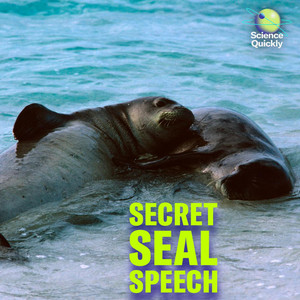
That strange noise is the call of a Hawaiian monk seal, one of only two species of monk seal in the world.
The call was recorded underwater off the coast of Hawaii as part of an e-study.
Researchers from the University of Hawaii at Manoa analyzed 4500 plus hours of acoustic data and heard more than 23000 vocalizations.
Within these sounds, the scientists identified 25 distinct calls, 20 of which have never been described before.
Although most people probably haven't ever heard the noises these monk seals make, Dana Jones, executive director for volunteer organization Hawaiian Monk Seal Preservation Ahana, knows firsthand how vocal these animals can be.
Most people who see monk seals usually see them asleep on the beach.
And unless they disturb them, they're not going to hear a whole lot of vocalization.
Dana wasn't involved in the new study, but she's an expert in rescuing and rehabbing monk seals.
In 2008, she was part of a team that took care of a pup who was rescued after being orphaned less than 48 hours after his birth.
His name is Hoa Aliona, but we always refer to him as KP2. because he was from Kauai.
Kauai pup two is what that stands for.
So he was one of my first babies.
The volunteers found out later that KP2 had developed cataracts that rendered him almost completely blind and couldn't be re-released.
Some also thought that he'd become too habituated to being around humans.
But when he was first taken in, Dana and the other trained volunteers hoped they might be able to return him to the wild when he was healthy again.
I was one of the caretakers that slept on the concrete floor next to his pool overnight many many, many times.
And we weren't allowed to talk to him because we had been told that he was going to be released.
But he didn't get the memo.
So he would talk all night long.
And he has these little bubble sounds that he would make and he would go a little oom oom, oom oom.
And if you didn't answer him, he would get much more vocal.
So when I saw this thing from UH Manoa talking about monk seals communicating, I'm going well, no kidding.
Duh.
Because he was a huge communicator.
For marine mammals such as Hawaiian monk seals, sound is very important.
They use it for various purposes, including finding food or mates navigating, communicating and engaging in social interactions.
Despite being a vital aspect of the species' lives, their vocalizations aren't well studied.
Underwater sound is the only means of long-range communication.
That's John Terhune, a professor emeritus at Canada's University of New Brunswick.
He's an expert in seals, having studied their hearing and vocalizations for more than 50 years.
Vision will work in very clear water for a few tens of meters as such.
And so really, the marine mammals in general and seals in particular, utilize sound to maintain contact for very social behaviors, individual interactions, interactions with the group.
John also wasn't involved in the study, but he's interested in the novel results.
The authors scientifically described 20 Hawaiian monk seal vocalizations for the first time and found that some of their calls were surprisingly complex.
The project was led by Kirby Parnell.
I am a PhD candidate at the University of Hawaii at Manoa, where I work in the marine mammal research program.
That's Kirby.
Her work on monk seal calls started in 2016, while she was doing her master's at the University of California, Santa Cruz.
The university had access to a monk seal in human care and thought it could be a good opportunity to record and describe the animal's vocalizations underwater, which she says had never been done before.
There's some papers back in the 90s that you know mentioned.
Oh monk, seals bark and bubble on land and produce foghorn calls underwater.
But these are, of course, anecdotal and nobody had ever really described them before.
To scientifically describe the animal's calls.
Kirby and her fellow researchers systematically recorded the features of the sounds, such as the length, volume and frequency.
That research, published in 2021, was the first examination of underwater calls from Hawaiian monk seals.
According to the study,
Once the project was finished, the natural progression from studying a seal in human care was to examine the calls of wild monk seals.
To do this, The researchers used passive acoustic recorders called sound traps.
Basically, there's these devices that record sounds underwater.
These self-contained underwater recorders, which are called hydrophones, don't necessarily look like the most snazzy equipment.
These small titanium cylinders weigh just a few kilos, so they have to be secured to a concrete block to keep them in place on the seabed.
The team lowered the devices into the water using ropes and left them recording the underwater environment, often for weeks or months at a time.
Kirby knew males sometimes patrol the beaches and swim in waters close to shore looking for mates.
So she decided to place her recorders in shallow waters, typically less than 10 metres, where you think monk seals are.
And you know they'll pick up sounds, everything from monk seal vocalizations to sounds from storms.
I've even picked up some earthquake sounds, as well as snapping shrimp and fish and other biological as well as anthropogenic noise.
One of the recorders had to be brought up after seven days because a curious monk seal chewed on the device and broke it.
But some recorded continuously for nearly three months.
After the researchers brought the devices back up and cleaned them, they were ready to find out what they'd captured.
Downloading the data alone took days on end.
I'd say that was one of the most exciting things for me throughout this PhD is getting the sound traps back and offloading the data and opening it up to look at the spectrogram and seeing, oh my gosh, we have data, we have.
There's fish and oh my gosh, there's monk seal sounds.
Oh my gosh, we did it.
And manually processing a tool was incredibly time consuming.
They're vocalizing a lot and we are logging every single one of their calls, the start and the end time to every single one of their calls.
So within a five minute period you might find you know up to 60 different vocalizations and that might take somebody 30 minutes or so to get through.
I have to give so much credit to my interns because they've done this now for four years, processing data for four years found 23000 calls.
That takes so long.
Listening back to the audio, the researchers were able to identify 25 different call types in total, 20 of which are new to science.
Six call types were elemental call types, which are just singular units of sound.
The croak is like...
The growl is like And then everybody's favorite, which you can do too, if you want to record yourself, is the whoop, which is whoop whoop whoop whoop, whoop.
Okay, I'm going to try.
Whoop, whoop, whoop.
The other 19 were combinational calls, which join the elemental calls together without any silence in between.
So you might have one call that's made up of the croak, hum, growl, and whoop.
It sounds a bit like a stomach rumbling loudly.
Then there's the growl, rumble, whoop.
And the hum, growl, rumble.
You get the picture.
Being able to combine these different sounds together in this way is unusual for these types of marine mammals.
I'm unaware of any other pinnipeds, you know seals, sea lions and walruses that are able to string these singular units of sound together with no silence between them.
John says these complex combinations are noteworthy because they could allow monk seals to more closely tie specific sounds to certain behaviours.
The effect of combination calls is that it does open an opportunity for more precise behavioural calls.
By ordering a call, say type ABC, it could be different than CBA, for example.
Although they identified about 20 combinations.
If you have five call types and three calls in a row, then that's a possibility of 125 different patterns.
And so there seems to be some specification as to which call types are being given in which order.
Now the scientists know that the seals make these noises underwater.
They want to find out why the animals are doing so.
To dive into this question.
The researchers plan to deploy more recorders for longer periods up to a year or more to see if they can spot any seasonal patterns.
For example, if they hear certain calls more during breeding season, it might suggest that those types of vocalizations are related to reproduction.
The scientists also want to gather additional context about the seals' behavior as they make these sounds.
To do this, the researchers have started using seal-mounted tracking devices with the ability to record video and audio and capture a variety of data points, including how deep underwater an animal is and how quickly it's moving.
It's basically like a seal Fitbit with a video camera and acoustic recorder.
So you kind of get like a bird's eye view of monk seal behavior underwater.
The researchers hope the video will capture what the monk seals are doing when making certain vocalizations so they can link types of calls to specific behaviors.
The team already has a theory about one of the elemental calls dubbed the whine.
So the whine, it sounds like...
During her PhD, Kirby came across social media clips of Hawaiian monk seals foraging and noticed that the animals produced this noise while looking for food.
She hypothesizes that the call might have something to do with finding a meal and is hopeful.
The seal's spy cameras will help the team confirm whether that's true.
It would be an exciting discovery because she isn't aware of many other seals doing this.
Only one other publication has mentioned a foasted seal or a true seal before producing a vocalization for foraging purposes.
And that was the elephant seal, who's closely related to monk seals.
Dana remembers a monk seal whose loud searches for food caused quite a stir in the local community.
We had a seal that came from Nihoa, which is one of the northwestern Hawaiian islands.
And she became quite a vocal girl in one of the canals on the west side.
And people would complain that she kept them awake all night because she would go into the canal to hunt for tilapia.
And she would scrounge and grunt and moan and do all kinds of stuff.
The seal was so noisy that people were worried about it, not to mention annoyed at being kept up all night by a grunting animal.
And Dana had to go to a community meeting to explain that it wasn't hurt.
Scientifically recording.
All this information is important because if we don't know about the lives of these creatures, we can't protect them.
These are foundational studies and just tiny pieces of the overall puzzle, right?
Working with an endangered species, we need to understand everything that we can.
And this is one piece of the puzzle.
Gathering this information about the different types of monk seal calls is an important first step.
Knowing that they make the calls could lead to a better understanding of what these vocalisations are for.
These insights will hopefully help clarify how human activity impacts their lives.
Scientists already know that, for other marine mammals, loud noises made by humans' activity can interrupt their communication, alter their behaviour or even temporarily or permanently damage their hearing, and it can make it more difficult for them to hear calls from far away.
The researchers want to know whether that's the case for Hawaiian monk seals as well.
In the study, the team found that the seals vocalize at a very low frequency, typically below one kilohertz.
This is important because this matches the frequency range that is produced by large ships.
And the ship noise, which can travel because it's very high source levels, often can travel for tens to hundreds of kilometers, will have the effect of masking the calls.
And so if you have a perfectly quiet time, say in the evening, with no waves and no nearby vessels, in that case the seals may be able to detect each other over ranges of up to say, two or three or four kilometers.
But if a ship noise comes along, that can be reduced very rapidly down to well under 100 meters.
If the noise of ships is masking the seals' calls so they can't hear each other properly, it might even interfere with their ability to find mates.
The monk seals also tend to live more or less separately most of the time.
And during the breeding seasons, the females with their pups will be up, often on shore, and the males tend to patrol back and forth along the beaches, essentially looking for mates.
The sound of seals serenading potential partners is something Dana has heard many times.
We could definitely tell when the males were on the move looking for a girlfriend.
They would get quite vocal when they would haul up on the beach. after a female.
The males are pretty aggressive when it comes to getting out of the water and coming up.
And the females are pretty aggressive, too, if they don't want to be bothered.
So we have some very vocal videos of basically fights.
And I couldn't tell you, I wouldn't want to translate what they're saying.
Get away from me, big boy, whatever. whatever they're saying.
If human activities were to interrupt these courtship calls, it could end up being really problematic for the species.
By the males and females calling, they are presumably able to locate each other, and then that would facilitate a successful mating.
If there is a very continuous high levels of large vessel noises then that could be interfered with and you may get slightly reduced mating opportunities.
And over a long period of time, that could have an impact on the population.
And when it comes to getting enough food, noise pollution could be a barrier if a vocalisation like the wine is in fact linked to foraging.
They may feed a little less, particularly if they're feeding on a fish species that is actually making calls.
So if they're able to identify the fish species and locate them by hearing their calls, then that would influence their ability for successful foraging.
It's also worth remembering that spending time in the water is a popular pastime for many Hawaiian residents, seal and human alike.
We have about 1.4 million people that live here in the main Hawaiian islands and about 400 seals.
So we have a huge overlap between seals and humans.
And of course, it's Hawaii.
We love going out into the water.
We love You know, snorkeling, freediving, being on boats, fishing, ecotourism.
All those water activities mean lots of vessels in the seal's territory making noise that might disturb the animals.
The researchers hope that this study could lead to improved conservation measures, because now that scientists have a better idea of what Hawaiian monk seal calls sound like, they can use audio recordings to determine exactly where the seals spend time during different parts of the year.
That gives them the knowledge to put protection measures in place, such as speed limits for boats.
In the meantime, if you're ever lucky enough to see a Hawaiian monk seal in the wild, don't approach it.
Give it plenty of space and savor the rare encounter.
If I'm in the water there's a monk seal around.
You know you're really supposed to move away from the animals.
But again, they are curious and sometimes they do follow you.
This is an endangered species.
You better enjoy that moment because that is incredible.
Like.
The fact that you're seeing one individual of this endangered species out in its habitat is just what a special experience.
So, so exciting.
That's it for today.
Tune in on Monday for a special roundup of 2025.
Science Quickly is produced by me, Kendra Peer-Lewis, along with Fonda Mwangi and Jeff DelVisio.
This episode was reported and co-hosted by Melissa Hobson and edited by Alex Yguiera.
Shaina Poses and Aaron Shattuck fact-check our show.
Our theme music was composed by Dominic Smith.
Subscribe to Scientific American for more up-to-date and in-depth science news.
For Scientific American, this is Kendra Pierre-Lewis.
Have a great weekend.
And Doug.
Here we have the Lemu Emu in its natural habitat, helping people customize their car insurance and save hundreds with Liberty Mutual.
Fascinating.
It's accompanied by his natural ally, Doug.
Uh, Lemu?
Is that guy with the binoculars watching us?
Cut the camera.
They see us.
Only pay for what you need at libertymutual.com.
Liberty, Liberty, Liberty, Liberty.
Savings vary.
Underwritten by Liberty Mutual Insurance Company and affiliates excludes Massachusetts.