Welcome to Spotlight Advanced.
I'm Colin Lowther.
And I'm Liz Waid.
Spotlight uses a special English method of broadcasting.
It is easier for people to understand, no matter where in the world they live.
This program is about a very famous artist.
But it is also about his mental illness.
It mentions suicide.
If you are thinking about suicide, please call a crisis centre in your area.
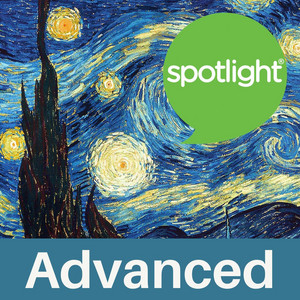
You have probably seen this painting before.
It is a painting of a night sky.
Stars shine over a small village.
The moon glows yellow.
But this is no ordinary painting.
Swirls of white and blue fill the sky.
Each star is as big as a sun.
It is clearly a real sky, but the way it is painted makes it a mystery.
There is some kind of magic in that sky.
But you do not know how it got there or why.
This painting is called The Starry Night, and it is by the artist Vincent van Gogh.
He lived during the 1800s in the Netherlands.
Some people say that van Gogh was a genius.
He influenced many artists who came after him.
But van Gogh was also unwell.
He suffered from mental illness all his life.
He died without much money at a very young age.
Few people knew about Van Gogh when he was alive.
But today he is one of the most well-known artists in the world.
Today's Spotlight is on the life and illness of Vincent Van Gogh.
Vincent van Gogh was born in 1853 in the Netherlands.
His family was wealthy.
Many of them were art dealers.
Some were Christian preachers.
When he was young, van Gogh did not impress many people.
He had mood swings.
Sometimes he was very happy and sometimes he was very sad.
These emotions were very strong.
They often annoyed family and friends.
He was not able to control these emotions, and the people who loved him did not know what to do.
As he grew up, Van Gogh did not know what to do with his life.
For a time, he was an art dealer, but he was restless and quit after a year.
Then he wanted to become a preacher, but the church did not accept him.
He often lived without much money, and he sometimes lived on money that his parents gave him.
Van Gogh did very badly when it came to practical things.
But he soon discovered that he was very good at making art.
He began to draw and paint constantly.
He believed painting was his calling.
He believed he was born to paint.
Van Gogh had a brother named Theo.
Theo was an art dealer in Paris, France.
He believed his brother was a great artist, so he funded Van Gogh's art.
Later, Theo invited Vincent to live with him in Paris.
Living in Paris was very important to Van Gogh.
That was where many other interesting artists lived.
There he was able to talk to and learn from them.
It helped him become a better artist.
There he created his own style.
But Paris was also where Van Gogh's mental illness really began.
He had always been very emotional.
Often he was very depressed.
He abused alcohol.
He especially drank an alcohol called absinthe.
But in Paris, things began to get worse.
Sometimes he would become terrified for no reason.
At other times, he would lose consciousness.
He would forget where he was.
After a few years, Van Gogh tried to leave Paris.
He found a house in a town called Arles.
He hoped leaving Paris would help him get better.
Instead, it made things worse.
Paul Gugain was a famous artist.
He lived with Van Gogh in Arles.
Van Gogh admired Gugain.
He wanted to work with Gugain.
But Gugain began to dislike Van Gogh.
They fought often.
Van Gogh told his brother Theo, Our argument is at times full of energy, like with electricity.
At times we end up with tired and empty heads.
It is like an electric battery after discharge.
Soon Gauguin told Van Gogh that he was leaving.
This changed something in Van Gogh.
Gauguin was very important to Van Gogh's plans.
He did not know how to deal with the change.
Later that day, he approached Gauguin with a razor blade.
Van Gogh did not hurt him, but Gauguin felt threatened.
He left soon after.
That night, Van Gogh began to hear voices, even though he was alone.
They tortured him.
To make them quiet, he picked up the same razor blade.
He cut his own ear off.
Then he went to a brothel.
He gave his ear to a prostitute.
Then he disappeared.
When the police finally found Van Gogh, they put him in a mental institution.
There, doctors tried to treat him.
They believed that he had epilepsy.
Epilepsy is a disease that causes fits.
During these fits, People lose control of their bodies.
But it can also give people hallucinations where they see and hear things that are not there.
Soon, Van Gogh began to recover.
He stopped drinking alcohol and he started taking medication.
He left the mental institution and he began to paint again.
During this time, Van Gogh made some of his most well-known paintings, like the painting described at the beginning of the program.
He painted similar things to other artists, like flowers and fields, but the way he painted was very different.
He did not just paint these things, he painted what he felt about them.
And he used colours in ways no one had seen before.
People began to recognise his works.
But Van Gogh's mental illness did not go away.
He had several mental breakdowns.
He went back to the institution several times.
He hallucinated and feared being poisoned.
And he was often very depressed.
He did not feel like a success.
He wrote to his brother, Theo I am so angry with myself because I cannot do what I should like to do.
At such a moment I feel that I am lying at the bottom of a deep dark well.
I feel completely helpless.
Van Gogh's mental illness was very painful for him.
One day it became too much.
He went out into a field with a gun.
He shot himself in the chest.
He did not die.
Later that day, he went to his friend's home.
He was bleeding from the chest.
Van Gogh died two days later.
He had committed suicide.
He was only thirty-seven.
After Van Gogh died, his paintings quickly became famous.
Museums began to display them.
Art collectors bought them for a lot of money.
Newspaper editors called him a genius.
He influenced other famous painters like Henri Matisse.
Today, Van Gogh is one of the most well-known painters in the world.
But for all this, we will never really know what illness Vincent van Gogh had.
Some scholars agree that he had epilepsy.
Others believed he had bipolar disorder.
People with this disease have extreme periods of depression, but they also have moments of high activity or mania.
A manic person often feels afraid of imaginary things.
He may hear people speaking that are not there.
Both of these diseases seem to describe Van Gogh.
But there are many other theories.
Many people even think he was such a good painter because of his mental illness.
They believe his strange colours were because of madness, Or they believe his swinging emotions pushed him to paint.
This may be true, but these things also pushed him to his death.
He felt so strongly and loved what he did.
He fought through many years of difficulty and changed the world of art.
But Van Gogh did not see this.
He died thinking he had failed.
Before he died, he told his brother If I could have worked without this terrible disease, what things I might have done.
Mental illness can be very serious.
If you or anyone you know feels suicidal, please find help.
There are many options for help you can call a suicide hotline in your country.
Or talk to a friend and ask them for help.
More than anything, you should know that you are not alone.
You should know that you can get better.
Have you ever seen a painting by Vincent van Gogh?
What was your experience like?
You can leave a comment on our website.
Or email us at contact at spotlightenglish dot com.
You can also find us on YouTube, Facebook, Instagram and Twitter.
The writer of this program was Dan Christman.
The producer was Michio Ozaki.
The voices you heard were from the United Kingdom and the United States.
All quotes were adapted for this program and voiced by Spotlight.
You can listen to this program and read along with the script on our website at wwwspotlightenglishcom.
This program is called The Hidden Life of Vincent van Gogh.
Visit our website to download our free official app for Android and Apple devices.
We hope you can join us again for the next Spotlight program.
Goodbye.