This is the TED Radio Hour.
Each week, groundbreaking TED Talks Our job now is to dream big.
delivered at TED conferences to bring about the future we want to see around the world.
To understand who we are.
From those talks, we bring you speakers and ideas that will surprise you.
You just don't know what you're gonna find.
Challenge you we truly have to ask ourselves, like, why is it noteworthy?
and even change you.
I literally feel like I'm a different person.
Yes. Do you feel that way?
Ideas worth spreading.
From Ted and NPR. I'm Manoosh Zamorodi.
Today on the show, Hidden Forces.
My grandma Toots was a big meat eater.
She was a classic 1950s style housewife in the US and grew up in a time when meat was everywhere.
80 or so years ago, when Sarah Lake's grandma was running her household and feeding her family, meat was served at pretty much every meal.
You would have breakfast with maybe perhaps sausage offered.
You'd have lunch where it would be deli meat sandwiches and you'd have dinner that would center over a large cut of meat.
And so my grandma was a product of her time.
Time now to tell you ladies how to keep father happy.
Sarah says it wasn't like grandma Toots was a meat -obsessed carnivore.
In mid -century America, there was a strategy to make meat the norm, starting after the Second World War.
As savory beefs do when it's armored...
It was impossible to avoid, and it was advertised heavily and pushed on consumers.
Hormel Bacon stays fresh longer when saran wraps...
This is when they first started creating national ad campaigns.
and when you see these ads that meat is essential for your amino acids, it's essential for a well -balanced diet.
That man must have food which furnishes energy, food to build muscle.
And this is where we started getting this idea that meat was normal to eat every day and multiple meals, when in reality, even 10 years prior to that, it was an exception to have meat in a meal rather than the norm." But three factors completely flipped what was for dinner.
First, the US government increased its meat subsidies.
Second, new technology led to larger farms that could raise and slaughter more animals faster.
Plus, people could refrigerate and store more meat.
Finally, the National School Lunch Program launched— —Lunches are designed to be nutritious— —with a mandate to serve protein.
—meats and other foods rich in protein.
—We saw the fastest and largest shift in our diets that has ever really happened.
Hmm, I mean, I guess that's when it became, like, the American thing to do.
You have meat and potatoes at dinner, you grill a hamburger in the summertime?
For me, I just remember when I was growing up, beef, it's what's for dinner.
The ad that, like, is branded in my brain and I guess that's the power of marketing?
Absolutely. It's a huge power of marketing.
And when we say meat is so American, it has been created to be American by the meat industry.
And there's industry associations not just for beef but for pork and for chicken.
We had, you know, pork, the other white meat, as an infamous campaign.
And all of these are industry funded.
We don't see this, right?
This is one of the many invisible forces that's shaping us, is the way in which these companies are influencing our choices.
Every day we make choices, but who and what exactly, are behind them?
When are our decisions guided by desires?
And when are they guided by design?
Well, today on the show, Hidden Forces.
From the food we eat to how we power our homes and even communicate with each other.
An exploration of some of the systems that guide our everyday behavior.
For Sarah Lake, a very personal health crisis made her consider how the American food system needed to be transformed to lead people to eat differently.
It happened back when she was a kid, and her dad had a heart attack.
He had really high cholesterol, he had several blocked arteries that required a six way bypass surgery.
And yeah, it was apparent that so much of this was linked to his eating.
And while he was having surgery, my mom had me and my brother and my sister, and she took us to get dinner at that point.
It was late at night, and the only place in the hospital lobby that was open was a McDonald's.
And we sat there eating this greasy food in the hospital.
While the floor above me, my dad was having heart surgery that I had just learned was caused by him having a really unhealthy diet.
Today, Sarah is a food system and climate expert.
She heads up the group, The Tilt Collective.
Their goal is to make it easier for people to eat less meat, and more plants, without even realizing it.
And the way in which we go about this is asking the question of how we can offer and incentivize more plant rich foods.
We recognize that many consumers are quite limited in their choices.
Limited by how much food costs, or where it's available, if they can access it.
So our approach is to say how do we get companies and governments, whether that's schools and hospitals or it's grocery stores and fast food restaurants, to offer and incentivize plant -rich foods.
What we eat is less about what we choose and more about what's offered to us.
Sarah Lake continues from the TED stage.
And companies and governments today still make it really hard for us to choose anything other than meat.
I mean it's offered everywhere and it's cheaper than other options.
What we need now is the same fundamental shift in what we eat, but in the opposite direction, back towards plants.
We need to grow more food on less land by 2050, and to do that we need to shift from land -intensive animal protein to land -efficient vegetable protein.
The story that I've been hearing from people is like, Oh yeah, you know, fake meat and burgers and hot dogs and things like that had a moment, but people just didn't want them.
Is that what happened?
It is partially what happens.
Part of the challenge is we're actually talking about a dozen different products with a dozen different technologies behind them, things like black bean burgers.
And you have others that are things like lab -grown meat, which couldn't be farther apart in terms of what they're made of and what the experience is eating them.
The other part is just simply figuring out how to market these to consumers.
One of my favorite opportunities is around what we would call, is for plant rich meats or blended meats, where you have a burger, and instead of it being 100 % beef, you actually make it 50 % beef and 50 % mushrooms or beans.
And these products are available today, but we don't yet know how to present this.
If you advertise a blended burger or a plant rich burger, consumers don't know what that is.
And quite frankly, a blended burger sounds disgusting.
That's not really a product that we see as tasty and desirable.
So a lot of this is a marketing challenge, some of it's an investment challenge, and part of it is just the time it takes to get consumers familiar with these products and start building up the demand where people can have healthier, more plant rich options without having to give up meat because ultimately this isn't about no meat, this is about less meat.
What we need is for companies and governments to offer and incentivize plant -rich diets the same way they did for meat decades ago.
I need to walk into a McDonald's and see a menu full of plant -rich options and have them be just as cheap or cheaper than the Big Mac.
And we need our schools and hospitals to offer plant -based foods as the default, where you can get meat, but you have to ask for it as the exception.
And we need just as much money to flow into the plant -based industry as, currently, makes meat wildly and artificially cheap.
We know that this can work because it has before.
Take Lidl. It's one of the largest supermarkets in Europe.
They decided to put their plant -based meat next to the conventional meat in the meat section and make it the same price.
So when you went to grab a package of ground beef, you had a healthier, sustainable, plant -based option right next to it that costs the same.
Within six months of making this change, the sale of their plant -based products went up by 30 percent and shows no sign of flagging.
Companies and governments have been telling us for decades what to eat.
They have the power to help us choose differently.
There's always something a little disturbing when you realize you've been making choices, not because you were conscious of them, but because the system was set up to push you a certain way.
so I guess I'm wondering the next time someone listening goes to the grocery store, what do you want them to be aware of?
It's always hard to realize that we might not be making choices out of free will, and it's not just about meat or just about a grocery store.
This happens all the time where certain products trend and we learn about new things.
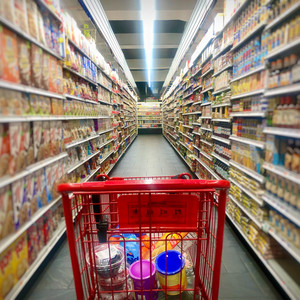
So when you walk in a grocery store and you know want to be aware of what's shaping your forces, one of the things is understanding how grocery stores are designed.
So there is a strategy that is if you put products in well -lit displays with good signage, and at eye level, it's easier to want those products.
And that is how a meat display is set up.
It takes up a large portion of the store, it's very well lit, you have signs for each type of product.
You also have a butcher counter, right?
We have a dedicated space to getting your customized choice of meat.
If you think about that compared to, say, beans.
Beans are often bottom shelf in a small, ugly metal can.
And so it makes certain products quite hard to find.
And we're seeing the same challenge with many plant -based options.
That there's no standard place to put plant -based options.
Sometimes they're in the freezer section, sometimes they're in a vegan section.
Sometimes they're next to the meat, sometimes they're not next to meat.
And so this is one of the main ways in which we can help people choose these products is by figuring out where exactly they should be in a store and having a standard display.
And ultimately, I think this is the heart of the issue.
We should have consumer freedom of choice.
But what we have now is actually the opposite.
Consumers, when you poll them and ask them what they want, they want healthy and sustainable foods.
They will largely say they want to be buying more plant -based products, but the challenge is they're not offered and they're not affordable, and many of the products aren't quite there in terms of taste parity.
But consumers want this.
I mean, on the plus side, when did we start saying plant -based?
I just remember vegan, and vegan always had this connotation of, you know, you were missing out on something.
There was a scarcity to it.
Whereas, I don't know, when did this happen?
Plant -based sounds kind of bountiful in its own way, much more positive.
Yeah, it's been an intentional decision to use the word plant -based, And I think to move away from this vegan mentality, I think it's all or nothing, often we hear, well, it's so difficult to make this change.
It's so difficult to go from a food system that relies on meat to one that relies on plants.
And what I always say back is, it's going to happen anyways.
Our food system is going to be wildly disrupted, whether that's from the impacts of climate change or zoonotic disease, or even tariffs and trade wars, And we can instead proactively plan, and we can start transitioning towards a more plant -rich food system that is better for farmers and ranchers, better for consumers and all around better for the planet." Sara Lake is a global food system and climate expert.
She's also CEO of the Tilt collective, a philanthropy working to shift consumer eating habits.
You can see her talk at TED .com.
Also, we reached out to the Beef, Poultry, and Pork associations for their thoughts on changing consumer eating habits and meat consumption.
The Beef and Poultry associations didn't get back to us, but we did hear from the National Pork Board, which represents over 60 ,000 pig farmers.
Their spokesperson told NPR that the USDA oversees their promotional materials, which are science backed and explain the benefits of pork as part of a balanced diet.
I'm Manush Zamorodi and you're listening to the TED Radio Hour from NPR.
We'll be right back.
Star Wars series yet.
Season 2 of the Emmy -nominated series is now streaming on Disney+.
Follow Cassian Andor as he embarks on a path from a rebel to a hero, starring Diego Luna and from creator Tony Gilroy, writer of Michael Clayton and The Bourne Identity.
Season 2 of Andor is now streaming only on Disney+.
It's the Ted Radio Hour from NPR.
I'm Minouche Zomorodi.
On the show today, the hidden forces behind our everyday habits.
So think about your typical morning routine.
Maybe you start your day with a nice hot shower.
Then you head to the kitchen, where you flip on the lights, grind up some coffee beans, turn on the stove to make breakfast. Oh, and it's a little hot out today, so you turn on the fan or crank up the AC while you listen to the day's headlines.
Live from NPR News in Washington, I corporate — Whatever your routine, every single morning, pretty much everything we do relies on a vast network of hidden infrastructure.
So things like water, it could be things like electricity, sewage, gas distribution, telecommunications, all kind of collectively in the space of what we think about as infrastructural systems. and we take these systems for granted and we just work on top of them.
This is Deb Chautara.
She is a professor of engineering at Olin College, and the author of the book, How Infrastructure Works, Inside the Systems that Shape Our World.
There's kind of a truism that our infrastructure systems are invisible until they break, and when they break they're sort of at the forefront of our attention, right.
If you don't have clean water coming out of your tap or if if you have an electricity outage, or even if the internet goes down, right, which is not a survival need, right, it's not a life -threatening thing in most cases, right, and it still really upends your day when that happens because we have learned to rely on these systems as our infrastructure.
Buckled roadways melted electrical cables, public transit shutdowns.
But these systems that we rely on are being pushed to their breaking point.
The extreme heat in the Pacific Northwest this past weekend was brutal for the region's infrastructure.
In Texas, millions of people are enduring their third day without electricity in freezing cold temperatures.
Many families are being advised to boil what little tap water they have. Others just have no water at all.
As the climate changes and severe weather events become more common, Deb says our infrastructure is struggling to keep up.
So one of the things which we can't kind of lose sight of is that we want these systems to remain functioning and resilient because they underpin what we can do with our days and how we do it, rather than spending our days thinking about, well, where am I going to get clean water from?
Or how am I going to function without electricity?
And I think for many of us lay people that we've taken for granted that, we turn on the tap and clean water comes out or that we always have electricity.
This is quite a wake up call.
So how much has a realization set in that the way we've set up our infrastructure has to change?
Well, I would say there's two pieces to that story.
So the first one is that almost all of the systems that I describe require energy to work.
And most of the energy that we use comes from fossil fuels.
So that's the first thing, that if they're powered by energy, and that energy is coming from fossil fuels, it produces greenhouse gas emissions, mostly carbon dioxide.
The second thing, though, is that we now know that that landscape is changing, right?
That climate change is being felt as climate impacts or climate disruptions.
That's really meaning that things that we kind of took for granted about how the landscape works, what weather would be like, what a hundred year storms are, are changing.
And what that means is that the infrastructural systems, the networks that we build, thinking that they were in a stable landscape, well, that landscape may not be stable.
In fact, most likely is not stable.
So they're just not going to work very well anymore.
And whether we like it or not, we need to rethink our infrastructural networks.
But these are physical systems that are embedded in the landscape.
And that means that we need to think about these sort of landscapes as a whole.
Here's Deb Chatra on the TED stage.
Our landscapes, of course, have been stable and we know that that's not the case anymore, right?
Climate change, that's what climate change is.
It's making our landscapes less stable.
And that means, you know, this is longer heat waves, this is stronger hurricanes, this is fires, this is flooding — everything that we think about as extreme weather events.
You know this idea of a natural disaster, right?
The thing that makes it a disaster is precisely that it's not natural.
It's that it affects humans and human communities.
And because our landscapes are becoming less stable, sooner or later, the who's affected will be all of us.
But we can flip this around, because as we decarbonize these systems, as we transform them, we have the opportunity to make them resilient, to make them responsive, to make them more equitable.
I mean, our infra -social systems, they are the most powerful tool that we have for how we can respond to climate change.
And we know that we can do this, right?
Because after decades of policy commitments, we've done the research, we have the renewable energy technology to transform this.
We know that there's at least a pathway, and once we know that a pathway exists, we know that many pathways exist. But we can only choose to walk those pathways together.
This is no longer an engineering problem to be solved.
So, in light of changing climate, unstable weather, unstable landscapes, we need to decarbonize our infrastructure systems. And you say that this actually presents a lot of opportunity.
We now know how to use renewable energy at scale in a way we didn't 20 or 30 or so years ago.
And it's hard to pin a date on it because there's two main things.
One is the Danish wind turbine, the standard wind turbine that I'm sure you and almost everyone who's listening has seen, and the other is the ability to produce solar panels relatively inexpensively and at scale.
And what those two changes mean is that we are now capable of using renewable energy at the same kind of scale that we use fossil fuels at. So 20 years ago, I would be saying at some point in the future, we'll be able to harness all of the abundant renewable energy that is arriving at the planet, and we'll be able to rebuild our infrastructure systems to use that energy instead, someday.
And now I get to say, that day is here.
And in some places, the work is being done.
In the UK, there's a massive effort underway to shift the electric grid to have 95 % renewable energy by the end of this decade.
Countries like Costa Rica, Brazil, and Norway are already there, all relying heavily on hydropower for their electricity.
And in the U .S., tech companies are leading the charge for transitioning to renewables to meet the future demands of the artificial intelligence industry.
The fundamental idea behind a lot of infrastructural systems is that you invest in these systems because you're investing in the well -being of the people who are going to use them.
We understand that building out infrastructural systems is widely understood to be something that pays for itself even in terms of return on investment.
A lot of hard -headed economists and financial analysts have shown that the cost of actually building out the infrastructure that mitigates the impacts of climate change is much, much cheaper than dealing with the effects of climate change.
I was actually recently just outside of LA where there are these massive wind turbines that you've mentioned.
And, you know, I couldn't help but think about electricity the whole time I was there because they were so in your face, they're huge, you can't avoid them.
And I asked someone, I was like, what do you think of them?
And they said, oh, you know, you get used to it.
they become part of the landscape.
Did you have a look at certain parts of California where they have heavy windmills?
But the president has said he is not a fan, like on the Joe Rogan podcast in 2024.
It is the ugliest thing.
It looks like a graveyard almost, a graveyard of windmills.
It's pollution. It's so bad.
And the federal government will not be supporting these projects.
So, where will the revamp of our infrastructure stand without federal funding?
So, I think that places that have the resources and have the kind of political will to start addressing this kind of transformative change and mitigating climate impacts, they will keep doing it whether or not they have federal resources to do it.
So, places that have the resources can move farther ahead and make more resilient sustainable communities, places that don't are not gonna be able to do that.
There'll be a bigger division between those two.
And that's not just in the United States.
That's gonna be true globally.
And a lot of that work will continue regardless of what is happening at any higher levels in the hierarchy.
And I teach teenage, like I teach undergraduate engineering students.
And so I really want them to understand that their lives are not about fixing the problems that their grownups left them.
No, your job is to build out this world.
right? And you will on the way there, you can address all the problems that that you've been left. I mean, when you put it that way, wow, what a time to be an engineering student.
This is like there is a chapter here where you can really make a huge change where a generation from now, if people just think what you've done is normal, you will have succeeded right that like almost like when the railroad tracks were laid in the United States?
I think it's very much like that because we remember, I think a few of us remember directly, but certainly we understand the role of the New Deal as making that big investment into our lives collectively by building out infrastructure.
And I think it's the moment where we have the opportunity to do that again.
And this time, we get to go much farther and to do it in a way that is much more responsive to our needs.
And it'll be, you know, there might not be another Hoover Dam to point at, right?
But I think the evidence of that work could and will be everywhere.
And it'll be just a part of the fabric of our lives.
I think that will be true after this transformation.
And some of it might be big fields, but a lot of it might be just embedded, you know, into our daily lives or into our communities.
So in the 20th century we built out these kind of massive monolithic systems and I have to say like I am a fan of our charismatic megastructures so in the US that's the Golden Gate Bridge to Hoover Dam, right?
These were built as monuments and they were built to endure but in the 21st century our infrastructural systems will need to endure not like monuments but like forests so if you think about a ecosystem, it's powered by the Sun, it's rooted in the earth, there's no waste, everything is basically used to grow new things, it endures, but it actually evolves and changes with time.
And of course it provides a place where all who live there can thrive.
Our infrastructure systems are how we take care of each other at scale, so that we can take care of each other as individuals.
They We underpin our agency and they really foster and allow us to develop our social relationships with each other.
All of these are about what it means to be human, right, and that means that a commitment to a shared infrastructural future is a commitment to our shared humanity.
So this is the world that we can create together.
Thank you. That's engineering professor Deb Chatra.
She's the author of the book, How Infrastructure Works, Inside the Systems That Shape our World.
You can see her full talk at TED .com.
On the show today, the hidden forces that shape our habits and choices every day, including the way we behave around other people, social norms. — Culture is this really interesting puzzle, because it's omnipresent, it's all around us 24 -7, but it's invisible.
We don't really think about it.
We take it for granted.
— This is Michelle Gelfand.
She is a cross -cultural psychologist. — And I try to do research to uncover the hidden cultural codes that guide our behavior, really what we call social norms—these unwritten rules for what's expected of us in everyday settings and you know we're constantly following rules we just don't really realize it.
Over the past three decades Michelle has published over a hundred and fifty papers in academic journals including one in particular that became well a hit it was published in the journal science in 2011.
The study examined cultural norms in over thirty countries around the world and it became the basis for Michelle's book, Rule Makers, Rule Breakers How Tight and Loose Cultures Wire Our World.
In some contexts, the rules are very strict.
They're what we call tight cultures.
They have a lot of rules and a lot of reliable punishments when people violate them.
On the flip side, we have contexts where there are looser norms, where there's a wider range of behavior that's perceived as permissible.
What we found was that just like we can classify people in terms of their personalities, we can also classify groups in terms of the strength of their norms. Here's Michelle Gelfand on the TED stage.
So, tight, loose is a continuum.
Some groups like Japan and Singapore, Austria and Germany veer tight.
Other groups like New Zealand or Brazil, Greece or the Netherlands veer loose.
And what we found was that tight and loose confers really important trade -offs for groups that we don't recognize.
So tight groups have the corner on order.
They have a lot more law enforcement and also security.
And they have much less crime.
Tight cultures with their strong rules have people also regulating their behavior more.
They have more self -control.
Tight cultures have less alcoholism.
They have less debt.
And they're less fat.
Loose cultures tend to be more disorganized.
They have more crime.
They have less synchrony.
And they have a host of self -regulation failures.
but loose cultures corner the market on openness.
They are far more open to many different types of people, people from different religions, from races, immigrants, people with disabilities, many stigmatized people.
In one experiment I did, I asked my research assistants from all over the world to wear fake facial warts, tattoos, and nose rings.
And they were asking for help on city streets or in stores, and there was a very clear pattern.
People in Loose cultures were much more likely to get helped when they were wearing these stigmas, as compared to tight cultures.
Loose cultures are also open to more ideas, they're much more creative, and they're much more open to change.
And tight cultures struggle with openness.
So you might be asking by now, what causes these differences?
Tight and loose cultures don't share any obvious characteristics, geography or language or religion or tradition.
But there is a hidden rationale, and it has to do with threat.
When cultures have a lot of chronic threat in their histories, you can think about threat from Mother Nature, like constant natural disasters or famine, or they have a lot of human -made threat.
Think about how many times your nation has been potentially invaded over the last several hundred years.
When you have a lot of threat, you need rules to coordinate, to survive.
And the idea is that loose cultures might have had less threat and that can afford more permissive norms because if there's less coordination needs then you don't need to have tighter norms. You know I always get worried about being like oh you know Germany it's they're rigid there you know nobody crosses the street even if there's no cars coming if it's not green and my question to you is like is this a case of science proving the stereotypes in some way?
You know Berlin actually quite a free wheeling city.
Except I lived there and it was true.
No one crosses the street if there's no traffic coming.
So I guess I'm curious, like, how do you sort of parse what is a stereotype that people have versus what the science tells you?
Yeah, I think it's a great question.
And you know, every culture has tight and loose elements.
You can, if we zoom into different domains, we could see Yeah, you know, in Germany, there's strict rules on time and on jaywalking, but you know, But then you see people having more nudity at beaches, which you wouldn't see in the U .S. The U .S. has, strangely, like a domain of sexuality is a little tighter here even though we have a lot of looseness when it comes to jaywalking, I can attest to that, you know, like my home New York state, New York City, it's really dangerous.
And so the point here is that we can place countries on a continuum, but we need to remember that it's dynamic, it can change, and that we can zoom in and we can find domains, and every culture that are tight and loose and try to understand why they are the way they are.
In a minute, Michelle Gelfand explains how the tight loose framework can help explain differences on a personal level, too, within our families, friendships and relationships.
On the show today, the hidden forces that shape our lives.
I'm Manoush Zamorodi and you're listening to the TED Radio Hour from NPR.
stay with us. It's the Ted Radio Hour from NPR.
I'm Manoosh Zamorodi.
Today on the show, the hidden forces that shape our lives.
We were just talking to cross -cultural psychologist Michelle Gelfand.
Michelle says that some cultures veer tight, meaning they have stricter rules and norms, while others veer loose, and she believes this framework can help us understand our differences.
Rather than red or blue, we can also differentiate our United States, 50 states in terms of a continuum of tight and loose.
In our research, we can see the South and some parts of the Midwest veer tight, and the coasts tend to veer loose.
Tight states, just like tight nations, tend to have more threat.
There's a remarkable similarity between scores on tightness in our data and mother nature's fury in terms of natural disasters.
Once you grasp the tightness lens you can also use it to analyze other differences that have eluded us.
Let's take social class.
In our research, the working class is far tighter than the upper class and it makes sense.
They experience a lot of threat.
It's the upper class that has more of a safety net, they have less threat so they can afford to be more rule breakers.
And is that partly because, like, if you don't have to worry about having health care and, you know, all those other things, like a whole a huge load is lifted off your shoulders and you can think about the world differently.
You can move more freely.
Bingo. One of our studies that we did that was the youngest people in our samples, they were three year olds.
Kids between three and five years old.
We brought them into the lab And we can't exactly ask them how tight or loose is your household.
But we have these kids playing a game, a new game with a puppet, Max the puppet.
In the middle of the experiment, Max the puppet does something a little strange.
She starts violating the rules of the game.
And we simply actually look at what do the kids do, do they laugh at Max, do they tell them to stop.
But we wanted to see, does this vary by class?
Like are there working class kids more likely to tell Max to stop as compared to the upper class kids?
And in fact, we have some evidence that that seems to be the case, that this starts early.
So this is just another way to think about Tight -Loose, this invisible pattern in a different level of analysis.
You're reminding me, I had a conversation with my brother the other day about my niece, who is like maybe not the like most athletic kid on the playground.
And he was saying she really wants kids to follow the rules because then things are predictable, right?
Like she, she's just, she's not hanging around on the monkey bars like some of those other kids who are crazy.
So I guess I wonder about that too, you know in every situation, depending on your limitations you veer towards tightness or looseness.
Yeah, that's right.
And actually very interesting, I mean parents, teachers, prime socializers of cultures, so you can even analyze school systems for how tight or loose they are, how to design schools that have a healthy amount of accountability but also empowerment from looseness.
So parents are socializing what they think is the right balance in their households with their kids.
Then schools are reinforcing this.
So we all have our own story.
I think what's exciting is to figure out where do our own mindsets come from, whether it's from our socialization, whether it's from our occupation or gender or culture, how has it changed over time?
And then we can think about, is it optimal?
Do we have their optimal balance?
Yeah. I mean, I would love to know, like how do you teach openness to somebody who veers more closed?
Like do you, do you do it with rules?
Like, you must be open and not punish anyone.
Well, you know, we might call that legislative looseness, right?
There's places and times where you're allowed to be loose, this is a very personal question.
Because I have a quiz that assesses our tight and loose mindset and asks people to think about themselves in general, like in your life.
Do you like rules? Do you try to manage your impulses?
Do you like structure?
Do you like predictability?
On the flip side, do you take risks?
Are you someone that's tolerant of a lot of uncertainty?
Are you someone who is a little more impulsive?
You know, these are kind of things that we ask people to think about, and by the way, you can think about it in general or you can ask yourself at work.
You can ask those questions in your work life is this, you know, how do you think about rules and impulse control and structure?
In your social life, do you have a different mindset?
So you can think about this in various different contexts too.
The quiz itself asks people to think about it generally and then you get a score, which is combining these variables.
And you can think about someone who gets a score of very loose, moderately loose, moderately tight, or very tight.
I took it. You took it?
What was your score?
I'm moderately loose.
You were? OK. I said that to my producer, and she was like, of course you are.
You always want to break the rules.
Wow. That's really interesting.
It helps us to, A, understand ourselves, and also be able to communicate with people around us with greater empathy.
So I score moderately loose on my own quiz.
My husband's a lawyer.
That dude is very tight, right?
He actually, we've been married for 30 years and we've made it work, but like he gets deeply disturbed by how I load the dishwasher.
And so, you know, he is in a context and occupation where there's a lot of accountability.
He has to have his time accounted for every six minutes.
Well, you're making me think of my kids where I know one I think would score quite loose, the other would score quite tight.
And I shift, I code switch between the two of them, encouraging one of them to go a little looser and the other to go tighter, just to balance them out a little.
Yeah, that's totally right.
And in fact, that's kind of an ambidexterity.
And my daughters will say, look, in our household, the norms that are tight have to do with basically respect, like we need to work hard, we need to take care of our health.
But the looser domains that they also know are like, you know, their rooms, how messy they are.
We just close the door, you know, their curfew.
They've always had very lax curfew because we say, look, you need to be accountable to yourself.
So we're not going to legislate that.
As we zoom into any level, like whether it's organizations or households or relationships, we can start being intentional about where we want tight and loose norms and we can negotiate it.
And that's how we help people to kind of pivot and have more in the dexterity.
This is what I call the Goldilocks principle of tightness and looseness, that we need a balance of the strength of norms in our everyday lives for the maximal happiness.
So I wanna leave you with a few different ideas of how you can use the tight -loose code in your everyday life.
The first is that we should understand our own mindsets.
We each have a certain default on the tight -loose spectrum based on our own personal experiences.
The second is that we need to cultivate empathy for others' mindsets.
Often people that we have a lot of conflict with are people that we have the biggest differences in our tight -lose mindsets, and understanding where they come from can be great to understand and empathize and build better relationships.
And finally we can harness the power of social norms to better our world.
Culture is in destiny.
We can tighten up norms when they're getting too loose, or loosen up norms when they're getting too tight.
Luckily for us, humans developed and invented social norms and we can use them to better our planet.
Thank you. That was Michelle Gelfand, she's a Professor of Organizational Behavior at the Stanford Graduate School of Business.
You can see her full talk at TED .com.
So we've talked about all kinds of different hidden forces in our lives, and that needs to include how we get around.
In 2023, the U .S. Census estimated that around 70 % of U .S. workers commuted by car in places like Phoenix, Arizona.
You know, 25 miles each way.
Hour and a half in traffic.
Ignacio Delgadillo used to spend a lot of time in his car Because Phoenix is one of the least walkable cities in the United States.
Its sprawling suburbs and wide streets are great for cars, not so much for pedestrians.
— We really didn't talk to our neighbors.
We don't really know— we just say hi and bye as we're driving by, right?
And then we're just all going straight into our garage.
— But about a year ago, Ignacio and his family moved to a community designed to be car -free— cul -de -sac in Tempe, Arizona.
Here the streets are built for foot traffic.
Buildings are close together.
Trees line narrow walkways.
A plaza with shops and restaurants serves as a town square.
You naturally see people all day doing what they're doing, right?
They're going to work, they're going to school, or they're just out enjoying their walks.
However much of a driving or car dependent city you may happen to be in, there's a certain number of people who when presented with the opportunity will live car -free.
And that that market is completely unmet.
This is urban planner Jeff Speck.
We talked to Jeff last year about his lifelong goal to make American cities more walkable.
He says that cul -de -sac Tempe is a great example of how neighborhoods can be transformed.
And that the benefits go well beyond just meeting your neighbors.
Traffic safety, community identity, tourism, stormwater management, transit effectiveness, urban competitiveness.
It reduces obesity, other chronic diseases, healthcare costs, crime, traffic congestion, maintenance costs, fossil fuel dependence.
But he also says making cities more walkable takes very careful planning, with seemingly invisible design choices that prioritize the needs of people over the needs of cars.
What that means at a deeper level is to create an environment in which people will make the choice to walk, or to bike, or to use some other form of micromobility, rather than driving.
And to do that, according to my general theory of walkability, the walk has to satisfy four basic criteria.
It needs to be useful, it needs to be safe, it needs to be comfortable, and it needs to be interesting.
And each one of those criteria then places upon us a series of mandates that surround urban design and city planning, my profession, to to create that environment for the potential pedestrian or cyclist. Okay, so to be walkable, a city needs to do those four things.
They need these attributes for every walk a person takes.
Let's start with the first. The walk needs to be useful.
What do you mean by that?
So, useful has to do with a proper mix of uses.
So places to live, work, shop, recreate, all within walking distance.
It typically means more housing in your downtown, which would balance the uses in your downtown and have it be active around the clock.
When a neighborhood, which is principally a business district, becomes a truly mixed -use district with the proper balance of jobs and housing, it comes to life.
Okay, so we've made our city, we've made our walk useful.
Now we need to make walking safe.
How? So the typical American street is designed for speeds well over the posted limit.
And that's the exact opposite of what they do in the Netherlands, for example, where you make the streets as tight as they need to be to cause the drivers to go the speed that is safe for the community.
The resistance that you find to accomplishing this typically lies in public works departments and engineering departments, which are led by engineers who still embrace the older concept of traffic safety, which in America grew out of highway safety.
So if you think about yourself when you're driving on a highway where your speed is a anything you can do to reduce opportunities for conflict, to increase elbow room, is going to make that street safer.
So, wider lanes, one -way traffic, no parallel parking, no trees, that's the clear zone, big swooping curves.
All those things make a highway safer, but it's precisely the opposite that makes a downtown safe.
You wanna have narrow lanes, you wanna have parallel parking, you want to have two -way traffic, like you want to have lots of intersections and lots of other things going on." And so the biggest impediment, often in cities, to making them safe and comfortable to walk around is a traffic engineer who is trained on highway design and has brought it into city design.
Our walk is useful.
Our walk is safe. How do we make it, number three, comfortable for walking?
—Comfortable is the most design -y aspect of the discussion because —and it's a little counterintuitive—we like to be in places that have spatial definition.
If you can picture lower Manhattan or, you know, the cranky parts of our oldest cities, those have the smallest blocks of all.
And that gets us into the comfortable walk and that delightful feeling of being embraced by buildings on both sides.
Yeah. So that idea of spatial definition is central to making walkable places and we, you know, our favorite streets tend to be quite narrow, and then the buildings aren't that tall, but they're considerably taller than the streets are wide.
And that brings us to the fourth and final principle of making a city walkable, which is that the walk needs to be interesting.
Yeah, so the final category of interesting is basically not having blank walls, not having parking structures, having lots of eyes on the street in the form of doors and windows and signs of human activity.
You know, we humans are among the social primates.
Nothing interests us more than other humans.
And that's what causes us to walk.
So when you arrive at a city to work with them, do you find that you need to first sort of change their cultural outlook on how to provide the best thing for their citizens?
Is there a mind shift that you have to get them to do before you actually start talking about the details?
Well, I think what's different now, as opposed to 10 years ago, or even certainly 30 years ago when I started doing this work, is that there's now an openness within public works departments and engineering departments to this information.
And the thing that has evolved the fastest is bicycle infrastructure.
And when we're building new projects now, we're mandated by the city to not have the bike lane in the street, the new standard is to put it up on the sidewalk edge.
I mean, you're speaking to, number two, a safe walk or a safe ride, in this case, on a bicycle.
But we've been hearing so many headlines about the rise in pedestrian and I believe biker deaths.
So if more cities are becoming more welcoming to walking and riding bikes, why is this happening?
So more cities are getting more serious about improving pedestrian safety, but that's really just starting to kick in at volume now, and it used to be that the poor people lived in the inner city and the wealthy people were suburbanizing.
Now many more of America's poor are living further and further from the city center in order to afford a mortgage.
That's where a lot of people are stuck now and sadly, they're stuck there without cars, many of them.
So you have a kind of the double whammy of people living without cars in an environment that was designed without ever imagining people living there using it without cars.
And I should say, when I joined this movement in the 80s, I really thought we could stop sprawl.
I've pretty much given up on that goal after 40 years.
But I've replaced it with a new goal, which is essentially to offer the walkable quality of life, the walking lifestyle to as many more Americans as possible.
And that's why I'm going where the people are and doing much more downtown work.
And most of my work is for cities who call me in and say, you know, We realize that we could be so much better if we made our downtown more walkable, and what are the steps to getting there?
That was urban planner Jeff Speck.
He's the author of Walkable City, How Downtown Can Save America One Step at a Time.
You can watch his TED Talks at TED .com and hear more from Jeff in our episode, A More Walkable World.
Thank you so much for listening to our show.
This episode was produced by Harsha Nahada, Rachel Faulkner White, Katie Montalion, and Kai McNamee.
It was edited by Sahnaz Meschampur, Katie Montalion, and me.
Our production staff at NPR also includes James Delahusi, Fiona Guiren, and Matthew Cloutier.
Our executive producer is Irene Noguchi.
Our audio engineers were Gillie Moon, Becky Brown, Jimmy Keighley, and...
Simon Jensen. Our theme music was written by Ramtin Arablui.
Our partners at TED are Chris Anderson, Roxanne Hylash, Alejandro Salazar, and Daniella Ballarezzo.
I'm Manoush Zamorodi.
And you've been listening to the TED Radio Hour from NPR.
This message comes from NPR sponsor TED Talks Daily, a podcast from TED.
TED Talks Daily brings you a new talk every day.
Learn about the ideas shaping humanity—from connecting with your inner monologue to finding out if aliens exist. Just listen to Ted Talks daily.