Ted Audio Collective You're listening to Ted Talks Daily, where we bring you new ideas to spark your curiosity every day.
I'm your host, Elise Hugh.
I remember growing up and seeing commercials with the tagline, Beef!
It's What's For Dinner.
I even saw one for pork on the side of a truck one time that went, I scream, you scream, we all scream for pork.
That's right. These are advertising campaigns that successfully shifted the way Americans eat.
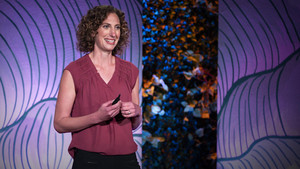
And in her 2024 talk, Dietary Guide Sarah Lake reminds us that what we put on our plates is thanks to government and company campaigns and incentives.
And those incentives can also shift things in the other direction to more plant -based diets.
Coming up after the break.
And now our Ted Talk of the Day.
When I was a kid, we'd go visit my grandparents.
And my grandma, Toots, was a classic 1950s American housewife.
She, though, was a terrible cook.
She cooked everything in the microwave, even meat.
And she had meat at every meal, even in her cottage cheese.
One time, my brother brought his girlfriend to visit, and she was a vegetarian.
And so my brother reminded Grandma Toots of this.
And she said, oh, okay, what does she want for dinner, then?
Chicken or fish? And Grandma Toots could not imagine that you would have a meal that didn't revolve around meat.
And I can see why. I mean, she grew up in a time where she was inundated by government promotions.
That meat was key to supporting your country.
And company ads that talked about it being essential for being strong and manly.
And it was cheap, too.
It was subsidized by the government and partially explained as a way of bulking up malnourished men so that they could fight in World War II.
But what my grandma witnessed in the first half of her life was unprecedented.
She saw the fastest and widest shift in diets that had ever occurred.
Within just a few decades, she saw the norm go from eating meat as a rare treat to having it three times a day, to having meat named after our meals.
So we had breakfast meats, we had lunch meats, and, well, beef is what's for dinner.
And that didn't happen because people just suddenly realized they really liked the taste of meat.
What we eat is less about what we choose and more about what's offered to us.
And companies and governments today still make it really hard for us to choose anything other than meat.
I mean, it's offered everywhere.
It's often the only choice.
And it's cheaper than other options.
So much so, if you took away all government support and subsidies for meat, a pound of ground beef would cost $30.
So now we eat more meat than ever before, and it's continuing to grow.
And we got to this point thanks to the extensive and far -reaching efforts of governments and companies to push our diets towards meat.
What we need now is the same fundamental shift in what we eat, but in the opposite direction, back towards plants.
I'm here today as a food and climate expert because diet shifts are critical for the planet.
The only way that we can reach climate targets and feed 10 billion people is by reducing the production and consumption of industrial meat.
We need other solutions.
We need regenerative agriculture, and we need to address food loss and waste, but those alone are insufficient to reach climate goals.
And diet shifts are also essential for food security and health.
We need to grow more food on less land by 2050.
And to do that, we need to shift from land -intensive animal protein to land -efficient vegetable protein.
And that also helps with our health.
Grammatants continue to put meat in pretty much every meal, and by the time I was about 11, that diet caught up with my dad, her son, and he had a massive heart attack.
I don't remember a lot about it, but I remember sitting in this hospital waiting for him to get out of six -way bypass surgery, and my mom took me and my siblings to get dinner in the hospital while we waited.
And she took us to the only restaurant that was available, a McDonald's.
So we sat there eating greasy cheeseburgers while my dad was on the floor above having open -heart surgery due to years of eating unhealthy food.
And we ate there because it was really all that was available.
And now, back to the episode.
After my dad's surgery, our household went largely plant -based, thanks to my mom, and my dad, he's still alive.
So I know firsthand how plant -rich diets can be lifesaving.
And now we know that overconsumption of meat is a leading cause of preventable disease, including heart disease but also obesity and diabetes.
We also know that meat is a leading cause of climate change.
Meat alone can account for as much as 20 percent of global emissions.
We also know that we're misusing nearly half of our farmland to grow feed for animals rather than food for humans.
But no one really wants to talk about this proverbial cow in the room, the fundamental need to shift our food system away from industrial meat.
And maybe it's because we know people really care about what they eat.
Or maybe it's because we know we're not going to get there by pleading with people to eat differently, especially when most consumers have to go out of their way and pay more for alternative products.
What we need is for companies and governments to offer and incentivize plant -rich diets the same way they did for meat decades ago.
I need to walk into a McDonald's and see a menu full of plant -rich options and have them be just as cheap or cheaper than the Big Mac.
And we need our schools and hospitals to offer plant -based foods as the default, where you can get meat, but you have to ask for it is the exception.
And we need just as much money to flow into the plant -based industry as currently makes meat wildly and artificially cheap, whether that's making better black bean burgers or novel alternative proteins.
We know that this can work because it has before.
And we know it's working again in the places where we've dared to try it.
Just last month, I was in Germany, and I walked into a Burger King, and bam, it was bombarded with ads for their plant -based Whopper.
It was all over the store, and the plant -based Whopper was center of the menu, and it was the same price as the regular Whopper.
Today, in Burger King's, in Germany, one in five of all Whoppers sold are plant -based.
One in five in the country that invented the Frankfurter.
Or take Lidl. It's one of the largest supermarkets in Europe.
They decided to put their plant -based meat next to the conventional meat in the meat section and make it the same price.
So when you went to grab a package of ground beef, you had a healthier, sustainable plant -based option right next to it that cost the same.
Within six months of making this change, the sale of their plant -based products went up by 30 percent and shows no sign of flagging.
Even in New York City public schools, the largest school district in the country, they now have plant -based lunches for students, so over a million children are eating plant -based lunches at least once a week.
Now, scaling from here, it's not easy, politically or personally.
But we're not talking about never eating meat.
We're talking about less meat and more plants.
We're talking about overconsumption of meat.
The average American right now eats six times the recommended amount of red meat.
Six times. If we were to just half that, it would have massive benefits for the climate, for food security, and for health.
And companies and governments have been telling us for decades what to eat.
They have the power to help us choose differently.
And yes, there's progress to be made.
We need products that are plant -based to be healthier and cheaper.
But without a doubt, eating more plants is better for the planet, better for animals, and better for us.
And when companies and governments make it easier for us to choose differently, we do.
People want healthy and sustainable options, but it's simply not that easy to make that choice today.
The momentum, it's growing.
That McDonald's in the hospital, it got kicked out.
And my dad gets to play and share not dogs and the occasional hot dog at family barbecues.
That's the world I envision for all of us, where we're able to improve public health, we have avoided the worst of the climate crisis, and we've improved global food security.
That world is possible because we've shifted diets before, and we can do it again.
Thank you. I'm Elise Hugh.
I'll be back tomorrow with a fresh idea for your feed.
Thanks for listening.