Grownups, Wondery Plus subscribers can listen to Wow in the World early and ad-free right now.
Join Wondery Plus in the Wondery app or Wondery Kids Plus on Apple Podcasts.
Hey, Wowzer fans, Mindy here.
And before we start the show, I gotta let you know that this November, with a special new episode featuring our friends at Circle Round and Terrestrials on Radiolab for Kids,
And don't miss when Elmo from Sesame Street stops by Wow in the World to make us all belly laugh on November 24th.
Oh, but that's not all, Reg.
On December 1st, we are sharing our 250th episode of Wow in the World with all of you.
We think this one is going to be music to your ears.
Literally.
Did I mention it's a musical?
And if you're a member of the World Organization of Wowzers...
Oh boy, do I have a surprise for you.
You can listen to our 250th episode early with me and other members from around the world on Saturday, November 22nd, at 7 pm.
Eastern.
That's right, we are throwing another listening party.
Join us as we dance along to our new songs.
React to the episode with other members in the chat and more.
Grownups.
If you want your wowzer to join this members-only listening party, you can sign up to become a member today at Tinkercastcom.
Slash wow.
Already a member?
Well, you can find the link and password to join the event when you sign in at Tinkercastcom.
Slash wow.
That's it.
It's going to be a November to remember.
But for now, let's get on with the show.
Woo!
Hey guys, it's me, Mindy.
And Reggie.
So before we start the show, we just want to say how wowed we are by all of your amazing drawings for our Show Reggie Some Love contest.
We've received hundreds and hundreds and hundreds of entries, and each one is so special in its own unique way.
We love them.
Oh, and Reggie says he thanks you from the bottom of his tail feathers.
And he also wants you to know he's wearing a tuxedo.
Wait, what?
Anywho, our panel of esteemed judges have narrowed down the entries and picked their top ten.
And now, picking the winner is in your hands.
Or your pigeon toes.
To vote for your favorite Reggie drawing, the one that will be turned into a Wow in the World t-shirt grown-ups.
You can find our voting page at tinkercastcom.
Slash Reggie.
Voting is open now through March 5th.
So go crazy.
The big winner and the official t-shirt will be revealed on Monday, March 19th.
So get to the voting booth or page.
Grownups, once again, you can find it at tinkercast.com slash Reggie.
And once again, thanks for all the love you've shown Reggie.
He says he feels very important.
And he wants to give you a kiss.
But he's afraid he might peck you in the face.
Okay, Reggie, that's enough.
And now, enjoy this brand new episode of Wow in the World.
Proceeded, three, two, one, ignition.
Get ready.
Okay, let's see, tripod deployed, lens mounted.
Now just to align this telescope to true north.
Let's see, adjust its elevation and there, got it.
What a beautiful night for stargazing.
It's so nice to get away from the hustle and bustle of the city.
Right here out in the open desert.
It gets some peace and quiet.
Hey, Guy Raz.
Hi, Mindy.
Okay, I got both tents set up.
I got the fire ablazing.
And all we need now are some marshmallows and some campfire sing-along songs.
Mindy, I'm not really in the mood for campfire songs right now.
Sure you are, little buddy.
It's raining top.
Mindy, that's not a campfire song.
Just open your mouth and sing along with me, Guy Raz.
It's not a sing-along if you're not singing along.
Well, anyway, speaking of sky, check out my brand new telescope here.
You check out your brand new... With its Newtonian reflector optics.
Solid oak. equatorial mount, and velvet-rimmed eyepiece.
Fancy!
Let me feel that thing on my eye socket.
We're gonna be up all night exploring the mysteries of our universe, and what better place to do it than right here?
Yeah, I was kind of wondering why you dragged me out here in the middle of the desert with asleep when you called
Mindy, it was three o'clock in the afternoon.
Oh, yeah, about that.
So I've been trying out the sleeping patterns of different marsupials.
You've been doing what?
And this week, I'm actually on koalas time, and I gotta tell you, Guy Raz, I am loving it.
What?
So when you called at three o'clock in the afternoon, I was dead asleep.
But now that it's the middle of the night, I'm wide awake and ready to see some stars.
Ugh.
So where exactly are we anyway?
Oh, we're in Death Valley National Park, Mindy, on the border of California and Nevada.
Ah, the old Death Valley, huh?
America's record-breaking national park.
That's right.
Death Valley is the lowest... riest and hottest place in the United States.
Oh, not just the U.S., Guy Raz.
I once read that back in 1913, they recorded a temperature of 57 degrees Celsius.
That's 134 degrees Fahrenheit right here in Death Valley.
Wow.
And...
More than 100 years later, it still hasn't been beaten as the hottest ever recorded air temperature on Earth.
Wow, you could practically fry an egg at that temperature.
Right?
Oh!
In fact, um, hang on.
There's one and two.
Oh.
Eat up, Guy Raz.
Mindy, did you just...
Pull those eggs out of your pocket?
Oh, yeah.
I cooked them on the hood of the car while you were asking that cactus for directions earlier.
Uh, excuse me.
Uh, yeah, I'm just wondering if you could give us directions to our campsite?
Hey, Guy Ross!
How do you like your eggs?
What?
In my mouth!
Do you like your eggs with a little bit of sand or a lot?
Wait, that was a cactus I was talking to?
Yeah, and one with a pretty prickly personality, if you ask me.
Now eat your eggs.
It was hot enough outside to cook these eggs on the hood of the car?
I mean, it wasn't quite 134 degrees outside, but still seemed to do the trick.
Mindy, there's sand all over these eggs.
I can't eat these.
Also, they've been sitting in your pants pocket for who knows how many hours.
Nine hours, nine hours, whereas it might have been hot enough to fry an egg on the car earlier, but i don't know now that it's the middle of the night, it's really starting to get cold out here and dark man.
I've never seen a place so dark before Exactly.
Exactly what?
The dark, Mindy!
You can add another record to this park's resume, because Death Valley also happens to have one of the darkest night skies in the country, which makes it perfect for stargazing.
Did you just say stargazing?
Oh my goodness!
Look!
Look over there!
There's Antonio Bandanas!
False alarm.
It was just a treat.
Mindy, I'm talking about stargazing in the night sky.
Okay, I'm with you, Guy Raz.
So darker skies equal brighter stars, but what makes it so much darker here than everywhere else?
Well, Mindy, it's mainly because we're so far away from any major cities.
Yeah, now that you mention it, this place does kind of have a middle of nowhere sort of vibe to it.
And because it's so far away from street lamps or headlights from cars and lit up buildings in the big city, it's less affected by light pollution.
Oh yeah, light pollution.
It's when artificial light from things like buildings and street lights and cars affect the night sky.
Right, and it becomes really noticeable when you look at a big city and the night sky around it seems to glow.
Speaking of which, I just read this study where scientists from the Light Pollution Science and Technology Institute in Italy they've predicted that 99 of people who live in Europe or the US have a night sky that is affected by light pollution.
Yeah, so when these bright lights from cities create an artificial glow in the night sky, it washes out the less intense light of the stars.
So you're saying that starlight really isn't that bright?
I mean, apart from the sun?
Well, up close, of course it's bright.
I mean, those stars would burn your eyes out.
But from here on Earth, the stars look a lot dimmer, Mindy, because, you know, they're so far away.
So if you really want to do some quality stargazing, you have to head out of the big cities and into places far away from all of that artificial light.
Places like here in Death Valley.
Exactamundo, Mindy.
Now, if I can just finish calibrating my telescope here.
Mindy?
Yep.
Did you just?
Nope.
Okay.
Just a few more degrees and there.
Okay, Mindy.
Why don't you take a look through this eyepiece?
Aye, aye, Captain.
What?
You get it?
Aye, aye, Captain.
Wow, a lot of crickets out here tonight, am I right?
Okay, let me have a look through this thing.
Okay, I see a whitish blur.
Let me just bring it into focus.
Huh, it says I star optics?
Mindy, you forgot to take the lens cap off.
Oh, yeah, oops.
Ah, much better.
Okay, um, let me see here.
Uh, I see a large reddish orb.
Wait a minute.
I know what this is, Guy Raz.
That's Mars.
Oh.
And wait, that's not all.
I can see a couple of black dots in front of it, too.
Ah, yes, those would be Deimos and Phobos.
Uh, Hubos and Demi-who?
Deimos and Phobos, Mindy.
They're Mars's people.
Wait a minute, Guy Raz.
You're telling me that Mars has a moon, too?
Yes, two of them.
In fact, most of the planets in our solar system have moons.
It's only the two planets closest to the sun, Mercury and Venus, that do not have a cosmic companion.
Aw, that's so sad.
And, Mindy, planets like Uranus have 27 moons, and Jupiter has 69.
69 moons?
What is it?
Think the whole solar system revolves around it?
What a moon hog.
What?
You hear that, Jupiter?
You need to learn how to share.
You know why?
Because sharing is caring.
That's right.
Mindy, did you just... Don't worry about it, Guy Raz.
So you were talking about Mars' moons?
Right.
So, out of all of the 186 moons in our solar system Deimos, and particularly Phobos, are among the most special.
Why is that?
Well, for starters, both of these moons are some of the least reflective objects in our solar system.
And that means that we can only really see them when they pass directly in front of the planet.
Like they are right now!
Look at them go!
And on top of that, Phobos floats just 3,700 miles above Mars' surface.
Which is about the same distance as a flight from New York to London, making it also the closest orbiting moon to any planet in our solar system.
Wow, that's crazy salad, Guy Raz.
Especially when you compare it to our moon, which orbits the Earth at a comfortable 238,000 miles.
Oh.
You know, if you were to cover that distance from New York to London, you would have to make that flight 60 miles times.
Imagine the jet lag.
You're telling me.
Even though it looks close, Mindy, the moon is still pretty far away from us here on Earth.
In fact, you could fit every single planet in our solar system between here on Earth and our moon.
That's a lot of space even for space.
So what makes this Martian moon so special?
Well, it's orbit is constantly changing.
Well, that's not that weird, Guy Raz.
I mean, moons are always changing their orbit, even our moon.
Really?
Really.
According to scientists over at NASA, our moon is drifting away from Earth at a rate of an inch and a half Every single year.
Oh no, was this something I said?
Don't worry, Guy Raz.
Cosmically speaking, it's completely normal.
Whew, that's a relief.
However, the moon's orbit has a huge effect on the Earth's rotation.
Which is how fast the Earth spins around.
You know it.
And with the moon slowly drifting further away, this new orbit is going to gradually slow down how fast the Earth spins.
Wait a minute, Mindy.
If one full spin of Earth is equal to one day, and Earth's rotation is slowing down, Yeah?
Does that mean we're slowly getting longer and longer days?
Exactoritos, Guy Raz.
In about a hundred years, our days will be about two milliseconds longer than they are right now.
Wow, what am I going to do with all that spare time?
Let's see, Esperanto lessons, maybe ballroom dance, I'll possibly get into urban beekeeping.
Anywho, you were saying that Phobos' orbit is also changing?
That's right, Mindy.
Phobos is slowly creeping towards Mars at a rate of six and a half feet every 100 years.
So does this mean that Phobos is eventually going to crash into Mars?
Not exactly, Mindy.
Here, look, I'll show you.
If you just press this button here.
Okay, this one?
And zoom in a little further.
Zooming in slowly.
You'll be able to spot one of Phobos' most impressive features.
Oh, wow.
Wow.
Look at that guy, Roz.
It looks like someone's taken a big old bite out of the side of Phobos.
That, Mindy, is the Stickney Crater, and it's about five and a half miles wide.
What?
That's like 98 football fields back to back.
And since craters are formed when planets or moons are struck by asteroids or other large pieces of space rock.
Well, scientists think that something massive must have hit Phobos at some point.
Huh.
Hold on, there's something else there.
Oh.
Um, hang on.
What button was it to zoom in again?
Oh, never mind.
I'm just going to press them all.
Mindy, take it easy.
It's this one right here.
Right.
If I look a little closer, I can see there are these weird lines running along the side of the moon.
What's up with all those rocky wrinkles?
Well Mindy, a scientist named Terry Hereford from NASA's Goddard Space Flight Center has suggested that these lines along the moon's surface may actually be the first signs of Mars' gravity, literally tearing Phobos apart.
Wait a minute, Guy Raz.
Tearing Phobos apart?
I thought that gravity was supposed to be the force that kept us glued to the planet.
Well, that's partially true Mindy, but for objects as big as say, a moon, it can also tear them apart as they drift closer and closer towards the surface of another planet.
Oh, that must be the Roche Limit.
The what?
The Roche Limit, Guy Raz.
It's the planetary point of no return.
Think of it as like one of those laser beam alarm systems that you see in spy movies.
Oh, I love spy movies.
I know you do.
And when someone goes past the laser beam... The alarm goes off.
Yep.
And so the Roche limit is kind of like that for planets, except instead of an alarm going off, the moon is just turned into dust.
Space dust, to be exact. torn apart by the planet's own gravity.
Guess what?
What?
We've seen a moon cross this line before.
Really?
When?
Where?
Um, hang on a sec.
Hey, Chad!
Can I get some dramatic music, please?
Sure.
Oh, that's good.
4.4 billion years ago, on the sixth planet, planet from the sun.
Uh, Saturn?
The planet with the redonkulous rings.
Wait a minute, Mindy.
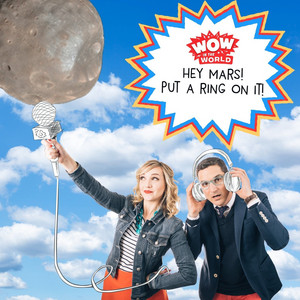
Are you suggesting there's a connection between Saturn's rings and the Roche limit?
That somehow those rings were formed when a moon got a little too close to Saturn?
This gaseous planet got its celestial bling when one of the planet's moons got a little too close for comfort.
Uh, isn't that exactly what I just said?
And broke up around Saturn when the planet's strong gravity ripped it apart into icy dust.
That's exactly what I just said.
Then, over millions of years, those broken up pieces of the moon went on to orbit around Saturn to ultimately
It's rings!
Wow, that's incredible, Mindy.
So does that mean that Mars is going to get its own ring system too one day, just like Saturn?
I mean, it's possible, Guy Raz, but it probably wouldn't happen for another 20 million years or so.
20 million years?
Yep.
Imagine all the Esperanto classes you could take in that time.
Well, I could finally learn Esperanto well enough to converse with Reggie.
Reggie speaks Esperanto?
Oh, yeah.
He's a multi-talented bird.
Well, I wish he'd take some knitting classes because I could really use a blanket right now.
Man, it's freezing out here.
Can we go over there and sit by the fire?
Yeah, that's a great idea, Mindy.
Hey, maybe we could sing some campfire songs as we walk back.
Mindy.
It's raining tacos from out of the sky.
Come on, Guy Ross.
Sing along.
Okay.
These tacos don't even know why.
Just open your mouth and close your eyes.
It's raining tacos.
Yum, yum, yum, yum, yummily yum.
It's like a dream.
Yum, yum, yum, yum, yummily yum.
With your sour cream.
Loud in the World will be right back.
Grown-ups.
This message is for you grown-ups.
It's mindy and guy ross here from wow in the world.
Mindy and i have some brand new wow in the world toys out in the world just in time for the holidays, made for the kids who love science and for the ones who don't.
Yet, from our 100 experiments, that wow kit to the telescope and astronomy kit, Our Wow in the World toys help your wowzer learn about their world through play.
Plus, you can hear exclusive audio content from me and Guy Raz to help your wowzer discover even more wows.
Grownups.
Give the gift of wow and wonder this holiday season with our latest Wow in the World toys designed with your curious wowzer in mind.
You can shop our Wow in the World toys at Tinkercast.com slash toys.
That's Tinkercast.com slash toys.
Hi, thanks for calling Wow in the World.
After the beep, get ready to record.
Hi, Mindy and Guy Raz.
My name is Bryn.
I just turned six.
I live in Ardmore, Pennsylvania.
My Wow in the World is that every leaf is different.
Bye, Mindy and Guy Raz.
I love your shows.
My name is Felix, and I'm from Philadelphia, and I'm eight.
And my wow in the world is that the first emperor of China tried to live forever but he died trying to do that because he ate mercury.
Hi, Mindy and Guy Ron.
My name is Gertie, and I live in Nashville, Tennessee.
Did you know that water blown out of a blue whale spout can shoot?
Name is kian.
I'm from towson, maryland.
My wow in the world is that a human heart is the size of a fist.
Bye, hi guys.
What's up, mindy?
My name is cameron and i'm six years old.
I live in london, uk.
My wow in the world is that the great wall of china stretches 5 5003 miles long.
Bye guys, what's up, mindy?
I love your show.
My name is Diego and I live in Malala, Oregon.
I'm six years old and my wow in my world is that paragon falcons can dive at a speed of 300 miles per hour.
I'm Indie Guy Ross.
I love your show.
Hi, my name is Sebastian, and I live in Chicago.
My wow in the world is that there's such a thing as an albino crocodile.
It's white with red eyes.
I'm Indie Guy Ross.
My name is Colleen.
I'm five years old, and I live in North Carolina.
My wow in the world is that a green shark lives up until it's 400 years old.
Bye.
I love your show.
And if you want to keep the conversation going, check out some of the questions we posted on this episode at our website, wowintheworldcom.
And grownups.
There you can find more details on how your kids can become part of the World Organization of Wowzers.
Lots of cool perks, exclusive t-shirts, autographed pictures of us and a bunch of other cool stuff wowintheworldcom.
Our show is produced by Jed Anderson.
Say hello, Jed.
Hello.
With help from Thomas Van Kalken, Chelsea Erson, and Jessica Bode.
Meredith Halpern-Ranzer is the big boss.
Our theme song was composed and performed by The Pop-Ups.
You can find more of their awesome all-ages music at thepopups.com.
And parents and teachers.
If you want to send us an email, our address is hello at wowintheworldcom.
Grownups, you can also find us on Facebook, Twitter, and Instagram at WowInTheWorld.
And if you want to be featured at the end of the show, call us up and tell us your WowInTheWorld.
Our phone number is 1-888-WOW.
And parents.
If you want to upload any photos or videos or messages to us, please visit wowintheworldcom and find a link where you can do just that.
And if you haven't already done so, please subscribe on Apple Podcasts, or however you get your podcasts.
Leave us a few stars and a review and be sure to tell a friend about the show.
Until next time, keep on wowing.
Wow in the World is made by Tinkercast.
Grownups, if you like Wow in the World, you can listen early and ad-free right now on Wondery Plus.
Join Wondery Plus in the Wondery app or on Wondery Kids Plus on Apple Podcasts.
Prime members can listen ad-free on Amazon Music.
And before you go, tell us about yourself by filling out a short survey at wondery.com slash survey.