Grownups, Wondery Plus subscribers can listen to Wow in the World early and ad-free right now.
Join Wondery Plus in the Wondery app or Wondery Kids Plus on Apple Podcasts.
Hey, Wowzer fans, Mindy here.
And before we start the show, I gotta let you know that this November, with a special new episode featuring our friends at Circle Round and Terrestrials on Radiolab for Kids,
And don't miss when Elmo from Sesame Street stops by Wow in the World to make us all belly laugh on November 24th.
Oh, but that's not all, Reg.
On December 1st, we are sharing our 250th episode of Wow in the World with all of you.
We think this one is going to be music to your ears.
Literally.
Did I mention it's a musical?
And if you're a member of the World Organization of Wowzers...
Oh boy, do I have a surprise for you.
You can listen to our 250th episode early with me and other members from around the world on Saturday, November 22nd, at 7 pm.
Eastern.
That's right, we are throwing another listening party.
Join us as we dance along to our new songs.
React to the episode with other members in the chat and more.
Grownups.
If you want your wowzer to join this members-only listening party, you can sign up to become a member today at Tinkercastcom.
Slash wow.
Already a member?
Well, you can find the link and password to join the event when you sign in at Tinkercastcom.
Slash wow.
That's it.
It's going to be a November to remember.
But for now, let's get on with the show.
Woo to Inside Tinkercast Studios, the show where I reminisce and revisit my favorite episodes of Wow in the World.
I'm your host, Dennis.
And that's Reggie, my co-host slash executive producer.
Right, and audio engineer.
And director of music.
And puppet wrangler, Reggie, for the last time, no puppets.
Because a visual art form has no place in an audio-based medium.
Also, they creep me out.
Okay, time for voicemails.
Let me just get the old answering machine pulled up here.
Okay, there we are.
Hi, you've reached Dennis from Inside Tinkercast Studios.
That's me.
Leave me a message.
My name is Cora.
And my name is Luke, and we live in Richardson, Texas.
And our question is... How does a vacuum work?
Bye, Dennis.
How does a vacuum work?
Like the vacuum of space or like a vacuum cleaner?
Now that you mention it, vacuum cleaners don't actually clean vacuums.
They clean the floor and the couch and Reggie's feathers all over the place.
And what's with the spelling?
Two U's in a row?
Hey, vacuum, why don't you clean up one of those U's?
Am I right, Reggie?
Ugh, whatever.
I'm hilarious.
Next question.
Hi, Dennis.
I'm a piece of toast from the bread bag.
Hmm?
Uh, did he just say what I think he said?
Exactly.
What is a piece of toast doing inside the bread bag?
That bag is for bread only.
And we're expected to believe that.
A piece of bread crawled out of the bag, jumped into the toaster, transformed into toast, climbed back into the bread bag and then called me.
To ask how toasters work?
Mr. Toast here should be the one teaching us about toasters.
Not me.
Next question.
I'm Ella, and I live in Three Rivers, California.
And my question is, who invented guacamole?
Thanks.
Finally, a question I know the answer to.
Because I'm a millennial, and we know everything about alligator pears.
Alligator pear, it's a fun name for avocado.
Get it?
Ah, you don't get it.
Guacamole is credited to the Aztecs, an ancient civilization that lived in what we now know as Mexico.
Oh, let's get that piece of toast back in here, spread some guacamole on it and have ourselves some breakfast.
Thanks for your calls, everyone.
If you've got a question for me, call and leave me a message.
The number is 1-888-7-WOW-WOW.
I just might answer your question on Inside Tinkercast Studios.
Okay, that takes care of that.
Good question.
Today's episode of Wow in the World comes to us from Season 3, Episode 13.
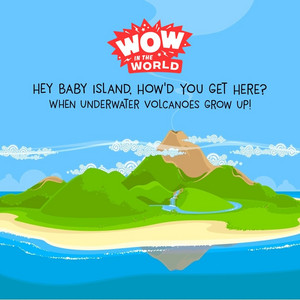
Hey Baby Island, How'd You Get Here?
In this episode, Mindy and Guy Raz take the Wow Machine out to the middle of the Pacific Ocean to visit the youngest volcanic island on Earth.
No, Reggie, the island doesn't look like a baby.
It looks like a small piece of land surrounded by water.
That's true.
It would be cool if it actually was in the shape of a human baby.
Let's play the episode.
And now, Inside Tinkercast Studios, brings to you a special encore presentation of one of my favorite episodes of Wow in the World.
Hey, baby island.
How'd you get here?
Dennis.
Mindy, it's four in the morning.
What are you doing up so early?
Just getting ready for my morning walk with Mr. Sleepy Pants in here.
Guy Raz, I'm outside.
Mindy, Mr. Sleepy Pants moved out of that house five years ago.
Lots of people have lived there before Guy Raz.
Back in the 50s, it was Lazy Susan.
Then after her was Mr. and Mrs. Party Pooper.
They were cool, but they also owned a lot of scaredy cats.
Dennis, what are you even doing awake?
It's the middle of the night.
Well, you're making a racket, and I'm an insufferable busybody.
Good morning, Guy Raz.
Good morning, good morning.
It's time to wake up friends.
Good morning, good morning.
Mindy, what on earth are you doing?
It's the middle of the night.
Um, actually, it's four hours past the middle of the night.
What?
It's 4 a.m.
Hi, guy.
Hey, since we're all awake, who wants to play Yahtzee?
Dennis.
Dennis?
Mindy?
What on earth is going on here?
It's Time for our new weekly neighborhood walk.
Remember I was saying how I needed to get more exercise after I won that napping hot dog eating contest.
Yeah.
And then you were like, hey, we should go on one long walk around the neighborhood once a week.
Uh-huh.
And then you said, come over to my house and knock on the door tomorrow at 4 o'clock.
And judging by the time on this watch I'm not wearing right now.
Oh Mindy, I meant four o'clock in the afternoon.
I assumed you would have figured that out by yourself.
Well, you know what happens when you assume.
What?
You get confusing logistical mix-ups like this.
Well... What?
You've woken me up, so I suppose if we start now, we might be able to make it better.
Back for sunrise?
Well, you know I love a good sunrise.
One time I took the Wow Machine to go back and forth in time just to watch the same sunrise 12 times in a row.
You know, if you're not careful, a bird's going to fly in your mouth.
Let me just get into my walkout gear and we can get going.
Just wait here for a minute.
Okey-doke.
I'll be waiting right here.
Here.
Well, Mindy, looks like it's just you and me.
A science-minded sassafras and a professional neighborhood snoop.
What?
Exactly.
What adventures lie in store for us?
Will we solve scientific mysteries?
Or will we go eavesdropping in the backyard?
Personally, I say eavesdropping.
I think audiences will really respond to it.
I'm ready.
Right on time.
Also, I really think it'll help flesh out our characters as we go into the six and seven seasons.
Where are you going?
You know Mindy, once you're actually out of bed and you've got the cold morning air on your face, it's actually quite nice being out at this time of day.
It's so peaceful.
I know.
No people, no cars, no babies running you over with their rollerblades.
Just peace and quiet.
Oh, it's ready.
Mindy, what in the wow was that?
Oh, that was my phone.
Who's trying to contact you at 4 in the morning?
Oh, that wasn't someone trying to contact me.
Then why did your phone just balk like a chicken?
That was just my phone letting me know that my app is finished downloading.
Your app?
Yeah, it's this new app called Nice Breakers.
Nice Breakers?
Mm-hmm.
It's kind of like ice breakers, you know, like the kind of questions that you ask people to get to know them a little bit better.
But Mindy, we've known each other for years.
Do you really think we need icebreaker questions?
And okay, here we go.
Guy Raz, if you could take one item to a deserted island, what would it be and why?
Oh, that's a good one, Mindy.
Hmm, let me see.
I suppose it would have to be my collection of essays from the London Review of Books.
Hmm. color me surprised.
Oh boy, I could read and re-read those for years and years and years, until someone stopped by the island to rescue me.
Oh, did I ever tell you about that?
One article I read Mindy, about carbon capture solutions and developing.
Well, if you must know, I guess I would have to take a rattle.
A rattle?
Maybe a pacifier.
Huh?
Maybe like one of those little cribs you can travel with.
A rattle?
A pacifier?
A
Mindy, why would you want to take all this baby baggage to a deserted island?
Well, Guy Raz, I'm thinking of a very specific island.
Oh.
The island I'm thinking of is a little baby island way out in the middle of the Pacific Ocean, near the island country of Tonga.
A little baby island?
Mindy, is this an island full of babies?
Yes, of course it's not an island full of babies.
Babies, Guy Raz?
Don't be ridiculous.
Oh, good, because I thought you were saying... The island is a baby.
What?
The island is a baby.
I don't think I understand, Mindy.
You're going to have to explain this one to me.
Well, I guess I could tell you about it.
Yeah? but I'd rather show you about it.
Come on, let's turn this nice breaker into a stone cold adventure maker.
I thought we were going for a walk, Mindy.
Well, it's kind of hard to walk to an island, Guy Raz.
I mean, for one, they're surrounded by water on all sides.
Well.
But good news for us, I have a partly functional wow machine that can get us there lickety split.
And since it can travel through time, we can just come back once we're done and I can wake you up all over again.
Anything for science, right?
Anything for science?
Yes!
Okay, you wait here and I'll run back and get the wow machine, okay?
Uh, okay.
Be back before you can say, hey, where did Mindy go?
I thought she was right here, but now she isn't.
Wow, she's faster than lightning.
I sure hope she'll be back soon.
Mindy, are you pulling along the wow machine with your cat?
All 47 of them.
Finally let them out of my adventure.
Come on, guys.
And what's that leaking out of the bottom?
What?
Oh, that's margarine.
Margarine?
Yeah, I ran out of butter.
Uh-huh.
Okay.
All right, there we go.
Okay, hop in, Guy Raz.
Uh, Mindy, did you move the door again?
Yeah, had to make room for the solar power toaster.
The door is now, uh, where did I, where did I put that thing?
Oh, oh, here it is.
Here it is.
Oh.
100% upcycled door.
Can you believe someone was just going to throw this thing away?
Mindy, Mindy, where did you get it?
Get this thing.
It looks 400 years old.
421 years old?
I found it on the side of a pirate ship.
An abandoned pirate ship?
Sure.
Oops.
Sorry.
Let me just grab that thing.
There.
Good as new.
Right behind you, buddy.
Okay.
Let's see here.
Just get these Empty coconuts off the dashboard.
Empty coconuts?
Yeah, Reggie borrowed the wow machine the other day.
He took a four-year vacation to Tahiti and was back in an hour.
Okay.
All right, let me see here.
I'm going to punch in the coordinates.
The island of Honga Tonga.
Let's lock it in.
And here we go.
Right.
Come on, let's go look outside from the observation deck.
Wait, the Wow Machine has an observation deck?
Yeah, it's right between the gym and the business center.
What?
Now, if you get to the pool, you've gone too far.
Huh?
Come on, follow me.
Okay, Guy Raz, may I present to you... Tonga Tonga.
One of the youngest, most teeny tiny baby islands in the entire world.
Whoa.
Can you even believe it?
It's four years old today.
A little toddler.
Such a little cutie.
Pretty soon he's going to be going off to island kindergarten to learn his island ABCs and make lots of little island friends.
Wait a minute, Mindy.
Is this what you mean when you were talking about a baby island?
Yeah.
Isn't it cute?
I mean, look at those little adorable sandbags.
I just want to eat them up.
Where exactly are we anyway?
Well, that's kind of a tough question to answer because, um...
Well, we're kind of in the middle of nowhere.
What?
Technically, this island belongs to the Kingdom of Tonga.
And the Kingdom of Tonga is a string of islands in the South Pacific Ocean.
You know it.
Tonga is made up of more than 160 islands and is 6,540 miles away from the U.S.'
's west coast.
Oh, yeah.
I can see it on my globe right here.
Your globe?
I'd never leave home without it.
Here it is, Tonga.
Huh.
It looks like these islands lie about halfway between Hawaii and New Zealand.
Yeah, that looks about right.
And this little baby was formed in the Kingdom of Tonga in January of 2015.
Huh.
So, do you want to watch?
Watch what?
The island being born.
Born?
Mindy, don't you mean formed?
Yeah, that's what I said.
Huh.
Do you want to watch?
Uh, yeah.
Well, then strap in again.
We're going to use this wow machine to travel way back in time all the way to 2015.
2015?
That's like seven guy phones ago.
I know.
Aren't ancient cultures so fascinating?
2015?
Here?
I had to dodge a royal wedding, two soccer world cups, and a Beyonce baby.
But we're here.
Safe and sound.
What was that sound?
Mindy, what was that?
Well, if I had to guess, I'd say it's an underwater volcano.
An underwater volcano?
Is there an echo in here?
Mindy, Mindy, what?
Why in the world would you land us right over an active underwater volcano?
Because, Guy Raz, this is how most islands are formed.
In the fiery and watery depths of massive underwater volcanoes.
Ah, now who shut the...
Mindy, are you sure we're safe in here?
Yes, of course I'm not sure we're safe in here, Guy Raz.
Now can you give me a hand with these blinds?
Because we're missing the best part of the show.
Well, sure thing, Mindy.
Oh, wait.
Don't you just pull this cord?
I knew that.
Whoa.
Look at that, Mindy.
All those bubbles and jets of water, that massive cloud of ash.
This is amazing.
And to think that just four years from now, there'll be an island right there, in that exact same spot.
Wait a minute, Mindy.
Is this a volcanic island?
You know it is.
You know, Mindy, I've read about these sorts of islands before.
But if I'm not mistaken, don't these islands only usually hang around for a few months before sinking back into the ocean?
Yeah.
In fact, over the past 150 years, only three volcanic islands have survived more than a few months.
Whoa.
Whoa is right.
But this island is extra special because... Because it's sort of shaped like the bat signal?
Close, but no.
This island is extra special because it's the only one of those three islands that have been born in the age of satellites.
Which means, Which means that we have satellite photos of it growing up, from a small little eruption in 2015 to the four-year-old we have now in 2019.
Bingo!
And if you played all those satellite images in a row like a flipbook, it would look a little something like this
Whoops, wrong button.
Where did I put the fast-forward button on this thing?
Oh, here it is.
A little something like this.
Whoa, that's incredible, Mindy.
I can see the island slowly rising up from the water.
And look, I can see plants starting to sprout on the black soil down there.
Wow.
Okay, we're coming up on 2019.
Gotta time this just right.
Right.
Wait for it.
Wait for it.
Now.
Ah, there we go.
Back to present day.
Nice landing, Mindy.
Thanks, buddy.
It's now been around four years, so does that mean that Hunga Tonga is here for good now?
Well, according to a team of scientists from NASA's Goddard Space Flight Center that recently visited the island on a research expedition, They expect that the island will be here for around another 30 years.
Wow, really?
Yeah, you know.
In fact, I think I see one of those little researchers down there on the beach right now.
What?
Maybe he can tell us more about it.
Here, let me just get on the megaphone.
Why does this keep happening to me?
Well, I guess we're going to have to investigate ourselves.
Prepare for a water landing, Guy Raz.
Water landing?
Three, two, one, zero!
Wait, did I ever fix that leak?
Huh?
Mindy, what are we going to do?
We're in the middle of the Pacific Ocean in a slowly sinking wow machine.
Well, the first thing we're going to have to do is stop complaining and go with the flow.
Get it?
Because of the leaking water?
Mindy!
And the second thing to do is grab an oar and help me get to land before this wow machine becomes a wow that sunk quickly machine.
Are the oars in the same place as last time?
Yes, of course they're not, Guy Raz.
Here, I'll get them.
Right next to the tennis rackets.
Do you want starboard or bow?
Does it matter?
Starboard it is.
Catch!
Catch?
Mindy, this is a tennis racket.
No time for semantics, Sky Ross.
Row!
And row!
And row!
And row!
And row!
And row!
Hey, we made it!
Yay.
Okay, let's get out and see what's going on on Tonga Tonga.
Hmm, smell that South Pacific Polynesian air.
Wow, Mindy, take a look at this soil.
It's completely black and its grains are bigger than regular sand, like small little, pea-sized pebbles.
Yeah, I think this might be basalt.
Basalt?
Oh, you mean the type of rock that forms once the lava from a volcano cools down?
Exactly.
All of this black stuff we're standing on right now probably started its life as piping hot volcanic magma.
And yet, look over there, Mindy.
Over where?
Over there!
There's green vegetation growing all over this baby island!
Green vegetation is my third favorite kind of vegetation!
Huh?
Come on!
Let's check it out!
Run!
Run!
Run!
Run!
Run!
Run!
Whoa!
Check this out, Guy Raz!
This is incredible, Mindy!
This island is in the middle of the ocean, hundreds of miles away from most of the rest of the world, and yet Life seems to be thriving here.
But how?
Well, if it's anything like other islands in the Pacific, the answer probably lies in what those feathered friends are doing over there.
Where?
See, over there, the birds.
Oh, yeah, those sooty terns chilling out over on the cliff face?
Right those sooty terns that have decided to make this island their home as they fly across the Pacific.
And these birds have most likely brought these plants with them.
What?
How?
Well... Ugh!
Is that sooty turn becoming a poopy turn?
Yup.
And the seeds from many of these plants probably arrived in the bellies of these migratory birds.
And once they pooped out onto the volcanic soil here well, it began to grow into what we see here today.
You mean like how those ducks were spreading duckweed from pond to pond and lake to lake all over America.
Exactly.
Whoa.
And that's not all, Mindy.
Volcanic soil, like the stuff we're standing on right now, is chock-a-block full of nutrients like phosphates and nitrates, and potassium and calcium, which are all needed for plants to grow up big and strong.
Yeah well, watch where you're treading there, Guy Raz, because there's a lot of that plant fertilizer all over this island beach.
Ugh.
So did you find out what the scientists from NASA learned about this island, Mindy?
Well, as it turns out, this little volcanic island could teach us a lot more about other volcanic islands.
And I'm not talking about just the ones found here on Earth.
Wait.
What do you mean?
Okay, so the scientists at NASA are hoping that these satellite images can help us to understand how volcanoes and oceans work together to make islands here on Earth.
Huh.
And if they can do that, they can use similar satellite images that we have from Mars to understand if they were also formed with oceans millions of years ago.
Wow.
You know what, Mindy?
It's actually quite...
Useful out here.
I know.
The perfect spot for our morning walk.
The beach, the waves, the pooping birds.
What more could you ask for?
Oh, I know.
This.
Oh, no.
Not more nice breakers.
Oh, yes, more nice breakers.
OK, let's see here.
Oh, this is a good one.
If you had to choose between getting woken up at 4 in the morning every day for the rest of your life, or row across the Pacific Ocean with nothing but a wooden door from a pirate ship and a tennis racket, what would you choose?
Wow in the World will be right back.
Grown-ups, this message is for you.
Hey, grown-ups, it's Mindy and Guy Raz here from Wow in the World.
Mindy and I have some Brand new WoW in the World toys out in the world just in time for the holidays.
Made for the kids who love science and for the ones who don't. yet.
From our 100 experiments, that wow kit to the telescope and astronomy kit.
Our wow in the world toys help your wowzer learn about their world through play.
Plus, you can hear exclusive audio content from me and Guy Raz to help your wowzer discover even more wows.
Grownups give the gift of wow and wonder this holiday season with our latest wow in the world.
That's it.
Back to the show!
Hi, Mindy and Guy Raz.
I'm Ryan.
I'm Jacob, and we live in Whedon, Illinois.
Our wow in the world is that a rare earth magnet the size of a Lego brick can lift 50 pounds or five bowling balls.
Hi, Mindy, Guy, Raz, Reggie, and Dennis.
Ahoy there.
My name is Noah, and I'm from Santa Barbara, California.
And my wow in the world is that owls can turn their head 270 degrees in each direction.
Also, T-Rex babies are born with feathers.
Hi, Mindy and Gray Mouse.
My name is Jackson and James Zinda, and we're from Austin, Texas.
Our round in the world is that the skin of a golden poison dart frog contains enough toxin to kill up to 100 people.
Hi, Rocky!
Woo-hoo!
Hi, Mindy and Guy Raz.
My name is Madalou.
I live in Oakland, California.
My wow in the world is that hippos make their own sunscreen.
Learned that from Wild Kratts.
Bet you didn't know that.
Bye.
Hi, Reggie.
Hi, Mindy and Guy Raz and Reggie.
My name is Juliana, and I live in San Antonio, Texas.
My wow in the world is hearing that they can hear a watch ticking from 40 yards away.
Bye.
Love your show.
Hi, Mandy and Guy Raz.
My name is Lucas, and I'm from Los Angeles, California.
My wow in the world is that humans share 50% of their DNA with bananas.
My name is Cyrus, and I'm from California.
My wow in the world is in a different galaxy to the planet with two suns.
Bye.
My name is Eli, and this is my sister, Isla.
She is two and a half years old.
We live in Rochester, Minnesota.
Our wow in the world is that blue light from the sun makes our bodies stay awake.
When it is nighttime and you are playing on your tablet phone or computer, the blue light tricks your body into staying awake because Turns off the melatonin gene that tells our body it is night.
Love you.
Our dog's name is Reggie.
Hey everyone, thank you so much for hanging out with us this week on Wow in the World.
And to keep the wow rolling, check out this week's scientific conversation starters at our website.
And grown-ups.
There you can find more info on how your kids can become members of the World Organization of Wowzers shop, our Wow Shop.
Upload photos and videos to us and check dates for our upcoming live events.
That's wowintheworld.com.
Our show is produced by Jed Anderson.
Who provides the bells, whistles, and silly characters.
Say hello, Jed.
Hello.
Our show is written by me, Guy Raz, and Thomas Van Kalken, who also provides silly characters.
Tom?
Hello there.
Thanks also to Jessica Bode, Casey Koffer, Rebecca Caban, Kit Ballinger, and Alex Curley.
Meredith Halpern-Ranzer powers the wow at Tinkercast.
Our theme song was composed and performed by The Pop-Ups.
For more info on their two-time Grammy-nominated all-ages music, find them at thepopups.com.
And grown-ups, you can follow Wow in the World on Facebook, Instagram, and Twitter at wowintheworld.
And our email address is hello at wowintheworld.com.
And if you're a kid with a big wow to share with us, call us at 1-888-WOW for a chance to be featured at the end of the show.
Also, if you haven't already done so, please subscribe to Wow in the World on Apple Podcasts or wherever you get your podcasts.
Yeah, leave us a few stars, a review, or just tell a friend about the show.
Thanks again for listening and until next time, keep on wowing.
Jinx!
Made by Tinkercast.
Grownups, if you like Wow in the World, you can listen early and ad-free right now on Wondery Plus.
Join Wondery Plus in the Wondery app or on Wondery Kids Plus on Apple Podcasts.
Prime members can listen ad-free on Amazon Music.
And before you go, tell us about yourself by filling out a short survey at wondery.com slash survey.