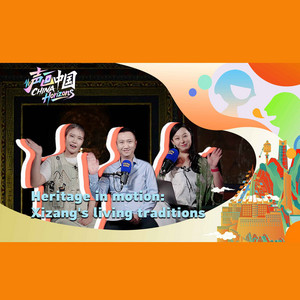
Hello, everybody. Welcome to Roundtable Special Series China Horizons, where we get out of the studio and go to different places in the country.
In today's episode, we take you to the enchanted land of Xizang, where every corner tells the story of old tradition and splendid culture.
Today, I am with Lai Ming and Dexing Yu, and I am Niu Honglin.
Hello, everyone. Hello, everybody. Great to be here.
And I have to admit, I love these special episodes a bit more than our usual shows because I get to ask the question where we are every single time.
Where we are? We are at a special and a bit mysterious place.
Actually, it's the Jibumgang Art Center located in the heart of Lhasa.
And it used to be an ancient building built in the 19th century, which is a mandala structure.
Yeah, in Chinese, we translate it into a tancheng, which we go into the trouble of translating it into English.
It sounds more like a shrine city. So it's... religious structure, obviously, and it's also a very important tool for meditation in Tibetan Buddhism.
It's also a ritual object using ceremonies.
And this building in particular was built in the late 19th century as the then government was getting ready to fight off invaders from a foreign country.
They thought it was a good idea to come up with a spiritual fortification.
I mean, that was their belief. to get the people prepared, both physically and mentally, spiritually as well.
They were thinking that maybe by building the structure, it could consolidate faith and somehow summon certain power or strength to fight off the invaders.
It didn't work out as they planned, but the building has remained and it's become a very fabulous place for us to visit.
If you can take a closer look at all the murals, the decorations, it's definitely with a lot of spiritual power in it, as well as a lot of Tibetan local style.
But after being built for a certain period of time, it was used by local people as residential houses.
They used it as a warehouse for the Grangs, which means they are not being that careful with the delicate, beautiful murals and pictures on the wall.
So if we tour the place, you would still see some scratches on the wall, which is such a pity because it's so beautifully painted and through the painting we can even detect a little bit of merger of different cultures because when cultures collide and meet each other you see the style of the painting changes a little bit and even if you are a fan of painting pictures you would first use one maybe a pencil to have the blue sketches the sketches of it and then put color on it and When the pictures are scratched a little bit, we get to see the sketch part.
And the sketch part also shows how cultures or different styles of painting transformed or traveled here in Xizang from the relatively center area in China and all that. is not that carefully protected or was not that carefully protected during a certain period of time.
Yet in 2017, local government began to do protective renovation projects so that we get to be in this splendid place.
And even certain, several actually artists have started their art exhibition in this quite traditional and ancient setting, which would definitely give a special color or final touch to the exhibition they were holding.
So, yeah, we are definitely at a very special place.
And I think that's the purpose of going to different places in the country.
We get to take you to the place we carefully chose so that it can be as representative as possible.
Sitting here and getting ready to record the show is a very, very special kind of feeling.
A few days ago, when we were first touring this mandala, the guide, a cute little girl, were introducing the history and the murals, artifacts stored in the structure.
And there was some level of disappointment and regret with regard to the damage and neglect that was caused to the structure.
But I have to say, an art doesn't have to be perfect to be appreciated.
I think obviously a lot of efforts and attention have been given to building the structure, that's for sure, despite the regret and the neglect into causing the damage.
I think the efforts of our generation in trying to restore the structure and trying to come up with a new way to make use of the structure to conduct outreach programs so that more people can have access to have the opportunity to come in here and get immersed in the artwork and in the history of Tibetan Buddhism as well as Lhasa and Xizhan as a region in the world.
I think that's just as important and influential as the amount of efforts put into building this place up.
Yes, it's hosting us. It's hosting a lot of other art exhibitions. it's becoming a place for artists to find their inspirations.
And more importantly, it's becoming a place for little kids to come in, learn about the culture, and even try their hands on certain kind of art activity they are learning here.
It's a little bit like a study tour for students here.
So this place is transforming to the kind of place that is combining tradition with modern exhibition or modern practices.
But the traditional part is still very important and very special.
We're in here. I feel like I am lowering my voice a little bit.
Yes, I feel that same way. It's very peaceful and quiet and you have to lower your voice almost like AMSR.
But the idea is that when you're walking here, you know you're in Xizang.
The Xizhang style is everywhere. It's in the air, in the smell, on the walls.
Yes, the smell, the Tibetan incense. Yes.
It's very soothing and healing, I have to say.
And even the way the floor creaked when you step on it, the wooden floor.
So everything combines to create that feeling that only you can get here.
And Lai Ming is whispering too. You have to when you're in the environment.
And that is the beauty or the special charm of not only this place, but also Xizang with a huge, splendid and very rich culture.
You cannot neglect the aesthetic price, the way, the perspective.
Because of the setting and background, people would have different ideas, even thinking about the same things.
And that has a lot to do with the fact that this place is full of different types of historical sites.
And Xinyu has visited one, the Backward Street area.
Yes, I have. Here, I got to say, Tibetan Buddhism is deeply rooted in the culture.
And if you look at some of the famous tourist sites in Lhasa, like the Potala Palace, Bakor Street, Chokhang Temple, they are all connected to Tibetan Buddhism.
But on the other side, there are also tourist attractions.
And a lot of visitors are coming every day to these places to visit.
So I somehow think that these sites, they have dual characteristics.
Yeah, a duality of religion and culture, even though sometimes they merge to a point that you can't tell them apart.
That's for sure. And we are here today to not only appreciate this temple or this mandala, but we are also here to get exposed to the permeating culture. that you can smell and see and hear in this region.
And we are just a few hundred meters away from the Ba Kuo Street, which is, and also the Jokhan Temple, which is the center of the city.
What amazed me the most was that all these places still look quite traditional.
I would assume it's still the same appearance as 200 years ago, even 500 years ago, yet it has been transformed to this quite modern place.
For example, in the Bacor Street, we can still see the very traditional buildings, the beautiful white walls with the red roof.
Yet on the door, the traditional style, Xizang style door, on the side of it, you got to see a QR code.
And if you scan the QR code, a history about this specific building would show up on your phone.
And people living still on Bacor Street are... able to enjoy electricity, internet connection without disturbing the beautiful appearance of the place.
That is fascinating. So technology has somehow felt it into the culture that's supposed to be traditional.
It is still traditional. And when you said a QR code, I was thinking that with that setting in place, perhaps I don't even have to travel here in person.
If I was somehow able to take a picture, of course I am able to.
If I were to take a picture of the QR code and send it to my friend who's perhaps thousands of kilometers away, then he or she may be able to appreciate and have the same, not exactly the same, but similar, you know, comparable experience as someone who's here.
Yes. And like you said, these sites, they are centuries old.
And they face the dire situation of preservation.
So in recent years, digital technologies are transforming the process of preservation as well.
If you look at the Potala Palace, we have this digital archiving to document and to preserve and also present these artifacts. to a wider audience in a different way.
Like they have this VR tours where you can wear this pair of glasses and go inside a building and maybe through these glasses, you are able to see some of the artifacts that are not open to the public or some of the artifacts that are fragile.
But through these VR technologies, you are able to learn about the deep culture of the Tibetan Buddhism.
Yeah, I came across this story while preparing for the show.
And can you imagine the regret I had when I learned that such an exhibition of the Patala Palace featuring VR technology was staged sometime earlier?
December last year. In Beijing, you know?
Because I, for one, have been to the Patala Palace four times.
And each time I had to, you know, I had to climb.
You know, with the high altitude here, 3,700, 800 kind of thing.
And when you're here, you have to climb the stairs.
You have to blend in with the crowd. You have to, you know, stick your neck up to see something, you know.
So that obviously is a very unique experience being, like I said earlier, to be there, to feel that. the air to hear the creaking floors and to even smell the sweat of other people fellow travelers that obviously is unique but then it's not ideal in the sense that you don't get to appreciate the details the nuances and details of the structure you you can't really study quiet get quiet and then just calm down and get yourself really immersed in the environment whereas if I had a chance to wear a VR camera and imagine myself alone, wearing the goggles, climbing the stairs without actually climbing it.
And the sunlight penetrating the curtains and throwing shadows on the corridors of the Potala Palace.
That's a different experience. I wish sometime they could stage that again in Beijing or somewhere else.
Yes. And for those of you who have actually been into the Potala Palace, you would definitely be able to appreciate what Lai Ming has said a bit more.
And also, you would have the experience of knowing how authentic, how ancient the buildings, the decorations actually are.
But you would also find it quite interesting to know that all these places are hooked in with electricity.
It is equipped with all kinds of gadgets so that all of the architecture's data are monitored by these smart technologies.
Right. They know whether or not there might be tiny little earthquakes, even the tiny ones, that might be harmless for other modern buildings.
For these ancient buildings, it could be a problem.
So monitors are in, and also monitors for whether or not there are fire hazarders, monitors of even the temperature inside the building, because maybe the Potala Palace would be fine, but the delicate, precious... items housed by Potala Palace or the murals might not be fine.
So all these technologies have quietly sneaked into the Potala Palace, protecting everything.
And that is the beauty of modern technology, preserving the ancient treasures.
This really is important to have technologies like that installed in ancient structures like that.
Because one of the characteristics of Tibetan architecture or Xizhang style architecture is that it uses a lot of rocks, stones, and wood.
Wood is very inflammable, especially when they get old and in very dry climate in this part of the country.
So it makes a lot of sense to have smart monitoring systems installed to keep something as valuable as this safe.
And like Xinyu has said, there are different sides to these sites.
There are the religious part. There are the part that they're with a lot of cultural value.
There's also the part that they're open to travelers.
But when it comes to traveling in Xizang, a lot of people would still think about Potala Palace, Bakor Street.
And these are definitely the pearls on this crown.
Yet, Xizang local government, as well as people working here, are thinking about different ways to make your traveling experience even more interesting, even more well-rounded, even more comfortable.
And I think... All of the oxygen tanks serve the purpose of being more comfortable.
But they are thinking about making it to be more fun.
You can have an all-time fun experience here in Xizang with a lot of new items or new entertainment experience people here are designing currently.
Because, for example, here in Xizang, we visit the beautiful lakes, we visit holy lakes, mountains, the natural reserves, for sure.
But now you can also have different types of festivals and activities held by local people.
I personally am very interested in the food festival they're holding.
And there's also a bicycle race happening here.
I cannot... That makes a lot of sense. Yes, yes.
For many years, we've seen stories of people sharing about themselves and taking on a challenge, riding along the 318 National Highway from Sichuan Province to Shizan Autonomous Region.
It was a challenge along the way. I mean, the sunlight... the inclement weather, the coldness, and the accessibility to amenities like food accommodation.
And so we always admire people who take on such challenge.
And so you would assume that already there's a huge group of people who are well-versed in cycling.
And for the locals to organize a cycling race, it makes a total sense.
Yes. And like any other place, any other tourist destinations here in China, Xizang is also welcoming the idea of having people come to the historical sites, wearing traditional Xizang-style costumes, ethnic group-style costume, and take beautiful pictures.
Yeah, I mean, when I was walking on Bacor Street, you easily spot young visitors.
They're wearing these beautiful Tibetan-style garments.
And oftentimes there's a photographer standing in front of them, taking pictures.
Looking professional. Yes, and guiding them how to pose in front of a building or structure.
I feel like this definitely has become a trend, traveling not only in Xizang, but also in other places in China.
But on Bacor Street in particular, there has been a surge of these photo studios lined on Bacor Street.
So since 2022, there have been, I think, over 200 photo studios being established here.
So you can see the amount of need and also young visitors, their urge, their craze for taking beautiful pictures on the beautiful landscapes of Shizang here.
I think it's quite interesting. People's tendency or people's preference for travel photography has certainly picked up over the years.
2012 was the first time when I came here to Lhasa and Shizan.
And back then, it was one or two of our colleagues, the outstanding and lively and effervescent colleagues who would take on the challenge again, challenge back in the days.
Because the rest of our colleagues, we felt that was an extraordinary move to put on Tibetan style garments and to show off their own beauty.
But I can see that this time around, I, for one, have taken it for granted.
Because if the past several times when I go to Barclay Street, I might felt a little, you know, reserved about people being braggy and being, you know, being show-offs by putting on, or even some kind of a cultural appropriation.
That was my, at least that was my personal opinion.
But now this time around, I see I have eased into the idea and the phenomeno. of people willing to have a taste of a different culture and really be proud of the culture in Tibet and also their own beauty.
Yeah. For one, my observation is that I was here four years ago.
At that time, these travel photography has already taken off.
We already see many people doing this. But this time, I noticed that many people that are in their silver hair age are doing the same thing.
Oh, right. xin yu said that oh young people are dressing up they're taking pictures they're happy they're perky they're enjoying the culture you know what elder people are doing the same thing and it's very romantic i have to say seeing people with a certain age holding hands posing for pictures it is really romantic and i understand that some people are talking about oh this is not your culture it's the Zang ethnic people's culture.
You are only using it as a way to have fun.
To look pretty. Or to show off on social media platforms.
But local people... Every time when I'm wearing their traditional costume, walking on the street, local people smile at me.
They are appreciative. They appreciate that I appreciate their culture.
They know that we are here to celebrate it.
And I think that is one thing about Chinese people.
We do not find it offensive when other people wearing qipao or dressing up in traditional Han costume.
We like that. We think it shows their appreciation.
Yes, true. And another travel trend that I observed is that in Ningchi particularly, especially during the springtime, there will be peach blossom festival held each year.
So this year, it was the 21st year. And it's huge.
If you look at the aerial photographs of Ningchi, it's covered, it's like blanketed with these pink colors of peach trees.
And it's been a huge hit. And especially during like in March and April, visitors from across China will flock to Ningchi to take pictures.
And also the local people, they have upgraded their travel experience.
It's not just about seeing and taking pictures.
You come here and experience the culture with us.
You taste, you try the local food and local drinks, and you have the local ethnic performances, and you can also experience picking fruits in the gardens as well.
So the activities are diverse, and people enjoy this, especially Galai village in particular.
The village used to be once situated in a remote mountainous area.
They moved? They haven't moved, right? It's still there, but...
Because of their location, they suffered from poverty for quite a few years.
But then in the past few years, they have developed this ecotourism and this peach blossom festival is like a brand now.
And the village has been lifted out of poverty for, I think, for a few years now.
And I was told that the villagers, they work for just one month and the income generated during that one month can cover their whole year revenue.
And if you want to improve the revenue or improve the profit, they are also starting, like Xinyu has just said, fruit picking.
Because it's not hard to imagine that fruit picking would happen in different seasons compared to the cherry or peach blossom period.
So during springtime, you have peach blossom festival.
During autumn time, we enjoy the peach picking or other kind of, I don't know, strawberry picking, because strawberry is a thing here in Xizang.
They are growing strawberry and cherry in Xizang.
And in winter days, they also transform or they also sell their flower seeds or flower breeds to other places and help other places grow these beautiful flowers as well.
So Throughout the entire year, they have something to work with and to profit from.
And eco-tourism is definitely one thing that Xizang can benefit of because of the endowment, for sure.
But the endowment lies not only in natural resources, but also cultural resources, for sure.
And for example, I'm not really sure if you're familiar with that part of the history, but for almost every Chinese kid, we would know the story of Wenchong Princess.
Yes. Yeah, it happened in the 7th century, and she was a princess of the Han Dynasty, one of the most powerful dynasties in ancient history.
And back then, the Han Dynasty was seeking to establish great relationship with the local government led by Songtsang Ganpo.
I think that he was the first king of the Tibetan Empire back in the days, and he also wanted to have friendly relationships with the powerful Han Dynasty.
So his idea was to marry one of the princesses of the Han Dynasty.
And what's special about this was actually Wenchuan Princess, she not just came herself, she came here with a huge entourage of followers, craftsmen.
So what's most influential was the skills and craftsmen that she brought, which really enriched the technologies and also many of the Seeds and breeds were brought here.
You can imagine the journey she had as an ambassador from so far away with a huge entourage, taking so many things and going to a place, a mysterious place she has never been.
And that story has now been transformed into an immersive piece stage play, live action performances.
And people are getting smarter and smarter when designing these shows.
Not only are the story enchanting, they're also including a lot of intangible cultural heritage skills and items showcasing the, for example, Tibetan opera and all those.
You can appreciate all those in one of these immersive stage play.
I mean, in the past, when I think about live action performance is just you standing in a stadium maybe and you just watch the show but this particular wenchang princess live action performance is totally different you get to be on the stage the performers you have the chance to dance with the performers so they have this local traditional dance party like a thousand people dance together and um Oh, they also transformed one of the agricultural or farming practices into a form of dancing.
It's called Daga Tu. So it's their tradition to... stomp the ground after they planted the seeds into the soil.
And one form of performance is they get as many people as possible and they will all use the tool and their feet to stomp the ground.
And it's kind of like drum performance, but only with human feet.
And the earth really reverberates and reacts to your performance.
And it's an exhilarating experience to be present at such a performance. especially if you're standing or sitting in the center of people performing or performing together with them.
Yeah, the collective effort of stomping on the ground.
And just last year, the Xizang Intangible Cultural Heritage Museum was opened to, I think the place is really near the performance site of the Wencheng Princess performance.
So people can enjoy the performance and pick your favorite item of intangible cultural heritage and then go to the museum, maybe try a little bit of the technique. and again, get an even more immersive experience.
Because here on this land, they have so many different types of intangible cultural items, skills, and all dates back to at least a thousand years ago.
Just yesterday, I went to a Tibetan-style carpet factory.
It's an authentic factory in the sense that it's not an exhibition center for people to go in, try it a little bit, and have fun. learn a lesson about it.
But it is a place where actual workers, they have been working in that place for over 30 years or around 30 years.
The equipment is 30 year old, by the way, as well.
And they live there, they work there, they hand make these season style carpets, and they take order online, and they would sell the carpets out.
And about traditional Xizang style carpet, the history is far more complicated and important and beautiful than the just several sentences I just shared.
Yeah, this dates back more than 2000 years.
And Tibetan carpet is among three most famous carpets is on par with Persian carpet.
And a lot of design and efforts have gone into promoting and improving the skills.
The patterns and artwork obviously are unique if we were to compare it to other famous carpets, that's for sure.
And the thing that's special about it is Tibetan people can't live without it.
You see it in their homes, on the floor, in their beds, and is considered as a necessity other than form of decoration.
And as far as I know, this Tibetan traditional carpet, they are really resilient.
They have this long durability. Based on my research, these handmade Tibetan carpets, they can last for like 50 to 100 years, maybe longer than my own life.
But those machine-made ones, they can just last for 5 to 10 years.
And it's because the materials used in the handmade traditional ones, these materials come from the Tibetan sheep wool, and they are more resilient and soft.
And also the machine-made ones, they are more like the synthetic materials, fabrics.
So that's how these handmade Tibetan carpets, they are really precious.
Yeah, I have also noticed that they have this motive of tigers on the carpets as well.
And that carpet or a bunch of carpets with traditional iconic pictures or iconic patterns as well as modern patterns have been exhibited here in this art center.
So yes, traditional Xizang style carpet is definitely one very important and representative item of its intangible cultural heritage.
And like Xinyu said, the handmade ones are more precious and even more resilient.
But people with the technique are developing new ways to make the machine-made ones also with the same or at least a similar quality.
They are doing the research. They are also rolling out different techniques and just trying them out as well. including, for example, the coloring of the thread.
With better colorings, the picture would be more delicate and more beautiful.
And also they're using 3D printing in certain parts of the carpet.
So a lot of new things are putting into this old delicate.
The man who showed us around the factory said proudly that this ball of thread is dyed with dye imported from Switzerland.
And like you said earlier, they are using computer to come up with creative and innovative designs.
And they're also taking orders from customers from elsewhere.
So even for a technique as ancient as this, a technique that's as demanding with the attention and skills is also trying to modernize.
I think, yes, for many years, I've read stories and seen videos comparing the handmade carpets to factory-made carpets.
And I have to say, there's a lot of steps and considerations that must go into a handmade carpet.
In comparison, a factory-made carpet is a new thing and they're yet to perfect the procedures and perhaps to experiment some more in order to come up with products on the same level as handmade carpets.
So it's safe to say, thanks to modern technology, we get to enjoy this really traditional item.
Yes. That is not the only example, though.
Yeah, nowadays, it's not just we as visitors, we're able to appreciate these traditional cultures in Xizang, but also you can have this hands-on experience.
Like in Ningqi, they have this cultural experience center in Xigamenba village.
So there you can experience how Tibetan paper was produced and how Tibetan incense was made.
So for Tibetan paper, I think it also has a history of over a thousand years.
It's made from local plants. So it makes the paper a little bit thick, but it's also really resilient.
What's special about this experience center is that you can not just watch the process of making the papers, but also you can experience.
And also after that, you can take it away.
Yes, you can. Thanks to the digital scanning and printing technology, you're able to print the photos or the Changka art on these Tibetan paper and take them home.
So this can be a one-of-a-kind souvenir to take back home.
So the story of Tibetan paper, Legendary has it, goes back to the period of Princess Wencheng as well, around the 7th century.
And back then, like I said earlier, she brought in skills and craftsmen, but she couldn't bring in the materials commonly used in Han Dynasty to produce paper.
As such, the locals will have to come up with their own ways, their own formula in making Tibetan paper.
And interestingly, one of the ingredients they used was somehow poisonous.
It was supposed to cause irritation in the eyes and on the skin.
But because of that particular feature, the paper was particularly pest resistant.
Interesting. How about people? The health of us using it.
Well, I guess you have to take care. It makes sense for you to reduce exposure to that paper.
That's the thing about... Protects your eyesight.
That's about Xizang that's so special, is that the local plant and material, it's hard to find this many types and variety of plants in other places around the world.
Only Xizang has that huge storage of these different types of plants, and they are transformed into different products, the Xizang style paper we talked about, as well as Tibetan incense.
It's also something that we are enjoying right now.
Part of the reason we're whispering a little bit because of the environment, the overall experience.
And the Tibetan style incense take place in different shapes, in different ways, because you use them differently.
You would light them up and have the entire room lit give you the beautiful enchanting scent and also you might put it in a closet so it drive away the pests and sometimes you would even use it as a way to cure certain disease in the sense that if you're having a headache it can help you it can ease the symptom so Tibetan-style incense is also quite popular among people living in Shizong, not only the residents in Shizong, but popular among tourists as well.
Yeah, the locals believe it has a cleansing effect.
So an effect works not only on the physical environment, but also on your mental well-being.
If you somehow feel stressed and maybe there's an appropriated type of tibetan incense that will alleviate your symptoms so it's become also a part of the everyday life for the locals here yes just like being here and smelling the aroma you feel like it really calms your nerves it's really soothing and healing as well so yes i'm gonna buy To get an incense maybe back home.
If you do that, it's quite easy on any market.
You can get the incense. It's an easy thing for you.
But it didn't used to always be like this.
I read a story about a craftsman knowing how to manufacture Shizang style incense when he was only 16 years old.
But back then, he had to manufacture the incense at home and then put them into a backpack, I'm assuming, and take it to different places in Shizang, in Lhasa, and sometimes even in Shikazh.
And it took him around six to seven days to sell out all of the product and earn about a thousand yuan.
But that journey can be prolonged to around half a month.
So you travel around, you sell your product.
But now he is able to produce the product still at home.
But again, just like the Tibetan style carpets, taking orders from online, selling them out online. and shipping them out with the help of professionals.
And that is why Xinyu is able to buy all these precious incense anywhere she wants.
And his story is one of government subsidy, helping him to procure necessary equipment to produce them on a massive scale.
But even with that, I believe the more important thing is to have the market for it, because you wouldn't be able to turn a profit even with the investment in industry and in technology, if there isn't a large sum of customers waiting to buy your products.
So I believe his story is more of an enlarging and developing market for Tibetan incense happening in the background as he is becoming more affluent with his skills.
Yes, his peer craftsmen are doing that. They realized that people have a good taste for Tibetan style incense, yet people do not really understand the market of it or understand the different types of product, which product is more suitable for which scenario.
So what his peer did was to create these two brands and trying to share the story of how to, for example, make these Cizang style incense and also how to use them.
And he would also even go to schools to invite kids to have their hands on making as a little bit of incense. try and make your fingers more skillful kind of practice.
You do not have to be a craftsman or an inheritor of Shizang style incense, but you can definitely try a little bit and have a little bit fun.
And with his effort, people living in other cities and provinces have a better idea about the brand and have a better idea of what product to buy.
And that definitely opened the market for Tibetan style incense.
Yeah, right. With a modernizing Shenzhen and a modernizing China, the old practice of carrying Tibetan incense in a backpack and seeking potential customers everywhere one can imagine has become a way of the past.
And nowadays it's very important for a businessman to have the idea, to have the creativity with regard to where the opportunities are.
And New Holland just provided a good example of a Tibetan paper maker, Tibetan incense maker.
The same thing is happening to Tibetan paper maker as well.
They're finding creative ways to put the paper into good use.
They're turning them into notebooks, lanterns, tanka material, envelopes, and even paper used to print photographs, pictures.
Yeah. I don't think it's hard to appreciate the traditional art here in Xizang, but I also find it quite encouraging to see people living here who are born with the culture and grow up with the culture, finding different ways to demonstrate the culture.
Just this year, around June, local people have started a competition of trying to figure out who gets to produce the most creative and most popular cultural creative items based on Cizang culture.
Okay. And they're doing more different things.
They are taking the portrait from a Cizang-style opera or a figure of a Cizang-style opera and transform it into Lego toys.
So you get to buy one and have your very own character from a Cizang-style opera in your home.
And also, like Lai Ming said, they are transforming the Cizang-style paper into notebooks.
I get to see how come they're good for my eyes because of the beautiful aroma and a little bit poisonous material in it.
And at the same time, they are also incorporating Xizang style lanterns made also by the same paper with electronic or voice controlled type of lanterns so that you can have them in your home.
Another very interesting one is from the Nanshan Park.
The Nanshan Park We talked about this on the previous show that National Park used to be a barren mountain just yet.
It was not as vibrant as today, but now it has over 100 species of plants and it has invited a lot.
By saying invited, I mean the natural environment is so good.
So birds fly to it, fly in. And all of these different birds and different plantations are inspiration for their bookmark, for notebooks and for these different types of recreational cultural product.
So accepting, embracing and creating, that is the process.
Right. I believe the local people, they always had creativity and it's been demonstrated here. by the artwork surrounding us, both in ancient times and in modern times as well.
It's just the communication between different ethnic groups and because of the language barrier and cultural differences and not even geographical challenges, communication has not been on a full swing back in the days, even though there's been plenty of examples of cross-cultural communication.
Wenchuan Princess was one typical example.
But again, given the challenges of history, the challenges of geography, communication has not been extra efficient.
But nowadays, with education being carried out in both languages, in Mandarin and in Tibetan language, that has made it even more effective. for people speaking different languages to communicate and understand each other.
And this somehow has opened up a bigger window for the locals, for the Shizhong people to showcase and be proud of their own culture.
Yes, you reminded me of one of the biggest regrets I have. and will continue to have, is that I know there is a talk show in the Tibetan language, and I won't be able to understand, but I would assume it's a really interesting one because they sold out the minute they started to have this performance in the lifehouse scenario or other type of club, and they use their local language, the Tibetan language, to... perform on stage.
And it was a huge hit. A lot of viewers say it was a fun experience.
We enjoyed it quite so much. And I won't be able to understand it.
And it's a huge regret. But it's also something I find so encouraging.
Because we have all heard of the misled claim that people here in Xizang are not using their own languages.
They are forced to learn other languages.
I'm forced to learn English, but now I feel blessed.
By your parents, right? By my parents. By saying that, I mean their language is flourishing on the land.
They are demonstrating different performances using Tibetan language.
Not only are we talking about local people quite difficultly when they start to talk to each other, they start to use Tibetan language.
But also the art form is being ever more diverse.
Yeah, because in China, stand-up comedy is really flourishing. right now.
And if you watch some of the stand-up comedy shows, you can find that the performers, they're speaking Mandarin most of the time.
Some of them in English. Yeah, in French.
And sometimes they have this regional accents with them.
And you find it actually really interesting.
But also what astonished me is that Tibetan people, the younger Tibetan generation, they also have this Tibetan language stand-up comedy.
I think it's a form of the younger generations, they express their thoughts, express their ideas, and to communicate with a wider audience through their own language, I think it's really fascinating.
And also, in terms of comedy, I also feel that language really plays a great part in getting the memes or getting the punchline.
You know what I mean? Yes, so that's why language, yes, it's really important for them.
Maybe for us, we don't understand what the performer says, but you know, among the group, they can really get the punchline.
I know. I do think that stand-up comedy only began to take place and to, you know... Really being popular.
To take off. That was the word I was looking for.
It was only beginning to take off a few years back.
We've only seen a few seasons of talk show, live variety shows.
We were enjoying crosstalks, by the way.
Of course. Different forms. But then we look at the story in Shizan in Tibet, and then we realized that the local language talk show took place a few years back and began to take off.
So that proves the point. Shizan no longer is an isolated place, despite the geographical challenges.
When I say they use local language in different performance forms, I was not just saying it because they have also been combining local language and local songs in local language with pop music, hip hop in these live houses, something I will definitely visit and enjoy someday during this trip.
I will be able to understand music, even though I do not know what they're singing about.
It's still something quite fun. And one of the most popular band here, I think it's called... Blackbirds.
Blackbirds. So fun. Yeah, it's a seven-member band of Tibetan artists who blend traditional sounds with contemporary genres like hip-hop, electronic and rock.
Their music fuses elements of religion, culture and everyday life. from galloping horses to the rhythms of village streets.
Oh, now I wish I could speak Tibetan so I can understand their songs.
Yes, and it's not only that. It's Tibetan-style coffee shops, coffee with local characteristics.
Yak milk? Yak milk in maybe a... Yeah. Yes.
Really? You haven't tried it? We've tried it.
Like yak latte. Yes. Wow. Very delicious.
And also Tibetan style fashion design. They blend the Tibetan traditional element into the designing.
So it's happening everywhere and it's happening to everybody.
We see the tradition being preserved and we see the tradition being transformed into modern ways.
Right. What are the reasons behind it, in your opinion?
We have been cherishing and celebrating the tradition for thousands of years.
Only these days we've seen this number of varieties, these types of soul flourish and amazing number of demonstrations of these traditions being demonstrated in modern ways.
What are some reasons behind it? I would beg to differ, because I would stand by the point that communication has always happened between Shizong and the rest of the country.
I would stand by the point that, in fact, communication has taken place continuously between Shizong and the rest of the country in China.
The example with Princess Wencheng was a case in point.
And in fact, within this mandala, within the structure, we see examples of cultural communication.
Some of the brushes we could clearly see are the styles of hand style drawings.
So even though they're trying to portray religious characters in Tibetan Buddhism, there are very obvious characteristics of hand drawing and hand painting.
And then in modern days, infrastructure obviously has made the communication even more efficient.
We have Wi-Fi in the hotel we're staying.
We have 5G network on the road as we were traveling.
And that has enabled communication to happen on a much massive and rapid scale.
And I believe this is somehow getting the local people close to the rest of the country and close to the world at large.
I totally agree. I think that is a good point.
What I was trying to say is that transformation has always been there.
It's just in these days, it's speeding up.
Previously, in order to see a picture that is not from your original place, it takes weeks or months for that picture to be sent to your hand.
Now you click on your computer and you see the picture and that could be your inspiration to create something new and put that something new in this something old and that would be an exhibition.
So what I was trying to say is also the same thing.
Thanks to modern technology, we get to enjoy the traditional form of art.
I have one more point to add. In fact, yesterday, as we were touring a live stream broadcast station, we realized that some of the studios, they were using AI, artificial intelligence technologies, to assist in their work.
I believe in China and throughout the world, AI is turbocharging technology. communication and also content and production.
And I just found the confidence during our conversation that perhaps in a few years when I come here, the next time I will see more of such result of communication assisted by technology, including artificial intelligence.
Yes, it's my first time being here in Xizang.
And I wonder what will take place in maybe a few years later when I come back again. maybe a lot of changes have taken place here in Shenzhen with the city embracing modern technologies and also preserving traditional cultures.
Yeah, a point that perhaps is slightly off the topic is that like in the same way we talk about the voice of developing countries, of cultures other than the Western kind being left out in AI development.
I don't know. I haven't tried it. I guess it's difficult to come up with typical Tibetan style content, be it language content, be it graphic or sound.
But I have this feeling that maybe we're not doing enough in this sense.
In the same way, we're not doing enough in emerging cultures, in cultures other than the Western kind.
So I believe perhaps in the next step, it's important for us to have our own database, our own AI built on the local culture, Xizhang and Tibetan.
And that brings us to the end of today's roundtable.
This is China Horizons, and we cannot wait for you to take on another trip with us.
Xizhang has taught us that traditions with the right heart will always be preserved, be transformed, and be celebrated.
I'm Niu Honglin with Lai Ming and Xin Yu.
Thank you so much for watching and listening.
We'll see you next time. Bye-bye. Bye-bye.