NPR. This is the indicator for Planet Money.
I'm Adrian Ma. This is a weird request.
Are we able to run a crackling fire under this whole intro?
Is that possible? Oh, I'm Kenny Malone from Planet Money.
Ah, yes. I can feel the warmth right now.
Jeff, come on in. Come around the fire.
Come on in. Come on.
Thanks. Thanks, guys.
It's getting kind of cold out there.
Here's Jeffrey Guo.
Jeff Guo. Great to have you here.
It's so cozy in here.
It is. Love a combustion event.
It's a time of the year where we gather with friends or, as we do on the indicator, where we gather with our Planet Money family and do what families do best around the holiday season.
Engage in brutal, soul -breaking arguments in a fashion most public.
There's nothing like it.
It's time for Family Feud.
That's right. Family Feud.
Just to recap the rules, each of us will make a spiel and argument for why our indicator is the indicator of the year and we'll only have 60 seconds or less to do it or else...
We die. Hey, that is too loud.
Come on. And in the end, you, dear listener, will vote on who had the indicator of 2024.
that's all after the break.
All right, Family Feud, indicator of the year.
We're going to have 60 seconds on the clock.
Each of us is going to have a chance to make our case for the indicator that best captured the year 2024.
Adrian, why don't you then take it first?
60 seconds on the clock and go.
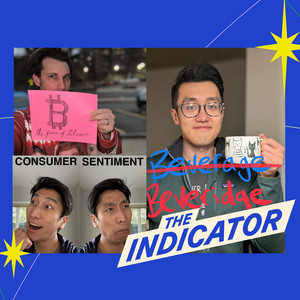
Nothing captures 2024 quite like my indicator of the year, consumer sentiment.
America's emotional barometer for how optimistic or pessimistic consumers are feeling about the economy.
In pre -pandemic times, the University of Michigan's Consumer Sentiment Index was hovering around 100, meaning people felt okay about the economy.
But for the past year, it's been down around the 70s.
And this one indicator explains so much of what we saw this past year.
It shows how people still felt the pain of inflation.
It explains why people felt lousy about the economy despite low unemployment and rising wages.
And it explains why a lot of voters wanted to ditch the Democrats and bring Donald Trump back into office.
The latest consumer sentiment numbers even show how Republicans felt a surge of optimism about the economy right after the election, while Democrats felt the opposite.
In short, consumer sentiment isn't just a reflection of the economy.
It was a political catalyst that shaped the world we're currently living in now.
Boom. Look, I'm not here to rag on other people's indicators, but I will say in last year's Family Feud, I won the indicator of the year with consumer sentiment.
Okay, let's see if you could do better, Kenny.
Yeah. What's your indicator of the year?
All right, ready? Put it on the clock.
Are we ready? Someone give me the go.
Okay, three, two, one.
Total diamond hands.
My indicator of the year is the price of Bitcoin.
One Bitcoin at the start of the year costs around $42 ,000.
It is now above 100.
Bitcoin was created in the wake of the 2008 financial crisis.
Distrust of institutions is baked into its very existence, and yet today it's true that maybe some people are buying this because they see uncertainty on the horizon, more distrust of institutions.
But what seems to be more prominent in an explanation is the spike is that people assume the incoming administration is going to be very friendly to crypto, which ironically is, I guess, a kind of trust, crypto trust in incoming institutions.
Either way, I think Bitcoin is an indicator of the year because its very existence, its modern value, is a very 2024 Rorschach test for how people feel about the world's institutions and where they are headed.
Thank you very much.
I rest my case. Okay, Bitcoin.
Can I ask? I'll be honest, did that make any sense?
I don't want to sound unconvinced in my own argument, but what do you think?
I think you gave it away at the end there when you said that Bitcoin is a indicator of the year, but not the indicator of the year.
Oh, Kenny's subconscious, thwarting him again.
No retakes. I mean, the way I would think about it, the way I would challenge our listeners to think about it is when in 40, 50 years, I don't know, when you're telling your grandchildren, man, 2024 was about blank.
Are they going to say 2024 was about?
Bitcoin? They might.
Bitcoin? They might.
You think so? Well, I don't feel great about that effort, I'm going to be honest, but that's okay.
Jeff Guo, let's put 60 seconds on the clock.
Actually, guys, before we get started, I'm actually a little parched.
So just give me one second.
I'm serious. Actually, I just need to get something real quick.
Hold on. Where is Jeff?
What is Jeff doing?
Didn't we say no bits?
No bits. What? No shenanigans.
No one said that. Jeff has literally wandered off camera.
His camera is off. He's making us wait.
I haven't, we have passed my heart out for this recording when I must go pick up my children, and yet Jeff must go get a can of soda for whatever he's about to do.
Disrespectful. I am very confused right now.
I'm back, I'm back, I'm back.
My apologies to Kenny's children, they're wonderful.
Okay, you can pay the daycare fee when we're late.
Okay, so now, with my ice cold beverage in hand, I can tell you about my indicator of the year, which is the beverage curve.
Which, to be fair, has nothing actually to do with beverages at all.
No, it has nothing to do with beverages.
It's not even spelled the same, but anyway.
Someone want to start the clock.
Yes. That is what we were waiting for.
Wonderful. I was thirsty.
Three, two, one, go.
Ah, okay. So, the beverage curve, which is named after the economist, William Beveridge, is the name that economists have for the relationship between the rate of unemployment and the rate of job openings.
So, for instance, usually when job openings go down, it's harder to find jobs, and unemployment goes up.
But, but, this past year, as the Fed was pumping the brakes on the economy, something weird was happening.
Companies were posting fewer and fewer job openings, but unemployment wasn't really going up that much.
In other words, the beverage curve seemed kind of broken.
And that is a good thing, because it means that the Fed has been able to tame inflation without inflicting a lot of painful unemployment on everybody.
It's almost as if a lot of those disappearing job openings were just like, you know, just like, you know, the froth on top of a carbonated beverage.
Get it? Get it? Okay, anyway.
To me, that is the big story of 2024, the broken beverage curve that helped us get to this soft landing.
Time's over. Time's over.
Well, we almost got to this soft landing.
After all of that buildup, we have half of my day.
I've only given you 45 seconds anyway.
You're lucky you got the full minute, Jeff Guo.
Now that we've gotten the feud out of the way, everybody, let's go ahead, let the old fire up again.
We could be cozy together and be friends, because that really is what the holiday is about.
It's about fighting briefly and coming back together, and then dorking.
And sitting in front of a chemical reaction.
Yeah, it's a beautiful, beautiful thing.
Yes. Okay, so we've made our cases for Indicator of the Year.
Now it's your turn to vote, listeners.
You can email us with your choice at indicator at npr .org, or check out our posts on Planet Money's Instagram, at Planet Money, and leave your choice in the comments.
Before we wrap up, we did want to take a moment as the year comes to a close to say thank you to each other, but to you, listener, for your support.
It is what keeps NPR going.
It's a nonprofit news organization, and it keeps the indicator and Planet Money going.
An easy way to support our work is through NPR+.
If you've already joined, we appreciate it.
But if you've never given to public media or haven't given in a while, consider it now.
A small recurring donation gets you perks for more than 25 NPR podcasts, like sponsor -free listening and bonus episodes.
Go to plus .npr .org for details.
Thank you again for being a part of the public media community.
Jeff, do you mind throwing?
Just go ahead and throw a log on there while we do the credits.
Just keep going. Whoa.
Not that big, Jeff.
Jeez. You know, it's not that good to have indoor fires because of the CO2.
It makes people drowsy, and it also inhibits cognition.
That's what a flu is for.
You have to open the flu and let the CO2 go out the chimney.
That's why. That's...
yes. You shouldn't have a fire on your kitchen table.
Wait, is that why they call it flu powder, Kenny?
Yes. Maybe. No. I don't know.
Yes. Cheb -cheb -alay, cheb -cheb -cho -ro.
All right. Shall we?
Wrap it up. Go ahead.
This episode was produced by Angel Carreras and engineered by Gilly Moon.
It was fact -checked by Sierra Juarez.
Kickin' Cannon edits the show and the indicators of production of NPR.