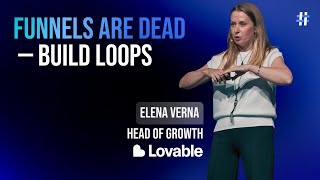
Hi, everyone, so excited to be here.
I'll also answer that question of, what will I do if AI eliminates my job?
So, hi, my name is Elena Verna, and I'm actively trying to eliminate my job, so I can do farming.
I already started with seven chickens.
It's going great.
Okay, so today I'll talk about collapse of pre-I distribution modes and how to build new ones.
A lot of times in product, we don't really think about distribution.
I think that's a mistake.
So, let's talk about how you should be thinking about this as well.
So she already did amazing intro on me.
I'm going to skip it.
So growth.
I've been running growth teams for the last 10 years of my career.
I started in analytics, actually.
But there's still a lot of confusion as what does it mean?
It's actually kind of embarrassing that 10 years later, after this profession really became a real, that we still have so many different opinions of what it means.
Like, nobody confuses what product management is.
But here we are.
Let me talk really quickly about what I think it is for my definition, and then we'll talk about the distributionships that are happening in growth.
So there is product.
There's all your beautiful product managers working on the product. and then there's distribution.
Now, those two are not the same things, because you can have an amazing product and if you don't bake in distribution into it, or you don't really think about distribution, you will die of slow deaths.
In fact, that there's millions of products that have been developed over the last couple of decades that we have never heard of, we have never seen, that were absolutely amazing.
However, what builds a successful company is having a great distribution for your product.
But product has to be just okay, because there's also a lot of really terrible products that are multi billion dollar companies.
You can kind of imagine of those, one of those products that you log into and, like one of your brain cells, dies every time you have to do an action in it and you're like thinking how is this thing alive?
Yet they have absolute monopoly in the category and nobody can displace them.
And that is because distribution, at the end of the day, wins of what's going to make a successful company.
When what growth works on is that distribution aspect of it, because great product is not enough.
Now it helps distribution.
If you have a great product, it makes everything so much easier.
But if you're not thinking about distribution right from the beginning, if you're not thinking about you go to market strategies.
If you're not thinking about growth as you developing products, you're going to be dead in the water.
Now, what is distribution actually entails?
It's actually very straightforward.
Four questions.
Those are the four questions that I stress about every single day that I lose sleep over, which is how do we acquire customers?
How do we activate them?
How do we monetize them?
And then how do we retain them?
Very straightforward.
That is a traditional funnel that you need to look into.
But ability to answer those questions in predictable, sustainable and competitively defensible way is what separates companies that win versus the companies that lose.
And this is something that you should also know about your company.
What is your acquisition strategy?
What is your activation strategy?
And the better you have alignment internally against it, the more straightforward your growth is going to be.
And the fastest growing companies all have one thing in common too.
They don't grow via funnels.
They grow via Loops.
Loops are super important.
Funnels is an F-word that sometimes I have to use, but I prefer not to because loops are just so much better.
And loops are very straightforward too.
It's a compounding flywheel.
So there's an input, let's say a new user.
They perform an action or step in your product that generates an output that can be reinvested to produce another input.
So there's lots of different types of loops that you have on marketing side, on sales side, most definitely on product side.
All of them have different spans of lifetime.
All of them have different caliber of the heavy hitting that they can do.
But you constantly have to think about your product as what loops.
Can I stand up on acquisition and retention, with monetization fueling all of that because it pays our salary?
But that is what creates predictable and sustainable and competitively defensible growth.
Not F-word funnels, but loops.
Loops is where it's all at.
Let me give you just two examples of what loops usually are.
I was a Dropbox last year.
Dropbox started actually with the loop that's not on the slide, but what was the loop?
Do you remember the viral loop that Dropbox had give credits to get storage?
That took off like a wildfire.
That actually took company to a first billion dollars, almost with no marketing expenses.
And that was a really strong loop.
They hooked into the user psychology very well.
Right now, 60 of acquisition for Dropbox is powered by this product loop, not marketing, not sales.
This product loop where they have a new user.
They come in, they upload the content, they want to share that content with somebody else and percentage of those recipients sign up to become new users.
60% of acquisition.
Basically, your users doing your own marketing for you, the best case scenario.
But it doesn't come from marketing teams.
It doesn't come from sales teams.
It comes from you, a product people, building into customer experiences.
Now, there's also lovable.
Lovable is only 10 months old, so we're still working on our loops.
That's something that I definitely lose a lot of sleep over.
But lovable also has a really incredible word of mouth loop.
This is a great place to start for any startup, for any new product to lean into word of mouth as much as possible.
Now, it's not really sustainable for a long time.
You can't just keep the word of mouth going indefinitely at some point.
It fizzles out.
Not everybody wants to talk about the products that they're using.
But at the same time, it's the really best way to kick off growth.
And this is where most of our growth right now is coming from.
Now, what is the word of mouth loop?
You have a new user, the product exceeds the expectations.
That first generation experience at Lovable is so magical that people go.
I need to tell the world about it.
And they do.
They tell their network and all some people sign up from it.
And it's a gift that just keeps on giving.
And it's all done just by providing lovable experiences to customers.
So make sure that you put in those love marks and that think about that activation in the first two minutes of the customer experience, because that's going to be between make it or break it for your word of mouth loop.
Now, then about five years ago, everybody started obsessing about product-led growth.
And honestly, it was somewhat overhyped.
I think we did too good of a job of advertising for it.
Now I really want to talk to you about why product-led growth even became a thing that we all started talking so much about.
And that happened because of the four shifts in the market.
That was like the first shift that happened.
And we'll talk and talk about the other shifts that are happening now, too.
So shift number one.
Users in B2B product also became buyers.
Now, this was kind of like a pent up demand because B2B products used to sell to enterprise buyers.
Surprise buyers would like to check their checklist.
It seems like all of the requirements are satisfied, and then they push the product down in the organization.
And then the end user afterwards were like, what is this?
This is terrible.
This is not solving any of my problems.
I'm going to go and find my own solution, which is where PLG was born those self-serve prosumer, consumer-like B2B products that actually solves people's problems.
And then they started going up market and also doing enterprise as well.
But that shift of the user becoming a buyer is very important.
And we'll come back to that in a little bit.
Number two is channel lifecycle.
If you adjust the reply.
Relying on marketing and sales to do your distribution, that's really tough nowadays.
Because any campaign that marketing puts out there on any, honestly any channels, how fast do you think it becomes irrelevant?
Marketing teams are lucky if they get a week out of it.
Now imagine how needing to produce these creatives, these campaigns every single week.
We're just not set up for it.
Maybe I will help us enable it more, but also our attention spans are like this short right now.
We'll like see something once and like we never want to see it again.
Imagine like, compared to like Coca-Cola that used to put out a campaign that would fire in for a year.
But now you cannot do that in the market.
It's just become way too crowded.
Number three is data availability.
You're all product managers.
I hope that you have your data dashboards to see how your product is performing.
That wasn't available before.
So now we actually know what's happening in the products.
We don't just have to hear to salespeople what they're saying.
So we can go and make those experiences better and make product work better for us and for our companies and for our customers.
And then number four is roles of blurring.
So all of a sudden, I don't know how about you, but just being a product manager is starting to be very quickly not enough.
You have to have a marketing hat, or at least product marketing hat on.
Every single marketer has to have a product manager hat on.
Everybody's an analyst in the room, or should be an analyst in the room, and that really empowers us to be more responsible than just specialize in this one little area, but be more responsible for the overall company and customer outcomes.
And that role blurring is honestly the most beautiful thing, because it gives you more agency, it gives you more autonomy.
But B2B products were definitely feeling the pressure because it's stressful to understand being responsible for monetization outcomes and acquisition outcomes.
And this is why I think that there was a lot of this hype about product-led growth, because in B2B, traditional enterprises, product measures are not used to operating this way.
And meanwhile, consumer products were like, what is this?
We've been doing this all along.
We've always been responsible for company outcomes, and we always had product-led growth.
You just rebranded it and put it as something new, whereas this concept existed all along.
So my biggest hint to you is, if you want to do PLG, just copy what consumer products are doing.
That's honestly the fastest shortcut that you can do.
But then something else started to happen.
What happened?
What has really changed in the last year and a half?
Yes, charge a PT open AI.
I'm gonna pick an open AI here.
Came along and all of a sudden there's LLM words all over the place and we're like sitting there going what is happening over there?
And All of the companies were like we need to get onto this gravy train.
So I saw this tweet.
I thought it was All areas.
Just change your loading to state to thinking and you are an agentic AI startup now.
That's my growth hack to you today.
You're welcome.
Thank you.
And by the way, what is our product roadmap started to look like?
There's companies and then there's AI.
And nobody asked for it.
Definitely not customers.
But let's start creating AI features and call ourselves in the AI company.
But honestly, it's not in our control.
We all know how roadmaps are made.
It's not based on customer feedback.
And it's most definitely not on innovation and what you're trying to drive.
Sometimes it's those sales requests and promises, but we all know who's in charge and who's actually making the final call.
But wait, AI is actually doing a lot of changes in product management, but it is killing our distribution channels.
This is an example of a company, G2.
It's also B2B company.
They do reviews, kind of like trust pilot for consumer, but they do similar for B2B.
Most of their growth was coming from SEO, search engine optimization, Google search organic, most of the, although some paint as well, I'm sure.
This is the snapshot just through February.
This trend continued down, and I just didn't have a chance to update.
This is just the acquisition that has reduced by 80 to 90% since chat GPT happened.
Now, why is that?
What is happening with consumer habits right now?
They're changing.
Are you still going to Google search to find things?
No, you're going to chat GPT or cloud or whatever you are, because conversational AI is so much better to answer your questions than doing search and then spending a bunch of time looking at the links.
And this is very much felt in the companies that were really optimizing against search being the main growth driver, that are now struggling very, very much.
The list goes on.
You can actually find a blog on my, on my sub stack that goes through all of those businesses that are crashing and burning so hard.
And social is not helping either.
Algorithms are changing every single day, algorithm give us, and then algorithm take us away.
And, most importantly, social networks are starting to clamp down too, because they optimize on intensity of use.
That is their retention tactic.
So you put a link out to try to drive traffic to your company.
No more traffic for you.
No more impressions for you, which makes it that search now is not a good channel.
Used to be big.
Social is also really hard to drive traffic through for your company, but wait, there is more.
Now I'm going to do a shameless plug here, but I see this is starting to happen in a really rapid fashion at lovable.
And I want you to pay attention to this as product managers.
Not lovable, in lovable, in vibe coding in general.
It's starting to reduce the friction and what it actually means to build any product, any software, whether it's website, whether it's a B2C app, whether it's a B2B app, you name it.
And what people are starting to do is, instead of paying for bloated subscriptions or bloated products, they're going and they're building their own tooling.
We call it lovingly SaaS replacement use case internally.
But people are literally going and if their functionality that they're using in the product is very simple, they're going and they're building it out in lovable itself.
I really urge you all to go.
You don't have to do lovable.
I'd love it if you do it in lovable, but go to one of those by coding platforms and try to rebuild your product, your main functionality in your product.
See how easy it is.
If it's easy, I'd freak out.
If it's hard and you can't unable to do it, you're a little bit more in a safer zone.
Because otherwise, if it's easy, your old son overnight are going to start competing not against other companies, but against your own customers that are leaving you and building their own replacements for you.
Don't want to be in that situation.
So a lot of the simple but formally defensible functionality, such as signatures forms, landing page generations, scheduling tools, no code tools dashboards, internal tooling, is all of a sudden no longer defensible.
In fact, it's becoming commoditized.
So that commoditization bar is really rising up.
If your company is still monetizing on commoditized functionality, get yourself out of that zone.
I kind of think about it two by two.
I love two by twos.
And you think about the simple functionality versus complex, high utilization versus low utilization.
If you have a lot of complex functionality that is hard to replicate, that is hard to vibe, code that have you high utilization, you in a safe zone.
Good for you.
Now, if you have complex functionality but low utilization, get that utilization up.
However, if you have simple functionality and that is what gets highly utilized, you need to think about your product strategy.
And in fact, we're already starting to see a shift where companies are being disrupted by their own users.
This was fascinating because DocuSign actually threatened the legal action against one of our users that replicated there's e-signature functionality.
So I mean, if you have to start going in the legal route as the way to defend your product market fit, That's also not the best way to grow, but that's sometimes the only lever that companies can pull.
So what?
All right, so we went through the platform shift.
Platform shifts are everywhere.
Your product roadmaps have something in AI, I'm sure.
Otherwise you're living on the moon or your CEO is not paying attention.
However, at the same time, there is also distribution shifts that are happening.
Our search volume is dying, our social networks are clamping down.
So how is it that you're actually supposed to grow the products?
Now, just betting on SEO and SCM and saying hey marketing, you'll help us with our growth, is no longer enough.
You have to take responsibility over growth in your company.
And product loops are still very much a thing.
Product loops is not where distribution is shifting.
You have to look at your product as almost like a marketing channel where you can advertise to your own users and you can deploy your users to be your marketing agent.
So make sure that you invest into baking distribution and baking those growth product loops into your product experiences.
I think freemiums are going to continue raging on just because we're all grasping for people's attention and it's constantly the fight to remove the friction of entry and we're going to continue doing that.
And I think AI is actually flipping freemium and making it harder, because now it's so costly to do freemium with AI.
And we no longer have margin profiles of those 80, 90 that were so flush across all of the tech, SaaS.
Now we're operating at 30% or less, but you have to start looking at your product as marketing cost.
For example, at Lovable.
Over half of our expense or cost comes from our freemium usage, but we look at it not as a cost center.
We're looking at it as our marketing budget, because we much rather give our product away to every single one of you to give it a go, as opposed to making Google richer.
If anybody's from Google here, I'm so sorry.
I think your company is great, but I do love our customers, and I'd rather give them our money as much as possible too.
However, There's other options.
So let's run through them really quickly.
Option number two is velocity.
Now AI.
One of the best things that it can do is it can accelerate your velocity of shipping to a point where it can become your moat.
At lovable, we're literally looking at velocity of shipping as our moat.
We protect it by all means possible.
And we do it because a couple of things.
Number one, we heavily invest in what we call, like what I call, they don't call it, I call.
AI native employees.
I don't want to put words in their mouth.
And AI native employees is just somebody who uses AI across many aspects of their work.
So their blurred roles.
Remember how I talked about like everybody can wear different hats.
We have engineers doing marketing.
They put something up.
They launch it.
They're responsible for it.
We don't have ability to staff marketing and product managers against every single thing.
We're actually only like 60 to 70 people large, yet we ship updates every single day, if not every single hour, with tier.
We tier it.
So like there's big launches and then there's tier two, tier three, the tier one big launches.
Usually on the bigger companies happen like what once a year, maybe twice a year.
We're like every three months, we have to do something enormous.
But tier two happened almost on a weekly basis.
Tier three, which is like smaller updates, but still meaningful every single day, if not every single hour.
So that in order to enable that velocity, you have to not be so cross functional.
Because if you have dependencies across everything, that creates a gridlock.
But if you empower your employees with agency, with trust, that's a hard one for us.
We don't really trust inside of our organizations.
But you have to, especially if you give them AI tools so they can take the project all the way from end-to-end, and full, full autonomy against it.
Now, the next one is oldie but goodie.
This one has always been around.
Data can definitely be your mode and your new distribution channel.
User data in memory is sticky.
It can be your defensibility tactic.
It can be your retention tactic.
Don't overdo it.
Don't keep your customers hostage, obviously.
But try to see how you can leverage it to either make your product better or make sure that customers see the value.
But there is also an interesting shift happening.
Salesforce realized how important their Slack data is.
So they decided to cut off access to it to other companies.
So, for example, that company may might have heard glean that is working on enterprise internal search.
All some lost access to Slack data.
Now, what is internal search without your Slack information?
Nothing.
And Salesforce knew this, which is exactly why they did it.
They're leveraging this to keep their moat. because they're trying to go into offense against it.
What is your next option?
This one's interesting, brand.
All of the product people are like, oh, not for me.
Where's my marketing counterpart?
I challenged that thought because brand all of a sudden is now a product exercise, not a marketing team function.
Now marketing might still come in with a tone of voice and colors and maybe some brand span.
Maybe they'll put a billboard up.
At Loveable, we're having our first billboard out going up here in San Francisco.
When it goes up, please take a picture and send it to me because I don't live here anymore.
But our brand.
If you think about Loveable, how many of you have, by the way, have heard about Loveable?
Awesome.
Amazing.
You feel the brand.
You know what the brand is.
We have zero branding spend.
We don't have brand marketing.
We barely have any marketing honestly, to begin with because it's felt through the product interactions, because we actually look internally and say, is this lovable?
The fastest way to fix anything at lovable is to say this experience is unlovable.
It gets fixed immediately.
So we are so It's very specific about making this experience channel or brand.
And that's actually can become your mouth.
Because when the democratization of software is happening or building the software, and all of a sudden there is a hundred options, people are no longer going to use the tools that are just utilitarian in nature.
They're going to use the tools that speak to them, that make them feel, because we, as humans, want connection.
So take it on as a product role to channel the brand.
As opposed to just saying, ah, brand marketing, they're going to do it in the corner over there.
Next one is also old but good, but ecosystem.
Integrations, integrations, integrations and partnerships.
This one is very important because, instead of trying to claw your way out into your own distribution, you say hey, you already have distribution, let me stand over here and get into your distribution channel by doing an integration or partnership.
Beautiful strategy needs to have first mover advantage.
So don't wait on it.
If somebody gives you a hint, you have to take it.
Otherwise you just have competition that is gonna take it on, but it's the channels that nobody really competes in, because there's so much manual things that need to happen.
Make sure to do it.
One of them that I'll just mention is two days ago, OpenAI released a new integration opportunity the App Store.
You should all be looking at it.
I know we are because we're like, is this it?
Is this the next distribution shift?
Is this the first time AI, OpenAI actually gonna provide distribution advantage to us, because otherwise it's just a destination?
There's no way to really market through it.
So make sure that you pay attention to this one.
Now this one is interesting, very uncomfortable for larger companies.
Founder of socials, we're just like even employee socials, like let's talk about it as a whole.
Connecting with your customers on the human level and for your customers to know who's behind the company is becoming more important than ever.
Now we have our CEO Anton that posts on LinkedIn, he posts on X all the time.
I just took a couple of screenshots of his LinkedIn posts.
10 months ago, when he started, he had like no following, no reach whatsoever.
Now, almost all of his posts get 2000 plus reactions and hundreds and thousands of impressions, millions of impressions.
By the way, free organically that is happening across all of these platforms.
There is something that a marketer would like just dream in their mind to achieving.
Yet you can create with just your own team.
So I would really encourage a you starting to up your social game, connecting with your customers on more personal level and humanizing your company.
We allowed lovable everybody to post.
Now we're small so we don't have a legal team yet that says so we can afford that in the larger companies.
When I was a Dropbox, the legal team was tell me to do anything for Dropbox.
But as much as you can possibly build in public, it can be a huge leverage for your organic growth strategy.
And it starts with you.
The more people that you can have in the company actually do socials, the better it is.
And then the last one that I'll talk about is Creator Economy.
So Creator Economy specifically is all of those influencers.
I don't know, it feels like a dirty word to say.
But there's so many eyeballs in the socials on those creators and your ability to market with them is no longer just a B2C strategy.
It is most definitely a B2B strategy.
We do a lot of influencer marketing on YouTube.
YouTube is huge right now.
If you're not on YouTube, I don't know what you're doing.
TikTok relevant for B2B, believe it or not.
Instagram relevant for B2B because there's influencers and creators that are building their audience, that have your potential customers there.
So make sure that you're playing in there as well.
But also keep an eye on any other new developments.
Like I said, those two days ago, the App Store for OpenAI, it might be the next Google search.
It might be a big, big, absolutely nothing.
Who knows?
But these types of things we need to look at because otherwise there's a gap in the market of how is it that we're actually going to grow our products?
But what I do want you to take away from this is that put that pressure on the product itself, because that is the most defensible channel that you have.
Because remember, distribution is everything.
That's what builds that successful company.
That's what makes that equity that you own in that business worth something.
Not just great product.
It's not enough.
It's great product plus distribution.
I'm out of time.
Thank you very much.
And catch me later.
Bye.