I would like to confess that I've been asked to cut about two-thirds of my speech out and deliver as short a speech as possible.
You are free to believe me or to disbelieve, but please take my word on it that I am not joking.
This is very serious, a matter of importance.
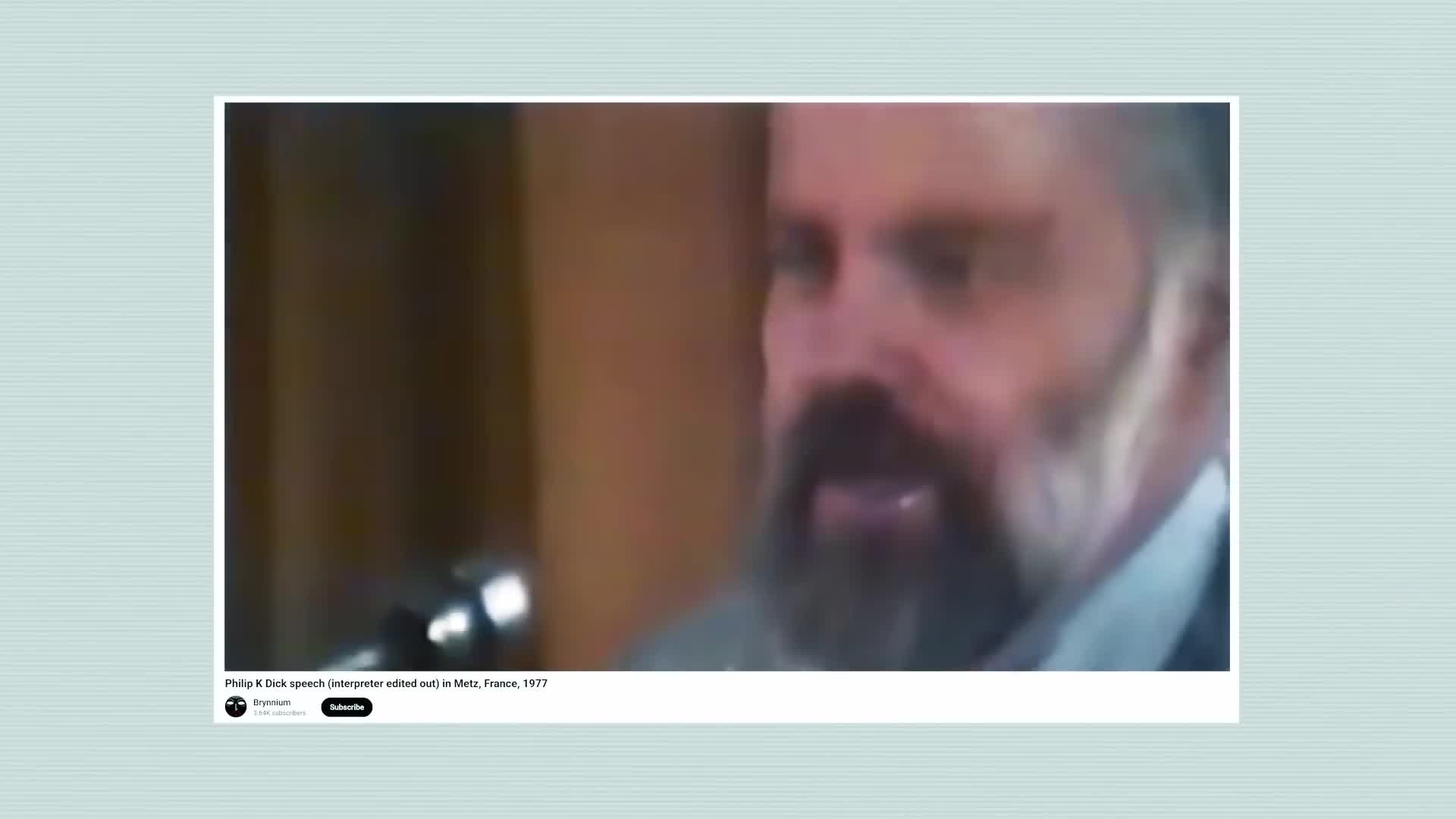
This is the recording some believe cost him his life.
In September 1977, the writer Philip K. Dick spoke to an audience in France.
The expected science fiction.
What he said instead revealed too much about reality and drew the attention of the CIA and FBI, changing his life forever.
The subject of this speech is a topic which has been discovered recently.
A breaching, a tinkering, a change had been made, but not in our present, had been made in our past.
A variable was changed reprogrammed, as it were, and that, because of this, an alternative world branched off, became actualized instead of the prior one, and that, in fact, in literal fact, we are once more living this particular segment of linear time.
He said the CIA and FBI had taken his work years earlier.
That's when you know he may have spoken too much.
In March of 74, the CIA opened my mail.
The FBI had a file on me.
I'd seen both.
But the cops were watching everything I did.
And I was correct.
And I was told the house was being washed.
And that eventually my house would be hit, my files would be opened, my papers would be taken.
And so it came to pass.
When I came home and found my house consisting of nothing but rubble ruins chaos, broken windows, smashed doorknobs, blown open files.
A few years later, he suddenly dies, right before the premiere of Blade Runner, June 1982, the film adaptation of his novel to Android's Dream of Electric Sheep.
Fans said it was strange that the author, who had predicted so many modern themes about AI, identity and reality, never got to see the movie that would finally make him widely famous.
What's strange to me is that he was only writing science fiction, yet the FBI and CIA started watching him.
To me, that means he was touching information never meant for the public.
That's what caught my attention, so listen carefully to what comes next.
I know attention spans are short, but trust me, this video will give you chills.
We are accustomed to supposing that all change takes place along the linear time axis, from past to present to future.
The present is an accrual of the past and is different from it.
The future will accrue from the present on and be different yet.
That an orthogonal or right-angled time axis could exist, a lateral domain in which change takes place, processes occurring sideways.
In reality, so to speak, this is almost impossible to imagine.
How would we perceive such lateral changes?
What would we experience?
What clues, if we are trying to test out this bizarre theory, should we be on the alert for?
In other words, how can change take place outside of linear time at all in any sense to any degree?
Philip tries to make this strange idea easier to understand with a simple picture.
Imagine a painting on a wall.
Instead of replacing the whole painting, the servants secretly change details on the same canvas.
They remove a tree, add a girl, shift small elements.
When the owner looks at it, he sees something new, yet also familiar.
His brain struggles.
It's the same painting, but also not the same.
Dick uses this example to suggest that reality might be altered in subtle ways, not fully replaced.
Contemplating this possibility of a lateral arrangement of worlds.
A plurality of overlapping Earths along whose linking axis a person can somehow move, can travel, in a mysterious way, from worst to fair, to good, to excellent.
Contemplating this in theological terms, perhaps we could say that herewith we suddenly decipher the elliptical utterances which Christ expressed regarding the kingdom of God, specifically where it is located.
He connects his theory of parallel worlds to the words of Jesus.
He points out that Jesus gave answers that seemed contradictory about the kingdom of God.
He said, my kingdom is not of this world, but also the kingdom is within you or among you.
Dick suggests these statements weren't meant to confuse, but to describe something deeper.
Maybe Jesus was speaking about these overlapping realms, multiple realities that can be reached by living human beings.
Some of them dark, others beautiful, and at the highest level, the just kingdom of God.
I, in my stories and novels, often write about counterfeit worlds, semi-real worlds as well as deranged private worlds inhabited often by just one person, while meantime the other characters either remain in their own worlds throughout or are somehow drawn into one of the peculiar ones.
This theme occurs in the corpus of my 27 years of writing.
At no time did I have a theoretical or conscious explanation for my preoccupation with these pluriform pseudo-worlds, but now I think I understand.
What I was sensing was the manifold of partially actualized realities.
It was in February of 1974 that my blocked-off memories of Track A returned, and it was in February of 1974 that my novel Flow My Tears, the Policeman Said, was released finally, after two years' delay.
It was almost as if the release of the novel, which had been delayed so long, meant that, in a certain sense, it was all right for me to remember.
That is to remember that the book was not fiction.
The book was based on subliminal memories which I had of such a world.
After connecting his book to subliminal memories, he went deeper into describing what happened to him in early 1974.
He said it began after dental surgery, when he was recovering at home.
One afternoon, a delivery girl came to his door wearing a necklace with a Christian fish symbol.
As the sunlight reflected off the necklace, Dick saw a sudden flash of pink light.
From that moment on, he reported a series of overwhelming visions.
He claimed, the pink beam carried information directly into his mind, not images he imagined, but structured knowledge.
He suddenly knew that his infant son had a dangerous undiagnosed medical condition.
When doctors checked, they confirmed it, saving the boy's life.
To Dick, this proved the experience was not fantasy.
In the weeks that followed, the visions intensified.
He said he lived in two overlapping realities California in 1974 and ancient Rome in the first century.
At times, he believed he was both himself and a Christian slave living under Roman rule.
He described it as if time had folded two tracks of history running at the same time and his consciousness could move between them.
Philip also reported receiving vast amounts of information, entire downloads of philosophy, theology and science that felt too complex to invent.
He said it was as if an external intelligence, which he later called valis vast active living intelligence system, was transmitting knowledge into his brain.
For him.
This explained why many of his novels already contained themes of false realities, hidden powers and overlapping worlds.
He believed those stories were subliminal, memories breaking through long before he consciously understood them.
Plural realities did exist, superimposed onto one another by so many film transparency.
What I still do not grasp however, is how one reality out of the many becomes actualized in contradistinction to the others.
More likely the matrix world, the one with the true core of being, is determined by the programmer.
He or it articulates Prince out, so to speak, the matrix choice and fuses it with actual substance.
The core or essence of reality, that which receives or attains it, and to what degree that is within the purview of the programmer.
This selection and reselection is part of general creativity, a world building which seems to be it, or his task.
As you can see, some people in the audience laughed at what he was saying.
Remember, this was 1977.
Back then, ideas about multiple realities and hidden programmers sounded completely insane to most people.
Today, talk of simulations, parallel worlds, or alternate timelines isn't new anymore.
Scientists and philosophers discuss it openly.
But what still makes me pause is not the theory itself.
It's the fact that the CIA and FBI really did open his mail, keep files on him, raid his home and take his papers.
That part still raises questions.
If he was just a sci-fi writer making things up, why go to such lengths?
Maybe he had said too much.
And to make his concept easier to grasp, he gave an example.
He compared reality itself to a game of chess.
Imagine two players, one representing a dark, destructive force and the other representing the guiding intelligence behind reality.
On the surface, it can look like the dark player is winning moves, capturing pieces and gaining control of the board.
But in truth the game is already structured so that the ultimate victory belongs to the higher player.
According to this view, the Guiding Intelligence, what Dick sometimes called the programmer, has already chosen the variables in advance.
Every apparent loss is only part of a larger sequence that leads to final victory.
People sense this instinctively, which is why they pray to be included in that winning path, asking not to be left behind in the game.
To be left out means staying under the influence of the destructive force, stuck in a darker version of reality.
But even as that force seems clever, even as it appears to win in the short term, it is already defeated.
It is blind to the full pattern of the game.
The higher player sees the whole board, sees every possible move, and because of that the outcome is decided.
The constructive force will always prevail, and the only question is whether we are moved along with it or left trapped in the losing side of the match.
I submit to you that such alterations, the creation or selection of such so-called alternative presence is continually taking place.
The very fact that we can conceptually deal with this notion that is entertained as an idea is the first step in discerning such processes themselves.
He gave some very simple examples of how these shifts might show up in everyday life.
You might reach for a light switch in your bathroom and suddenly realize it has always been in a different spot.
Or you might go to adjust the air vent in your car, only to find there was never one there at all.
These are reflexes left over from another version of the present.
Habits from a timeline that no longer exists, but which still linger in your memory at a subconscious level.
Sometimes we even dream of people or places we've never seen yet.
They feel familiar and vivid, as if we really had known them.
Most of the time, we dismiss it and move on.
But one of the strongest impressions many people experience is deja vu, that strange, undeniable feeling that we are reliving the present moment exactly as it happened before.
We hear the same words, we say the same words, and we are sure we've been here before.
Dick argued this wasn't just a trick of the mind.
For him, deja vu was evidence.
He believed it was a clue that at some point in the past a variable had been changed, as if reality was reprogrammed, and that a new timeline branched off from the old one.
In other words, we are not just imagining it, we are literally reliving the same segment of time again, only in a slightly altered version of reality.
A breaching, a tinkering, a change had been made, but not in our present. had been made in our past.
Evidently, such an alteration would have a peculiar effect on those persons involved.
They would, so to speak, be moved back one square or several squares on the board game which constitutes our reality.
Conceivably.
This could happen any number of times, affecting any number of people, as alternative variables were reprogrammed.
We would have to live out each reprogramming along the subsequent linear time axis.
But to the programmer, whom we call God.
To him the results of the programming would be apparent once.
We are within time and he is not.
We are living in a computer programmed reality and the only clue we have to it is when some variable is changed and some alteration in our reality occurs.
He believed that every time reality shifts, a new lateral world is generated, and with each shift, the guiding intelligence, the programmer, achieves a kind of victory.
Each new version of reality isn't perfect, but it's slightly better than the one before it.
In his view, the universe is constantly being refined, stage by stage.
Through this process, The way he described it, the old universe doesn't disappear.
It becomes raw material, a kind of stockpile that is used to build the new one.
What looks like chaos or broken fragments in one timeline might actually be the foundation for the next.
This means reality isn't moving toward collapse, but toward improvement.
Even if we can't always see how the process keeps pushing forward, generating alternate worlds, one after another, each infused with a little more order and structure than the last.
What we need at this point is to locate, to bring forth as evidence someone who has managed somehow it doesn't matter how to retain memories of a different present latent, alternate world, impressions different in some significant way from this, the one which is at this stage actualized.
According to my theoretical view, it would almost certainly be memories of a worse world than this, for it is not reasonable that God, the programmer and reprogrammer, would substitute a worse world in terms of freedom or beauty or love or order or healthiness by any standard which we know.
If what Philip K Dick was describing is true that reality can shift sideways, that alternate versions of the world appear again and again, then maybe we've already seen signs of it without realizing.
One of the clearest examples is what we now call the Mandela Effect.
Millions of people around the world share the same memory of something that doesn't match today's official version of events.
The name itself comes from people remembering that Nelson Mandela died in prison during the 1980s.
They remember news reports, public reactions, even school lessons about his death.
Yet in this timeline, Mandela was released and later became president of South Africa, living until 2013.
For those who have the older memory, it feels as though history was rewritten.
And it doesn't stop there.
People remember the Berenstain Bears spelled as Berenstein with an E.
They remember the Monopoly Man having a monocle when in fact he never did.
They recall the movie line Luke, I am your father, when the actual line is No, I am.
These aren't just a handful of mistakes.
They're shared consistent memories across millions of people, as if we really had lived in a slightly different version of reality.
Philip K. Dick's theory offers one possible explanation.
If variables can be changed, if a programmer can shift us laterally from one track to another, Then deja vu, false memories or the Mandela Effect might not be errors at all.
They could be traces of previous presence.
Fragments of timelines we once occupied but no longer do.
This is where things get even stranger.
Because it's not just personal memories.
Pop culture itself sometimes seems to reveal knowledge of events long before they happen.
One of the most famous examples is The Simpsons.
For more than three decades, the animated show has been making jokes that later turn out to mirror real-world events with uncanny accuracy.
Years before smartwatches were invented, The Simpsons showed characters using wrist devices to make phone calls.
They joked about a defective autocorrect feature on a handheld device.
Long before smartphones made that frustration a daily reality.
They even portrayed Disney eventually buying 20th Century Fox, a merger that seemed absurd at the time but became reality in 2019.
In another episode they showed a skyscraper with a design almost identical to London's Shard, drawn over a decade before construction even began.
They sketched a Nobel Prize prediction board that matched the actual Nobel winner announced years later.
And in one storyline they featured a three-eyed fish living near a power plant, which was followed years later by news photos of a three-eyed fish discovered in Argentina living by water contaminated from a nuclear facility.
At some point, the list becomes too long to ignore.
These aren't just vague jokes that can be stretched to fit events.
They're oddly specific details, many of them tied to technology, science or cultural shifts that hadn't happened yet.
Some people laugh it off as coincidence, others wonder if the writers had hidden knowledge, and some even go further suggesting, half joking but half serious, that the show's creator might have glimpsed the future or somehow tapped into the same overlapping layers of reality Philip K Dick described back in 1977
When you place these examples next to his words, the similarities are hard to miss.
He spoke of multiple versions of the world, stacked like film transparencies, with one becoming actualized over another.
Whether through shared memories, déjà vu or a cartoon that seems to predict events years ahead of time, the effect is the same.
We're left questioning whether reality is as fixed as we assume.
And once you notice it, you start to wonder, are these just coincidences?
Or are they clues that we are already slipping sideways, moving through alternate timelines, without even realizing it?