What you're suggesting here is something.
Uh, i think i think if, if i can read into what you're saying, it has implications for science and for the scientific community.
We're locked in this apparently solid, substantive reality.
The universe has many, many levels of reality.
We just haven't accessed the level that shows us how profound and magical that reality is.
What i'd like to do next is i'm working on a book that is the practical application of this holographic idea and all of its very phases.
We've got to understand that we have this enormous capability but our conscious mind feeds it all kinds of things unwittingly and gives it all kinds of mistaken directions.
And I want to write a book that really deals with all these things and all kinds of levels.
Saying here are the practical applications outweighs it.
You don't have to deal with the very sort of heady space-time aspects of these things.
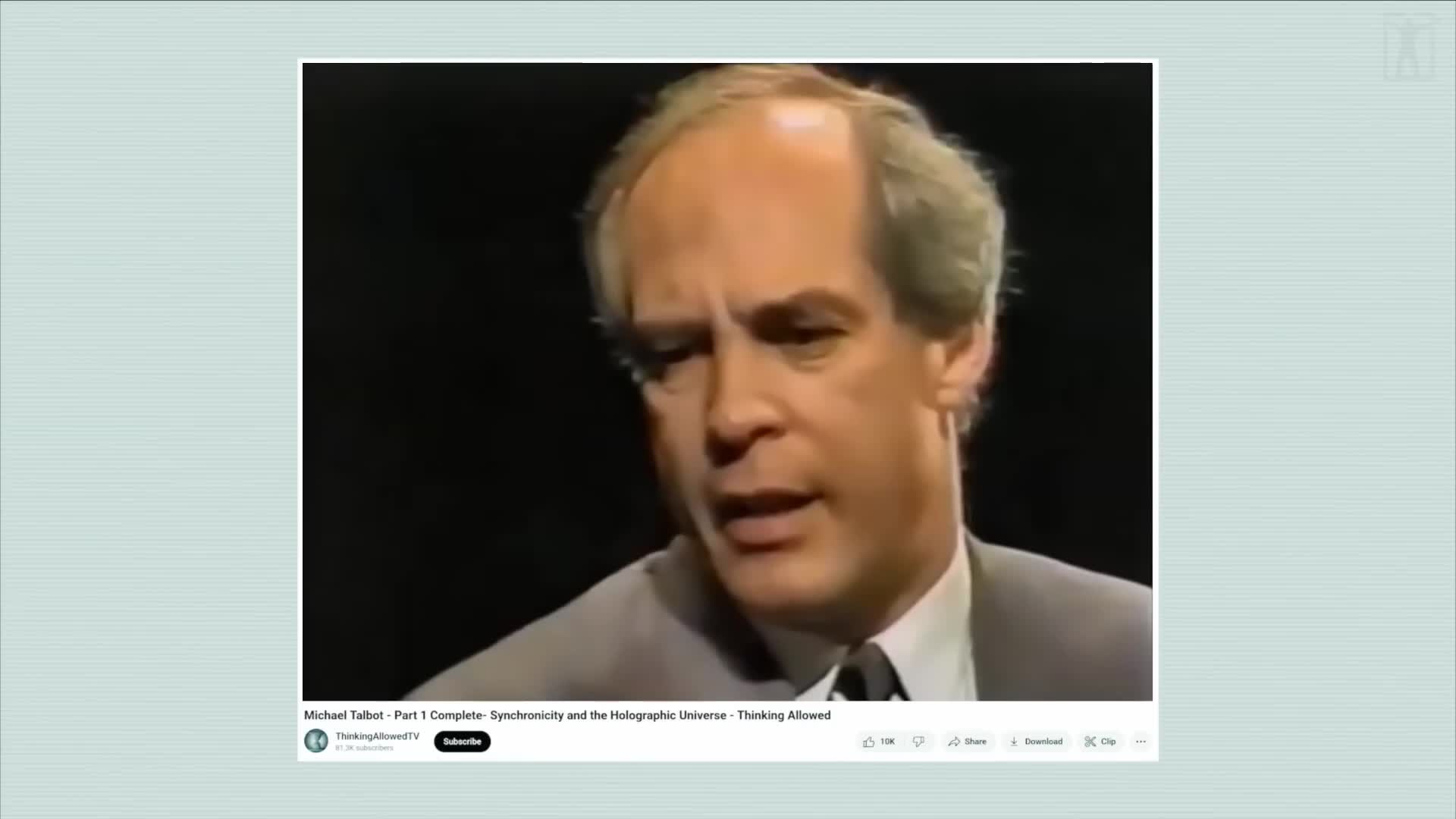
Right after making that statement on TV, he died in a very strange way.
His name is Michael Talbott, an independent researcher who had decoded reality or multiple realities, something most people were never supposed to know.
He passed away suddenly, and his ideas forced many scientists to question what they thought they knew.
Talbot's central claim was bold.
This world isn't the only one.
There are parallel realities happening at the same time, but we can't normally see them.
By the late 20th century, quantum mechanics had already exposed cracks in the traditional view of an objective universe.
The double-slit experiment revealed that particles behave differently when observed, suggesting that the observer is not outside the system, but part of it.
Rather than dismissing this as an anomaly, Talbot treated it as the foundation of understanding existence.
Reality in a hologram can manifest in two ways as a concrete image or as this sort of indecipherable blur of energy.
An analogy to this is when you're watching Johnny Carson's new television set.
That's really his image is encoded in two ways.
One is as the concrete image on the TV set, one is as the blur of radio waves permeating the living room.
And if the universe is a hologram of some sense, in some way it suggests that there may be two very drastically different levels to reality, that the concrete reality we see, you know, when we look at these chairs and at you know the trees and the clouds and everything like that, our bodies are just one way that reality manifests and that at some deep level, there's another.
There's a level of reality where everything dissolves into an ocean of energy that is holographically interconnected, where every portion of the universe is contained in every tiny area of the universe.
From this perspective, reality is layered.
Each level of perception connects to deeper levels and all of them converge into a unified field where the division between mind and matter disappears.
Within such a framework, Death is not an ending, but a transition.
A movement into another layer, similar to shifting frequencies.
This wasn't presented as vague speculation.
It was a coherent framework.
Matter depends on consciousness, not the other way around.
For ordinary readers, this was a shocking reversal of common sense.
For certain institutions, it overlapped with secret research into altered states and perception.
If you take two subatomic particles, like electrons in certain instances, when you do something to one, it will always affect the other, no matter how far apart they are.
It's kind of like stories that you've heard of identical twins, where when one is hurt, the other feels the pain.
And the problem is is that we can find no process known to physics that explains how these could be sending a signal back and forth.
Because it would have to be faster than the speed of light.
Instantaneous.
It would have to be an instantaneous signal.
And Einstein's theory of relativity said you can't have instantaneous signals because it would mean that you could violate the time barrier and conceivably call your grandfather and tell him not to marry your grandmother.
And most physicists say well, this would be just too troubling to incorporate into a rational picture of reality.
Think about identical twins.
There are countless stories where one feels something the moment the other is hurt or in danger.
Even if they're miles apart, It's hard to explain that in normal physical terms.
Talbot connected this with what physics was already finding at the quantum level.
Particles that act the same way, linked instantly no matter the distance.
And if matter itself can stay connected like that, then maybe our minds work through the same hidden network, connected in ways science still doesn't fully understand.
If the universe is holographic, then everything we experience is interconnected and every part reflects the whole.
Time, space and matter may not be absolute, but flexible, shaped by deeper laws we don't yet fully grasp.
Talbot suggested that life and death are part of one continuous spectrum where consciousness moves across realities rather than vanishing.
Just as this message began to spread more widely, he died.
And what he left behind continues to raise questions about the very structure of existence.
At a deeper level, a very holographic level of reality.
Every particle in the universe collapses to a sort of cosmic unity.
They're not signaling each other.
They're like that fish where there's the level of the aquarium.
And so what that means, talking about words, is that there is no separation between electrons.
Furthermore, there's no separation between people.
And this has all kinds of very boggling implications, one of which is that we've always tried to understand, for example, psychic phenomena like how could I get information out of your head and my head as some sort of signal going back and forth?
But if we're organized, if we live in a universe that's organized holographically?
This was one of his most provocative claims.
That separation itself is an illusion.
If every part of the universe already contains the whole, then the idea of being isolated, whether as particles or as people, simply collapses.
What appears as distance is just part of the projection.
In that sense, telepathy or intuition would not be about sending signals back and forth, but about accessing a field that already holds everything everywhere at once.
The real shock was how far this could go.
If every person carries the entire universe within them, then boundaries between minds are only temporary filters.
Under certain conditions those filters could loosen and experiences usually dismissed as paranormal might be glimpses of how reality truly works.
Well, it also turns out that our brain uses fourier transforms to translate visual information.
This is a very unusual state of affairs.
It's kind of like discovering Eskimo speaking Spanish.
You know, it's not proof that the brain is a hologram, but it's suggestive that the brain is a hologram.
And it turns out, in fact, all of our senses appear to rely on sort of Fourier transforms, that they all seem to use the same mathematics.
So again, here's evidence that the brain uses the same mathematics to decipher the sensory world as they're involved in the making of a hologram, which is, as I say, not proof but compelling evidence that something is going on there.
This was another piece of evidence pointing in the same direction.
The mathematics of holograms seem to show up in the way the brain processes sight, sound and other senses.
If true, then our entire nervous system might be working on holographic principles, breaking reality into frequencies and reconstructing it into the world we see and feel.
That would mean perception itself is not a window onto an external reality, but a process of decoding a far more complex pattern hidden beneath appearances.
For Talbot, this was more than theory.
His perspective was shaped by direct experience.
At a young age, I had an out-of-body experience where I left my body and it became quite apparent to me while I was having this experience that I was thinking, but my brain was back in my body, which I could see in my bed.
I knew it wasn't just a dream because I floated out over the ground outside my family's house and I saw a book lying on the ground.
And it was a book by the French short story writer Guy de Maupassant.
And the next day, a neighbor said, by the way, Michael, I lost a library book by Didier Maupassant.
Have you seen it?
And I thought, well, I floated over it last night.
I didn't tell the neighbor that.
But there was the book.
And I was always very, I'm still very scientifically oriented.
I want to understand the world in scientific terms.
But it was really the first time that I sort of had to confront the difference between my spiritual beliefs that we can survive our bodily death and this deeply held scientific belief of mine that it's the brain that's doing the thinking.
And I realized I had a kind of epiphany where I thought it isn't the brain that's doing the thinking.
So I am not entirely certain that it's just the electromagnetic interference patterns, that is, the brain hologram, because those obviously would perish when the brain perishes.
I think there might be some subtler level, some subtler energy that we haven't discovered with our technology.
That's involved in this also.
If thought could continue outside the body, then the brain could not be the ultimate source of consciousness.
Something else had to be at work, some layer of energy or order that science had not yet detected.
For him, this was the beginning of an unavoidable conclusion.
Death might only affect the body, not the mind that animates it.
There's a device called a squid, which is a sort of electrical coil in which it looks like we may be able to demonstrate that the current.
If you say which direction is the current going in the coil, it's going both directions at once, which is kind of an impossibility.
But to simultaneously do that, that too is a quantum phenomenon, that these two realities are overlapping.
So I think we will cross that barrier.
Experiments like this push the idea further.
If a current can flow in two directions at the same time, then reality is not locked into one outcome.
It means that different possibilities can exist side by side overlapping, until something forces a choice.
That's not science fiction.
It's a lab result pointing to the same conclusion.
Our universe may hold multiple realities at once.
And if quantum systems can do this, the question is whether consciousness itself is capable of moving between those overlapping states.
The implications here go beyond physics.
They touch everyday life, even medicine.
In medicine.
People have used this application of the holographic idea that we respond to the model of reality, say this may be why we respond more to the placebos to fake drugs.
There's a very famous example of a fellow who had a lymphatic cancer, tumors the size of oranges all throughout his body.
His doctor basically thought he had about three days left to live.
The fellow heard about a new drug called Crebiosin and said, you've got to give this to me.
And the doctor said, well, frankly, you know, I don't think you have long to live in this drug.
It takes several weeks to take effect.
He gave the man Crebiosin and three days later the man's tumors melted, as the doctor put it, like snowballs in a hot stove, completely gone out of his body.
Faster than the strongest radiation treatment could have melted them away.
The man is up around, walking around his hospital room, resumes his normal life.
Seems to be completely cancer-free.
Several months down the line, he reads an article saying crebiosin isn't that effective.
Boom, boom, boom, all his tumors come back.
He's back in the hospital.
The doctor starts to realize that maybe it wasn't the drug that cured the man, but the man's belief.
So he lies to the man and he says, those articles are wrong.
Crebiosin is effective.
And in fact, I've got an even more potent version of it.
He injects just salt water into the man's veins.
Again, the man's tumors melt away.
He resumes his normal life.
Unfortunately, many months down the line he reads final studies on Crebiosin, saying it's completely ineffective.
Boom, boom, boom, his tumors come back and he dies.
Stories like this reveal something we usually overlook.
The body doesn't just respond to chemicals, it responds to belief.
If the mind expects healing, the body can sometimes follow, even when the treatment itself is fake.
That's the placebo effect, and Talbott saw it as another clue that consciousness is not separate from physical reality, but directly shapes it.
Think about what that means.
If expectation alone can shrink tumors, then our model of reality isn't just in our heads.
It reaches into the body, into matter itself.
The placebo effect stops looking like a medical trick and starts to look like evidence that belief can bend the physical world.
One of the areas you had mentioned earlier that one of the exciting things about the holographic idea is that people have taken this and explored all different realms.
You know that some have used it to say this is how acupuncture works, because it turns out that there are little microacupuncture systems where you can find the entire body in the acupuncture points of the ear.
Recapitulated in the ear, yes.
We talked about the placebo effect.
Some have said that the holographic idea applies in near-death experiences.
One of these individuals is Kenneth Ring, who is at the University of Connecticut studies near-death experiences.
And it's interesting because in report after report of people who have been declared clinically dead, you know, go to some apparent other level of reality and then come back.
They refer to this other level of reality with terms like frequency and energy and even hologram, that it's a plastic, a more plastic level of reality, where thought seems to create things instantly.
There are instances of people having near-death experiences, where they think they're hungry and instantly food appears.
Or perhaps an even better example, when people find themselves out of their body.
There are cases where people look down and see that they're in a naked body and they go oh my gosh, I'm naked.
Instantly they have clothing on.
Now, we don't assume that clothing has a soul, you know, that has a spirit that survives.
Near-death stories take things to another level.
People who go through them often say their mind kept going even when their body had stopped.
What they describe sounds very different from normal life more flexible, more alive, almost like the world around them was responding straight to their thoughts.
Talbot looked at this and said maybe this is a small glimpse of how reality really works when the brain is no longer in the way.
I very much believe that our soul lives many, many lives and goes through these things.
And I think at this point in our development that we have manifested in the physical because we don't have a consciousness that's developed enough to deal with reality with its full grandeur and plasticity that for us it would be very frightening if there weren't solid rules, if everything started to slip and slide.
But i think as your soul goes along it starts to learn to deal with more than this reality, with other levels on the holographic television set.
And when you start to open those doorways, that's when reality, the plasticity of reality, starts to seep in.
But then you go through a sort of shamanistic rite of passage, because you've got to go through.
Most people go put an interpretation on.
They go oh, this is an angel or this is, you know, a demon or a ufo abduction.
And if you do that you're missing the basic lesson of shamanism, which is that everything that you experience in the non-ordinary reality of the shaman has psychological meaning for you, that that you are entering a level of reality that responds so directly to your thoughts that your every thought helps what manifests.
And in that instance you can't ask what is there?
But why have I created what is there?
And I think that's the lesson that our souls are learning as we evolve.
As consciousness evolves, those rules loosen, and we start to see how plastic reality really is.
That's why strange experiences visions encounters, even UFO abductions, might not be what they seem.
They could just be the mind trying to make sense of another layer of reality that answers directly to thought.
When you encounter something that is truly of another reality, your perceptions are trying to pull it out of this blur of energy and make it into a hologram.
Don't quite know how to put it into form.
And so I think that the reason there are many psychological motifs in UFO experiences is because there's something going on, but the surface appearance is a product of the person's own psyche.
In other words, a lot of what's going on in these various holographic realities are like ink blocks.
Right, they can be interpreted like dreams as well, that they have psychological symbols in them.
But there's also something real there, because UFOs can be tracked on radar.
They leave circles on the ground, they leave traces of physical evidence.
The universe, in his eyes, wasn't a fixed machine.
It was alive, layered, holographic, and deeply connected to consciousness.
Death wasn't the end.
Paranormal experiences weren't random.
Even the strangest encounters could be part of a deeper structure.
We're only just starting to notice.
Talbot didn't live long enough to see how much his ideas would spread, but the questions he raised remain just as sharp today.
What if reality is not as solid as we think?
What if our minds are part of a field far larger than we've been taught to believe?