This BBC podcast is supported by the UK.
Enjoy coffee with the best quality in your home with Philips Latte Go 5500.
Discover what reaches 20 drinks of hot or cold coffee with one touch of the button.
From the rich espresso to the ice-cold coffee.
Prepare your coffee from your favorite coffee beans to get rich and high quality coffee in every cup.
Coffee in the way that suits your taste.
Prepare at your home at the moment you choose.
Reema, do you think we're going to make Sambousa again this year?
Honestly, Azouz, last time was very nice.
Welcome, Madam Khawla.
Welcome.
The Sambousa preparation place with Chef Hassan is ready for the family.
Wow.
It's nice to remember him.
This is The Happy Pod from the BBC World Service.
Hello, I'm Oliver Conway, and in this edition I've called it Galahadisukas Jonesi, so Jonesi notably here honouring Rhys Jones, my physics teacher.
It was such an unexpected privilege and honour to have a crocodile named after me.
The physics teacher honoured by one of his former students.
The school in Brazil that's transformed itself from one of the worst to one of the best.
Plus...
When my eyes actually focused in, I thought, oh, it's a leg.
And then I thought, oh no, where's the rest of the person?
I'm looking up the cliff thinking, surely someone's not fallen down the cliff.
The woman who found a prosthetic leg ten months after it was lost and Performing again after two years of painful silence was simply incredible.
I felt seen and heard for so much more than just my illness.
I felt like myself again.
The man given back his voice thanks to A.I.
But we start with a story about an inspiring teacher.
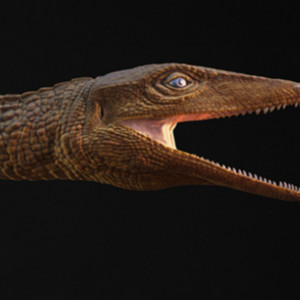
29-year-old Ewan Bodenham is studying for a PhD in physics and while analysing fossils, he identified a new species of ancient crocodile.
When it came to naming it, he decided to honour his school physics teacher, Rhys Jones, calling the creature Galahadossuchus jonesi.
Here's the moment Ewan told Mr Jones via a video call.
I just had...
Today, the first paper of my PhD published.
All right.
So the first chapter of my thesis is naming a new species of fossil crocodile.
And I'm naming it after you.
Good God.
What an honour.
What a privilege.
Fantastic.
I'm delighted to hear that.
That's very, very kind of you to remember me.
Yeah, honestly, you were such like an inspiration in school.
I'm welling up a bit.
Hang on, I still am.
I'm still here.
Well, Ewan and Rhys spoke to the Happy Pod's Holly Gibbs.
I think it was something that I was always interested in and sort of, yeah, naturally interested.
But yeah, Mr Jones really sort of like helped me pursue that interest.
And Mr Jones, a.k.a.
Rhys, is also here.
Rhys, what do you remember about Ewan at school?
I think I taught Ewan for about five years at Cardian School.
He was very serious-minded at times, a little bit mischievous, at other times, a good sense of humour, but he was always going to succeed at whatever he chose.
There was no question of that.
So, Ewan, talk to us about the species that you have discovered.
Yeah, so this species is from the Lake Triassic of what is now southwest England.
Yeah, this is one of the earliest members of the group. crocodile amorpha.
So this is like extant crocodiles and their extinct relatives.
So one of the earliest members of those.
And this is quite ecologically different to crocodiles that we're familiar with today.
And so I think people have this perception that crocodiles have always looked the same, but this group has explored a whole array of different ecologies.
So I've called it Galahadossuchus jonesi.
So jonesi is Notably here honouring Rhys Jones, my physics teacher.
Rhys, how does that feel?
Wonderful, of course.
It was such an unexpected privilege and honour to have a crocodile named after me.
Delighted, over the moon about it.
How did you find out?
It was three o'clock or just before three o'clock on a Friday afternoon.
Not a whole lot of teaching going on, to be honest.
I think I may even have been drinking a cup of tea and I get a call from the head's office report to the head immediately, which is quite irregular, to put it mildly.
I was somewhat anxious, made my way straight to the head's office, didn't know what to expect.
And there was Ewan's face on a computer screen on a Zoom meeting.
All a bit of a blur, to be honest.
But then he let me know.
And yeah, it's taken a while to sink in.
Rhys, could you ever have imagined that this would have happened in your teaching career?
Good God, no, no, it's...
You know you get the pleasure from teaching, of seeing students go on to be successes in the community and further afield.
And that's the greatest reward you think you can get.
But something like this goes way above and beyond such things.
It's wonderful.
And Ewan, what would you say to teachers like Mr Jones who go on to inspire schoolchildren to go and achieve big things?
I mean, thank you if they're already doing that.
But I think, just in terms of what Rhys did so well is just yeah, have a real interest in his subject, because that really comes across and helps to inspire.
And also just treating the students like friends, like adults, showing them sort of respect, keeping a sense of humour.
I think that goes like a long way in terms of making students feel valued and helping to inspire them.
One of the great things about you when coming to school next week, I'll be able to say to the students in my physics lab, the same room he sat in, what?
11 or so years ago now I'll be able to say.
Ewan Boddenham from St Dogmose sat in that chair and he went on to discover new crocodiles.
And I'm sure he will continue to discover many more things in his career ahead of him.
It makes it much more accessible to people.
The students we have in our school.
They'll be able to think oh, if he came from Cardigan, if he came from a local village, I can do the same thing.
And that's invaluable for me.
It makes my job so much easier if they have the belief that they can actually reach the top.
Ewan Boddenham and Rhys Jones talking to Holly Gibbs.
From Mr Jones' classroom to a school in Brazil called Parque dos Sonhos, or Park of Dreams.
Many people had given up on it a decade ago, but it's now gone on to win a prestigious international award, all thanks to the man who reluctantly took the job of headteacher.
The BBC's Ruth Pina has been to visit.
When we arrived...
When we got there, all the computers from the computer room had been stolen.
And every day I would think, what am I going to find there?
What's going to happen today?
That's Maria de Lourdes de Lima, a teacher at Parque dos Sonhos, a public school which once faced constant breakings, theft and violence.
But now it has been recognized as one of the best in the world.
It sits between Latin America's largest port, Santos, and the steep mountains of Cerro do Mar.
In the early 2010s, the city ranked among the most violent in the state because it was often used for drug routes.
And the school was known for being dangerous, as it was completely exposed to local drug trade.
As a result, the school was subject to breakings and vandalism.
Regis Marques was invited to become principal because of his experience dealing with challenging school environments.
Half of the students have requested transfers because they didn't want to study here, because of the violence, because of the assaults.
Hedges set a big goal to turn the school into the best in the region within five years.
He pitted the project as a way to give back.
He argued that education is the best tool to transform the community and create a fairer society.
The full-time school introduced 23 projects, including sports, journalism and theatre.
Esther is a student.
At first, I thought it was just going to be the classroom, so I didn't like it very much.
But then things started to grow.
The school got new projects.
And today it's really cool because we're not just stuck in the classroom.
There are lots of other spaces.
But the most transformative project came from a simple decision teachers began making regular visits to students' homes.
At the same time, we started working on listening to the students, having a more humanised perspective, really focusing on them.
What moves me is seeing this entire process, this transformation, understanding how the school can be a point of change.
Last year, the hard work paid off.
The school Parque dos Sonhos won the world's best school prize in the Overcoming Adversity category.
Esther Silva remembers it well.
It was very emotional.
People were crying.
I was extremely happy, really, really happy when we found out we were ranked number one.
Wow, it made me want to cry.
It was so emotional, so emotional.
And the transformation that brought the award home also had an impact on student performance.
The school's official score more than doubled, a significant improvement, even if they aren't at the very top of the state's ranks yet.
Last year, Parque do Sonho served more than 530 elementary school students.
This year it will also begin offering high school a new chapter for a school once considered impossible to save.
Imagine a school that was about to close in 2016 because it didn't have enough students.
And by 2026, we'll be starting the year with 1,200 students.
It's inspiring.
Ruud Pinier, reporting.
A 69-year-old woman has been reunited with her prosthetic leg ten months after she lost it.
Brenda Ogden was braving her first ever open water swim off the east coast of England when a wave knocked her off her feet and the prosthesis washed away.
Her custom-made titanium blade was eventually found more than 20 kilometres away.
Jake Zuckerman takes up the story.
So much.
This was the moment Brenda Ogden got her leg back.
Oh, no.
It all started ten months ago here on the beach at Bridlington.
Brenda was looking forward to her first swim with the Flamborough Flippers, but as she entered the water, disaster struck.
A huge wave just come and knocked me off my feet.
And I just fell completely over.
And when I tried to stand up, I'd realised it was gone.
Brenda fell and I saw her leg drift off.
And as I went to grab it, a wave came and took it.
And yeah, never seen again.
Despite everyone's best efforts, there was no sign of the leg.
Small children were looking for it.
Old people were looking for it.
Dogs were looking for it.
Everyone was looking for it.
Nobody found it.
It seemed the leg had gone for good.
Until Lizzie, a fossil hunter, was out combing the shoreline at Hornsea when she came across something a little unusual.
I looked at the cliff and I said, I did a double take.
I was like, that's weird.
So I went across and had a look.
When my eyes actually focused in, I thought, oh, it's a leg.
And then I thought, oh, no, where's the rest of the person?
I'm looking up the cliff thinking, surely someone's not fallen down the cliff.
Thanks to social media, the two were quickly connected and after ten months kicking about at the bottom of the North Sea, the leg is now finally back with Brenda.
Ooh.
Really, really, really lovely.
Because it was something I'd never thought I'd see again.
And you get very attached to things.
This is part of my body.
It's one of my legs.
Without it, you're not going anywhere, are you?
Brenda can't wait to get back in the sea.
And the rest of the Flamborough flippers helped her celebrate with a bottle of bubbly.
Don't get legless.
Jake Zuckerman reporting. still to come on this podcast.
I had a heart transplant June 2024 and after the heart transplant I joined this exercise session.
It's helped me a lot physically and emotionally.
The Pilates class that's gone viral for helping men over the age of 50.
See the family of Badr coming to celebrate Ramadan in Hilton.
Rima, do you think we will make Sambousa again this year?
Honestly, Azouz, last time was very nice.
Welcome, Madam Khawla.
Welcome.
The place to prepare Sambousa with Chef Hassan is ready for the family.
Wow.
Nice, remember.
Hilton, for the stay.
And with world-class service in the Emirates lounge and exceptional comfort on board.
You can reach global business hubs in style with Emirates.
Arrive ready for your next meeting in over 140 destinations in the Emirates network and connect to hundreds more with their airline partners.
You'll experience all the world-class comfort and service, along with chauffeur-driven airport transfers and lounge access.
It's a better way to do business.
Book now on Emirates.com.
When you fly Emirates on business, you can relax from the start.
You get a complimentary chauffeur-driven transfer from your door to the airport.
Then when you land, your chauffeur will be ready to take you wherever you want to go.
It's exclusive for Emirates first and business class travellers.
And with world class service in the Emirates lounge and exceptional comfort on board, it's just a better way to do business.
Next on The Happy Pod.
Police officers in the US state of Kentucky searching for a missing child last month were helped by an unexpected hero.
As they conducted door-to-door inquiries, the team from the Louisville Metro Police Department were approached by a dog.
The animal eventually led them to the missing three-year-old.
The police department has since released body cam footage of the dog.
Frankie McCamley has the story.
A police helicopter joins officers on the ground in Louisville Kentucky, to search for a missing three-year-old boy.
The search captured on body camera footage shows police going door to door asking neighbours if they'd seen the little boy.
But he's nowhere to be found.
Then a dog appears.
There's a dog.
Where's he at?
Let's go.
He gets Officer Josh Thompson's attention and signals that he wants the police officer to follow him.
It led me all the way back to the backyard.
At that point, I'm thinking, OK, there's kids in this backyard.
Officers search a garage but find nothing.
The dog then runs over to a vehicle in the same back garden and sits by it.
The dog went right to the back bumper.
Check the rear here.
Goes to the back bumper, just sat there.
Officer Story follows him.
Yeah, he's right here.
Grab and pull it.
The police managed to pull the door of the SUV open to get the child out.
Here's Officer Thompson again.
He jumped out of the car, bear hugged my neck and wouldn't let go.
Good job, buddy.
The child was unharmed and has since been reunited with his family.
All thanks to those police officers and a hero dog.
I don't know where the dog came from, but it was a blessing from God that day.
Frankie McCamley with that report.
Time for some Pilates with a twist.
One, two, that's it.
Keep it moving, yeah?
Come on, get granddad to do it properly.
Up and then down and rest.
Well, this particular class has been viewed millions of times on social media.
It's aimed at men over the age of 50 and it's put on by leaders at a mosque in the north of England.
The BBC's Cathy Minton has been along to find out more.
Prayers in mosque, a routine for spiritual well-being.
But what of physical and mental health?
Well, don't worry, this mosque has got that covered too.
One, two, that's it, keep it moving, yeah?
At the Jamia Usmania mosque in Bradford, men come for the prayers and stay for the pilates.
Classes are intended for men over 50 and they're proving popular.
So popular that this video on TikTok has had 2 million views.
We are shocked, to be honest.
It's gone worldwide.
We've had nearly 2 million views. on TikTok and a lot of views on Facebook as well.
And we've had comments from as far as America and Indonesia and Malaysia, people asking how do we do this in mosques across the world.
I think for men, you know, when younger men, they're more into bodybuilding, body image.
As the men grow older, into their 50s, 60s, there's less opportunities for them.
And the mosque was an ideal opportunity, a comfortable environment.
And you don't have to wear, you know, tracksuit bottoms, whatever.
You can train in your traditional clothing.
That's what made it more comfortable and more appealing to the older men to come on.
Come on, get down now to do it properly.
Up and then down and rest.
I had a heart transplant June 2024.
And after the heart transplant, I joined this exercise session.
It's helped me a lot physically and emotionally.
And also with this session, I met a lot of new people.
And some people are my best friends now suffer from sciatica and lower back and obviously that this is helping, and also you meet and socialize as well.
So obviously when you get the people like 87 and 60, obviously we're young.
So i mean, if we can do it, so should anybody else should be able to do it as well.
From my own personal point of view, obviously i feel much better mentally physically, and i've seen the same change with some of the other people i've taken part in that, With plans for Mosque Pilates classes for women in the future too.
It's a healthy movement that's worth shouting about.
Cathy Minton there.
To Bangladesh and a community centre giving carers a space where they can feel looked after and meet others in a similar situation.
The charity Carers Worldwide was set up in 2012 to support unpaid family carers.
The BBC's Tahmeed Chowdhury has been to one of the centres near Dhaka.
It is a one-storied building with a large common space and what looks like an office room.
Around 20 carers and volunteers are playing board games such as ludo and carom with their children, while singing both in English and Bangla.
My name is Moinul Islam and I look after the KRR project.
We have initiated this program in Bangladesh first.
The reaction from the KRRs and from their family, from the community, it was really mixed.
Now their family is also very positive because of that.
They realize that KRRs they have also a platform in their community.
I have spoken to some of the mothers here.
Hena and Mariam both have daughters with physical disabilities.
When I was at home, I thought mine was the only child like this and that there were no other such children in the world.
I always thought I was just a mother, that all the responsibilities were mine alone and no one else's.
But after coming here, my husband also cares a lot now, which wasn't the case before.
This happened after coming to the center.
When my daughter was born, everyone was blaming me, my husband, my family and the people around me.
Everyone said the problem was because of me that she is disabled.
Then I came here, talked to everyone and shared my sorrows.
So our mental pressure has decreased, we stay happy.
I now understand that yes, we are also carers, we have responsibility.
Taking care of this girl gives me an identity.
Just as those who work are employees, we are now carers, we have respect and a name.
The center supports around 20 carers full-time, but almost 100 other families can access it when there are events or just for advice.
Moinul, who runs the project center, says most of them are women.
In our one study, we have seen that 85% carers are females and most of them are mothers.
So besides their caring responsibility, now they find out the carers have their own life.
They can participate, they can raise their voice.
So carers' lives are changed.
So it was the carers from the beginning, they were totally invisible.
Now they are visible.
There are six centres like this across Bangladesh.
There are also similar centres now in Nepal and India, with plans to expand and help carers in other countries.
Tami Chowdhury in the Bangladeshi capital Dhaka.
And for more stories like this.
Search for People Fixing the World.
Wherever you get your BBC podcasts.
Finally, we often hear about the downsides of AI, but our next story highlights a more uplifting side, with artificial intelligence used to bring back one man's dream.
We'll sail, sail away.
That's folk singer Patrick Darling.
The song was recorded four years ago, but he's since lost his singing voice through motor neurone disease.
Patrick has recently returned to the stage though with a new voice generated by AI.
Rajini Vaidyanathan spoke to Patrick as well as his bandmate, his speech therapist and his mother.
Patrick answered using his AI voice.
Singing was something that I considered to be such a hugely important piece of my identity.
The grief that came from realising all of that was being stripped away from me was completely overwhelming.
I often felt like there wasn't much point to me being here if I couldn't sing.
Performing again after two years of painful silence was simply incredible.
I felt seen and heard for so much more than just my illness.
I felt like myself again.
It will forever be one of the most special experiences of my life.
And how did you feel when you heard your AI voice for the very first time?
I was amazed at how lifelike and realistic it was.
It sounded so human.
It was like hearing the real me again.
And with it came a whirlwind of emotions.
That's the voice of Patrick there.
Well, let's bring in his mum, Leslie, and bandmate Nick Cocking to start with.
Leslie, you're with Patrick at the moment as you speak to us, so is Nick.
You're all together at Patrick's house.
How does it feel now to hear your son's singing voice again?
Emotional.
It's wonderful to hear him singing again, but also, as you can imagine, it's quite upsetting as well for us.
But we're so proud of him can't tell you how much we're just bursting with pride indeed.
And nick, let me bring you in i know you're with other members of the band as well as a band who's performed together for for years, and then that diagnosis that patrick got, i'm sure there were moments where you thought that you'll never be able to make music together, and now you are, and that's that's a wonderful, wonderful place to be, isn't it?
It's surreal, if I'm perfectly honest with you.
It's two long years since Patrick last sang on stage with a live performance in the band.
And things were pretty hard for us all back then, obviously for Patrick more than anybody.
And yeah, when Patrick sent me the track with the vocal and the guitar on it took me half a dozen times just to get past the first two words because it was just far too emotional.
But it's been amazing.
It's been really amazing.
Let's bring in Richard Cave, a speech therapist who helped design Patrick's AI voice.
Listeners will wonder, well, how do you create a voice through AI?
I mean, just going back to basics, how do you start?
This is just an example of AI for good.
And the way that we managed to make it work was that we have 11 labs, have some technology where you can take a snippet of an earlier recording.
And Patrick very kindly gave me a recording of a song that he sang in his kitchen playing with his acoustic guitar.
It was not recording quality and it was quite short.
It was only a few minutes long.
And so we used that and we uploaded it and it just took an hour or so to create the voice, and Patrick's voice was not perfect.
It was a bit husky at times and he hit most of the notes, but he missed some of them slightly.
It was it was just a song for himself, and the most beautiful thing was that when this AI voice got created just a few moments later really that the AI voice was slightly husky at times and it didn't hit all the notes perfectly all the times, Wow.
So it didn't make it sort of quote-unquote perfect, it made it authentic.
Yes, it made it human.
And perfection is not what we want here.
Humanity and authenticity is.
Yeah, let me bring Leslie in, Patrick's mum.
For Patrick, it's definitely given him a new, a renewed career now as well.
Yes, it has.
And it's really uplifted him, his spirits.
Patrick, Leslie, Nick and Richard speaking to Rajini Vaidyanathan.
And we thought we'd end with some of Patrick's music.
That's all from The Happy Pod for now.
You can contact us on Global Podcast at bbc.co.uk.
This edition was mixed by Tom Bartlett and produced by Holly Gibbs.
Our editors, Karen Martin.
I'm Oliver Conway.
Until next time, goodbye.
Arrested on his birthday.
Andrew Mountbatten-Windsor, the former prince, has been released under investigation after being held on suspicion of misconduct in public office.
Join me Iqra on What's in the World as we break down the details of the arrest, what this could mean for the British royal family and how this might connect to the Epstein files.
What's in the World is a daily podcast from the BBC World Service.
We cover news and trending topics every weekday in less than 15 minutes.
Find us wherever you get your BBC podcasts.