Grown -ups, Wondery Plus subscribers can listen to Wow in the World early and ad -free right now.
Join Wondery Plus in the Wondery app or Wondery Kids Plus on Apple Podcasts.
Hey, Wowzer fans! Mindy here.
And before we start the show, are you looking for another podcast that will wow the animal fans in your world?
Wait, you are a fan of animals?
Well, then I've got just the podcast for you.
Introducing Flip and Mosey.
Hosted by two space alien travel guides, Flip and Mosey, this intergalactic musical podcast brings animal conservation into your family's conversations.
So get this. After their spaceship got stranded here on Earth, Flip and Mosey found that they had to wait like 3 ,000 light years just for a tow ship to come.
So they decided to spend that time exploring our big blue beautiful planet and all of the amazing creatures who call the Earth home.
And with every animal they meet, Flip and Mosey get one step closer to learning how to be an Earthling.
Listen to Flip and Mosey wherever you get your podcasts.
Just search Flip and Mosey in your favorite podcast player and don't forget to subscribe.
That's it. And now let's get back to the show.
Hey grown -ups, looking for the family movie of the summer?
Smurfs in theaters July 18th is an adventure that will blow you away.
When Papa Smurf is taken by evil wizards, Smurfette, voiced by Rihanna, leads the Smurfs on a mission into the real world to rescue him.
With the help of some new friends, the Smurfs must work together and harness new magical powers to save not only Papa Smurf, but also the universe Smurfs features a star -studded cast including Rihanna John Goodman Nick Offerman Amy Sedaris Sandra Oh Octavia Spencer and many more familiar voices Smurfs is filled with original new music from Tyla DJ Khaled Cardi B and Rihanna with her chart -topping hit from the movie friend of mine with a unique new animation style all -star cast and rocking In a shocking soundtrack, Smurfs is the must -see family movie of the summer.
Don't miss Smurfs, only in theaters starting July 18th.
They have flying dragons, too.
It's about science, where no spells are required.
Walk beneath a towering Falcon 9 booster, touch a real moon rock, and come face -to -face with Space Shuttle Atlantis.
Plus, take a behind -the -gates bus tour for an exclusive look at NASA's legendary launch sites and the future of space exploration.
Visitors also have the chance to meet an astronaut.
Talk about a core memory in the making.
And get this. Our friends at Kennedy Space Center have offered our listeners $7 off admission.
Just use code WOW at checkout.
With missions to Mars, rocket launches, and deep space exploration, no trip to Orlando is complete without landing at Kennedy Space Center Visitor Complex. Discover something real.
Proceeded 3, 2, 1, ignition.
The trouble is on a picture of magnificent proportion.
I don't know what you've been told, but we're in a golden age.
So many discoveries that are jumping off the page.
Wow in the world. Wow in the world.
Wow in the world. Wow in the world.
Wow in the world. Wow in the world.
Wow in the world. Wow in the world.
Wow. That's the other way, Houston.
How much longer, Reg?
Ah, so close. I hope it's baked all the way through.
Oh, I don't know how long you're supposed to bake a clam cake for, Reggie.
Especially one this size.
Oh, coming! Hey, Reg, keep an eye on the oven for me.
Walk, walk, walk, walk, walk, walk, walk, walk, walk, walk.
Opening the door? Hey, Mindy.
Hey, Rozzy, what are you doing here?
Uh, you just called me.
Remember, um, you said you needed help delivering something?
Oh, yeah. So, what was it that you need help delivering?
Oh, a birthday cake.
A birthday cake? Yeah, and it should be coming out of the oven any second now.
Hey, Reg! How's it looking in there?
Whose birthday is it?
I don't know. Reggie and I just got the order in this morning.
Got an order in? What are you talking about, Mindy?
Oh, okay, so Reggie and I started a cake -to -go business this morning.
We're calling it Cake It Till You Make It.
Uh -huh. Oh, sounds like the cake's done.
Mindy, what's that smell?
It smells like fish.
Oh, it's not fish, Guy Raz.
It's clams. Huh? Ah, smell that clammy goodness.
Mindy, why are there clams in your birthday cake?
I don't know. It's what the client asked for.
Here, look at this order form.
An extra large clam and squid cake with enough room for 400 candles?
Yep. That's why we need your help delivering this cake, Guy Raz.
Now get in here and help Reggie and I move it into the ice cream truck.
All right. Okay. Now, I need everyone to grab a corner.
Got it? Got it. Now, on three, everybody lift. Okay.
Freeze! Mindy, this thing weighs a ton!
Yeah, we used a lot of clamps.
Okay, everyone, shimmy toward the door.
Shimmy, shimmy, shimmy, shimmy.
Opening the door with my foot.
Got it. Okay, now just tilt it on its side a bit to get it through this door.
Wait, what? I'm getting clam juice all over me Why is it leaking?
Almost there Guy Raz Right there Let me just unlock the ice cream truck here Great Now set it down in the back Okay Piece of cake Uh, Guy Raz?
Yeah? Smells like you've been bathing in clam juice Indeed Indeed.
No time to change, Guy Raz.
We've got to get going to this birthday party.
Everyone hop in. Fine.
All right, everyone strapped in?
No. Great, because here we go.
Okay, let me just double -check where we're going again.
Guy Raz, here you take the wheel.
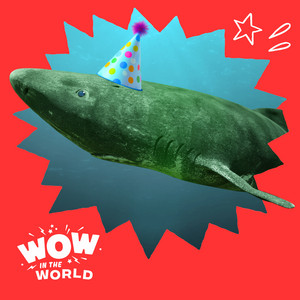
All right, it says the cake is going to the aquarium, deuterium, and it's for a Greenland shark's 400th birthday.
Huh. A Greenland shark?
Yeah, why? Do you know them?
Well, not personally, Mindy, but I have heard about them before.
Have you heard about them living to 400 years old?
Well, actually, yes.
Greenland sharks are some of the longest living animals on the planet.
They live just off the coast of Greenland.
Oh, Well, that makes sense.
But the thing is, nobody really knows why these Greenland sharks live for so long.
Until now, apparently.
What? There's a new leading theory according to this order form here.
Really? Yeah, straight from the Leibniz Institute in Aging in Germany.
And according to this order form, we're supposed to present the cake right after the gift, which, P .S., may help explain how the Greenland shark is able to live for so long.
Wow, sounds like quite the party.
Oh, yeah, it's gonna be a real rager, right, Reg?
Okay, now, Guy Razzi, you're going to have to change for this party.
Here, put this on. What is this thing?
What does it look like, Guy Raz?
It looks like a big, fluffy onesie.
Oh, yeah, that's because it is a big, fluffy onesie.
Well, why do I need a big, fluffy onesie?
It's 73 degrees outside.
outside. Yeah, but the location that's hosting this party is super duper cold.
Really? Why? Well, because the Greenland shark lives in water that's about 30 degrees Fahrenheit.
So, they've cranked the AC in this place way up.
Trust me, you'll thank me later.
Okay, Mindy, uh, if you say so.
I do say so. Look, I even got one for me and Reg.
Here you go, Reg. Okay, give me the wheel, Alright.
One leg in. The other leg in.
And zipping up. How do I look, Mindy?
Aw, like an adorable little fluffy marshmallow.
Perfect. Just in time, too.
I think we're here.
Well, what makes you say that?
Uh, the big banner outside that says, Happy 400th Birthday?
How many other people do you know celebrating a 400th birthday today, Guy Raz?
Okay, opening the back of the ice cream truck.
Careful with this cake, everyone.
We don't want clam juice going everywhere.
Okay, lift on three!
Oh, sorry, made a little spill.
Okay, everyone, through these doors over here.
Quickly, Mindy! This thing weighs a ton!
What? What? What? Opening the door!
Hello! Welcome to the party.
Hi! Oh, my. What is that?
Uh, yeah. Well, that must be the clam cakes.
Yeah. We're cake until you make it.
Uh, where do you want the cake?
Just put it down on that table over there Away from the guests, please Great idea Oh, that's terrible And then you want us to bring it to the stage after the present?
Yes, that's right, I'll let you know Now please get that thing out of my face With pleasure Come on, Mindy All right, Kairos Walk, walk, walk, walk Almost there And down That was quite the workout.
You can say that again.
That was quite the workout.
Now this is a party.
Yeah, look at all these old animals, Mindy.
We got a Galapagos tortoise chilling over there by the punch. They can live up to 200 years old.
Oh, yeah, and look over there by the balloons.
That's an ocean quahog.
They can live up to at least 220 years old.
Wow. What's that, Reg?
Ooh, Reggie says he recognizes one of his college roommates.
Which one, Reg? The parrot over there in the corner?
Oh, yeah, I see him.
How old is he? Well, it would be rude to ask, Guy Raz, but some parrots can live up to 80 years, which is super long for a bird. Wow, this is a real who's who of old animals.
What? I don't feel that old.
Thomas Fingerling? Hey there, filler.
Hey, Mandy. Thomas Fingerling, what are you even doing here?
What am I doing here?
What are you doing here?
I heard this was a real who's who of old animals.
Yeah, adults only. Grandma G -Force, you're here too!
Hi. No, we're here to drop off the birthday cake.
Ooh, birthday cake, hey?
What is it, chocolate?
Marble? Carrot? Quiet!
I said carrot, not parrot.
Uh, no. It's a clam cake.
Well, I know it sounds a little weird, but it is this Greenland shark's favorite food.
Weird? Sounds delicious to me.
Could I, uh, have a slice, maybe?
Me, too. Let me add it.
I love me some clams. Okay, you'll both get a slice, but first you'll have to wait until after the presents.
Right. Now, where is that Greenland shark anyway?
I gotta wish him a happy birthday.
I think it's over there in the tank, Mindy.
Oh, yeah, I see him.
Hey, buddy. Hey, Greenland Shark.
Happy 400th birthday.
Look, Mindy, someone's coming to the microphone.
I think this party might be getting started.
Hello, everyone, and welcome to this special shark's 400th birthday.
Now, before we can get into that stinky cake over there in the corner, we have a little present for you, buddy.
can we bring in the present please what is that it looks like a book but it's as tall as a person what we have here is your entire genome printed out into one single book genome isn't a genome like the body's instruction manual exactly Exactly.
It's the building blocks inside every living creature that tells it how to grow.
Now, I know we've already given out this same gift to a couple of you out there in the audience.
Galapagos tortoise, I know we gave you your genome sequence back in 2018, but this one is special.
Yes, baby! I was just getting to that.
This genome is special because it's the longest one we've ever written down.
Anyway, shall we bring up the cake?
Where did that pigeon and lady go?
Reggie, that's our cue!
Come on, Guy Raz, one last lift. We've got to bring the cake up to the stage.
You got it, Mindy. Okay, on three… Alright, one… Three!
Mindy, stop doing that Doing what?
Easy, easy Excuse us, coming through Coming through How much farther, Mindy?
Almost there, Guyron And down Okay, who's ready to sing happy birthday?
Wait, wait, wait What?
Why are you yelling?
We have to do the candles The candles, Mindy?
Mindy, this shark is 400 years old.
Are you telling me you brought - 400 birthday candles specifically for this cake?
Yes, absolutely I did.
Here, Reg, catch. Why don't you get to start lighting those candles?
This might take a minute.
Right, okay. Okay, everyone, we're going to take a quick break here as we get the cake set up.
Be back soon. So, Mindy, what are we going to do while Reggie gets his candle set up?
Well, I want to take a look at this genome book, Guy Raz I want to find out how this Greenland shark got to be 400 years old You think the secret to its long life is in this book?
Yep, let's take a look Opening the book Huh?
What is it, Mindy? I think they might have had a misprint, Guy Raz Why?
Well, all I see are the same four letters repeated over and over and over again in some random order.
Well, I think it's right.
I mean, that's what DNA is.
DNA is just a bunch of random letters?
Well, kind of. Each of those letters represents a base, kind of like a building block.
And all of those bases strung together in a very specific order is what makes DNA strands.
Ah, so if those bases or building blocks are the letters, a DNA strand is sort of like a sentence?
Yeah, or a collection of sentences.
So we're reading a DNA strand right now?
Exactly. And see how some of them are clustered together?
Well, those are genes.
Oh, and genes are sort of like special sentences in the body that give very specific instructions on how certain parts of the body should grow.
Yeah, like what color hair you should have or what color your eyes should be.
And maybe even instructions on how long you should live?
Maybe. I mean, isn't that what those scientists from Germany were looking for?
Yeah, look, they've highlighted some of these genes over here.
Check it out. Yeah, it looks like there's a note attached to it too.
What does it say? It says, jumping genes.
Jumping genes? Isn't that what Fingerling always says when we surprise him?
No, Mindy. Jumping genes are genes that are able to move around within the DNA.
Oh, like cutting and pasting in a document.
Exactly. Exactly. It looks like almost 70 % of the genes inside the Greenland shark are these jumping genes.
What does that mean?
Well, usually when an animal has a lot of these jumping genes, it's actually a bad thing.
And why is that? Because all that jumping around, all that cutting and pasting can really confuse things.
Ah, I get it. Like if you start taking the instruction manual and mix up all the steps, it might be hard to follow.
Exactly, but it looks like the Greenland shark might have found a way to use this to its advantage.
And help it live for hundreds of years?
Maybe. Hey, look over here.
There's another note attached to this other group of genes.
Huh. This one says, super fix -it genes.
Super fix -it genes?
Yeah, according to this note here, it says that these genes help repair DNA once it gets all frayed and old.
What? Well, it turns out a lot of these long -living animals here have these super fix -it genes.
So these animals are able to live for so much longer than everyone else because they have these genes that go around and repair their DNA as it gets old?
It could be. So maybe that's how this Greenland shark reached its 400th birthday.
A combination of these jumping genes and these super fix -it genes?
Yeah, that's certainly what those scientists from Germany are thinking.
What in tarnations is going on in here?
Well, uh... Are you reading through the genome?
No. Maybe. Are we almost done with those candles?
Uh, let me see here.
Hey, Reg! How we doing with those candles?
We're almost done. Oh, good.
We need to cut this cake ASAP.
Some of these animals are getting antsy.
Reg, hurry it up! All right, we're ready to go.
All right, everyone.
We're ready for the cake.
After me. Happy birthday to you.
wait Mindy how is this shark gonna blow out all these candles I mean he's a shark yes we're about to find out happy birthday to you Mindy I'm soaking wet yeah me too buddy didn't realize we were in the splash zone now who wants the first slice of cake me me me You'll have to get through me first, Fingerling.
Oh, yeah. Yeah. Well, it wouldn't be a 400th birthday without a couple of octogenarians fighting over some clam cake.
Oh, boy. I think it might be time to get out of here.
Loud in the World will be right back.
Grown -ups, this message is for you.
That's it. Back to the show.
Wow in the World Hi, thanks for calling Wow in the World.
After the beep, get ready to record. Hi, Nadine Giras.
My name is Elena. I'm from Nigeria, Ohio.
My world and the world is that approximately 90 ,000 nanometers is equivalent to the thickness of a human hair.
Bye! Say hi to Reggie and Dennis.
Ahoy there! Hi, my name is Alexander and I live in Mexico City.
And my world and the world is that there are habitable planets outside of our solar system.
Hello, my name is Eleanor, and I live in Oakland, California.
My wow in the world is that newborn Tasmanian devils are the size of raisins.
Cool, right? Hey, Miniyangai Roz.
My name is Cameron from Kingsville, Utah, and my wow in the world is that it can actually rain frogs and fish.
Bye, Miniyangai Roz.
Hi, my name is Lila.
I live in Beverly, Massachusetts.
And my wow in the world is sometimes when it's going to rain, the leaves will turn upside down.
Love your show. Say hi to Reggie for me.
Bye. Hi, my name is Will, and I live in San Diego.
And my wow in the world is that giraffes have the same number of bones And their neck has people do Bye Hi Mindy I'm Guy Roz My name is Celine And I live in Jackson, New Jersey My wow in the world Is that animals Spit to survive One animal is the archer fish And it spits to catch Insects that are flying in the air Bye Mindy I'm Guy Roz Love your show Also say hi to Grandma GeForce Reggie and Dennis and everybody else.
Hi, my name is Richard and I live in Bloomfield, New Jersey and my wow in the world is that if you make a spider web as thick as a person's finger, it can hold back a jet airplane.
Bye. Say hi to Reggie for me.
Hi, Mindy and Gay Ross.
My name is Yael, and I live in Vancouver, B .C.
My wow in the world is that in Indonesia, the Kauai -Isian volcano produces lava that shines blue at night.
This is because sulfur spews out with the lava, and when the sulfur burns, it gives off an eerie electric blue color.
Say hi to Reggie and Dennis and Thomas Fingerling and Grandma G -Force.
What's up? Bye, I love your show.
End of messages. Grownups, if you like Wow in the World, you can listen early and ad -free right now on Wondery+.
Join Wondery Plus in the Wondery app or on Wondery Kids Plus on Apple Podcasts.
Prime members can listen ad -free on Amazon Music.
And before you go, tell us about yourself by filling out a short survey at wondery .com slash survey.
Bay. Thanks for listening to this episode of WoW in the World.
If you're a kid with a big WoW to share with us, call our WoW hotline at 1 -888 -7 -WOW -WOW for a chance to be featured at the end of the show or an upcoming episode of To What's in a WoW.
And while you're at it, why don't you head over to Apple Podcasts and tell us what wows you about our show by leaving a review.
You just might hear your reviewsy read by Dennis on Wewow on the weekend.
Oh, and don't forget to visit us at Tinkercast .com and become a member of the World Organization of Wowzers.
With that, you'll get year -round mailings, weekly activities, birthday cards, and more.
On Tinkercast .com, you can also shop our Wow Shop, get tickets for upcoming live events, Find our books and learn about all the other amazing podcasts from Tinkercast. Once again, that's Tinkercast .com.
Wow in the World is written by Mindy Thomas and Tom Van Kelken with contributions from me, Guy Raz.
Original sound design and music editing is done by Tyler Thole with help from our senior production director, Jed Anderson.
You can also hear Jed Anderson in the voices of Dennis, Thomas Fingerling, Reggie and many of the other silly characters you hear on our show.
This episode also features the voice talents of Lizzie Freilich. Thanks, Lizzie!
Jessica Bode keeps our facts straight as our fact checker, and Meredith Halpern -Ranzer powers the wow at Tinkercast. Our theme song was composed and performed by three -time Grammy nominees, The Pop -Ups.
Find them at thepopups .com.
Special thanks to our team, including Kit Ballinger, Rebecca Caban, Dr. Natasha Crandall, Kenny Curtis, Kristen Yang, and all of the other Tinkerers at Tinkercast HQ.
Grownups, you can follow WOW in the World on Facebook, Instagram, and Twitter at WOWintheworld, and our email address is hello at Tinkercast .com.
Thanks for listening.
Find episodes of WOW in the World every Monday, to What's in a WOW every Friday, and WeWow on the weekends with Dennis every Saturday and Sunday right here in the Wow in the World podcast feed.
Until then, keep on wowing!
Wow in the World was made by Tinkercast and sent to you by Wendery.