Hello my friends and welcome back to the Easy English Podcast.
The best podcast for learning English through learning new vocabulary and practicing your English listening skills.
I'm your host Oliver and today, on a very special day, we have an interesting topic.
And I say it's a special day because I'm releasing this on my birthday.
Well, I'm recording this episode on Sunday, so the day before my birthday.
So if you're listening to this on Monday this week, the 3rd of November, it is my birthday.
But to be honest, I'm at that age where it isn't an exciting birthday anymore.
Let's just say I'm in my late 20s now.
So it's not a birthday that I'm all excited to be older.
I remember when I was younger, when I was a teenager or in my early 20s, and I was almost excited to be older.
Whereas I guess now I'm pretty neutral.
I wouldn't say that I feel negative on my birthday, but I definitely don't feel excited about being older anymore.
But I thought on my birthday that this is an interesting topic today.
And it's what we would call an abstract idea or an abstract theme.
And what that means is you can't touch it, you can't measure it easily and you can't put it in a box.
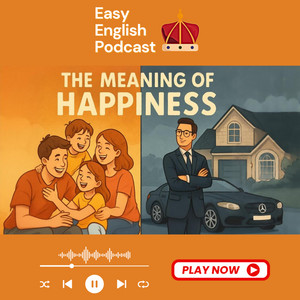
And that is happiness.
What it means, how to talk about it, and what it means for our lives.
And I think that it's an important and relevant topic, I guess for a birthday, because I feel, as I am getting older and I think as people get older in general, you start to think more about what it means for you.
You know, as you age and develop, what brings you happiness?
What are your goals?
What... are you doing to make yourself happy?
What does this idea mean?
Is it, you know, making more money, getting more things, going to more places?
Is that what happiness means?
Or is it enjoying what you have, spending time with family and friends and just living, enjoying living.
Well, today we are going to look at some of the practical language that you need to define what happiness means to you.
And we're going to discuss wellbeing.
We're going to explore the difference between short, intense happy moments and long-term satisfaction.
Long-term happiness.
As always, like every episode, we are going to do, or we're going to look at, five pieces of key vocabulary for today's episode.
If they're new for you, I want you to learn them.
If you've heard them before, that's absolutely fine.
Try to actively listen for them in context to help reinforce your learning.
Okay, so...
We have some quite simple, some of the words are quite simple vocabulary today.
The first word is key to what we were talking about.
These concepts.
And this is abstract.
Abstract.
Abstract is an adjective in this case, and it means an idea that exists only in your mind.
So it's not a physical thing that you can touch or lift or move.
It is an idea in your mind, maybe a feeling.
So even love or justice or happiness, these are all abstract things.
The next word today is subjective.
Subjective.
And this is also an adjective.
And when something is subjective, it's based entirely on your personal feelings or opinions, not on facts.
So it's something that you, you know, feel or you have an opinion on.
It's not necessarily factual.
So beauty, for example, is subjective.
Some people find certain traits or things beautiful and others do not.
That is a subjective thing.
Our third word today is well-being.
Well-being.
And well-being is a noun in this case.
And it is the state of being generally healthy, comfortable and happy.
So for example, good sleep and good diet are essential for your mental well-being.
Or we might say diet and exercise are essential for your physical well-being.
Our fourth word today is contentment.
Contentment.
And this is a noun.
And it means a calm, quiet state of being satisfied and happy with your life.
If you have contentment, you have this state.
You can have a verb of this as well, so to be contented.
Our final word for today, so number five, is achieve.
From the verb to achieve, so this is a verb form and it means to successfully reach a goal or a standard.
You've definitely heard of this verb before, but listen out for it today.
So to achieve.
He worked hard to achieve his goal of learning english, for example.
So, to start with, when talking about happiness, Let's try and define some different feelings in English.
You're probably right now saying I'm happy or I feel happy.
But there are different feelings and they mean different things.
So it's important that we know the different types and what they mean.
So when native speakers talk about being happy, we often use different words to describe the type of happiness.
It's not all the same feel, sorry, I'm quite tired.
It's not all the same feeling.
And the first of which is joy, joy.
So feeling number one, joy.
And this is sort of the quick, intense feeling of happiness.
Joy is the strong, sudden, immediate, happy feeling.
It's what you feel when you get a great present.
Or let's say, you're watching football and your favorite team scores.
You feel joy, but this is often temporary.
You might feel this happiness very fast, very quick, but then it disappears.
Perhaps you're watching your favorite team, like I said, play football.
A goal, they score a goal and you feel joy.
But then a few moments later, the other team scores a goal and your joy is gone.
You feel sad, angry, annoyed, and frustrated.
When we talk about joy, we usually use very strong adjectives.
So, for example, pure joy, exhilarating joy.
When we talk about this emotion um yeah, we we tend to favor those strong, um very strong adjectives.
Let's look at our second type of happiness that i like to define as contentment.
So that is your calm, stable feeling, And contentment is the opposite of intense joy.
It's a peaceful, steady happiness.
It means that you're satisfied with your current life and that you don't need this extra excitement or rush.
And when we talk about this type of happiness, this contentment, we use more calmer language calmer, reflective phrases.
So for example, you know, I feel satisfied with my life.
I feel contentment in my life.
We can describe contentment as quiet, as calm.
So calm contentment, quiet contentment. quiet, satisfaction.
These are common combinations, let's say, of those words and phrases.
Now, the third type of happiness that I want to define today is well-being. well-being.
And this is really your overall state of happiness.
And it is the most holistic overall term.
And it includes both your mental happiness, your health, your balance and your priorities.
So it's really an all-round happiness.
I would say that it's your overall state of living, how you're living.
And how do we talk about it?
So we use this term when we're talking about our health our mental health or physical, even our priorities or what we're doing in our life.
So in that sense, we usually tie it with something.
For example, I'm focusing on my mental well-being or I'm trying to exercise more to help my physical well-being.
So this is happiness in a way, but we're more looking at our lifestyle.
Okay, so those are our three types of happiness.
But very quick before we continue.
So we've had, I think, in the last two weeks more than maybe 3000 4000 new listeners online across different podcast platforms.
So I want to first welcome all of our new listeners and make you aware that we have a couple of extra Easy English things.
I know I talk about this a lot on the podcast, but it really does help to get support for Easy English.
So the first of which is if you're interested in taking your English learning further.
So if you want to have transcripts with every episode, PDF files which have questions and additional learning, as well as an extra episode of the Easy English Podcast every week on a Thursday, then you can sign up for the Easy English Patreon.
And for a subscription fee, a small fee every month, you get access to all of that.
You can also ask me questions on any episode and I will try to answer as well.
And furthermore, you support the show.
So you can sign up at the Easy English Patreon.
The link is in the description below.
And we also have and I know a lot of you have already purchased this and supported the show with a phrasal.
Verbs are easy.
This is my first English textbook, or my first English book which I've released, which teaches you 50 of what I think are some of the most useful phrasal verbs in English.
And I do that by pairing each one with a short story.
So it teaches you from context.
And if you've listened to this show for a while, you know that I love teaching from context and helping you to learn new words.
So check out that book, the e-book, in the link in the description below.
Okay, back to happiness.
So to summarize, we have our fast, intense happiness, that feeling of joy.
We have, number two, our quiet, slower happiness, more about satisfaction with our life.
That is our contentment.
We have happiness type three, and that is our well-being.
So the overall state of our lives, our physical health, our mental health, and what we do.
It's that well-being.
Now, since happiness is really subjective, so when we look at it it's very opinion-based or feeling-based.
It's not factual.
It can be quite hard to talk about it.
And there are some ways to share your beliefs about this, how you feel.
So when we talk about something that is subjective or a little bit more abstract, you can say a phrase such as for me
So for me or to me.
So for me, happiness is spending time with friends and family.
Where happiness means and then what it means to you.
So you're sharing your subjective experience.
And when we talk about abstract ideas, it is important to discuss them in this way about your personal experience, what you believe or think.
Because of course, one person's happiness may be different from another's.
So if I say, happiness is... is playing video games for seven hours every day.
Well, to me now, when I was 16, I would think that is a great definition of happiness.
I would love to play video games for seven or eight hours a day.
But for me now, much older than 16, that sounds like a nightmare.
It sounds like something that I would not be satisfied with.
So it just shows how your definition of happiness can change as well.
For me, when I think about happiness, it really like our definitions of the three different types.
It really depends on what we are, what we're talking about.
So, for example, i might say you know that i'm feeling happy and it could be a good mood.
Perhaps i've had a bad week before it, but i have a good day and i feel happy and i'm talking more about my mood.
Maybe, in the case where I have that feeling of joy, something good has happened, that I do also consider happiness, but more of a feeling.
But when I think about happiness long term, I do believe that it is more of and this is my opinion more of that feeling of contentment.
So enjoying and taking the time to appreciate what you have.
And it's very hard to do that, particularly in our modern world, because all the time we're being told that we need more.
We need to buy more.
We need to experience more.
We have to travel more.
And there's never really a focus on what we have, on having enough.
And I always say that's why it's very important, particularly and I know we have a lot of listeners that want to visit or move to the UK or the US or Canada or some of these countries.
And perhaps it's important to ask why.
I do understand there are very many different reasons.
But ultimately...
When you come to these places, you will realize that there are very many unhappy people.
And although people may afford more, they purchase more.
Perhaps there are even wealthy people.
They may still not be happy.
So it really is subjective, and you can be the poorest person in the world or the richest and be equally as unhappy.
I did read some articles and some studies that do show that a certain amount of you know, increase in money or wealth does increase happiness to a level, to a point.
And that is more about certain stresses that we have to deal with, with money.
Whether it's paying for essentials, whether it's affording enough for groceries, for living.
And after that point and after people are more comfortable, there's very little benefit from more income or more money.
And then it really is about our mental state.
So how we think about things and how we appreciate things.
Because if we constantly want more, then we will never be happy by definition.
And if we're taking that definition of contentment, because how can you be content if you always want more?
And I think that this is one of the big issues of Western countries, but not just Western countries now, almost any country that has our model of economic capitalism.
Really,
And it's that feeling that we need to achieve more achieve a higher status, to get a higher salary, to own a bigger house, more cars, to go on more holidays to different places.
This is all about achieving more rather than enjoying the level that we're at, and it's a very fine balance, because i also recognize that even for myself, this desire and motivation to achieve is very important, for example, with this podcast.
If I was satisfied and content with the size that the podcast is, I wouldn't have the motivation or the drive to try to grow it.
So to get more followers, more listeners, to try to release more things, to try and build the Patreon with the dream or the hope that I can do this as a job.
That is motivation and it comes from, I guess, a place of not having full contentment, which I think is good in some cases.
But it's also important to balance that with appreciating what you have.
So that's, I guess, what I'm saying is I try to keep myself not 100% contented, but I at the same time enjoy what i have and appreciate what i have and for me that's a difficult balance with happiness but i think you could also be happy and content with wanting more but for the right reasons so not material desires So for me, I don't really have big dreams to be rich or have fancier cars or bigger house.
For me, it's more about my experience and my development.
So for example, I want to see this podcast become the biggest English learning podcast in the world.
It's my like ultimate dream and goal.
Not because I want lots of money from this, but because I love to see it grow.
I love to see the success, the development and the impact that it makes on people's language learning and journey.
If I cared the most about trying to make money or any of that, I wouldn't have made money.
You know, 150 episodes over the last five years, basically earning zero for the first five years.
So for me, wanting more is not always a bad thing.
I think it depends on the reason.
A little bit of a side note there on that conversation.
But I think it's important to think about what happiness means for us.
And I guess that's what it means for me.
It means appreciating what we have and being content with it, but also, for me, still pushing forward for more, for the right reasons.
So that leads me to our listener spotlight today.
So let me just get our questions up from a previous episode.
So I asked on, bear with me one little second...
So last episode, we still don't have too many answers there.
But I asked recently on our sarcasm, if sarcasm is popular in your country.
And I had a few responses already, which is nice, which is nice to see.
So I had a great comment, which I thought was very funny, from Adam on YouTube.
And Adam said, I'm so happy... Actually, sorry, I should read the question first.
So first I asked... if sarcasm is popular in your country.
But some people did comment using sarcasm, which I thought was funny.
So they didn't answer the question directly, but they actually used sarcasm.
And Adam on YouTube commented I'm so happy that you keep reminding me every time to leave a like, follow and subscribe to the channel.
Without that, there's no chance for me to support the show.
Then he said, PS, that was my first try to be sarcastic in comments on YouTube.
In fact, I really like your style of communication and marketing as well.
I wish you to grow fast and keep your unique performance.
Thank you.
Thank you, Adam.
That gave me a good laugh, because I do sometimes hate having to say like please subscribe or follow.
But it was a good use of sarcasm, a very well-written comment and very funny.
So I had another comment on Spotify and two comments and a user named Jelly said, love it.
Sarcasm is the definition of personality.
And absolutely, sarcasm can be a big element of an individual's personality.
So it's a great point.
And I had another person say the Dutch are more sarcastic, but it's mixed with ignorance.
So I'm not 100% sure what that means.
Like, are they sarcastic, but they don't understand?
Yeah.
I would be interested to hear you expand on this a little bit more.
Tell me about the Dutch, about why they are sarcastic.
I would be curious to hear.
Okay, so today we've talked a little bit about this abstract theme of happiness.
And I can tell you, I'm very happy on my birthday.
I'm very content today.
And it was a fitting theme, a very good topic.
So thank you very much for listening.
I hope that you are content, that you find contentment, that you're happy and you appreciate you get some joy from listening to this episode as well.
And I will tap to you very soon.
A new episode coming out on Patreon this week as well, a little bit later.
We had a bonus episode last week called the Why Behind English episode about much versus many, a disappearing article in English and more topics as well.
We also had, the week before that, a bonus episode about the best way to study English, looking at different methods and styles.
So if you want to check those out, you can become a Patreon member.
So thank you so much for supporting the show, for listening and for being around.
I hope you have a wonderful rest of your day.
Goodbye.