How have we been starting our mornings the same old way since forever?
Alarm clocks and O .J.
over and over. But if you've tried D 'ol 100 % pineapple juice, you know it's like sunshine in a can.
Made with naturally sweet sun -ripened pineapples picked at peak freshness.
One sip will transport you to the tropics.
Delicious and excellent source of vitamin C.
No added sugar. It's time for a refreshing change of pace.
D Idea from us. Includes 100 % pineapple juice, and a new light dol pineapple juice drink with 60 % less sugar.
Let your glow show.
Hey everyone, it's Anna!
Before we get started today, I just want to ask a quick favor.
We're working on our Valentines Day Episode, and we want you to be a part of it.
Can you tell us about the moment you knew were falling in love?
Where were you? What was happening?
What did it feel like?
It can be about a relationship you're currently in, or a relationship from the past.
We just want to know about the moment you could tell, hey, I'm falling in love with this person.
Record your answer as a voice memo and email it to ModernLovePodcast at nytimes .com and we may end up featuring it on the show.
One more time, tell us about the moment you knew you were falling in love and send it as a voice memo to ModernLovePodcast at nytimes .com.
We are so excited to hear from you.
So, if you want to be included in the episode, your deadline is February 5th.
Okay, let's start the show.
Love now and do. It was strongly than anything.
And I love you more than anything.
And I still have love.
From The New York Times, I'm Anna Martin.
This is Modern Love.
Every week, we bring you a story inspired by the Modern Love column.
We talk about love, lust, and all the messiness of human relationships.
I'm gonna put you on the spot and ask you something.
I wonder if you could do...
What kind of voice would you use for, let's say, a podcast host of the New York Times about love and relationships.
What voice would you put on?
It feels mellow. It feels calming, should be connected and soothing.
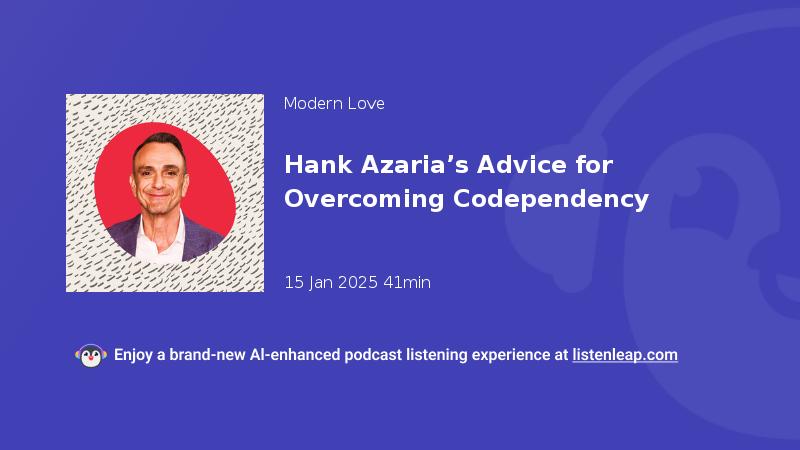
This is Hank Azaria, who is of course a beloved Hollywood and stage actor.
He has hundreds of credits on different TV shows and movies and he's in a new play on Broadway called all -in but you probably know him best as a voice actor as one of the many many characters he plays on The Simpsons like Mo the bartender I kind of get an angry look on my face Or Professor Frank which is Hank's
favorite I don't know it just sounds so amusing to me so I never really get tired of walking this way.
Sometimes I get caught in loops and my wife has to tell me to knock it off.
Or another one Hank says, he gets stuck on a loop in Snake the Jailbird.
I like to ask my wife really inane questions like hey sweetie what's your favorite ancient war, Why is that Peloponnesian?
What's your favorite liquid soap?
He's ivory. After years of doing that to her, she went, you know what the problem with this guy is?
What? Because he's not really interested in what your answer is.
He just wants to tell you what he likes.
I wonder when you're interacting with people in real life and in your real relationships and you slip into one of these characters, how do you know what it's time to end the character, right?
How do you know when it's time to sort of come back to you?
Do you know when it's time to come back to you?
Well, you know, sometimes I'm better than others.
I used as a young man I was more like a puppy with it.
And I was never was kind of constant And yeah, I was always like switching characters and trying to delight you and it was like you know We've all been with comedians who they don't stop Yeah It kind of gets annoying you're like I need to just actually connect with you and have you calm down But you try
to read people right and usually a little goes a long way You know folks even if they're delighted by it, like that's enough of that Today, Hank reads a Modern Love essay all about putting on a character to make people laugh and what happens when the author finally decides to live as himself.
That's after the break.
Stick with us. Okay.
I'm opening the New York Times app.
app. The app has so much more than you might expect.
The way the tabs are at the top with all of the different sections.
It's just easier to navigate that way.
There is something for everyone.
When I open the YouTube I get a short list of articles that are more related to me.
Twenty stories picked for you every day.
You're able to add sections that interest you?
That's really handy.
There are some individuals in here.
I can add Paul Krugman or Jim Albusi like him.
The lifestyle tab. The photos are just phenomenal.
It's kind of like a collage.
I go to games always.
Scroll over to the games page.
Play Wordle or Connections, and then swipe over to read today's headlines.
There's an article next to a recipe, next to games.
And it's just easy to get everything in one place.
And before you know it, you're going to be late to work.
The New York Times app.
All of The Times, all in one place.
Download it now at nytimes .com slash app.
OK. Hank, you're reading an essay today all about the difference between our true selves and the version of ourselves we put on for others.
You want to just tell me really briefly why you chose this essay.
It's a beautiful story about trusting that moment of connection that you've had with someone trusting your instinct from your authentic self, not from your false self.
It's about a person who really spent time getting to know themselves and who they really were and then taking that show on the road instead of trying to fit themselves into who they think somebody else wants them to be.
And that really resonates with me.
I just like that trusting your authentic self, spending time with yourself and then seeing who fits into that and not the other way around.
All right, Hank, whenever you're ready, I'm excited to hear this essay.
All right, here we go.
In Defense of my Emu Tattoo, by Jimmy Harnie.
Getting a tattoo during a first date is a risky move.
Afterward, my mother said to me, how drunk were you?
The best friend of the person I was out with said to her, oh, he's in love with you, and the mutual friend who would introduce us said to me, do you guys sleep together?
Eight years earlier, when I was a freshman in college, I considered getting the word laugh in Gaelic tattooed on my body.
I chose laugh because I was 19 and didn't think anyone should take life too seriously.
I chose Gaelic because I am of Irish descent and was grasping for some sort of cultural identity.
Fortunately, I was still scared of what my parents thought and never mustered the energy to even find out what laugh looks like in Gaelic.
But I still wanted a tattoo.
Humor has been my go -to coping mechanism since practically before I could cut my own food.
It got my parents' attention, helped me make friends, defined my exterior personality and gave me a kind of superpower, ...allowing me to fake and extroverted existence.
My high -school yearbook is filled with O .M .G.
You're so funny, and I will miss all your hilarious comments.
Humor was the only way I knew how to make myself feel appreciated.
That's what happens when you're too scared to be yourself.
When I was 21, I studied in Sydney, Australia for a semester where the whole experience felt like an extension of the extraverted version of myself that I had mastered.
It was a sprint along a path that wasn't really mine filled with adventure -seeking, bar hoping, beach time, writing a deeply offensive short story in my creative writing class for the sake of laughter and shock, masking any real thoughts or feelings.
On that same sprint, I jumped headfirst into a relationship, my first as the wrong version of me.
Then in the midst of my act, I stumbled into a where I didn't have to pretend.
It was at a wildlife sanctuary, of all places.
While everyone else was talking at kangaroos and koalas, I was staring at a caged bird, an emu.
It stared at me with its big eyes -and kept staring.
I stared back... For a long time, in the silence… I could not relieve the silence with a joke or a selfie, and I felt no need to.
I felt clarity, for the first time in maybe forever, but I did not know how to make it last.
Three years later, 2 years too late, the girlfriend I met in Australia and I broke up.
The ghost of a broken heart wove in, and out of my life for a year.
Teasing me at bars, when I had no one to buy a drink for and no one to walk home with.
Lingering in my phone as I searched my contacts for someone to share my good and bad news with.
Staring at me in restaurants from the empty seat across the table.
Until slowly the pain started to fade and I realized that my broken heart was not actually mine, but belonged to the person I had tried to convince myself I was.
So I mourn the loss of my false self and celebrated the possibility of a new beginning.
I went on new adventures, going to the movies by myself, walking around the city at night, unconcerned with having any social plans, sitting in cafes alone and reading.
The old me, the broken -hearted me, could not tag along as I leaned into the person she never wanted.
My introverted and sensitive self.
And then I began yearning for a tattoo again, but it was not this realization of a new beginning or my ability to find the light at the end of the heartbreak tunnel that I wanted to immortalize on my body.
So, I continue to wait until I knew which version of myself was worth remembering.
On my 26th birthday, I found myself alone at a bar in Williamsburg, Brooklyn.
It was a special moment because I felt I deserved 20 or so minutes to myself, sipping a beer and observing the crowd without having to engage in pleasantries.
I did not start the evening alone, nor did I end it that way.
A friend from preschool had come into the city for the night.
Two high school friends joined, and others from college and adulthood, surrounded me.
The love shown by my friends is not from my experience the suffocating kind.
It exists like a weightless hug but I'm not a hugger by nature so I had to sneak out to a nearby bar to steal some time alone.
As I sat by myself I ignored my friends texts and calls, I just needed a moment to re -energize.
Was I being rude? Probably but it was my birthday and I did not owe anything to anyone.
I was learning the delicate balance of setting boundaries.
And then I learned what kind of company matters.
It went something like this.
A few months later, I was in a bar in Harlem, drinking margaritas with a few friends, including her – a person I knew only through someone else.
Just her presence made something click.
I want a tattoo," I said.
I wanted more than a tattoo.
I wanted connection.
Now, you know, a mutual friend said, you're just bored.
I regretted saying anything.
Of what? She said. I told her the story of the caged emu.
How dumb but beautiful they look, how I had yet to find the calmness I found that day on the other side of the world.
I made jokes trying to lighten the moment, but mostly I was scared that my random thoughts would not be received as I intended them.
I actually didn't know how I intended them, I just wanted someone to understand, a person, unlike an emu, who could speak back to me.
And then she did. That story actually wasn't as stupid as I expected it to be she said smiling from across the table.
I say go for it. With that something shifted at the table, in the air, in the city.
By the end of the night, I found myself on the subway with her and then later at another bar.
In between, we sat on a stoop in the West village and I drew a sketch of an Emu, once, twice, even seven times until she bluntly said that she couldn't let me put any of my own drawings on my body.
Still riding the wave of this strange, bold feeling, I walked with her to a tattoo shop, the first one we found open, and had them pull up a photo of an emu on Google Images.
Ah, that one," I said to the guy, "...but make it cartoonish." I was surprised by how calmly I said it.
He had no questions.
She and I waited as he went downstairs and drew up what I thought would be a terrible picture I would never want to have on my body forever.
He would reappear with this bad drawing.
We would laugh. I would back out.
We would part ways, letting this be yet another late night story of what might have been.
Wow. That's actually really good, she said when he returned with his drawing.
And soon I was sitting on a chair in a downtown basement, letting a stranger draw a bird on my arm in permanent ink.
But afterwards, sitting with her at the bar, I felt full clarity for only the second time ever.
This person stared at me as we talked.
She understood me. I stared back, no jokes, no need to disrupt the moment.
Two years later, I was staring at the EMU on my arm and talking to her about that night as she sat next to me on the couch in the home we share.
I still can't believe I let you go through with that, she said, you look so calm in the chair, I was freaking out on the inside.
I was never freaking out, not with her there.
What started as a symbol of solitude that I found in the Australian desert is now a symbol of the best company and best conversations I will ever have.
Beautifully done. But while it's still very fresh, what thoughts are running through your mind as you finish reading this piece.
Jimmy Harney, the author of this piece, he mentioned so many elements of dating and choosing a partner that, in my co -dependency recovery I had to address very consciously.
In that world, you call it fixing your picker.
Fixing your picker.
Fixing your picker, like you're picking the wrong people.
Right, gotcha. picking people to have a kind of, let's say, toxic interplay with— Overly enmeshed perhaps.
That's recreating an unhealthy dynamic from your childhood and early life… and there was so much mention of it here, even though it's not really about that, that I was drawn to it.
When we come back, Hank tells us how he found his authentic self.
Hi, I'm Josh Hainer, and I'm a staff photographer at the New York Times covering climate change.
For years we have sort of imagined this picture of a polar bear floating on a piece of ice.
Those have been the images associated with climate change.
My challenge is to find stories that show you how climate change is affecting our world right now.
If you want to support the kind of journalism that we're working on here on the Climate and Environment desk at the New York Times, please subscribe on our website or our app.
Thank you. — Thank you.
So, Hank, there's this part of the essay that I really want to drill down with you on.
It's this moment where the author is in Australia and he's standing in front of an email.
And he has this moment of clarity about his true self, his authentic self for the very first time.
I'm just really curious, like have you ever had a moment like that?
Have you ever had your own kind of emu moment?
Partly what drew me to this story was I had to really construct that like piece by piece over several years, my first marriage ended about 25 years ago and I was very heartbroken and I really needed to address my codependency issues.
I really needed to, I look back at my relationships up to that point and I had about 5 pretty serious love relationships up to the point which is a lot for someone who is only 36 years old.
And this marriage was to your first marriage to Helen Hunt.
That's right. And I started going to the Al -Anon program which is for the family and friends of alcoholics.
I wanna make clear my ex -wife is not an alcoholic But allin autism is what they call paralcoverism where you take on the characteristics of that disease without ever picking up a drink or a drug.
It's sort of the same thing Savannah if you're not self -medicating with booze or drugs.
Your thought patterns and sort of relationship patterns?
That kind of thing.
It's the same, sort of angst and an upset.
And your drug of choice is kind of other people.
It's getting overly enmeshed for other folks.
And I remember my sponsor in that program, I'm a wonderful guy, I said, well, what's the one constant in all those relationships, all those variables?
Who was always there?
It was me. So that's why I relate to this piece so much.
My false self wasn't introverted, but it was a humor thing.
I think probably why I'm a voice guy in a character actor is not just my plastic vocal chords that I developed that sky.
I also, underneath it, as a darker, low self -esteem thing of really wanting to be anybody but myself, you know, that really drives the obsession with being great at these characters and being other people.
I really wanted to be an actor so I could be other people, and much to my chagrin, when I got into an acting class, the teacher was like, what are you doing?
You got to be yourself up there, which I hated.
He wouldn't allow me for about four years to do any voices or even be particularly funny.
Was that happening at the same time as you were in the Aladdin treatment?
Or was that, is that different?
So it's kind of building on itself?
That was in my mid -twenties.
I did start therapy then.
With a guy you might have heard of, Phil Stutz.
Jonel did a documentary.
Dr. Stutz talks like this.
He would call me Schmuck.
In the nice way? Well he was a kinda...
he was sort of the loving, tough fathering, I never had.
Schmuck... your problem is you're a fucking baby.
That's what he's saying.
Really? But then he'd come up with a brilliant explanation of how I was being not too mature.
So I had to trust that even as Chief Winam, it was funnier and better if I, as Hank I'd really Oh, well, how would I act if I were a cop and what would I do?
I wasn't so good at that part of it.
Trusting I didn't trust that if I were myself in front of people they'd find it interesting at all.
So I had to learn to be alone, I had to learn to...
what do I like? What's my predilection?
Even simple things.
What movie do I want to go see?
What dinner do I want to have tonight?
Let alone how I like to spend my time or who I want to spend it with.
And I had to shift my whole worldview into...
I had to date myself for a year.
Tell me all about that...
How do you... I mean, I really resonate with what you're saying.
It's like there's a deep sort of desire, like you say, to be liked, to be to be the person, yeah, exactly.
How did you learn to tap into what, you want it even with those more quotidian things of like a movie or or dinner?
What did that actually look like in a day to day?
For example, Helen and Helen loves the beach.
For example, she loves it.
It's where she's a happy place.
It's a safe place. Good for her.
I hate the beach. I just don't like sand everywhere.
I don't like the ocean.
I'm not a good swimmer.
And there's not much for me at the beach sunburns.
The whole thing, you know that became a problem.
It's like she always wanted to be there on down times and I never wanted to be there and I told not that that's the biggest deal in the world, But I completely blew that off earlier in our relationship a shirt at the beach You know people pleasing like yeah, I love the beach.
I don't love the beach the problem is when you people please like that when you sublimate your own dislike of the beach and a lot of other things You're totally with their program.
Why wouldn't they enjoy you and what you're doing?
Right the problem is Resentments get built up right and you don't like not being yourself for so long.
And one of the things I learned in this program I started calling it the contract and the messy room that's what I started calling it.
Love it. The messy room is all the junk you don't wanna deal with in yourself.
You're like, let me just follow you around, and we'll go to the beach or whatever else you want.
And, you pick the movie and you pick.
But, for dinner tonight and other deeper things, and I'll go along with it and I'll be with you.
And, I won't have to look at my big messy room that has all my junk and emotional baggage in it.
So, the contract is we're gonna do all the things you wanna do and we're gonna ignore my stuff.
And, that's a terrible contract even if it were spoken out loud.
But, it's just like unconscious.
on an ESP thing going on, then maybe about once a month, you kind of want it to be about you.
Actually, I have a problem where I have something I want to do, or I want to pick dinner tonight or I want to do this or that.
And every once in a while you're like, oh my messy room needs some cleaning out, can we go in there?
And I'm like, no, because that's not what we do.
And so eventually I got very upset and I'm now sponsored enough people to do this and know that they do too.
And you kind of explode.
god damn it, I wanted to be about me right now, and then all of a sudden, you're this lunatic raging in the relationship, and that's not good.
And I really had to learn to actually, first of all, realize what is it is that I wanted and liked, whether it's the beach or other deeper things.
Express them in calm connected ways and advocate for myself and speak up for myself not just in the relationship, but everywhere, at work and in life and with friends, and I really had to look at that.
I mean, you lay it out in this way that makes complete logical and emotional sense but that's really tough to do.
I assume that was work that occurred over years, it's not something that happens quickly.
You're married, you're remarried.
Can you tell me about some moments perhaps where you struggled against those people pleasing impulses in your current marriage?
By the time I met my wife, Kate, I was well into this recovery.
And you actually, that sponsor, I mentioned, it was Roger Lovely Guy.
Part of the whole program and the recovery is you make lists of the qualities you want in someone and you divide up what it wants, what it needs, what are deal -breakers, what aren't.
Big -and -little things, Like I don't like the beach for example, I can make that mistake again, I don't want to take on someone's jealous rage.
I'm no active alcoholics or attics.
That's kind of a good one.
And more subtle things, obviously there needs to be chemistry and for me, I love New York.
I don't think I could be with anyone who just couldn't take it here.
I love movies and TV and theater so much.
I don't think I could be with someone who didn't want to go to those and discuss them afterwards.
I love playing poker.
I've been through relationships where my partner or didn't like that I played and got annoyed at Poker Night.
No good for me. It sounds like a long list.
A very long list. And you change it over time and then you can get deeper too.
Like full disclosure.
Not on date three, but eventually if you're gonna be with someone, you need to know their whole past.
They can't be like, you're never telling me that.
That's kinda important.
You know what I mean?
Eventually it's got to all go out on the table.
so on and on and on, right?
And you worked the list?
I mean, I'd have a date even if it was a coffee and I'd call my sponsor and it said, okay, so how was it?
Would you literally be going through the list?
A real list, a written out list.
Paper list with like a pen saying yes, yes, no, No way.
Well, no. I think, you know, she might be a little jealous or whatever it was, right?
I think she might have then she's like, okay, well, and the whole point was he would always say to me, you can love the wrong person dearly.
Okay? If you really fall in love and it doesn't mean you love them but they're not it's not gonna be good and he would say love is not enough.
Like when the shit hits the fan when these things don't work out your genuine love of the person isn't gonna fix the situation.
It's just gonna break your heart.
So and I at that point I was literally in the same way that an addict feels I was like I can't go through another binge again.
It could kill me. I swear to you, that's how I felt about.
I can't go through another heartbreak, like I can't, it took me like a solid year, year and a half to get over my marriage and feel like I could kinda join the land of the living again and that was like the fifth time I had gone through something like that.
So I had to spend about a year among other reasons why this piece resonated for me.
Just kind of dating myself Just like no heat, we called it.
No flirting, no first dates, no nothing.
Just what do you like to do?
No heat. Drinking, drugging, dating, overworking, binging on food, and I qualify for all these programs by the way.
And I've been to most of them and had recovery in most of them.
What do you like that isn't all that unhealthy stuff?
And I had to discover what that was, And then, when I did, then it's like, okay, now, who wants to be invited into that world with me?
That's the difference.
That's not people -pleasing.
And fortunately for me, my wife, my current life, fit into that whole world.
Tell me, when you went on your first date with Kate, did something register, it was the first time ever that you felt like so many of these boxes were being checked, or when did that sort of moment hit for you?
Like, after my year of no heat, after these years of work, this is it.
I mean, as you said, this felt like life or death to you, which I really resonate with.
Like, love can feel like that.
Well, Kayna had a bit of a journey.
I was very, very drawn to her.
And she actually, not too far into our first go -round, did not check out on the list.
I recognized that she had some co -dependent tendencies.
And she actually broke up with me.
I kind of started pulling away a little bit because I was noticing that, and I wasn't, like a good recovery guy.
I wasn't really letting my heart fall in because I was unsure still.
And when we first had met, I wasn't working.
And then I got this job.
I was doing a show called Huff for Showtime where I was producing and starring in it.
So all of a sudden, I got wildly busy, Which, she didn't like at all, and she broke up with me.
Whoof! And I said, you know, that feels like a bit of an overreaction.
We definitely have some things to work through but breaking up with me isn't a great way to, like I think we can try to work through it.
Right. But she did.
Were you devastated?
Not at that point, because I was being very careful with my heart.
You were a lit guy.
Long story short. I introduced her to the Alan on Program.
I said you might want to Check this out because you're just you're kind of overreacting here and and she did she started going and She circled back to me.
Not long after that and I said, you know, I think you need to go attend to yourself Do you recognize game, right?
I was like I said, you know that was a little bit extreme and I think you you might want to attend to this and then let's see where, you know, if we're still both free down the road, let's circle back to each other.
Long story short, when Kate and I circled back to each other by the time we did, she really had.
And she started recognizing these things in herself.
And it turns out that her authentic self and my authentic self really did match up.
How long was it between the sort of first go and the second go?
A couple of years. Oh, wow.
Yeah, and you were dating other people in that time.
And you almost got married to somebody else in that time.
Oh my gosh Yeah, and we both got sober unbeknownst to each other in that time Wow and had also this codependency recovery going Yeah, we had you know We went on this big journey and totally kind of fell back to each other It's true what they say.
If it's meant to be it'll it'll happen.
That's really beautiful.
I appreciate you sharing that I want to return to this image that I loved this sort of the messy room of it all, when you and Kate reconnected, was it like, had you cleaned your rooms or was it like they were still messy but you were cleaning them together?
I know I'm plumbing the that - It's a never -ending process.
As I'm speaking to you right now, I'm cleaning, there's things in the messy room I'm working on.
It's a lot neater than it used to be.
It sort of looks like a hoarder room when you start out.
And then you kinda like, wow, okay.
It makes me think somewhat, just sort of back to this essay, the sort of integrating of different parts of yourself, the parts of yourself that feel good, and the parts of yourself that don't feel so good like the author does this work in his own way of integrating this sort of humorous extraverted
part of him that is real but then also the more sensitive introspective self that feels very authentic to him as well.
I guess I wonder like you've done so much work over the years in terms of your relationship itself your relationship to others Do you have any advice on how to integrate all of these different pieces of ourself into a cohesive?
Whole that is a big question, but I feel like you could be prepared, you know, one of the Things on my list was and my sponsor made me put it on He said what about spiritual program they have to have a spiritual program I was like, you mean like they have to go to AA or they have to go to Allen?
I goes, no, doesn't have to be a 12 step program but they have to have some relationship to themselves where they're honest with themselves and can process and take responsibility and accountability and be transparent and work through stuff.
And to me, it felt a little cultish when he said it, so I'm like, Ah, what are they gotta be in a cult?
Like, what do you mean?
But over the years I've come to realize it means that.
it means, do you honestly look at yourself and do you share that with your loved ones and are you accountable for what your part is in things?
And is that measurable?
Whatever version of that anyone can see doing, I don't know anyone who shouldn't do it.
Find what's ever comfortable for you, whether it's a therapist or whatever group it is.
and it always has to be relational.
You cannot do it alone.
You can't read a book and go, oh got it.
I mean you can read a book that helps you, but you have to talk it through to someone.
You have someone you love and trust.
However you go on that journey, I suggest you go on it.
Cause it, I don't know anyone who doesn't need it.
Can you describe then what does it feel like to sort of live on that other side, like, what does it feel like for you now?
I feel like I can, I didn't even know I was missing this, I can genuinely connect with other people, I'm generally, genuinely connecting with you right now, right, I can really feel that.
During it and to me, that's the high I was always chasing, that's what I wanted out of the bottle or the drug, that's what I wanted it in the relationship didn't know how to get it.
That's what I wanted in all of it was just that fit.
I didn't know what it was.
We call it in recovery the god -sized hole, that no matter how much booze or food or drugs you or relationship you or sex or whatever you pour into it.
You could fill it sort of, but it empties out.
To me, what higher power really is it's actually human connection based on authenticity, based on, here's the stuff I'm ashamed of.
Here's what I really feel, here's how at first, really, what's honest is how bad I feel about all manner of things, and then eventually, it can be about how good you feel, too.
But either way, I'll take that connection is to me, that Dragon I was always chasing, and that to me, is higher power.
That is genuine connection with other folks.
In your marriage, currently, how do you put all of this work you've done into practice to make the relationship sustainable.
Well, we each, you know, keep up our own programs.
Meaning we go to meetings, we have Sponsies, we...
Oh, she does too, currently?
Oh yeah. Wow. Okay.
We, you know, continue to work it, it works if you work it, so work it, you're worth it, we say at the end of meetings.
No way. Oh, yeah. Do that one more time.
It works if you work it, so work it, you're worth it.
Works if you work it, so work it.
You're worth it. Okay.
You're cheerleaders.
So, that's kind of the main thing.
You can imagine in a marriage how somebody having a spiritual program comes in handy.
Of course. Like, she'll come to me or I'll come to her and say, sweetie, you seem a little edgy around this particular topic these days.
We have a 15 year old son.
So, you seem to be a little impatient with him.
It could be about something really mundane like, you know, around his coat being on the floor.
Is something up for you?
I don't think so. Well, can you think about it and maybe ask your sponsor or see if anything's up?
And then day or so later, circle back anything, and sometimes you're just like, no.
He's just annoying with the thing— I triggered a thing.
about my mom and I need to in I addressed it and you're right I need to be more patient with him around that stuff and vice versa you know and it really takes like one thing is on grateful for is we've mined a lot of our own teen years and childhoods and so we talk a lot about how do we respond not react
to the teen stuff going on in our house, and, you know, come back with a measured loving, whether it's a boundary, or an ignoring, or whatever it is, and not looking for him to validate us.
Um... Yeah, I was gonna say it strikes me that this kind of spiritual program would not only make you a -a great and an intune, you know, husband, but also certainly a parent.
I mean I'm thinking about how different my teenage years would be if my I love my parents.
But if they had had That kind of oh, yeah training or whatever experience I think he would have been different.
I was still a pill You know, I mean, that was still like That's a whole we could talk for hours about that.
But yeah, you know, we're trying to created, you know, a different environment for him then.
than we were raised in.
And that requires a lot of attention, a lot of communication between the two of us.
So we do spend a lot of time on that particular, reverse engineering from, how are we going to respond to the boy?
And every day it's kind of a new thing like whack -a -mole that's another program thing.
Listen I love these slogans.
The slogans are a big part of recovery.
Like you go into room and they're laid out in cars or all over the wall.
Like, it's not just you remember them and so they're like, you know, dogg Corona in your mind and it works You hear me at first.
It's like kindergarten Ridiculousness, I like kind of are yeah, but then you live with them and like oh, that's what they mean by say what you mean But don't say it mean I get it work it Work it.
You're works. If you work it it works if you work it so work.
So work it your workers Hank thank you so much for this conversation.
It went places. I can never have expected and I'm I'm really grateful Thank you.
Sure. Thanks for having me.
This episode of Modern Love was produced by Davis Land.
It was edited by our executive producer, Jen Quyant.
Production management by Christina Joseph.
The Modern Love theme music is by Dan Powell.
Original music by Aamen Sahota, Roan Iron minister Kumar, Diane Wong, Pat McCusker and Dan Powell.
This episode was mixed by Sophia Lanvin, studio support for Matti Mosiello and Nick Pittman.
Special thanks to Heboared Crybalani Mel Gologli, Jeffrey Miranda and Paula Shoehman.
The Modern Love column is edited by Daniel Jones.
Mia Lee is the editor of Modern Love Projects.
If you want to submit an essay or a tiny love story to The New York Times, we've got the instructions in our show notes.
I'm Anna Martin. Thanks for listening.
thing.