Hello and a very warm welcome back to the Easy English Podcast.
I'm your host Oliver, and today we are going to be talking about a very interesting and relevant theme, and that is the time of the year that it is currently now autumn or, if you prefer American English, fall.
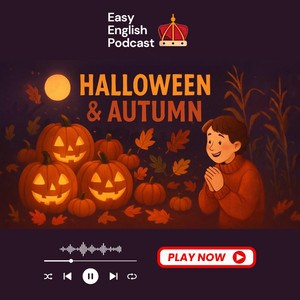
And particularly, we're going to be looking at something a lot of you might find quite interesting, and that is the festival and celebration of Halloween.
If you're new here, Easy English is the best place to practice your English listening skills while learning some new vocabulary.
But on today's theme, you all probably know that feeling.
Around this time of year, the air, it starts to get what we call more crisp.
A little bit colder, maybe sharper or fresh.
And you might start to smell some of those scents of cinnamon, pumpkin spice, that type of thing.
And if you're in the West or other countries that celebrate Halloween, you might start to see some spooky or scary things decorations around the place of some ghosts, maybe witches or some other unpleasant things.
So today we are going to look at two specific sort of festivals, celebrations and that is the whole season of the harvest, autumn or fall and the fascinating sort of cultural shift, including with halloween.
But first, before we look at our key vocabulary for this episode, i have some news, so a little bit of news just around the schedule of the podcast.
So for the past year I have made two episodes of the podcast every single week.
And I haven't missed a single one until last week.
Because it's not by accident, it is by choice.
So I've been making two episodes every week, which is a lot, as this is not my full-time job.
I have another job that I work Monday through to Friday for my full working hours.
So doing two episodes a week, it was a great challenge and it's something that I was very dedicated to and I didn't want to miss any episode.
But recently, over the last few months, I noticed personally that the quality of the second episode every week was not quite where I wanted it to be.
Perhaps the topic or the editing, or just generally, i felt that the two episodes is too much, and now i'm at a place where we have over one hundred and seventy episodes of the podcast And this means that for new people joining us, they have so many episodes to listen to.
And making two episodes a week, as well as Patreon bonus content, has become too much.
Especially as I want to improve the episodes every single time.
So I've made the difficult decision, but I think it will be better for the podcast that Easy English will have an episode every Monday.
So every Monday.
So there will still be an episode every single week for you to listen to.
And of course on Patreon there's going to be a lot of bonus content there as well.
So I want to focus on more complicated videos and topics on Patreon for people who want to take their learning to the next level.
But the main purpose is to really improve the quality of this podcast, and I'm going to improve the episode that comes out every Monday.
We're having great topics and great conversations.
So that's just the tiny little bit of news.
Of course, if you want to get bonus content, bonus podcasts, bonus transcripts for every episode and vocab list, you can join and sign up to our Patreon.
The link is in the description below.
Now for the key vocabulary for today's autumn themed episode.
And the first word that I want you to actively listen for today is harvest.
Harvest.
Harvest.
So, harvest can be two things.
It can be a verb, which means to collect plants or food.
We harvest these things.
We collect them.
But the word I want you to focus on is harvest as a noun today.
And harvest, as a noun, is the time of the year when the crops, so the food, like corn or pumpkins, are gathered.
So, for example, your local farm might be celebrating harvest, the time of the year when they are, you know, harvesting their food.
The second word for today is earthy, earthy.
And this is an adjective and it means to have a natural, deep flavor or the smell of soil or plants.
Now, a good example of this is if you are in the countryside or near some fields or plants and it rains.
When you go outside after the rain, you can often smell an earthy smell, that kind of smell of the wet soil and plants.
I think it smells great.
The third verb or word, which is a verb, today is carve, to carve.
And this is a verb which means to cut a shape into a material.
And in this case, we're going to be talking about pumpkins on Halloween.
So to carve something is to cut a shape into something.
Our fourth word is spooky.
Spooky.
And it's an adjective.
And I think I've used it already in today's episode.
And to be something that is spooky.
It's something which causes a feeling of maybe, fear or nervousness.
But I think spooky is more of a light word.
So it's like using the word scary or maybe terrifying if you want to get very intense.
But spooky is more light.
It's not so scary, but it has those feelings on a very small level.
But spooky can be fun as well.
A fun scary, if you will.
And our final word for today is costume.
Costume.
Okay, so costume is a noun and a costume is a set of clothes which are worn to disguise yourself, especially at a party or a festival.
So it's something you put on to change your appearance.
For example, you want to dress up as a ghost.
That is a costume that you are putting on.
And people often wear costumes to Halloween parties.
Okay, let's get into our episode.
But first I want to remind you to make sure that you are following or subscribed to the Easy English Podcast, wherever you're listening.
If you're on Spotify, make sure you are following the podcast.
Spotify always reminds me to tell people, because it is one of the biggest factors, the biggest things that they use to promote the podcast.
So the more people that follow, the quicker, of course, the podcast grows, but also the more people that Spotify start to show the podcast to.
So wherever you're listening, please do help out and make sure that you're following or subscribed.
Okay, so the comfort and flavor of the harvest.
Let's begin with food and why it matters.
Food is often my favourite topic when it comes to the different seasons and different places and things.
So the harvest is all about food.
Autumn and harvest time, really, in my opinion, I think there's a lot about food.
And this season is really important because of the historic events in the past.
So when people would gather all of this food and they would celebrate it, because this food would help them to survive through the cold winter, whenever the food is not going to grow.
And that's why all of those flavors and smells, in my opinion, are probably quite deeply comforting to us.
Whenever we smell cinnamon or ginger or all of these spices and scents, it's probably quite a deeply comforting smell, because we know that it's harvest and that we have this food for the winter.
And there's a few words I want to introduce to you today that are specifically around this seasonal food.
Because, to be honest, when we eat stuff, it's not always just enough to say that something is sweet.
There's quite a bit of vocabulary from the season that we can use.
The first word I love is tart, tart.
And to describe something as tarty or having tart, this is usually with the taste of apples or cranberries.
If you've ever had an apple pie or in the UK we often call it an apple tart this is that taste, that tart taste.
Or let's say you're having a nice, warm, hot cup of coffee.
And you could describe sometimes the dark flavors of that coffee as earthy.
So that's one of the words we've introduced already.
Earthy.
I say it weirdly.
I don't know why I find it an awkward word to say.
So really to summarize, on the food whenever you love, like pumpkin spice, those scents like cinnamon around this time of year, when you connect that mentally to this time of year, you're really tapping in or you're drawing from quite a collective feeling, I think.
So it's that, recognizing that the summer is over and that we're starting more of a cozy, slower season.
But as this season continues...
It's not all about cosiness and about food and about being indoors more or enjoying the changing colours.
It starts to become a little bit closer to a very big festival.
One that's popular in many countries around the world.
And that is the spooky night of the year.
The spooky night of autumn.
Halloween.
And to understand the language of Halloween.
I'm going to give you a little bit of history first about what Halloween was originally, so generally, how it started.
And actually, Halloween started in my home island of Ireland.
Its origins.
So its beginnings really start in ancient Celtic traditions, in an ancient Celtic festival.
So Celts.
These were people that lived in Ireland I think parts of Scotland and Wales as well way in the past.
So these people had a festival that was called Samhain.
I've probably said it wrong, but that's what it's called.
Samhain is it's written as.
And this festival, like many around the world, for this time of year, marked the end of summer and the harvest.
But these people, they believed that on this night, so on the night where summer ended and the harvest, we entered this new period.
They believed that before the new year, so they considered this the new year.
The boundary, that line between the world of the living and of the dead became one, so it crosses over.
And to protect themselves from the dead or all of the evil that they fought may come.
People would light big fires to try and scare away spirits.
And they would also wear disguises.
They would change their outfits, which we now call costumes in the modern day.
And this is to keep away any spirits that might find them or see them or be looking for them.
Now the most famous symbol, which is called a jack-o'-lantern, so a pumpkin.
When we take a pumpkin and we carve a face out of the pumpkin and we put a light inside, so it's a very famous image associated with halloween.
Now, this jack-o'-lantern actually comes from an irish legend about a man who was called jack And he was so clever.
He was so smart that neither heaven nor hell would take him.
Neither heaven nor hell would want him, right?
So he was doomed.
He was destined to walk around the earth carrying a light inside of a carved turnip.
It's a similar type of plant to a pumpkin.
And when this tradition came to America, people found out that pumpkins were much easier to carve.
But in the olden days, back in these old festivals, people in Ireland actually used to carve turnips instead of pumpkins.
So we carve a pumpkin and the final result is the jack-o'-lantern.
And you might be doing this while you're already dressed up in your Halloween costume.
So a couple of things that happen on Halloween.
To be honest, usually it's more focused around children this holiday.
It's a time of excitement for kids, where they can dress up and go around and get lots of sweets and chocolate.
Sometimes people wrongly, in my opinion, think that this is like an evil holiday or it's bad.
But when you understand the history of this tradition and holiday, it comes from a place of deep love, ancient culture and maybe misunderstanding or their understanding of the world.
It is not a modern holiday or tradition that is linked to modern religions.
That's important to always remember when we're talking about Halloween.
Of course, it's become a very sort of commercial holiday, but it wasn't always that way.
There are a few fun things that I always remember from Halloween.
And one of them is something that we call trick or treat.
Trick or treat.
Now this phrase, it means essentially give me a treat, so candy, or I will play a trick on you.
I will play a joke on you, essentially.
And children.
They go from door to door, usually in their neighborhood, and they ring the doorbell, they hit the button and they go trick or treat when you open the door.
And you either have to give them some candy or they will play a trick on you.
But of course the tradition is you just give them some candy or sweets and they have a great evening.
And they usually go around with their little baskets collecting.
So you'll usually say something like happy Halloween and give them a little treat.
Now the holiday for adults.
Some people like teenagers or young adults.
People have Halloween parties, particularly teenagers.
And it's simply just meeting up with some friends, having some drinks and perhaps dressing up in costumes as well.
But generally, it is definitely more of a holiday for children.
But you know, I would say a lot of people do celebrate it in a way by perhaps watching a scary movie or just enjoying that atmosphere with the children, trick-or-treating and having a good night.
Okay, so now we have our listener spotlight.
This is the time when you write in to me and answer the question that I set for the next week.
This week's question is about holidays and seasons.
Well, more specifically seasons.
I want you to tell me what your favourite thing about autumn is.
Even if you don't like autumn so much, I'm sure you can pick one thing that you like about it.
So if you can tell me what your favourite part or favourite thing about autumn is and why.
Leave it in the comments.
You can write to me about it as well.
But do let me know.
Practice your English writing skills.
Now, in the last week's episode, we had a lot of listeners, but not so many people wrote in answers.
So I asked... you know, what people like doing in their free time with friends.
Just to get some answers.
We had some reactions and some comments that were not related, but I had one good answer that I'll read out for you today.
And that was from Brenda, who always leaves great comments.
And Brenda said, Hi Oliver, thank you for another great episode.
As always, I've learned new phrases by listening to it.
And today's question, I love discovering new cafes and restaurants.
Lately, a lot of Instagrammable places have been opening in my city.
So my friends and I enjoy going out trying new flavors and catching up on what's been going on in each other's lives.
That's a great activity.
I think it's very popular now to find places on Instagram or TikTok or other social media sites.
It can be a great way to learn more about our area.
To be honest, I see things all the time that appear in my local city too that I had no idea existed or I didn't even know that they were opening or being created.
So social media, especially Instagram, that's perhaps one thing that Instagram is very positive and good for.
But it's great that you're spending plenty of time with friends.
Okay, so remember for next week's episode.
You have one week from the date that I publish this episode.
So answer and tell me what your favourite thing or things about autumn are and why.
And I will pick and read out some of the comments in next week's episode.
Okay, so today we've learned a little bit about the language of autumn and, more specifically, halloween.
We've talked about everything from some of the autumn food and harvest to why halloween is a thing.
So what happened, what started it, and even a little bit about some of the activities that people do on that specifically trick or treat.
So hopefully you've learned a little bit more about this history and about why autumn is a special time.
Of course we've got all of the stuff to do with the days getting shorter, the leaves, and I've made episodes about this before.
So I wanted to have a bit more of a focus on harvest and a little bit extra on Halloween this year.
But I'm going to make an episode probably a little bit later from now about daylight.
So that's to do with the different daylight hours, about the time that the sun is up in the sky, about it changing and a little bit about the effects of that.
So stay tuned, keep watching, and that episode will be out soon.
If you want the full transcript for this episode, as well as vocabulary list and a longer bonus episode every week.
We're going to have all of this on the Easy English Patreon.
So do sign up and become a member today, and you get access to all of the previous bonus episodes, as well as this.
The link, as always, is in the description below.
But thank you so much for listening, and I hope you have a wonderful rest of your day.
I'll see you soon.
Goodbye.