Hello, it's Bryce here.
Welcome to another episode of From the Vault, where we put on a mask and dive into the Squiz Kids archives and fight our way past the cobwebs to pull out and dust off a classic Squiz Kids shortcuts episode.
And this week, I'm excited to bring you one of my favourites.
And it should hopefully be obvious why I've chosen to run it this week.
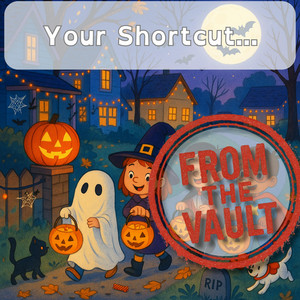
It's the Squiz Kids' shortcut to Halloween, explaining in wonderful detail the historical origins of this holiday and how it's gone on to become one of the biggest days for lolly sales right around the world.
With only a week to go before the trick or treating gets underway in a neighbourhood near you, get ready to get your spook on and enjoy.
This is a Squiz Kids podcast.
Your fresh take on what's happening in the world around you.
It started 2000 years ago.
Today, Americans spend half a billion dollars on it just for their pets.
And every year, more Australians get into it.
This is your Squeeze Kids shortcut to Halloween the podcast where we dive into the who what when where, why and how of the big news stories.
I'm Amanda Bower.
And I'm Bryce Corbett.
More than a quarter of all Australians celebrate Halloween and we're guessing, many of them are kids.
It's hard to resist a holiday that involves getting free lollies, Bryce.
Sure is.
And today we're going to take you through where Halloween comes from, why people dress up and what the traditions of Halloween are all about.
Listen carefully.
There's a squeeze at the end.
Where?
So Bryce, I've heard a lot of people complaining that they don't want Halloween to be celebrated in Australia because it's a sign of us becoming too Americanised.
But Halloween didn't start out as an American holiday, not by a long shot.
Oh, so where is it from?
Well, we'll need to get into our time machine and head back 2000 years to ancient Ireland, Scotland and the Isle of Man.
Cool.
Right about this time of year, the ancient Celtic people who lived there would celebrate the end of summer, the end of the harvest and the beginning of winter with a festival called Samhain.
Ah, I always thought that was pronounced Samhain.
I mean, that's how it's written.
S-A-M-H-A-I-N.
Yeah, it's a tricky one.
Everyone, give it a go.
Samhain.
Samhain.
Samhain marked the beginning of the cold, dark time of year, and the ancient Celts believed that on the night between October 31st, which they thought of as the end of summer, And November 1st, the beginning of winter, ghosts would come and visit.
They would light big bonfires, dress up in costumes and tell each other their fortunes.
But then how did we get from Samhain to Halloween?
Okay, so in the 1st century, the Romans conquered the Celts.
Right.
By the 9th century, Christianity had pretty much spread across the Roman Empire and it started taking over the old Celtic traditions.
Uh-huh.
And in the 10th century, the church created All Souls Day, which back then was known as All Hallows.
All Hallows Day was on November 1, and it featured bonfires and people dressing up as angels and devils and saints.
So it kind of sounds like it was copying Samhain.
Yeah, so most historians agree that the church probably came up with All Hallows' Day as a Christian replacement for Samhain.
And then the night before All Hallows Day was All Hallows Eve and that became known as Halloween.
Right, so Halloween really started in Ireland and Scotland.
Yep, and don't forget the Isle of Man.
It was only when Irish immigrants flooded into America in the 1800s that it became so popular there.
But it definitely didn't start as an American holiday.
Now, when I think about Halloween in America, I think about the fact that people spend billions of dollars every year on costumes.
So why is dressing up so important on Halloween?
So Bryce, remember that the ancient Celts lit huge bonfires and wore costumes for Samhain?
Yep, sure do.
Okay, so they dressed up in animal skins.
They would sacrifice animals and some of the crops they'd just harvested to their gods, in the hopes of having a safe winter and a good harvest the next year.
But as the Christian influence spread, people became afraid of the ghosts that were said to be roaming on All Hallows' Eve.
And they kind of dressed up as a way to disguise and protect themselves from the ghosts.
Oh, to disguise and protect themselves from ghosts.
Cool.
And then, starting in around the 16th century, people began to do something called mumming and guising in Scotland and Ireland.
Guising?
Hang on, that sounds a bit like disguising.
Yeah, that's exactly right.
And mumming meant performing.
So groups of people would wear disguises or costumes and then they'd go from house to house performing songs or poems in exchange for rewards of food.
Ah, right.
So, mumming and guising sounds very much like trick or treating.
Yep, you're a smart one, alright.
So, Halloween costumes didn't start in America either.
Definitely not.
But just as most things in America are bigger than anywhere else, they have definitely made it into a.
Sure have.
Americans spend the equivalent of $4.4 billion on costumes every year, Bryce.
Wow.
They spend half a billion every year on costumes for their pets.
What?
That's nuts.
Squeezie the newshound isn't quite sure what to make of that.
Now that I've learned about the history of Halloween and costumes, what can you tell us about some other Halloween traditions?
What?
Bryce, there's so much to choose from.
Apple bobbing, haunted houses, pumpkin carving.
Haunted houses, yeah.
All right.
So the first haunted house that existed to make money was in England, and it opened in 1915.
So what they thought of as scary stuff back then is pretty tame by today's standards.
But you would go through a maze of rocking floors completely in the dark, with air blasting up from below and vibrating walls.
So it was pretty spooky for back then.
Ah!
Over in America, haunted houses started to appear in the 1930s, but they got really popular when the Disneyland Haunted Mansion opened in 1969.
Oh yeah, I love that one.
Okay, after visiting a haunted house, I'd like to carve a pumpkin.
Is that an older tradition than spooky houses?
Sure is, although the original version is actually turnip carving.
Carved pumpkins are often called jack-o'-lanterns, and there's this old Irish legend about a man called Stingy Jack who did a very bad deal with the devil Bryce and he was doomed to roam the earth with only a hollowed-out turnip to light his way.
That's a raw deal.
So the turnip was Jack's lantern and he was Jack of the lantern.
Oh, I see.
Jack O'Lantern.
Nailed it.
So hollowing and carving pumpkins instead of turnips means that you can roast pumpkin seeds, make pumpkin scones, pumpkin soup, pumpkin pie.
Way yummier than a turnip version.
Oh, yes.
Now, speaking of yummy, tell me quickly about the tradition of apple bobbing.
All right.
So remember how the Romans conquered the Celts?
So the Romans had a late summer festival to honour their goddess of fruit, Pomona.
Young, unmarried people would try to bite into an apple that was floating in water or hanging from a string on a line, and the first one to successfully munch into the fruit was supposed to be the next to get married.
So that festival with the apple became incorporated into Samhain, and then it stayed with us for Halloween.
Although, thankfully, it has nothing to do with marriage anymore.
Still a lot of fun, though, especially when your face blending into a bucket of water.
That's for sure, Bryce.
Halloween is a lot of fun.
Time for the quiz.
This is the part of the podcast where you get to test how well you've been listening.
Question number one.
What do we call mumming and guising today?
That's right.
We call it trick or treating.
Question number two.
What was the name of the ancient Celtic holiday that eventually became Halloween?
Samhain.
Thanks for pronouncing it properly.
Question number three.
What do Americans spend half a billion dollars on each year?
That's right, they spend that on pet costumes.
And they spend over four billion on human costumes.
Crazy.
That's all we have time for today.
Thanks for joining us as we explored the who, what, how, where, when and why of Halloween.
Now get out there and have a most spooky day.
Over and out.