We're standing in the galleries at the William Harvey Museum of Art at Talladega College.
We're so excited to be in front of these masterpieces by the great Hale Woodruff.
This is a multi-part series that tells the story of the mutiny on the Amistad.
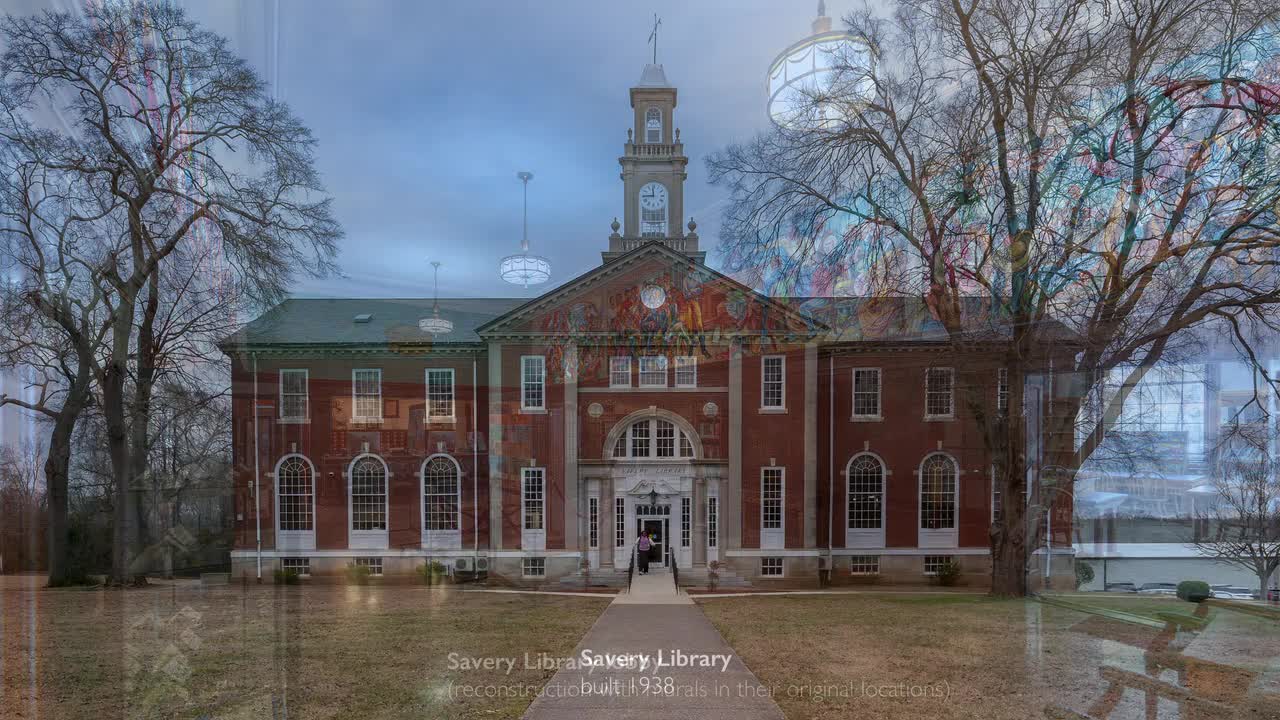
These paintings were hung in the library here in Savory Library on the campus at Talladega.
That is the most powerful element of these canvases, their presence among students.
And it would inspire many generations to understand that the civil rights struggle of the 50s and the 60s was important and pivotal moments.
But there was an uprising that took place in 1839.
Which brings us through this history.
I think about Buell Gallagher and George Crawford.
Buell Gallagher was the president of Talladega who commissioned the work.
George Crawford was a graduate of Talladega, but he was also the chairman of the board.
Both of them understood that it was important to have a work of art in a building that would commemorate freedom.
What we're seeing are figures who have been kidnapped from Africa, brought to Cuba in horrendous conditions.
They've boarded a second vessel to take them to yet another location in Cuba, where they'll be enslaved on a plantation, probably harvesting sugar cane.
And on that second journey, they decide, I'd rather die than be a slave.
We have 10K featured very prominently, but you also have the two crew members who were spared, Jose Ruiz and Pedro Montes.
So here we're looking at an event that took place in 1839, before the Civil War.
The Atlantic slave trade has been made illegal, and yet it is continuing.
Multiple nations were involved, Portugal, Spain, and then of course the U.S.
Many ships were part of that transatlantic slave trade, but this was pivotal in the sense that the Africans rose up and began to take back what was rightfully theirs.
So let's walk through what we're seeing here.
On the top left, some of the African captives who are joining the insurrection, the mutiny.
We see Sinque, the leader, the hero, who instigates along with others the mutiny.
And he's killing the cook.
The cook becomes a target, because there was a rumor that the cook was going to chop the captives up and feed them to the crew.
The captain had been rationing food and water to the captives, who were hungry and scared and very far from home.
Very far from home.
They are in the high seas in waters that were not easily navigated.
So every element of the voyage is riddled with tension, not only among the Africans who were trying to figure out what is happening to them, but also the crew.
You have the Spanish speaking Ruiz and Montes, the African captives who speak different languages.
Just this confusion and chaos and lack of understanding really among everyone here and fear.
And fear.
I feel like that's best expressed by that white crewman who is fleeing.
Fleeing.
Yes.
And we know, in fact, that some of the Africans also fled the boat.
That's right.
When the mutiny is over, they take control of the ship and they say, we want to go back to Africa.
In different languages, literally having to employ nonverbal communication in such a defining moment.
On the right, we see one of the African captives wielding a machete toward the figure with the green cap, holding a gun, holding up his hand to shield himself.
It's so dramatic, but that musculature.
You can tell that Woodruff is engaging with the whole history of art.
I think back to Michelangelo and that emphasis on heroic musculature, even quotations from ancient Greek and Roman sculpture.
Yes, absolutely.
It is doing the deep research of the subject itself what happened aboard this ship but it is also a study in what he took away from his time in Paris.
And it's the vibrancy of the color, the way in which he is thinking about African sculpture, in particular Mende works of art.
If you look at Mende's sculpture, you see the high cheekbones that Woodruff is incorporating in these portraits.
And you have this pyramid of figures over to the left wielding machetes.
The Spanish figure looking up, praying to God to save him.
The machetes really stand out.
They stand out.
They do.
But then you have these other weapons, so you have the gun.
One African is holding a rifle and there's a tug between the two.
Woodruff is walking us through the violence of these instruments.
The artist is using foreshortening, Literally coming off the canvas at us, the violence.
It's as if the viewer is there.
And I think also that's achieved by the very strong contrasts between light and dark.
So when he's modeling the skin of the figures, or even the drapery, the fabric that we see from the sails, or even the wood on the floor, Everything stands in very high relief.
And the more you stand and view, you are taken in by every detail Everything is so close to us.
It's close.
He's giving us a sense of what he learned during his time in Paris.
These brilliant colors that I can't stop thinking about as I look at this work.
And then the wrath of the Medusa is prevalent here, in the way in which he captures the boat, the subjects in agony.
And of course, he had also gone to Mexico City.
That's right.
He's learning from the great Diego Rivera, thinking about the activist way in which Diego Rivera is employing his work, understanding that these paintings would be seen by people walking into Savory Library.
And so for me, it is really important to champion the work of the American Missionary Association, the AMA.
Their work had started in 1839 as the Amistad Committee.
But it started even before that in 1831 with the proposal to establish a college in New Haven.
That was quickly shot down.
They were undeterred and they decided to wait until there was a moment that they could act again.
And that moment was this Amistad incident of 1839.
The work that they did to help the captives leads them to create the AMA.
And the AMA is the reason we're standing here today at Talladega College and the building of so many colleges for the education of the newly freed people of the South.
They said of themselves that they brought light and love after the guns and the bullets of the Civil War were over.
They were an invasion throughout the South.
And the invasion of course takes place in the establishment of these institutions that I call the AMA schools.
These institutions were race relation laboratories.
They were integrated communities that started to push back on the segregated ways of life that existed outside of the gates of these campuses.
They were much more than just liberal arts institutions.
They were laboratories that allowed for the partnership of black and white.
So during the 20th century, when you had all around the south the memorializing of the confederate soldiers, Simultaneously you have this memorial to freedom, this building that was built by both blacks and whites to house these murals, to house this idea of freedom, of us working together.
Because on the outside, at the campus borders, everyone was in their own separate area separate churches, separate housing, complete segregation but on these campuses there were people who were working together as equals.