Welcome to a special GTC edition of the NVIDIA AI podcast.
This is the fifth and final of our episodes on the road to GTC Live in Washington DC conversations you won't hear anywhere else about the state of AI across industries and from different perspectives.
It's a great series, so be sure to give the first four episodes a listen.
Now we're delving into the world of robotics and manufacturing, with a group of industry pioneers discussing how the boundary between digital intelligence and physical action is disappearing.
Robotics and automation are turning insight into production, and we're about to find out how.
Enjoy the conversation and subscribe to the AI podcast for new interviews from the leading edge of AI every week.
The physical world is becoming programmable, and this fusion of intelligence and industry is creating new types of factories, new jobs and a more resilient manufacturing base.
The leaders driving that transformation join us now.
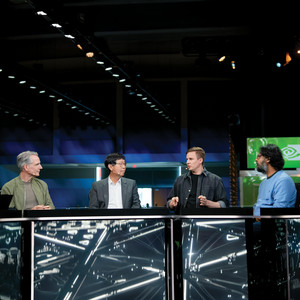
First, we have Peter Kurta, Chief Technology Officer and Chief Strategy Officer at Siemens AG.
We have Yong Liu, Chairman and CEO at Foxconn.
We have Brett Adcock, Founder and CEO, Figure AI.
And we have Aki Jain, President and CTO, Palantir US Government.
So great to see everybody here.
So, Young, I want to ask you the first question.
First of all, my relationship with Foxconn goes back to 1995.
And I don't know if they call that experienced or old.
But you are one of the biggest manufacturers for all precision goods, from smartphones to hyperscaler data center equipment and pretty much everything in between.
Talk to me how AI and robotics is transforming technology. what Foxconn does.
Okay, first of all, thank you for having me here.
This is a very great event for technology companies these days.
Foxconn is the largest manufacturer in the ICT industry.
And we used to be very much labor intensive.
And then we transformed to automation intensive.
With new generative AI technologies, we think the AI intensive manufacturing is coming.
And with this new technology this is new and disruptive.
We'll have to work with industrial leaders or technology leaders like Nvidia, Siemens and the friends at this table together to be able to catch up and apply the new technologies to our manufacturing facilities.
And currently we are building up factories here in the States in Ohio Texas, Wisconsin and California.
And we think the AI era is coming, and I call this industrial 5.0.
That's excellent.
Peter, your company is known for being in all of the connective tissue inside of manufacturing.
And I'm curious, how is AI making manufacturing in United States more competitive?
Because that's a big talk, particularly here in Washington DC And, quite frankly, it has a lot to do with and Brad pointed this out in an earlier segment even national security.
Right.
So we believe that AI really will be a key driver for the establishment of manufacturing yet again in the United States, which is going to be smarter.
So we think of it as more of an AI native factories that we want to build.
So it starts with the sensors, right?
I mean, the sensors that you all carry and that we all carry, we love the data.
And because we've got so many sensors now everywhere, humans cannot make sense out of this anymore.
So therefore, we need to automate that.
And so as we build now factories, we build them always twice.
We build them first in the digital world and we optimize them and we see how you place the machines, how the material will be flowing, how humans will be interacting with machines.
And then we optimize them over and over and over again until we finally think this is great.
Then we build the real thing.
So the real factory, but still you've got the real one and the digital one and they talk to each other.
So whenever you have, like a supply chain glitches that we used to have remember the semiconductor shortages you actually can go to your digital model and you can look at it and say what if actually this part is missing.
What will be the implication on, of course, on the shop floor?
And that gives you unprecedented speed.
It gives you unprecedented productivity and, of course, sustainability and energy efficiency.
And I think this is vital as we think about the next generation of manufacturing improvements here in the United States, which is very labor-constrained because we don't find enough people to fill all the factories.
We have to automate that, and Siemens is a key part of bringing manufacturing back to the United States.
Makes sense.
Hey Brett, a lot of people talk about Tesla and Optimus, and what they may not know is that Figure AI has emerged as a startup, from a small startup to a real leader in humanoid robotics.
We heard you earlier this morning jamming with Jensen about the things you're doing with NVIDIA to put you at the front of that pack.
Tell us a little bit about FIGURE, where you are and how the relationship with NVIDIA is so potent in really launching you into a leadership position here.
FIGURE is trying to basically build humanoid robots that can do everything a human can.
You can't code your way out of that problem.
Mathematically we have like 40 different joints in the robot that can ultimately be in.
I mean, every joint it's a motor can move like 360 degrees.
So you basically have 360 to the power of 40 equals the number of states.
The robot could possibly like the basic body positions.
It's like more than atoms in the universe.
So it's just, you can't, you have to solve this with neural nets.
And so for us, we have this like kind of phrase we use where we're trying to give AI a body and to do everything a human can.
So that means everything from pre-training, like we have to basically build large-scale data collection efforts of human-like data.
To do training we use NVIDIA there.
And then that means at test time, when we're running policies on robot, we're doing inference on NVIDIA GPUs on robot without any network connection.
So we can basically run robots in full end-to-end situations, like doing work without any network outside network.
So for us, we think of ourselves like an AI business.
We happen to be building these physical agents around the world, similar to web agents.
We're basically just in the physical world touching things.
And NVIDIA has been a very significant partner and investor of ours and I think they will be significant in the future as well.
And you guys today, just give people a sense as to where you are.
We heard a million robots out at Amazon.
How should we be thinking about how many humanoid robots you guys are going to be producing today, two or three years out?
I think to be candid, the problem that the entire space feels for humanoids is we have to solve a general purpose robot.
You have to be able to just talk to it and have it through anything you want it to do in unseen locations.
That problem is not solved.
That problem is 10 times, 50 times, 100 times harder than making a humanoid robot, in my view.
So the hill we need to climb, like the hill we're trying to hill climb now, is how do we build a horizontal AI stack that can do everything a human can?
And, quite frankly, we have robots that are working in the commercial market as of right now, like to this very moment.
And it's been really good for us to get those lessons learned.
But it also gave us insight to build like what is the right technology stack to go build?
And that technology stack is like end-to-end deep learning.
And so I think for us, we're trying to hill climb that problem.
In parallel, we've now announced BotQ this year, which is our basic high-scale manufacturing facility out in California.
We do all the final assembly testing and robot shipping from there.
And that problem is hard.
It's more like a consumer electronics manufacturing problem, but it dwarfs in comparison to solving a general purpose humanoid robot which is just like on the surface, just like an incredibly hard problem.
It's tractable, it's an approachable problem, but that's the problem we need to solve first.
And then from there, we need to figure out how to manufacture at scale.
That's like heavy automation.
We need robots in the loop for end-to-end manufacturing.
And we're doing it now in-house.
So we figure out how to build MES systems, how we build lines, how we do end-of-line testing, how we deliver it to the customer and make that better and validate it.
So we're basically trying to get good at manufacturing while we're trying to solve the problems of how do we basically solve general robotics.
Yes.
Aki Palantir.
I heard Alex say the other day Alex Sharp, of course you're solving the ontology problem that sits between silicon and getting useful outcomes for companies, for businesses, for physical intelligence.
Talk to us a little bit about how you think about the role that Palantir plays in bringing us from the promise to reality.
Yeah, absolutely.
So, if you go back to the core of what Palantir is all about, you have all these data systems, you have ERPs MRPs, random software that people have built in the ecosystem, and all those systems solve a specific problem.
They have different security frameworks and whatnot.
How do you provide the ergonomics, whether it's for an autonomy stack, whether it's for a factory worker, whether it's just for a human to actually answer questions about that business and optimize it?
And that's really what the ontology is.
It's kind of that agility layer.
Your different data stacks integrate with it.
They provide the security, the privacy, other controls around it, and they provide the ergonomics.
You know, the AI.
Yet
When Brett's done, the AI will be able to walk down the hall, you know, and kind of sit at the water cooler and learn things about the organization, learn things about the IP, learn things about the processes.
But right now it can't, right?
The way it can is actually interacting with APIs.
And so Mantology ends up serving as an SDK for the AI, for the agents, for the models, whether the awesome NVIDIA open models, Nematron, Cosmos, some of those capabilities are the proprietary models.
And Foundry and AIP on top of Ontology, provide the ability for humans to orchestrate those models to achieve goals.
So at the end of the day, kind of the core insight is, if you reframe the data which is what we do into the Ontology, you can reframe the operations of a factory, an organization, kind of any process at scale.
Maybe, you know, I'll start with you, Aki, on this, and we can go across the group.
You know, we've talked a lot today about open models.
I think NVIDIA's contributed more to these open source libraries than any other company on the planet.
We'll hear more about that later today.
What do you see really being employed in industry today?
We obviously have these frontier labs that are producing these incredible models, but what do you see in terms of the hybridization?
Maybe the ensemble model approach, maybe some Chinese open source models that you see being leveraged by US companies, etc.
?
I'd be curious what you see out there on the front lines.
Yeah well, I think right now, at least from Palantir's perspective, both across.
Half of our business is commercial, half of our business is global government.
And what I would say is look, we always start with the big, heavy cloud model from the Frontier Lab companies.
And there was proprietary models.
I gotta be honest, they're moving so fast and they're so effective.
So we use them to solve any problem is the first thing we try.
But we're finding more and more specialties move to the edge, as we're thinking about inferencing at the edge.
We think about the need to sort of take those models, train them on bespoke data and then move that towards kind of more of an edge inferencing architecture that solves specific problems, either with a small language model or even something that maybe is just a traditional machine learning model for a lot of problems where data becomes critical.
So we're seeing the trend of open models and the ability to take those models, quickly refine them and kind of get to something that solves a specific problem at a low swap as being really critical.
Yeah, we concur.
It usually starts horizontal.
The horizontal ones are more open by nature.
But once we get into the use case specific applications, then actually they become more closed because you have to retrain.
So as an example, we are doing a model there that helps to do machine programming.
In the US, we're going to miss 2 million people by 2030.
And we don't find the people that are skilled to do that.
So to program a machine is a very specific code.
And so we take a general language model and a large language model to apply it.
But then we do all the racks, all the training, retraining of it in order to make this work.
And then we are held liable for actually feeling that this works.
So therefore, you need to close it to some extent that you get a little bit of a control over what the quality and the results are.
Yeah.
Another line of question I'm interested in.
You know we again back to this question about the global AI model race in the re-industrialization of America.
You all have a role you're playing in that re-industrialization.
Foxconn has made some major announcements about investments it's making in the United States and frankly, about data centers that you're building in partnership with NVIDIA around the world.
Talk to us a little bit about how you see your role in the re-industrialization of America.
Based on our experience in terms of the level of AI intelligence for the manufacturing.
And we found there are three levels of intelligence.
Level one is for the simple and the fixed operations.
Level two is for simple but flexible operations.
Level three is for complicated but flexible operations.
With these three levels of intelligence, it requires large compute power to do the training and the inferencing.
And with that, that's why we're building a lot of AI-related facilities in the States, as I mentioned, from Ohio to Texas, to Wisconsin and California, in order to support the demand for this compute power.
But besides the compute power that is needed, we also need talented technicians and engineers to apply and to use these technologies.
And that's another challenge that we're facing.
That's something that we will have to do together with the government to have education that is steered towards this.
Great point.
Brett, I know that you and Elon are leading the charge on robotics being built in the US, right?
And obviously China famously has some leads in autonomy and in robotics, etc.
Handicap for us, if you will, How you're feeling today?
What's your level of confidence that we're going to be able to compete effectively on the global stage, both from a capability and a cost perspective, in robotics, with what's coming out of China?
I get this question a lot, and I have a very strong opinion here.
I think what really matters today is we see the core horizontal technology stack, both in hardware and software, and AI come together to build general purpose, almost like human-like intelligence in the physical world.
That's the key unlock.
I can't stress that enough.
People are looking past that in terms of cost and manufacturability and all this different stuff.
We're at a stage now where we've got to go build synthetic humans.
And it's incredibly hard.
And I think what we are proud about at Figure is we've been able now to show these real pockets of long-horizon intelligence done with neural nets.
I think the shortcomings are that we couldn't put them into a house that's unseen today and do hours and hours and hours of work.
We want to get there.
We think we will get there, but we've seen all the now the ingredients of the puzzle pieces to be able to show that that is going to happen.
Um, I think we've been leading that globally.
Um, I think, if you're going to say like okay, here's a robot now out in the real world that needs to run all day with like like low human intervention rates, like low faults.
Like we've been able to show that both in the commercial market and the work we've done in house.
Um, I think we are like, in a lot of ways, miles ahead of other competitors we see in China and that and that in that aspect from there.
Uh, Once that is solved or close to solve, it does become like a manufacturing game.
This is a consumer electronics manufacturing process.
It's not an automotive manufacturing process, which means we have different piece parts and electronics that we need to fabricate.
We need to do FATP.
We do integration, EOL testing.
We do all that extremely well.
I think that is an extremely tractable and surmountable problem that you can do even at scale.
I mean, we produce, what, a billion phones a year almost by hand in some way.
We can definitely create millions and millions of robots traditional consumer electronics manufacturing processes.
But what it's not solved is be able to do real end-to-end general-purpose robotics.
And I think the US.
Today at least we can say what we know of figure.
I think we're leading that head and shoulders globally.
And we hope to continue to pull away.
I'm going to be jumping on a flight right after this to make the engineering stand up in a day to try to continue that and pull ahead.
Brett, there's been a lot of discussion and doubts around a general-purpose biped robot that can operate in the home And in the factory.
I mean, you got so many people, you dropped a video of one of your robots folding laundry.
And I mean, everybody went nuts, like, hey, I want one of those.
But I'm curious where does the technology have to be, where you can confidently serve both of these markets?
Maybe put one of them into Young's factory as well.
We can do a deal here.
Let's get a deal.
Listen, I think one thing we're proud about is we have a robot running right now and our first commercial customer.
It's running a 10-hour shift as we speak.
We've been doing it for almost six months now.
We've got operational readiness there.
It's running autonomously.
We've been trying to track fault rates, human intervention rates per shift.
Those have all been dropping.
Performance has been rising every single month.
So we now have a better line of sight to what it takes to launch a vertical job in a commercial world.
What we're also trying to tackle and what we found learned a lot last year is we need to solve the horizontal stack.
We need to be able to build true general purpose work to put robots anywhere in the world.
So we've basically refactored our entire autonomy and AI stack from scratch.
It's all done now end-to-end with neural nets.
We think that's the only way to really scale.
And it's done at the foundation level so we can scale into any work.
So I think maybe to answer your question more directly we will see robots in the commercial workforce over, like now.
And in the next year or two, we will try to put more and more out.
We will try to get cost down, reliability of the robots up.
We'll try to make it really real.
In parallel, we're trying to solve a robot in a home.
It's been in my home now for like three or four months.
We're doing small parts of this, like small parts of laundry and folding and dishes.
We now have to connect all of it together like this tissue.
We have to make it language condition so we can talk to it.
We have to put it in pixel space.
So there's a bunch of work in AI models and foundation work and pre-training that we have to go do.
But we do see a path.
It's a little light in the tunnel that we want to go at.
It'll definitely be solvable this decade.
It'll be solvable, hopefully, in the next few years that we can have this work.
So we're excited about that.
But that is more of a car autonomy in a city versus car autonomy in a highway.
They're very different.
One's super unstructured high variability, and a lot of the engineering challenge is proportional to that variability.
So we're going head on with that problem.
I would say you're going to see them in the workforce over the coming year or two.
And then we will only launch a product in the home, in the workforce, at scale, once we feel confident of the product.
We will not do it early.
We will not teleoperate them in market.
We will not do any of this silly stuff.
And I think that's maybe different from other groups maybe in the space.
But we are trying to build Indian autonomy with low human intervention rates in this commercial market.
So once we're able to really sell into your home, to Brad's home, we want to be really confident it's going to really work and it's going to be really safe.
Can I give you my credit card now?
We're happy to punch it.
Aki, you know, you guys have long been important partners to the U.S. government.
You know, we obviously have had a major changing of the guard over the course of the last year.
A lot of people, including Jensen, have said that this administration is far more open to Silicon Valley and technology companies coming in sharing their concerns, sharing their complaints and getting deals done.
Talk to us about how you're feeling about the state of industry-government partnership today versus what you've seen over the course of the past many years.
Yeah, I mean, this is year 21 of Halter for me, so I've seen it all, to be very clear.
It's like night and day, right?
And that's not a knock on the prior administrations.
I just think you had a a particular status quo or way of doing things, and industry was often held at bay.
And Silicon Valley.
Frankly, I mean part of why we moved our headquarters to Denver when we went public was very much a monoculture.
You couldn't have disagreement.
You couldn't actually discuss national security and the importance of national security to Silicon Valley and vice versa.
And so I think what you see is kind of both At the intersection of the administration, you know, taking on some really hard, gnarly challenges at the same time as gender of AI is coming through is kind of, when you think about AI, infrastructure is kind of the way of the future.
And we think about how we're going to build things, how we're going to make sure we do reindustrialize and bring a lot more capability back to being built in America.
You kind of have this perfect storm in the moment and the people and what I've been impressed, incredibly encouraged by, is the openness right.
Look, every administration gets something wrong.
But that ability to say hey, that doesn't look right and to give feedback and frankly, for people to take calls and kind of hear that feedback from industry and think through hey, how do we make this great for government, for every American and for industry, I think is unparalleled.
And I think that that's kind of what we're seeing right now.
I think it's also then, kind of on the back of that, driving a huge resurgence from Silicon Valley to say hey, we want to be.
I mean, Jensen said this so many times if you're doing work in technology, you need to spend time in DC, you need to share what you're doing and you need to talk about how it's going to help every American out there, kind of as they kind of think through this.
Otherwise, there's going to be a lot of fear and certainty and doubt out there.
So we also have this responsibility as technologists now to kind of share that vision, share what we're doing, share how it's actually going to help and kind of bring the American people along.
And this administration is doing that in spades.
So we're thrilled by it.
You know, I am curious if you guys share the same experiences vis-a-vis Washington.
I mean, I think one of the critical things this administration did was to name David Sachs, you know, the czar of AI, so that there was a technologist, a point person, who could frankly walk into the White House and help break through some of the largesse that just is institutionally part of Washington.
Have you all shared similar experience that we just heard as it pertains to getting stuff done in Washington?
Absolutely.
The willingness to listen, but also then to take actions and to implement is really, really key.
And, in particular, to be pro-business understanding about where regulation is required but where it isn't.
And in the industrial world we have business-to-business relationships where obviously we have professional terms that govern the quality of service.
But you don't need a lot of regulation.
And there, it's about speed and really making it accessible.
And so we find that a very friendly way to bring that technology into the United States.
We felt the same way.
I think this government is quite open to the technologies and very supportive to the new technologies.
Right.
That's good.
So, Peter, Young, Brett, Aki, I want to thank you for coming on here.
We saved the best for last.
And you guys were awesome.
Thank you so much.
Thank you.
Thank you.