This BBC podcast is supported by ads outside the UK.
If journalism is the first draft of history, what happens if that draft is flawed?
In 1999, four Russian apartment buildings were bombed.
Hundreds killed, but even now we still don't know for sure who did it.
It's a mystery that sparked chilling theories.
I'm Helena Merriman and in a new BBC series I'm talking to the reporters who first covered this story.
What did they miss the first time?
The History Bureau, Putin and the apartment bombs.
Listen on bbc.com or wherever you get your podcasts.
This is the Global News Podcast from the BBC World Service.
I'm Charlotte Gallagher and in the early hours of Monday, the 26th of January, these are our main stories.
As outrage grows over the fatal shooting of a nurse by US federal immigration agents, President Trump has said there will be a thorough review and the agents will leave Minneapolis at some point.
More than a million households and businesses in the US are without power because of a huge winter storm.
Also in this podcast, Interpol is accused of not doing enough to stop Russia pursuing its political opponents abroad.
A French crew breaks the record for sailing around the world non-stop.
And... Journalists were attacked, beaten up and their equipment smashed.
I was threatened and locked up in a temple.
This was a bad day for Indian secularism.
Mark Tully, the BBC's voice of India, has died.
We look back at his career.
We'll be right back.
President Trump said his administration is reviewing everything that's happened in the city and hinted at the possibility of immigration enforcement officials being withdrawn eventually.
In an interview with the Wall Street Journal, Mr Trump declined to say whether the agent who shot Mr Preti had acted appropriately.
Our correspondent Tom Bateman reports from Minneapolis.
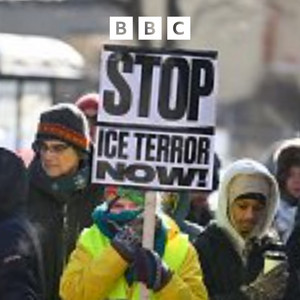
Well, one of the sounds you get used to here is the combination of The crunch of the snow and ice beneath your feet and the repeating chants of the protesters to get ice out of Minneapolis.
And thousands have turned out in...
A couple of days now since Alex Preti was shot dead.
Something in itself is a pretty astonishing move, because temperatures dropping down to about minus 25 Celsius overnight.
It is extraordinarily cold.
So you've got a nice hot cup of coffee to keep your hands warm.
Good idea.
Which I don't normally do, but now I need to, to protest.
What does the sign say?
Ice out.
Ice out.
Of Minnesota.
Yeah.
A day of truth and freedom.
We both marched on Friday and now we're back just trying to find out how we can show up, because the people of Minneapolis are tired, very angry and Irate.
Irate.
I fear where it's going to go is war.
I do, because this is...
Domestic terrorism.
We are being terrorized.
These are things that have happened in the past when regimes have taken over countries.
We're divided.
We are a nation divided.
There's too many people still supporting this injustice, and so I'm afraid of war.
We're here using our constitutional rights.
The man who died had every constitutional right.
They killed him.
They took his gun first.
They let their friend clear his body, and then they murdered him.
It's clear, clear, clear.
Well, the protests have remained largely peaceful.
Cars coming past.
Honking horns, trying to show solidarity.
A lot of fists raised in the air when they do that.
But at the same time you've had this escalating rhetoric between the Democrat-led city and state authorities here and the Trump administration in Washington, particularly doubling down over their account of the killing of Alex Preti.
They have maintained that he was going to carry out, in their view, an armed attack.
They published pictures of what they said was his 9mm semi-automatic handgun.
And we heard from Greg Bovino who is this commander-at-large of the Border Patrol, now a sort of known figurehead on the streets roaming with his agents.
And he has suggested that people shouldn't come out and choose to do what they've been doing when they've been observing and filming these ICE agents here.
I would implore upon any individuals, whether they're anarchists, rioters or anyone else, that thinks it wise to go into a law enforcement scene, to disrupt, to delay is to don't do that.
At the same time, the Homeland Security Secretary, other parts of the administration, seeing what happened here as, in their view, domestic terrorism.
Now all of that has been totally rejected, both by the protesters, the Democrat authorities here and Alex Preti's family, who call that a lie and say they want the public to understand the truth about him.
His dad is Michael Preti.
He cared about people deeply and he was very upset with what was happening in Minneapolis and throughout the United States with ICE, as millions of other people are upset.
It really feels like a standoff now between this Democrat city and the Trump administration.
It represents a much wider story about the battle for contemporary America.
A Trump administration that says it's delivering on its elected pledge to carry out a mass deportation campaign, accusing people here of inciting an insurrection.
And the protesters and the Democrats here saying that they are seeing their city occupied by agents geared up more for war than carrying out immigration enforcement.
Tom Bateman reporting.
A monster winter storm expected to affect 200 million people has been hitting parts of the US.
Thousands of flights have been grounded and more than a million left without power.
In some places, temperatures were as low as minus 40 degrees Celsius.
At least 23 states have already declared a state of emergency.
The mayor of Philadelphia, Sherelle Parker, warned people to stay off the roads.
The city remains under a snow emergency that began at 9pm last night.
As of this moment, there is no update on when we anticipate lifting those restrictions, as we still have more hours of precipitation to navigate and to clear.
This woman who lives in the southern state of Arkansas says it isn't prepared for the weather.
I'm from New York originally, so just not having anything plowed blows my mind.
When it snows, you're stuck.
Our reporter in Washington DC is Helena Humphrey.
This is an absolutely massive storm.
It is stretching right across the United States some 2,000 miles.
Really remarkable to see that storm system from the likes of New Mexico, stretching to New York, heading up to Maine, where I am in Washington DC right now, blanketed in snow.
We're expecting to see up to a foot of snowfall today alone.
But really the main warning here is with regards to the extreme cold that we're seeing.
It's around minus 12 degrees celsius where i am right now, but the wind chill factor is making it feel all the more colder, and that's really what these warnings have been about.
Authorities have been saying these are life-threatening conditions.
There is the risk of hypothermia frostbite, and sadly we have learned that in louisiana two people have died from hypothermia.
And when you think of somewhere like Louisiana, you don't think of particularly cold weather, and is that part of the problem that people maybe aren't as prepared in places like Louisiana as they are where you are?
That's such a good point.
I mean, it's really so remarkable to see southern states like Louisiana Mississippi Texas, for example, all knocked off the power grid.
More than one million properties, so homes and businesses are without electricity.
People waking up in the dark.
In some places in North Carolina, people are without heating. right now.
And they've just been told to sit tight for a number of days because it is treacherous even getting out to repair the power lines.
And, as you mentioned, places on the east coast of the United States.
They're pretty battle hardened when it comes to these storms.
But this is so severe that we've even had that warning from the mayor of New York saying don't go out, Don't risk it.
He hasn't declared a snow day officially in New York.
Children will have to go online for their learning tomorrow.
But nevertheless, I think everyone is feeling it right across the country.
And how much are the authorities able to help if it's such a huge storm and there's so much snow?
I mean, I imagine they've got their work cut out.
They've certainly got their work cut out.
I was up early this morning, around 4am, watching the snow ploughs try to plough through the streets, but no sooner had they passed.
And essentially what you saw were the streets blanketed white once again.
President Trump has declared a state of emergency for at least 23 states.
And what that does is It unlocks federal funding in this kind of effort.
But in many cases it's a case of people having to take the advice from authorities hunkering down, sheltering in place if they can.
Of course, there's always that concern with regards to people who perhaps don't have a home unhoused populations, certainly an issue here in Washington DC, and they've been opening warming shelters for people who have nowhere to go.
Helena Humphrey in Washington, D.C.
The French sailor Thomas Covell and his seven-man crew have set a new round-the-world sailing record.
They completed the 50000-kilometre non-stop voyage in 40 days, 10 hours and 45 minutes, wiping more than 12 hours off the previous record to claim the Jules Verne trophy.
Helen Fretter, who's the editor of Yachting World magazine, says it's a gruelling challenge to undertake.
The Jules Verne Trophy is basically around the world non-stop.
You start from France, you go down South Atlantic around the bottom of the world and you come back.
Originally it was called the Jules Verne because to do it in under 80 days was seen as incredible.
Now they're trying desperately to get it under 40 days.
And the technology, since it was set in 2017, has come on in leaps and bounds.
The boats are incredible machines.
But the margin that they have broken the record by is still really small, because it's just such an incredible challenge.
You're at the lap of the wind gods, effectively, as to what conditions you get.
And there's also the real technical challenge of managing these really complex boats through really extreme sea states, all the fatigue and damage that can occur over a month and a bit of pushing it to its absolute limits.
Coming up the equator, northbound the second time, they were a good chunk ahead.
But storming grid brought not only really strong winds, but huge five metre plus waves.
It's boat breaking conditions, basically.
Things start to break up and degrade.
And you have to really, really nurse your boat through those sort of sea states.
It's utterly relentless.
You're trimming, you're adjusting the foils, the sails, constantly trying to squeeze every fraction of performance out of this boat.
And they're hurtling around at 30, 35 upwards knots, which is right on the limit.
And then...
The noise on these boats is phenomenal.
The foils in the water create this really high-pitched howl and the movement of the boat is kind of like your worst nightmare fairground ride.
It's lurching and pitching and slamming around.
So it's a really hard physical environment to be in as well.
It's cold, it's noisy, it's really hard to rest.
So the physical challenge is relentless.
That was Helen Fretter. still to come in this podcast.
I've been bringing my boy here since he was a baby, so I hope it becomes a good memory for him.
I'm glad we could come today to remember them.
Saying goodbye to Japan's giant pandas, but will China send them any more?
Internal Interpol files shared with the BBC show Russia is consistently breaking the global agency's rules when Moscow is requesting arrests abroad, devastating the lives of those left in limbo.
If journalism is the first draft of history, what happens if that draft is flawed?
In 1999, four Russian apartment buildings were bombed, hundreds killed.
But even now, we still don't know for sure who did it.
It's a mystery that sparked chilling theories.
I'm Helena Merriman and in a new BBC series I'm talking to the reporters who first covered this story.
What did they miss the first time?
The History Bureau, Putin and the apartment bombs.
Listen on BBC.com or wherever you get your podcasts.
They're waiting for their cases to be overturned.
An Interpol whistleblower has also revealed evidence that extra scrutiny measures the organisation had in place on Russia following the invasion of Ukraine have been diluted.
Natasha Peach reports.
I would always express my beliefs.
I would openly say that Putin is a criminal.
But then I started feeling the screws are being tightened.
Eugene Lorenchuk was running a theatre in Moscow until in 2014 he says he no longer felt safe.
He returned home to Ukraine, directing operas and plays here, at the Ivan Franko Theatre in Kiev.
But whilst travelling for work, he was detained by the Italian authorities.
At passport control, they stopped me.
Only two words stood out, arrested and Moscow.
Russia had requested, via Interpol, for Eugene to be arrested, accusing him of fraud and seeking his extradition.
Apparently, I stole money from a theatre.
I don't know what to tell you.
It never happened.
Interpol didn't take a view on his criminal case.
He spent three weeks behind bars in Italy before the organisation decided to cancel Russia's arrest request because of doubts raised over whether it was politically motivated.
Today's threats are global threats. you need a global system.
And that is exactly what Interpol is about.
Interpol has long faced criticism that authoritarian regimes use its systems to hunt down opponents.
Ukrainian CCTV captures these images of the Russian military crossing the border from Crimea to the south.
After Russia invaded Ukraine in 2022, Interpol acted and said it would add extra scrutiny on requests from Russia.
Despite the extra checks, leaked documents reveal Interpol approved about 90 of Russia's requests in 2024.
At the same time when Interpol's independent watchdog was reviewing complaints about Russia's requests, they overturned roughly half for breaking the rules.
Internal reports also showed Interpol was aware of Russia's flagrant violations of its rules.
I've been working for Interpol for quite a while now.
I won't say where.
That's a whistleblower from inside Interpol who has leaked thousands of internal documents to BBC Eye and Disclose a French investigative newsroom.
We've disguised their voice and identity.
They claim to be transparent, but that's just not true.
Everything is on a need-to-know basis.
Our source told us there's evidence that Interpol has weakened some of its restrictions against Russia.
Interpol disputed our findings, saying they have a constitutional obligation to remain neutral and have strengthened their safeguards to prevent misuse.
They said they were not able to comment on whether any restrictions against Russia had been lifted.
We tracked down one of the men Russia has targeted since the war began.
And when he faced the Reds, When you're hit with a red notice, you're like a cornered rat.
Igor Petrikov now lives in the south of France, where he is seeking asylum.
His companies were major producers of rare earth metals.
In the lead-up to the war, he refused to stop selling abroad.
I was against this, have to sell much cheaper and to whoever the ministries told me to.
It wasn't just a business issue, it was a moral issue as well.
He says his refusal led to his companies being nationalised and to a criminal investigation.
He left Russia and was put on Interpol's wanted list.
Your bank accounts get blocked.
It's the stress, the nerves, the pressure, the lawlessness inflicted into you.
The Russian authorities did not respond to our allegations.
Igor's name was on the wanted list for almost two years before Interpol ruled that his case was predominantly political.
And that was Natasha Peach.
A big part of Saudi Arabia's reinvention of its troubled global image has been through hosting sporting events.
That'll culminate in the World Cup in 2034 going to Saudi.
But the path is not proving entirely smooth.
It's just been announced that the Asian Winter Games, which the kingdom was due to host in three years, have been postponed indefinitely.
The event was due to be held in the planned megacity of Neom, So how's that progressing?
It's something that Alison Killing from the Financial Times has been looking into.
She began by describing the vision for NEOM.
There were a number of projects that were actually part of it.
One that people might have heard of is the line.
That was this giant megastructure which was meant to be 200 metres wide, 500 metres high and then 170 kilometres long.
It looks like this giant mirror glass wall stretching from the sea up into the desert.
And 9 million people were supposed to live inside the to go to, whether it's the school or the hospital, or to do your groceries, or a neighbourhood park, or a museum or a football stadium.
All that's going to be contained in this one giant megastructure.
But because you can move in three dimensions, all of it's going to be relatively close.
In addition to that, there was going to be a ski resort in the mountains, which was called Trajana.
And that's where the Asian Winter Games were intended to.
Past six months, certainly potentially more work has slowed down significantly.
And in fact, Saudi Arabia has just announced that they are redesigning what would have taken place there.
And there's no longer going to be this megastructure.
They're thinking instead about a much more modest proposal.
And I guess part of that matters potentially politically in Saudi Arabia, because Mohammed bin Salman has associated himself so much with the specifics of this project.
And saying no to somebody who has such power in the country must have been a difficult thing to do and presumably carries a certain cost for all those involved.
Yeah, things that I heard from sort of talking with people who'd been involved with the project was that it was very difficult to bring criticisms of the project and to be listened to.
People said at the time, these 9 million people who are supposed to come to NEON by 2030, like where are they going to come from?
Can we really build a city to accommodate them all by 2030?
What is this thing actually going to cost?
When NEOM was first announced in 2017, there was 500 billion from Saudi Arabia's sovereign wealth fund that was devoted to it.
And they said, we don't think this is enough.
The line, it looks like it's going to cost trillions.
But they said that it was very, very difficult to get criticism listened to.
And people who did try to raise those questions were either told to keep quiet or were pushed out.
What we saw instead was NEOM, as they started to sort of adjust to reality.
They would say well, you know, initially the first phase of the line was going to be some 10 kilometers.
And they gradually cut that down until they were only going to build two and a half kilometers as the first phase.
And then late last year, they started to announce, well, OK, it's not going to be ready by 2030.
You know, this is a multi-generational project.
And so we've seen this gradual climb down, which is also allowing people to save face, allowing Prince Mohammed to save face.
That was Alison Killing of the Financial Times speaking to Tim Franks.
The Prime Minister of India, Narendra Modi, has led tributes to Mark Tully, who reported for the BBC from there for many years.
He said that Sir Mark, who was 90 and died in Delhi, left an enduring mark on public discourse.
Mark Tully was known as the BBC's Voice of India.
Mark Tully was a towering figure in South Asian media for decades.
The rich, warm tone of his voice, familiar to BBC audiences in Britain and around the world.
He reported on some of the defining moments in South Asia, from wars to famines to assassinations.
In 1992 he witnessed a huge crowd of Hindu hotliners tear down an ancient mosque in Ayodhya in northern India.
Some of them threatened him, chanting, Death to Mark Tully.
Within hours, there was nothing left of the mosque, and lanes like this were full of triumphant Hindus shouting slogans against Muslims.
Journalists were attacked, beaten up, and their equipment smashed.
I was threatened and locked up in a temple.
This was a bad day for Indian secularism.
Mark Tully was fluent in Hindi and grasped the complexities and nuances of Indian culture and religions.
For many Indians, he was always Tully Sahib.
Appearing on Desert Island Discs in 2003, he said he believed that spending most of his life in India was his karma.
In India, I'm always being asked, you must have passionately wanted to be a journalist.
And I said, no, I didn't.
It was all happened to me by accident.
India has had a very profound effect on the whole way I live my life.
It has given me a much greater appreciation of the role of fate in one's life, that you don't actually make your life half as much as
In this sort of achievement-oriented society.
In the West, people are taught to believe that a lot of your life is made for you.
I grew up listening to Mark Tully's dispatches and reports in the 80s and 90s and he was an inspiration to many aspiring journalists at that time.
His colleagues and friends remember him as a uniquely warm, generous, gentle and helpful man.
As the historian William Dalrymple put it, as the voice of India, he was irreplaceable, a man prepared to stand up to power and to tell the truth, however uncomfortable.
That was Ambarasan Etirajan.
And finally, thousands of people have queued at a zoo in Japan to see the country's final two giant pandas before they leave for China on Tuesday.
The twin bears were born in Tokyo in 2021 to parents on loan from Beijing.
Our Tokyo correspondent, Shaima Khalil, reports from Uene Zoo.
It's been a big day here at Tokyo's Ueno Zoo emotional for some, as large crowds gathered to say goodbye to Japan's beloved twin pandas, Shao Shao and his sister Lele.
I am surrounded by panda souvenirs, stuffed toys, magnets, bags, hats.
The four-year-old giant pandas have been national darlings since their birth here, but their return to China was always part of the loan agreement.
Many people here tell me that, even though they knew that they had to go home someday, it's still hard saying goodbye.
I've always liked pandas, but seeing the twins and witnessing their growth, especially since they were so small, has been such a joy.
It's rather sad that they are leaving.
But considering their situation and thinking about their future partners, it really is better for them to be in China.
I've been bringing my boy here since he was a baby, so I hope it becomes a good memory for him.
I'm glad we could come today to remember them.
Record numbers have wanted to come here to see the pandas for the last time, so a lottery was drawn to pick the lucky visitors.
But the viewing itself has also been restricted about a minute or so, just barely enough time to wave, to say goodbye and maybe take a selfie.
China has long used these loans as part of its foreign relations, known worldwide as panda diplomacy.
Loaning pandas when things go well, withdrawing them when relations sour.
But this farewell comes against a particularly tense backdrop in the Japan-China relations, after the Japanese Prime Minister, Sanae Takeuchi, said that Tokyo would respond militarily if China attacked Taiwan.
Comments, of course, that infuriated Beijing.
Now this has cast doubt over whether Japan would be able to secure any new giant pandas once the twins leave.
With Xiaoshanlele's departure, Japan will be without any giant pandas for the first time since 1972, the year it normalized diplomatic relations with China and got its first panda loan.
Officials here say they have put in a new request.
So far there's been no response from Beijing, as fans here wait and hope that diplomacy could avert a potential panda crisis.
That was Shaima Khalil reporting from Tokyo.
You can also find us on... use the hashtag Global News Pod.
This edition was mixed by Charlotte Hazroy-Tajimska and the producers were Muzaffar Shakir and Stephen Jensen.
The editor is Karen Martin.
I'm Charlotte Gallagher.
Until next time, goodbye.
If journalism is the first draft of history, what happens if that draft is flawed?
In 1999, four Russian apartment buildings were bombed, hundreds killed.
But even now, we still don't know for sure who did it.
It's a mystery that sparked chilling theories.
I'm Helena Merriman and in a new BBC series I'm talking to the reporters who first covered this story.
What did they miss the first time?
Listen on bbc.com or wherever you get your podcasts.