Hey everybody!
Welcome back to my YouTube channel.
My name's Arianita La Gringa, and in today's video we're going to learn some English at the grocery store.
Let's get started!
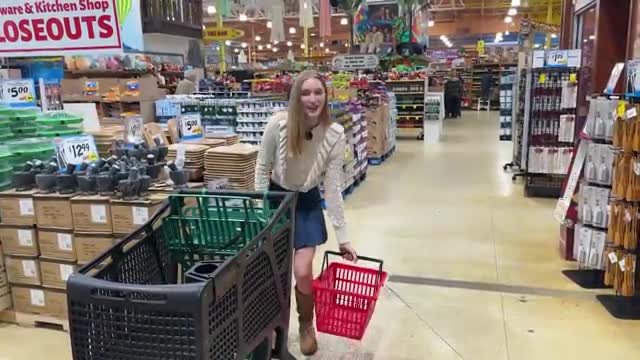
Before going inside, let's grab a shopping cart.
A shopping cart is probably better if you're going to buy a bunch of groceries.
It's easier to push the shopping cart than carry a heavy basket.
But if you are going to be in and out of the store and you're only going to buy a couple of items, then I recommend you grabbing a basket rather than pushing a shopping cart.
Right now I'm inside the grocery store and before coming to the grocery store, I like to make a list of items that I want to buy, or a grocery list.
This is a grocery list and it does come in handy because I can find things in the same aisles and I can make sure I want to buy the things on my list and not forget anything.
Inside the grocery store, you can find different sections of foods.
For example, right now I'm in the produce section, and in this section you can find vegetables and fruits.
They have different types of produce in the store.
They have organic and conventional.
Organic is grown without pesticides and it is a little bit more expensive than the conventional produce.
And conventional is grown with pesticides.
Here is the organic section where you can find organic fruits and vegetables.
For example, the price of an organic green bell pepper is 499 per pound and a conventional green bell pepper is 249 per pound.
Can you see the difference between the prices?
Organic produce is more expensive.
Many fruits and vegetables are sold by weight.
When you're ready to check out.
At the checkout counter, you will have to weigh, for example, a bunch of bananas to determine the final price of these bananas.
This is a scale.
So if you wanted to know the weight of a bunch of bananas, you will just put this bunch on the scale and it's around two and a half pounds.
The unit price tells you how much you'll pay per pound, ounce, or item.
Talking about bananas, how do you know the best time to eat one?
If they are ripe.
These bananas are ripe.
That means the bananas are mature, they are perfect to eat and they are normally yellow.
If the bananas are hard and green, they might be underripe, So these bananas aren't ready to eat.
But if the bananas are overripe, they might be brown, soft, and mushy.
So these bananas are good to eat, but you need to eat them fast because they might go bad.
And it's the same thing with avocados.
Can you tell me which avocado is ripe?
This is a ripe avocado.
It's soft and a little bit mushy, and it's ready to eat.
This avocado is underripe.
It's hard, the outer shell is green, and it's not ready to eat.
It's probably best to buy an underripe avocado if you're not gonna eat the avocado the same day.
A lot of you might know a lot about the common types of fruits like bananas, strawberries and apples.
But can you guys differentiate the different types of apples?
For example, this is a Granny Smith apple.
It's a green apple.
So a lot of these apples over here have different sizes, colors, and tastes.
So this one, the green apple, might be kind of sour, but a honey crisp apple, a red apple, might be sweet.
As you can see, there are many different types and kinds of apples in the store.
And what's your favorite?
I personally like the green apple.
It's kind of sour and I like to dip it in peanut butter.
Excuse me, where can I find some laundry detergent?
Laundry Thursday will probably be down in American Grocery aisle, I'll say aisle seven.
Okay, thank you.
Learning English can be a little bit like navigating a grocery store.
Sometimes you need a little help to find your way around.
I've been using this app called Preply to learn Spanish and it's been amazing for connecting with tutors and finding the right resources.
Preply is a language learning platform with the best tutors worldwide.
You can find tutors from Great Britain, America and Australia.
They have filters so you can find lessons that fit your budget and schedule, whether you prefer one-on-one classes or group sessions.
Why put it off?
Right now it's November, so let's make some real progress before the year ends.
If you guys want to improve your English, head on over to Preply and use my discount code Arianita50 for a 50 discount on your first trial.
Thanks to Preply for sponsoring this part of the video.
Now let's get back to grocery shopping.
Now I'm in the deli section.
In this section, you can order sliced meats and cheeses at the deli counter.
Talking about ordering meats, let's go ahead and order at the deli counter.
At the deli counter, you can see how thin you want your meat sliced.
So you can get it shaved, very thin, thin cut, sandwich, or dinner cut.
And the dinner cut is pretty thick.
When you order at the counter, you will order per pound.
So you can get a quarter pound, a half a pound, three quarters pound, or one pound.
If you want a quarter pound, it'll be probably for one or two sandwiches.
And if you want one pound, that'll be enough for four to five sandwiches.
Hi, can I get half a pound of ham, please?
True thing, how do you want that cut?
Sandwich cut.
Is that all for you today?
Yes, thank you.
Now I'm in the bakery section.
Here you can find bread, cakes, pastries, cookies, and even more things.
Also in this section you can find some baking supplies if you do want to bake some cakes or cookies.
Hi.
What can I get for you?
Yeah, can I get some cheesecake?
Yeah, what's it like?
Um, the one on the stick with chocolate.
Yeah, I would like the cheesecake stick.
Thank you so much.
Have a good day.
Thanks.
Now I'm in another section of the grocery store, the cereal section, but we don't really call this a section.
We call this an aisle.
It's a pathway with shelves next to you.
In this aisle you can find different types of cereals like Fruit Loops, Apple Jacks and Raisin Bran.
This is a box of cereal.
It's the regular size, but they also have a large size and a giant size.
In the US people normally eat cereal for breakfast.
But let me know down below what you guys normally eat in your country for breakfast.
Now I'm in the canned food aisle. literally, food that comes in a can.
And here you can find soups, vegetables, fruits, etc. that's in a can.
And these are non-perishable items, so they last a lot longer if you don't open the can.
For example, This is canned food.
It's a can of homemade chicken noodle soup.
And let's find out and see the expiration date, because the expiration dates will be on the bottom of the can and this will tell me how long I have to eat this soup until it goes bad.
Wow, i have until july 24th of 2026, so i have around a year and a half to eat this can of soup.
Whoa, somebody called the firefighters because this section is hot and spicy.
So in this area of the grocery store you can find different types of hot sauces and chili powders, and over here they have a case it's actually locked with the premium hot sauces.
Here you can find the hottest hot sauces and one of them costs $600.
Would you guys try out some of these hot sauces or do you guys even like to eat spicy food?
Let me know down below.
Right now I'm in the seafood section.
They have salmon, tuna, cod, and they even have live lobsters in the seafood section.
Let me know down below in the comments if you've ever eaten a lobster.
Hi, can you tell me what people normally order here at the seafood department?
On Fridays, our oysters are $1, so mostly people come in for that.
And do you have anything exotic or weird in this department?
Any exotic thing we have is called a monkfish.
It's a bottom feeder.
It's like that fish on Finding Nemo with the light on his head.
But besides swimming, he sits at the bottom and eats everything.
Oh, wow.
And supposedly, it tastes like lobster.
Wow, interesting.
Thank you.
Can you show me the big fish that is in Finding Nemo?
Hmong fish.
Well, it's a cousin of them.
The actual angler fish swims around.
These guys sit on the bottom and they have this little worm appendage and they just dangle it.
As soon as the fish bites it, they just open that.
And if you look in there, their teeth go all the way back.
Right now, I'm in the meat section of the grocery store.
They have different types of meats like pork, chicken, turkey, and behind me they have beef.
I'm going to ask a worker to explain to me the different types of cuts of beef.
Hi, can you explain to me and tell me the different cuts of meat?
Yeah, absolutely.
So lots of different cuts come off the cow.
For instance, this one is the ribeye steak, probably the most flavorful steak, really popular.
This is going to be your T-bone steak, shaped like a T. That's why it's called that.
Strip steaks here.
Yeah, tri-tip steak.
And then, you know, as we go down this way, we got a lot of our roast.
The chuck roast is probably going to be the most popular roast that everyone's really familiar with.
And then we got the grump roast down here. and there's probably about 30 more cuts that there are.
So every part of the animal is called something different.
Right now I'm next to some pork and here they have different types of cuts.
These are some baby back ribs and they have some ground pork right here and some fork loin.
And with chicken, it's the same thing.
There are different cuts of chicken like drumsticks, boneless chicken, ground chicken, and breasts.
And now I'm in the beverage section of the grocery store.
And here you can find different types of beverages like pop, or you can just call it soda juice, energy drinks and water.
And this is the dairy section.
Here you can find things like eggs, yogurt, cheese, and milk.
And they also have different kinds of milk.
So the milk is in a fridge, And they have whole milk.
This is a gallon of whole milk.
In this fridge, they have some 2% milk.
This is 2% milk or reduced fat milk.
Lactose-free milk.
This is lactose-free milk.
And they even have organic milk.
Right now I'm in the frozen food section and here you can find a bunch of frozen foods like pizza, ice cream and even french fries.
So frozen food is preserved in a freezer and it actually lasts longer.
This is a frozen pizza and the nice thing is that it comes in a box and it's already made, so you don't have to make the dough, put the cheese on top or the pepperoni.
You can just put it in the oven and then bake it, and then it'll be done.
A lot of people like to buy frozen food because it lasts longer in the freezer and it's already made.
You don't have to make any rice, you don't have to cook beef or any broccoli, you can just stick it in the microwave and you'll have a nice meal.
But personally, i don't really like frozen food.
I like fresh food, so i'm gonna put this back.
I walked around the whole store and found some groceries, and now I think it's time to pay.
Where do you pay for your groceries?
Well, you will go to the checkout area to check out and pay for your groceries.
And there are two ways to pay.
You can go to the checkout counter where a cashier will scan all the items and you will pay over there, or you can check out at the self-checkout where you yes you, the customer will individually scan each item and then pay by yourself.
You find everything okay?
Yes, thank you so much.
Sorry, what's my total again?
$73.06.
My total is $73.06 and now I will pay.
There you go.
Thank you so much.
After paying for my groceries, I have to put all my groceries in my car, and that's called loading the groceries.
So I will load the groceries and put them in my trunk.
Now I have to return my shopping cart.
Okay, everybody, I hope you guys learned some essential vocabulary at the grocery store.
If you guys liked this video, go ahead and give me a like subscribe, and I'll see you guys next week.
Bye!