From the New York Times, I'm Natalie Kitroff.
This is The Daily.
Capitol Hill is still closed for business as the government shutdown heads into week two.
We're six days into the government shutdown and the Trump administration is capitalizing on the moment.
Far from working to end the shutdown, Donald Trump is using it as an excuse to ramp up his slash-and-burn cuts to the government.
By freezing billions of dollars in spending in cities and states run by Democrats and threatening to lay off thousands of government workers.
So who is the man who appears to have the high trust of President Trump and gets to decide which federal workers will stay and which will go?
The man at the center of that push to dismantle and reshape the American government.
Russell Vogt.
Russell Vogt.
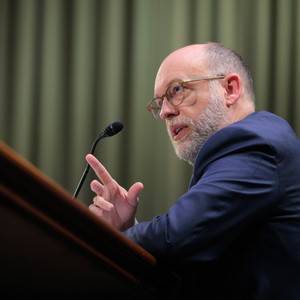
Who is Russ Vogt? is White House Budget Director Russell Vogt.
Today, my colleague, Coral Davenport explains how Vogt, a once obscure bureaucrat who worked on Project 2025, became one of the most influential figures in Washington.
It's Monday, October 6th.
Coral, Russell Vogt is someone I've generally been aware of.
But right now, because of the shutdown, he has taken on much more of a protagonist role in the Trump administration.
Everyone seems to be talking about him.
So just to start, who is Russ Vogt?
So Russ Vogt is the director of the White House Office of Management and Budget, which is normally a pretty wonky role.
But at this moment in the shutdown, he has really taken center stage.
He has had this plan to... cut the government, cut spending, cut agencies, cut workers.
And now it's kind of Russ Vogt's time to shine to do that.
And we've seen that this week, as Democrats have painted him as this villain in the shutdown scenario.
And even Senate Republican leader John Thune said, we don't even know what this guy's going to do.
And sort of.
Most spectacularly of all, the president posted this video of Russ Vogt as the Grim Reaper.
So in this video you see Vogt as literally the Grim Reaper striding in front of the Capitol, and Trump on the cowbell.
They sing like, now the time has come.
Their power's gone.
He ties your hands.
Russ wields the pen, the funds, and the brain.
You know, this video is nuts, but it's also sort of the core of it is really accurate.
In so many ways, that's what's going on right now.
The plan that Russ Vote has been putting in place is about taking power away from Congress, tying the hands of Congress, bringing the power over to the White House, to the president.
So...
You know, it's like this crazy internet meme that is kind of spot on.
Okay, so setting aside the question of whether we can fact check the AI imagery in this truly wild video you're saying, it accurately assesses votes' role.
Absolutely.
I mean.
Normally the role of the White House budget director is just this very kind of behind the scenes job.
That's really about taking the president's policy agenda and translating it into a budget.
Vote does far more than that.
He is really using the role as an agenda setter itself.
He has spent years preparing this vision for the entire federal government.
And I should say...
This comes from a place of thinking of the federal bureaucracy as something that is deeply problematic.
He calls it woke and weaponized, and he really thinks that the federal government is the problem.
And I should say another thing that comes up in my reporting a lot is the word nerd.
He really is this like hardworking policy nerd who has focused his whole career on this objective of smaller government with less spending and less workers.
He's such a true believer.
He even named his dog Milton for Milton Friedman, the free market economist.
Wow.
And now he has met this moment of shrinking federal government.
Okay, you described him as a true believer.
How does he arrive at those beliefs?
How does he get to where he is now on this mission to radically change the shape of government?
Natalie, I have spent weeks and weeks of reporting trying to get at that.
And I should say that Russ Vogt did not grant me an interview for this piece, but I have read hundreds of pages of his writings.
I've listened to hours and hours of his podcasts.
I talked to between 30 and 40 people who are kind of in his orbit and have worked with him and know him and are his friends.
And what kind of came up is someone who really has believed this for a very, very long time.
I have spent my entire career caring about taxpayers and families.
He talked about that in his very first Senate confirmation hearing.
I come from a blue-collar family.
I'm the son of an electrician and a public school teacher.
He grew up in a conservative, religious, blue-collar family.
He is the youngest of seven children, grew up in Trumbull, Connecticut.
His father, interestingly, was a union electrician, and he was a Marine Corps veteran.
His mother was a public school teacher.
In both of those cases.
You know, I don't think of that as being something that would lead you into trying to work to minimize government, but he has described how his parents worked incredibly hard to support him and his siblings.
I know what they went through to balance their budget and save for the future.
My parents worked really long hours to put me through school, but they also worked long hours to pay for the high levels of government in their own life.
I think he really genuinely sees the burden of paying for taxes and government as weighing so heavily on families like his own.
My old boss called them the wagon pullers in our country.
Others have referred to them as the forgotten men and women.
They have always been my test for federal spending.
Did a particular program or spending increase help the nameless wagon pullers across our country working hard at their job, trying to provide for their family and future without the luxury of watching C-SPAN at that particular moment, to know that we might increase their burden at that minute?
It sounds like he was kind of turned against the idea of big government from the very beginning as a child, seeing his parents navigate this country.
Yeah, and you really see that through line.
You know, as soon as he graduated college, he went straight to Washington and got a job working for Senator Phil Graham, a Texas Republican who was at the time known as this icon of fiscal conservatism, fiscal austerity.
And I talked to Phil Graham about Russ Vote, and he said something interesting.
He said usually, you know, people come to work for me because they really want to come and work for me.
You know, that they're really sort of driven by this idea of slashing government.
And I asked him, you know, what he remembered about Russ Vogt.
And he said he remembered him as almost working too hard.
You know, working by day to support the agenda of cutting government and then going to law school at night.
So it's passion that's combined with this really intense work ethic.
Passion plus discipline.
Absolutely.
So after Phil Graham, he goes to work for the House Republicans.
He focuses on budget policy.
This is kind of during the time of the rise of the Tea Party. movement.
So there's this wave of intense fiscal conservatism anti-government, sweeping through Washington, and he's a natural fit with all of that.
And then he goes from there to the Trump administration.
But I should say, it wasn't necessarily an automatic fit for him.
You know, one way that Russ Vogt is very different from President Trump is he's very religious.
And He takes his faith really seriously.
He teaches adult Bible study at his church.
And before joining the first Trump administration he actually thought about kind of leaving the world of Washington policy and going to seminary and studying to be a pastor.
Russ Vogt doesn't curse.
President Trump has a foul mouth.
He refers to Christians in the third person.
I think just culturally, there was some discomfort with that fit.
But in the end, the call of the White House won out and he joins the first Trump administration.
He's there from the very beginning.
And what does he do in that first Trump term?
Washington has a spending problem and it endangers the future prosperity of our nation for generations to come.
So he enters the first Trump administration as deputy budget chief.
By the end, he's running the whole office.
During that time, he argued that the president had the power to block federal spending that Congress had approved.
And we are saying to the American people we can no longer afford the paradigm that Congress keeps giving us, which is that we're never going to make any tradeoffs, that we're never going to align what we spend with what we take in.
And he tried to do that in a number of really memorable cases.
Breaking news President Trump reportedly ordered to hold back military aid for Ukraine for at least— He was part of a group of White House officials who froze military spending for Ukraine in defiance of Congress.
Listeners will probably remember that that essentially paved a way to the president's impeachment.
The Trump administration will divert 36 billion in defense spending for 175 miles of the president's wall along the US-Mexico border.
He also helped come up with the idea of using emergency powers to redirect Pentagon spending to build a border wall, also without congressional approval.
You could almost see the lawyers at DOJ.
You know their heads just spinning off their axis, because they are going to be the ones who have to defend this national emergency.
Essentially saying, you know, the president can do what he wants with this money.
That new executive order that will make it easier to hire and fire some federal employees.
And he pushed an executive order that would have enabled the president to easily fire tens of thousands of career civil servants.
And the idea of that was both saving money by eliminating employees, but also this idea that the bureaucracy, the people who work in all these federal agencies remain here, regardless of who is president.
And there's this sense of these federal agencies are full of workers who, he believes, tend to be more liberal-leaning people and are not loyal to the president.
So the firing of these civil servants, it sounds like, is very much about going after what Trump and his allies see as the deep state, this group of people that are working against him and his agenda from within.
But at the same time for vote, it's also about his really primary focus, which is giving the president control over spending and eliminating it as much as possible.
That's exactly right.
The philosophy is expand the president's power and use it to shrink the federal government.
But in the end, all of these efforts were undone or reversed.
You know, the budget office was eventually forced to restore the Ukraine money.
All the other moves were reversed by the Biden administration.
So, despite all of Vought's grand ambitions and his efforts to really see them through in that first term, he gets stymied.
He does.
And then Trump loses the election.
He has to leave the White House.
But really from the very last months in the White House to the minute he leaves the White House, Vogt becomes obsessed with this idea of how can we do it different.
How can we take what we learned?
What went wrong?
How can we do it right?
How can we cut off this money and make it last?
And I talked to a lot of people who said he was so driven by this.
During these Biden years, during this kind of time in the wilderness he just kind of becomes obsessed with like all right well, how can we do it and have it stick the next time?
And how does he channel that obsession?
Like, what is he actually doing with his time and on all of that energy during the Biden years?
So he leaves the Trump White House.
He goes and starts his own think tank.
It's called the Center for Renewing America.
In the first year that he's working there, the tax records show he's the only employee.
And he rents out this space.
It's based in this kind of grungy row house near the Capitol that was actually infested with some kind of clawing animal, either rats or pigeons, clawing in the walls such that it was distracting to people who were visiting.
And our colleagues Annie Carney and Luke Broadwater wrote about this in their book Madhouse, really conveying the idea that he is very much in the wilderness in these years.
A far cry from the White House.
Yes.
And so during this time, he's thinking really hard about what the comeback looks like, all the puzzle pieces, how to pave the way to it.
He's writing a lot of white papers, doing a lot of research, working with a lot of fellow Trump alums, working with the folks, of course, also who are working on Project 2025, which was another one of these blueprints for the second Trump administration.
And I talked to a lot of folks close to him who said, you know, this really seemed to be a time of getting radicalized, getting angry, just kind of having this edge at that time.
What's an example of that harder edge?
Like, how do you see it show itself?
Well, so a few weeks after the 2024 election, he goes on Tucker Carlson's show.
And there had been this clip that had circulated of him where he had talked about how he wanted government employees to be in trauma.
Yeah, I remember that.
So Tucker asks him about it, and he leans into it.
One of the arguments that they're using in the press against me right now, as they say he called for trauma within the bureaucracies.
Yeah, I called for trauma within the bureaucracies.
The bureaucracies hate the American people.
He embraces it.
He says, yeah, I want government employees to be in trauma.
You go every agency and it's not just big government.
It's weaponized against the country.
Of course.
And so yeah we we, I would want to provide trauma against that bureaucracy in a way that frees the American people from the people that have assumed the type of power that the Constitution and no law, no public debate ever gave them.
And in that same interview, he also lays out how he is going to get this done.
He's got a very specific legal strategy in mind for how to cut the government, dismantle these agencies and get rid of these employees.
And that legal strategy is centered on this idea of impoundment, bringing back the notion of impoundment.
And this is something that... Of what?
Of impoundment.
The ability to not spend money.
For 200 years, presidents had the ability to not spend a congressional appropriation.
Impoundment is the idea that the president can block spending that has already been approved by Congress.
The Constitution, in Article 2, gives Congress the power of the purse, the power to say how much money is going to be spent and direct where it's going to be spent.
And essentially votes reading is that if the president disagrees, the president can refuse to execute that spending, can impound that money.
So 200 years, presidents are using impoundment.
They get money for something.
The president says, I don't think it's a good idea or I certainly can do it better.
One way that vote has put it is that Congress gets to set the ceiling.
Congress can set the ceiling of how much will be spent.
But you weren't ever meant to be forced to spend it and it has become a floor.
But not necessarily the floor.
— The idea being that the legislature, according to Vote, can tell the federal government what the upper limit of spending is.
Like, you can't spend more than this amount.
But Congress can't compel the government to spend a minimum amount of money.
— Exactly.
But the last time a president tried to actually follow through on this idea was Nixon.
President Nixon in the 70s decided not to spend money that had been appropriated by Congress on things that he didn't want to spend.
It was clean water programs, environment programs.
Congress had appropriated this money and the Nixon White House refused to spend it.
And Congress said, whoa, no, we want to make sure that you cannot do that.
And they passed a law.
They passed the Impoundment Control Act, which was really the Impoundment Elimination Act called the Impoundment Control Act.
And I believe, as a budget guy, that was the original sin on why we can't do anything fiscally from that moment on.
But Russ Vogt thinks that the Impoundment Control Act, that that law is unconstitutional.
Impoundment is vitally important, not just to save the country fiscally.
It is vitally important to be able to wrest control of the bureaucracy.
And he wants to get that impoundment power that he was not able to execute in.
Trump won all those times that you know the White House tried to block money or freeze money and it got undone and the president got impeached.
He's trying to figure out.
Well OK, if the law got in the way of that, how can we change the legal landscape?
So what he wants to do is intentionally set up legal fights over the Impoundment Control Act that will eventually go to the Supreme Court, where people close to him have said he is supremely confident that the Supreme Court will eventually either overturn the Impoundment Control Act or essentially determine in some way that the president has constitutional authority to block this spending.
And we know that he has a pretty friendly Supreme Court where the conservatives have this six to three majority.
I assume he's also banking on that advantage.
Absolutely.
So Coral, it's one thing for Vote to have developed these ideas in his four years in the wilderness coming into office for a second time.
I'm wondering what President Trump makes of this plan to radically change the way that money is spent in Washington.
I mean, Vote would need Trump's buy-in to execute it, right?
Do we know what Trump thought of it?
Well, Vote is very much a loyalist and a good soldier who has been there with Trump from the very beginning.
And an interesting thing about what Vote wants to do is that he really is again deeply driven by fiscal austerity and cutting budgets, which is an issue that the president does not particularly care about.
But the president sees in vote and in this plan something that can give him a lot of power.
And I think that for vote.
Vote sees Trump, when president, as someone who can help him realize this vision of much smaller government.
So both President Trump and Vote believe that there should be more power concentrated in the hands of the presidency.
They have different reasons.
But in any case, there's this marriage of convenience.
They both have good use for one another.
Absolutely.
And so then we get to this moment where Trump and Vote are heading back to the White House.
Vote has done all of his homework.
He is so prepared.
He has plans and blueprints and contingencies, and he has mapped it all out.
He has a 360-degree vision for how it's all going to go and he's ready to go into the White House and realize it.
But then he runs into the richest man in the world, Elon Musk.
We'll be right back.
Coral, you said vote, all ready to go, runs into Elon Musk.
What did you mean by that?
Well, Musk had contributed more than any other donor toward the reelection of President Trump.
He's the richest man in the world.
And of course, he came in with this idea of what would become Doge this, move fast and break things, tear up the federal government.
And vote... very much had his vision.
They both envisioned, you know, clearing out all the inefficiencies and streamlining the government.
But beyond that, the practice of how, in fact, to do it was profoundly different.
How so?
Because it does seem like the two might be rowing in the same direction, being kind of philosophically aligned on this issue.
Absolutely.
But, you know, the way one person put it to me is like, Vote did all his homework.
Musk did not do it at all.
You know, Vote had to be brought in to help brief Musk on how the government works.
And Musk came in and he had all this money and he had access to the president and everything.
He was kind of given free reign to do what he wanted.
And in many ways, at least at the beginning, vote was not sort of in the center.
He was kind of sidelined.
He was extremely frustrated.
And what Musk was doing drove vote crazy.
Can you give us an example just of what the kind of frustration of vote actually looked like?
I mean, when did Musk get in his way?
How exactly?
Yeah.
Sure.
So early on in the Doge era, Doge informed all federal employees that every Friday they had to send an email listing five things that they had accomplished that week.
But the basic process by which that email had been sent out was not legal.
And there's a lot of federal agencies where people work on things that cannot be publicly disclosed.
You know, it's the kind of thing you could probably send out in a private company.
But in the federal government, it set off all these legal tripwires, caused all these problems.
And crucially, what Doge was doing was sparking off a lot of litigation that...
Vote did not want and had not planned.
Vote wants litigation.
He wants lawsuits, but he has a very specific roadmap of exactly how he wants those lawsuits to go.
The Doge was just like breaking stuff and cutting stuff all over the place, doing things that Vote knew were illegal and were causing all this litigation that he didn't even want.
It's interesting.
You hear a lot that the Trump administration you know has tried to do this flood, the zone, approach of overwhelm your opponents with so many things that they just can't contend with them all.
But Vote is really advocating the opposite, it sounds like.
I mean, he is wanting a very deliberate plan to be executed.
Absolutely.
He is the consummate disciplined executor in every way.
The opposite, I think, of how Musk operates.
And that's why, once Musk finally blew up with the president and left town, that really is where we have seen the rise of Russell vote.
And what has that rise actually looked like?
What's the manifestation of vote unleashed, unencumbered by Musk?
So, as soon as Musk leaves, you start to see Vogt enact this stepwise approach to legally locking down a lot of the cuts that he wants to put into place.
First out, he sends this request to Congress saying hey, I want you to cut about 8 billion in foreign aid that we don't want to spend, that you've already appropriated.
Congress is very uncomfortable with this.
Even a lot of Republicans are very uncomfortable with this.
So what Vogt does is he inserts in that package something that he thinks that will make it irresistible to his fellow conservatives.
The proposal would rescind $1.1 billion in funding to the Corporation for Public Broadcasting.
Which is cuts to the Corporation for Public Broadcasting.
Which has funded a politically biased public media system that has promoted radical and divisive ideologies at the American taxpayer's expense.
And that strategy ends up working.
On this vote, the yeas are 216.
The nays are 213.
The resolution is adopted.
And Vote gloated about this.
We've talked about defunding Corporation for Public Broadcasting for decades.
President Trump's the first one to be able to do it.
He said we budgeteers, we conservatives have tried for years and years to kill the Corporation for Public Broadcasting, and now we've finally done it.
So then he escalates this idea of taking the power of the purse from Congress.
Today the president and Russ Vogt sent over to Congress a pocket of about 5 billion in rescissions.
And what he said is look, we have about another 5 billion in foreign aid that you Congress, have appropriated that we don't want to spend.
Hmm.
Hmm.
And it's not just $5 billion, it's $5 billion of the absolute worst examples of foreign aid.
We're not going to spend it.
We're going to cancel it.
Unless you vote otherwise by the end of the fiscal year, which is September 30th.
Kind of daring them to do this.
Daring them to vote against him.
Yes, but they didn't do it.
And so essentially that allows the White House to kind of roll over them and say, all right, that money is now canceled.
There is this congressional watchdog agency, the Government Accountability Office, that says this is absolutely illegal.
And what I have been told by people close to vote is that he would like to see them sue, that that's like a lawsuit that he wants to have and take to the Supreme Court because he is so confident that he will win.
So it sounds like in this case, Vote has basically gone to Congress and said look, we're not going to spend this 5 billion in foreign aid that you've already appropriated.
Go ahead and challenge us on it.
Congress does not challenge the Trump administration on this.
And now he's waiting and wanting this watchdog office to bring a legal challenge, because this is a way to get the Supreme Court to rule on the issue he cares most about, which is impoundment.
Basically, the ability of the president to not spend money that Congress has directed him to spend.
Yes.
And you know I can't say that this is going to be the exact vehicle, but they are definitely trying to line up these cases and kind of line up these moments where they are intentionally pushing against what is seen as the lines of the law in order to engineer such a Supreme Court case.
Coral, I want to zoom out and just ask you a question that I've been thinking of as we've been discussing votes aims.
Is there not a risk that all this work he's done to empower the executive could just make it even easier for the next president to do exactly what Biden did last time overturn a bunch of this stuff and undo all of votes work?
Like what's to stop a powerful Democratic president from just turning back on these spigots that he's turned off?
Great question.
And he's definitely thought about this and he's talked about this.
We can actually save the country.
And that's really what it comes down to.
The hour's late.
It's not too late, but it's really late.
He understands the people who he's working with very much, understand that they're not going to stay in power, that they have a limited amount of time to do what they want to do.
If we don't execute, we may never have this chance again.
So creating something permanent is the ultimate aim.
And so the way that Vote has described this is once they can kind of re-engineer presidential power to cut off spending to agencies and programs.
The idea is basically starve them to death.
We want to make sure that the bureaucracy can't reconstitute itself later in future administrations.
Cut off spending to foreign aid, to the Environmental Protection Agency, to agencies like the Federal Reserve.
Cut off all this spending so profoundly that, even if a very liberal agency Democrat president comes in after Trump leaves, these agencies aren't just slimmed down or, you know, somewhat deprived of resources.
They've basically been scorched down to nothing.
And the idea is that it would need a generation or more for them to come back, that just turning on the spigots would not be enough to bring them back.
The picture that you've described here Coral, is one where you have an incredibly meticulous planner, motivated and empowered to carry out a pretty radical vision.
And I wonder if we consider what it would look like for Vote to carry this all the way through for his vision to be fully realized.
How do the contours of the American government change in a world where he really implements his plan to the fullest?
So Vogt has described how he thinks this would look.
If you have a radical constitutionalism, and that's really what I've been calling for, given this crazy unconstitutional situation that we're finding ourselves in.
If you have a radical constitutionalism, it's going to be destabilizing.
He would call it radical constitutionalism.
He would say that he is trying to create a world that is what the founding fathers wanted.
There are no independent agencies.
Congress may have viewed them as such, SEC or the FCC, CFPB, the whole alphabet soup.
But that is not something that the Constitution understands.
The whole notion of an independent agency should be thrown out.
I think we would see independent agencies completely beholden to the White House or not existing at all.
But we would also see the powers distributed really differently between the three branches of government, with so much more power seated in the president.
Where any kind of program, whether it's social scientific environmental, no longer relies on that approval by Congress but really depends forever on whether or not the president wants it to happen.
We would see a fundamentally remade three branches of government, with a lot more power and authority in the executive and less checks and balances in the other two.
I guess I'm wondering whether, as vote progresses toward that goal, there's a world in which it starts to backfire on him.
As he and the administration move to fire thousands of workers, for example during the shutdown, to slash spending at this time, you'd expect to see a negative economic impact.
Right.
The government is one of the biggest employers in the country.
And you've told us Trump isn't as bought in as vote is on shrinking the government from a philosophical standpoint.
So if this plan becomes politically costly for Trump, might that lead to the president abandoning votes?
Vision.
That is the big question is what will the political and economic fallout of this look like?
I think the man driving the train right now is driven by radical ideological fire and ultimate preparation.
But what will happen when the safety net is taken away, when jobs are lost, when people really feel this?
When the rubber hits the road.
Yeah, I do think there is also a bet from the White House that voters will like this, that voters will want to see government drawn back and removed from their lives.
That's what vote wants to see.
I think that if Americans realize they don't like that and that there is a tremendous backlash to the pulling back of all these safety nets, that Trump himself could get cold feet and walk this vision back and that vote might not get what he wants.
You know, we'll see what the political fallout looks like.
Well, Coral, thanks so much.
Thank you, Natalie.
It was great to be here, as always.
We'll be right back.
Here's what else you need to know today.
Israel and Hamas are set to begin a new round of negotiations in Egypt on Monday, where the two sides, speaking through Egyptian and Qatari mediators, will discuss President Trump's proposal for ending the war in Gaza.
They're expected to focus on the potential release of all Israeli hostages in exchange for Palestinian prisoners.
On Friday, Hamas said in a statement that it agreed to Trump's framework for returning to Israel all living hostages and the bodies of those who had died.
But the militant group left many questions unanswered, including whether it agreed to the White House demand that it be barred from political power in Gaza.
Trump told the news site Axios that he'll push to finalize a peace deal between the two sides in the next few days.
Today's episode was produced by Rob Zipko, Caitlin O'Keefe, Carlos Prieto, and Anna Foley.
It was edited by Lisa Chow and was engineered by Chris Wood.
Contains music by Dan Powell, Marion Lozano, and Diane Wong.
That's it for The Daily.
I'm Natalie Kitroweth.
See you tomorrow.