Black perspectives haven't always been centered in the telling of America's story.
Now, we're taking center stage.
Introducing NPR's Black Stories Black Truths,
a collection of Black-led stories from NPR's podcasts.
Search NPR Black Stories Black Truths wherever you get your podcasts.
You're listening to LifeKit from NPR.
Hey everybody, it's Maryl. Consider today's episode helping hand
ahead of July 4th, because while many of us enjoy the holiday tradition of eating
grilled veggies and cabbabs and burgers, some of us have never been taught how to do the grilling.
I'm in that category and so is Ruth Tam. She's a journalist and she loves to cook, but
well, this was her before she learned how to grill.
All right, time to check on these chicken thighs.
Oh no, they're burned! These two are.
This is the sound of failure.
Lucky for us, Ruth went on a grilling journey after that,
and she did an episode for us. On today's LifeKit, how to level up your food game with grilling.
Enjoy!
Support for this podcast and the following message come from Wise, the app that makes managing
your money in different currencies easy. With Wise, you can send and spend money internationally
at the Mid-Market Exchange rate. No guesswork and no hidden fees.
Learn more about how Wise could work for you at Wise.com.
All that sitting and swiping, your body is adapting to your technology. Learn how
and what you can do about it. I really felt like the cloud in my brain kind of dissipated.
Once I started realizing what a difference these little bricks were making,
there's no turning back for me. Take NPR's Body Electric Challenge,
listen to the series wherever you get your podcasts.
In this country, some truths aren't self-evident. An NPR's Black Stories Black Truth,
so collection of stories is wide-ranging and real, as the people who tell them,
we celebrate the Black experience for all its soul and richness.
Search NPR Black Stories Black Truths wherever you get podcasts.
This is my voice. It can tell you a lot about me and I'm not changing it for anyone.
In NPR's Black Stories Black Truths, you'll find a collection of NPR episodes
centered on the Black experience. Search NPR Black Stories Black Truths wherever you get podcasts.
This is NPR's Life Kit. I'm Ruth Tam. I love to cook,
frying, roasting, sauteing, all the cooking ings, except for grilling.
Even though I loved grilled food and I love cookouts, grilling just totally stresses me out.
Maybe it's because I've never had the space or the money for a grill,
or maybe it's because grilling as an activity has never really been marketed towards me,
a woman who lives in the city. But I've decided to get over my fear with the help of Jess Larson.
She's the founder of a food blog called Play's Well with Butter.
Like me, Jess loves grilled food, but she didn't want to rely on someone else to make it for her.
The first night she lit up her grill. And I was starving, so I took it upon myself to figure out
how to turn on our grill. And that night is the night that I really fell in love with grilling.
The grilling process itself, and I haven't looked back. It is definitely my favorite way to cook,
especially during the summer months. I don't know much about grilling, but the things that I do know
are pretty much limited to the types of grills, which is where I'm hoping we can start.
One thing I was wondering from an experience, grilling, or like yourself, is if there's
truly a difference in flavor between the food that's cooked in a charcoal grill versus a gas grill,
or is that mostly perception, or does this even maybe depend and become more specific when we're
talking about types of food where like you can really taste it in some dishes and maybe less
so with others. Yeah, totally. So a charcoal grill is what comes to mind when you are going to think
of grilling likely. That smokey flavor, that iconic kind of kettle look, and it is a great place
to start for beginner grillers, because charcoal grills end up being a little bit more affordable.
The downside I think of charcoal grilling is that that's kind of where the intimidation factor
comes into play. Managing a charcoal flame requires just a little bit of experience. There's
just a little bit of a steeper learning curve associated with it. A gas grill will preheat really
quickly, and the beauty of a gas grill is that the machine kind of takes care of a lot of the
gas work for you. You just set the dials to whatever your recipe calls for, and it manages the
temperatures. And that's why I think that for many beginner grillers, gas is a great place to start.
Let's stick with gas grills just for the moment. If you've decided that this is the grill that you
want to go with, what kind of fuel should you use? I use propane in our grills. We don't have
my patio area doesn't have a natural gas set up. If yours does, you can definitely look for a grill
that will attach to your natural gas line. My grilling area doesn't have that. So we use
propane tanks, and they're easy to come by at our local hardware store. So that's what we
personally like to stick with. If you've never bought a giant propane tank before, is there anything
to it beyond going to your local hardware store and being like, I'd like a tank of propane is propane?
No, it's really not. They'll fill up the tanks generally outside the store, and they'll probably
cost anywhere from 20 to $40 based on the price of gas at that time. And with charcoal grills,
what are we looking for in charcoal? They tend to look kind of all the same to me. They're just like
a black rock. What types are out there and what should you factor in when you're making that purchase?
For beginner grillers, I think it's really important to just lean on the convenience that is built
into some of these products. So there are some types of charcoal that are like a quick light charcoal
that you don't need to use lighter fluid with because that's how the charcoal is designed to ignite
easily. And I think that's a great place to start for a beginner. Okay, quick light is fine,
is what I'm hearing. I think so. I'm sure there are other people who will have different opinions,
but I think a quick light charcoal is a great convenience. For charcoal grills in particular,
because you can't just like turn an om and have it ignite, what's your what's your go-to method
for starting a fire? So I use what's called a charcoal chimney. And what you'll do is you'll
pour your charcoal in the chimney itself. And there's a little kind of mesh grate at the bottom of it
that keeps the charcoal from falling through. It contains the charcoal. So you pour your charcoal
through the top of the chimney. And then at the bottom underneath it, you would light either,
you could light newspaper, you could light lighter cubes that your grill manufacturer, your charcoal
manufacturer might sell. And you just kind of let that set up do its thing. And the heat and the
flame from whatever you lighted will heat the charcoal. And then once everything is lit, you just
dump your charcoal right into your charcoal grill and you're ready to go. Okay, and you just
described a relatively simple process, at least that's what it sounds like with the chimney.
For charcoal coals, once they've been burning for a while, they can look a different way from
when you first lit them. Let's say there's like ones that are burning red and then there are others
that are like really gray. What's the range of heat there and what should you be looking for visually?
Yeah, so your charcoal will go from that red, red flaming hot color, like you mentioned to an ash
your gray as you're lighting it. And that ashy gray is the end goal. And nothing is flaming anymore.
It's just they're heated and warmed through and you're ready to go once they reach that gray color.
If you're used to cooking on a stove top, you're like, okay, go to low medium, medium high,
heat. Those levels are built into the process. In this case, you have to figure out what is low
medium and high for your grill and for what you're making. So how does one start to develop and
instinct for that if they're new to grilling? There's just that kind of learning curve,
that experience curve that is built into charcoal because that is definitely sort of like where the
art of grilling with charcoal comes into play. So most grilling recipes will indicate some level
of temperature that is needed to prepare the recipe. And you can buy a little oven thermometer,
something like that to place on the grill grates to kind of gauge what temperature you have in
your grill and where you might need to adjust the vents within the grill to get the air as hot
or as cool as you need. And because I'm far more experienced cook than a griller, I'm just going
to keep on going back to what the experience is like when you're at a stove top. But in terms of
trying to recreate the experience of having access to different burners, can you talk about
what it's like to arrange food on a grill with different temperature zones? How do you achieve that?
Yeah, so you're bringing up what is my favorite kind of tool and trick when it comes to grilling,
which is two zone grilling or grilling with different temperature zones. So based on how you
arrange the charcoal in the bottom of your grill, you can create a super high hot zone of temperature
if you kind of like stack all of the charcoal on top of each other off to the side. And then
whatever area of the grill grate is in over that or is further away from that stack of charcoal,
then becomes a cooler temperature zone. It's a great way to grill food that is especially prone to
drying out because you can cook it a little bit more gently and then finish it over that hot,
hot heat to create those like crave or the charred bits that you're looking for when you're grilling
something. That's good to know because I feel like when I cook over high heat and it tends to be the
case when I'm grilling and I don't know how to manipulate heat. It's like the reverse thing. I'll
get the charredly bits first and the inside is not as cooked. Yeah, yeah. Or if you're grilling
something like sausage, they'll crack open and kind of create a mess on your grill and they'll just
get dried out. Our chicken breast is like a huge food that people struggle with on the grill.
And that's just because they're generally grilling with too high of heat. Yeah. Okay, well then let's
switch to food now that you're mentioning different types of things. People grill what types of food
tend to do well in this scenario. Like are there meats, vegetables or fruits that taste really good?
They taste best maybe when they're grilled. Yeah, so I really believe that you can grill pretty
much anything and it just kind of comes down to knowing your machine and having a solid recipe
or having a solid knowledge base. Some of my favorite things to grill during the summer months
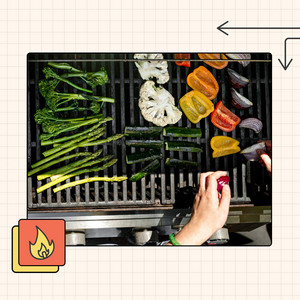
are vegetables. The grill isn't just all about meat. You can make amazing grilled vegetables,
especially with summer produce. It just takes to kind of the the charred flavor really, really
nicely. So at my house, you'll often find me grilling up sweet potatoes, grilling up cauliflower
steaks, grilling up mushrooms and making things like a veggie board for entertaining or like tacos
for just like a weeknight dinner. Something else that's really fun to grill during the summer
months is stone fruit just because it's so beautiful and it's so in season. But you'll want to
look for a slightly less ripe peach, for example, or nectarine and just give it a quick kiss over
really high heat and the sugars begin to caramelize. So grilling with fruit, especially stone fruit,
is really fun during the summer. And it's a fun way to entertain as well. Your guests might not
necessarily expect fruit coming off of your grill. And what's a good beginner dish for people like
me who are new to grilling and then how can I work up from from that first dish? Yeah, so I would
really encourage beginners or total newbies to grilling to think of the first challenge as lighting
the grill. And you know, the first night you light the grill, that's success. So that night, you
could maybe buy some like pre-marinated proteins from the butcher section or your favorite butcher shop
and just keep dinner itself easily and consider the big win to be, you know, I lit the grill and that
is that's an amazing starting point. And then once you get more comfortable, I think learning how to
grill things like burgers or like pieces of chicken is going to be probably the most approachable
and useful for an everyday cook and sort of progressing from there into different foods that just
require a little bit more care. Okay, so if the next evolution is maybe like a multi-course meal where
you have dishes that are going to be cooked at different temperatures, how can you keep track of
of different types of food on the grill at the same time? I think when I host people, even when I'm
just like cooking in my kitchen, that's like the number one stressor, making sure that everything
gets the attention that it needs without being really. Totally. And I think that it just comes
down to kind of creating a prep timeline for yourself in the case of entertaining where, you know,
you have things pretty much prepped and ready to just be set on the grill as your guests are arriving.
I feel like I should have seen this coming. I feel like a lot of advice that is applicable in life
is just like be better prepared. Well, I think especially when it comes to, you know, entertaining
people get so nervous that just, you know, taking the hour or the 90 minutes that you need to really
get yourself ready is really time well spent. I think one thing that's really challenging about
the stuff that people tend to grill and I'm really talking about meats in this scenario is that
it might be visually, it might look done, but on the inside, it's not edible. So how do you know
when certain things are ready to come off the grill? Yeah, a very easy way to fix this problem is
having an instant read thermometer in your kitchen. You can just rely on the tool to do its job and
it eliminates all of that uncertainty. So if there's one piece of kind of like extra equipment that
I recommend, grillers grab for themselves, it's that instant read thermometer because to your point,
there's nothing worse than feeling uncertain about when to pull the chicken from the grill. So
you end up overcooking it and there's just no coming back from that. Having that instant read
thermometer on hand just eliminates all of the guesswork. Okay, well while we're on tools, are there
other things that are kind of must-have for a grilling situation? I know so many grills come with
all these different attachments and add-ons and what do you think is actually truly necessary
in addition to an instant read thermometer? Yeah, I love this question because I'm such a minimalist
in my kitchen. I don't like, you know, single use appliances, single use gadgets. The one thing that
you'll need to grill for sure is grilling utensils. So grill tongs, a grill spatula, a grill brush
if you like to barbecue or baste. And why you shouldn't use just whatever tongs or spatula you
might have in your kitchen for cooking at the stove on the grill is because they have a shorter
handle. They have a shorter shaft and that means that you have to really like get your hand
right close to the flames where it's hot and it just makes the process a little uncomfortable,
especially for a beginner griller who might be afraid of the flames a little bit. So
grill accessories are manufactured and designed with longer handles so you don't have to stick
your hand right next to the heat source. I think people question, do I really need another tongs
just for the grill? And that is where I definitely would say yes, you do. Let's talk about safety.
Depending on how you're grilling, you know, you're dealing with an act of flame that you can't
just turn down or shut off in seconds. What are your methods for cooking over a fire safely?
I think you need to, you know, read up on your owner's manual before you even get started when
you set it up. Just make sure it's set up very securely and that you know what the manufacture
of your grill suggests. So some some grills say they're deck friendly, some say, you know,
you should be really grilling on cement or on pavement. So I think having that knowledge that
just comes right from your manufacturer is is a great resource. And you are talking about placement
for the for the grill and you were suggesting reading your owner's manual. Are there
some very obvious tips though in terms of where you place your grill should not go under a patio
roof or an awning or something like that? Yeah, generally speaking, you don't necessarily want
anything above your grill. So if you have a balcony, it might not be the best set up to like
place your grill on a balcony where there is someone else's balcony above yours, for example,
your neighbor. Generally, that's not the greatest idea. You want to have your grill kind of
in open air. Just so there's a lot of space for the air to circulate and for the heat to kind of
disperse itself. And you generally don't want to place your grill like along your house siding
because it gets really hot and you don't want anything to happen to your siding as well. So kind of
having the back of the grill positioned in more open environment is is also useful. And then as far
as you know, just general safety precautions, it's always a good idea to have a fire extinguisher
on hand and just the knowledge that, you know, air feeds flames and when in doubt, close the lid
and let the fire die out on its own. Jess, are you telling me to be prepared again?
I'm sorry. I'm a Virgo.
This Scorpio wants to grill whenever whenever she wants to grill. Anyway, any other tips that
I that you want to share or things that I missed? No, I think we covered a lot of great
information today and I would just encourage listeners to really feel empowered to just give it a try
because it's really fun, especially if you already love to cook. Grilling can unlock a whole
different world of flavor for you. It's really just about practicing and you'll get the hang of it
faster than you think. So just a little pep talk there, but I'm so excited for so many new grillers
to hit the grill this summer. Here are Jess's takeaways if you're learning to grill for the first time.
If you're choosing a grill, gas grills are far easier to use but they can also be much more
expensive than charcoal grills and while charcoal is going to take a little bit longer to learn
and adjust to, they're a lot easier on your budget and they can bring out that distinctive
smoky flavor that a lot of cooks love. Don't be embarrassed to embrace ease. If you're new to
grilling like me, it's fine to make things easier on yourself and use quick light charcoal or get
pre-marinated meats from the store. Using either the dials of a gas grill or by stacking coals in
different places, create heat zones on your grill to cook foods at different levels of heat.
For tools, grilling utensils are must-have and an instant read thermometer is super helpful.
And if you have a charcoal grill, a charcoal chimney will help you light your coals.
Lastly, safety first. Read your owner's manual for correct placement and care of your grill.
Make sure there's open air above and around your grill and don't place it under a roof or
against the side of a house. That was Journalist Ruth Tam. For more life kit, check out our other
episodes. You can find those at npr.org slash life kit. And if you love life kit and you want
even more, subscribe to our newsletter at npr.org slash life kit newsletter. Also, we love hearing
from you. So if you have episode ideas or feedback you want to share, email us at lifekit at npr.org.
Megan Cain is our supervising editor and Beth Donovan is our executive producer.
Our visuals editor is back Harlan and our digital editor is Malika Greed.
Our production team also includes Andy Tagle, Sylvie Douglas, Claire Maurizian-Eiter and Margaret
Serena. Engineering support comes from James Willetts, special thanks to Fiona Scarborough and Rachel
Friedman. I'm Mary Elcigara. Thanks for listening.
Last year, over 20,000 people joined the Body Electric Study to change their sedentary
screen-filled lives. And guess what? We saw amazing effects.
Now you can try npr's Body Electric Challenge yourself.
Listen to updated and new episodes wherever you get your podcasts.
David Lynch's films explore dark themes. But in a rare interview on Wild Card this week,
he says he's remarkably content and you can be too. We're supposed to be like little dogs
where the tail is wagging and being happy. Little smiles on our face all day long. This is the way
it's supposed to be. I'm Rachel Martin. Join us on NPR's Wild Card podcast. The game where cards
control the conversation. I'm Rachel Martin. After hosting Morning Edition for years,
I know that the news can wear you down. So we made a new podcast called Wild Card. We're a special
deck of cards and a whole bunch of fascinating guests help us sort out what makes life meaningful.
It's part game show, part existential deep dive, and it is seriously fun. Join me on Wild Card wherever
you get your podcasts, only from NPR.