This is a Squiz Kids podcast.
Your fresh take on what's happening in the world around you.
Each fortnight we give the world globe a spin and see where we land.
Then we take the kids of Australia and the world on an audio excursion to visit that country and its people.
I'm Christy Kidgerina and today on Squiz the World...
We're visiting a land where the ice cracks, groans and booms all by itself.
Where the sun can disappear for weeks at a time and then, later in the year, refuse to set at all, and that world leaders are suddenly talking about.
Can you guess?
Strap yourselves into the Squiz Kids super fast, supersonic jetliner as we take off and take a squiz at Greenland.
Just the facts.
Let's start with the basics and a few myth busters along the way.
Greenland is called Kalalit Nunat by the people who live there.
That name means land of the Kalalit people, the indigenous Inuit people of Greenland.
The capital city is Nook, N-U-U-K, one of the northernmost capital cities on earth.
Around 57,000 people live across the entirety of Greenland.
That's fewer people than you'd fit in a packed sports stadium spread out across a place that is absolutely enormous.
In fact, Greenland is the largest island in the world.
And no, Australia doesn't count.
Australia's a continent, not an island.
Greenland is bigger than Mexico, similar in area to Western Europe.
Or if you're thinking in terms of Australia, it's bigger than Queensland but smaller than Western Australia.
And unlike those places, 80 of Greenland is covered by a massive ice sheet, a thick, slow moving blanket of ice that can be kilometres or miles deep.
You'll find Greenland in the Arctic Ocean off the east coast of Canada.
It's so far north that two thirds of Greenland is above the Arctic Circle.
Now, if you've ever looked at a world map and thought Greenland looked almost as big as Africa, you're not imagining it.
But the map is a bit misleading.
Many world maps use something called the Mercator Projection, which stretches places near the top and the bottom of the Earth.
That makes countries close to the poles look much bigger than they really are.
It's what happens when you try to flatten a round planet onto a flat page.
Something always gets squashed or stretched.
Politically, Greenland is a self-governing territory within the Kingdom of Denmark.
It runs many of its own affairs, including education and decisions about natural resources, and that's one reason Greenland sometimes pops up in the global news.
But to really understand this place, we need to rewind the clock and do some...
Time travel.
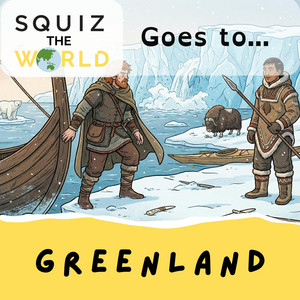
Long before any Europeans arrived, Inuit peoples made their way to Greenland from what's now Canada.
They arrived in several waves, beginning around 2500 BCE and continuing right up to around about the 12th century CE.
They were expert hunters and travellers with a deep knowledge of the sea, the ice, the animals and the seasons, skills that made life possible in one of the harshest environments on Earth.
Then, about a thousand years ago, a very different kind of traveller arrived, a Norse Viking named Erik the Red.
Erik wasn't exploring for fun.
He'd been banished from Iceland after getting into serious trouble, including doing a few murders.
Oh, Vikings.
During his exile, he sailed west and found new land.
When his banishment ended, Erik returned to Iceland and tried to convince other people to come back with him.
There's a medieval story written about him called a saga.
Sagas were long storytelling histories written centuries later that mixed real events with legend.
One saga says Erik named the land Greenland to make it sound more appealing rather than icy and frightening, and that the name helped to persuade people to move there.
It seems to have worked, because between 3,000 and 6,000 Norse settlers followed him.
Those Norse settlements eventually disappeared, but Inuit culture continued.
Centuries later, Greenland became part of the Danish realm.
In 1979, Greenland was granted home rule and in 2009, it gained even greater self-government, while still remaining part of the Kingdom of Denmark.
So what's it like growing up in Greenland today?
Well, we're going to find out because it's... Time for school.
School in Greenland is free and education is compulsory in principle, but how schooling works can look very different from what Australian kids are used to.
Greenland is huge.
The weather can be extreme and communities are often far apart.
Because of that, some children learn from home, have tutoring or use remote learning, especially when weather conditions make it difficult to travel.
Primary school lasts for 10 years, from ages 6 to 16, and after that students can attend one of the four high schools in greenland or they can go to a vocational college to learn a trade.
Greenland only has one university And it mainly focuses on humanities and social sciences.
So if you want to become a doctor or an engineer, you usually have to leave Greenland to study, often in Denmark or another country.
From their very first day at school, kids learn three languages.
They learn Greenlandic, also called Kalalysut, Danish and English.
There's no school uniform, but there is a special tradition that on their very first day of school many children wear the colourful traditional national costume.
And getting to school depends on where you live and the seasons.
Some kids walk, some travel by boat, some take snowmobiles and in a few places yes, it might even be by dog sled.
Now, if that all sounds extreme, just wait, because Greenland is full of things that sound almost unbelievable.
Believe it or not.
Believe it or not, Greenland's glaciers are always on the move.
They creep slowly towards the sea, cracking and groaning as they go.
Huge chunks of ice regularly carve off the glaciers, crashing into the ocean and becoming icebergs.
Scientists estimate that if all Greenland's ice melted, global sea levels could rise between six and eight metres.
And if it did, these would come in handy.
One of the world's most famous boats was invented there.
The kayak was designed by Inuit hunters for silent travel across icy waters.
And as you're probably aware, versions of it are still used all over the world today.
Greenland is also home to some truly extraordinary animals.
There are whales and walruses narwhals, the unicorns of the sea, polar bears and arctic foxes that change colour from brown to match the rocky tundra in summer to snowy white in winter.
Under Greenland's land and sea are valuable resources too.
Greenland contains 25 of the world's 34 critical rare earth minerals.
And these are used to make things like mobile phones, computer chips and clean energy technology.
There are also large reserves of oil and natural gas.
And Greenland sits in a key Arctic position between North America and Europe.
That combination of location and resources is why world leaders, including US President Donald Trump, have talked about Greenland's importance.
Greenland and Denmark are very clear about one thing, though.
Greenland is not for sale.
After all that ice, history and wildlife, I don't know about you, but I am hungry.
It must be... Dinner time.
Food in Greenland is shaped very much by the environment.
Traditional diets include fish, whale meat, seal, seabirds, musk ox and reindeer.
Sorry, Rudolph.
Because of the long, cold winters, many foods are dried, smoked or fermented to preserve them.
Some traditional dishes include sua sat.
It's a thick soup made with meat, rice and onions, raw reindeer liver and whale meat.
It can be a tricky place to be a vegetarian, but today modern foods are also common, especially in large towns like Nook.
I've stuck a link to a recipe for Suisat in the episode notes.
And if you want to give it a try and your local store doesn't stock them, you can substitute the seal, the whale or the reindeer meat for beef.
Time for the quiz.
This is the part of the podcast where you get to test how well you've been listening.
Question number one.
Greenland looks huge on many world maps, sometimes almost as big as Africa.
Why is that?
Is it because A Greenland is actually the biggest place on Earth?
B maps often stretch areas near the poles, making them look bigger, or because C Greenland keeps growing every year?
Yes, the answer is B, maps often stretch areas near the poles making them look bigger.
Question number two, it's true or false.
About half of Greenland is covered by a massive ice sheet.
Is this true or false?
And the answer is false.
It's actually around 80% of Greenland that's covered by the ice sheet.
And finally, question number three.
Why did Eric the Red call the land Greenland according to Viking sagas that were written later?
Was it because A, it was completely green all year round?
Was it because B, he was naming it after his favourite colour?
Or C, he wanted the name to sound inviting and attract settlers?
Of course, that's right.
The answer is C. He wanted the name to sound inviting and to attract settlers.
Well, that's all we have time for today.
Thanks for staying curious about the world and joining me on this incredible trip to Greenland.
Now get out there and have a most excellent day.
Over and out.