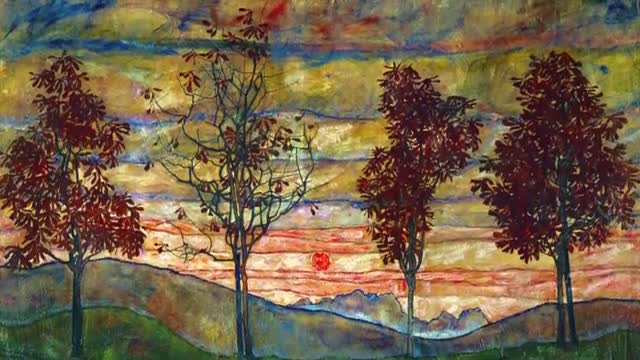
Egon Schiele was one of the leading figures of Austrian Expressionism.
His portraits and self-portraits, searing explorations of their sitter's psyches, are amongst the most remarkable of the 20th century.
But his mastery extends beyond the radical renditions of the human figure he is mostly known for, to landscapes and seascapes, all equally important in art history terms.
This painting, Boats Mirrored in the Water, is considered one of his masterpieces.
The whereabouts of the painting, however, are unknown.
It was confiscated by the Nazis from Fritz Grunbaum at the start of World War II.
The exact details of the wartime fate of the painting after it was confiscated are unknown until 1956, when it was sold by a Swiss art dealer to a wealthy collector.
Who was that collector and who owns the picture now?
We know the painting has been in the same private collection since 1990, but we don't know whose collection that is.
This film looks at how stolen art disappears in a complicated practice designed to obscure facts and create wealth for the art market.
How the true owners of these artworks, the descendants of Holocaust victims, are still fighting a system that stops at nothing to keep secrets and protect its wealthy clientele.
There are works in private collections and established museums right now which were stolen by the Nazis.
I think it's about time they were returned.
Oh, yes.
Fritz!
Franz Friedrich Grunbaum, also known as Fritz, was a Jewish cabaret star in Vienna, whose innovative routines openly criticized Nazism and Adolf Hitler, ultimately leading to his banishment and arrest by the Nazis in 1938.
Egon Schiele was one of the great Vienna modernists whose work scandalized Austrian society with its emaciated, eroticized forms and taboo subject matter.
Both Grunbaum and Schiele were hard-working provincial artists who came to Vienna with ambitions to make an impact on the cultural scene of the capital of the Habsburg Empire.
And each of them pushed the limits of freedom of expression while speaking universal truths.
Sheila and his pregnant wife Edith both died in 1918 in the worldwide influenza pandemic that killed off even more of a war-ravaged generation.
Grunbaum, was murdered in 1941 in Dachau concentration camp and his wife Elizabeth, known as Lily, was murdered in 1942 in Mali, Trostinet's extermination camp near Minsk, Belarus.
Grunbaum was also a great collector of art, and with Schiele he found a kindred spirit.
He owned 80 works by the artist, amongst others in his collection.
His extensive art collection is, for the most part, still missing.
He was an angel.
Grumbam was born in 1880 in Brunn in Austro-Hungary, which is now Brno in the Czech Republic.
He studied law at the University of Vienna but by 1906 was working as the master of ceremonies at a cabaret called Hell, tucked away in the basement of the famous Vienna Theater.
He fought for Austria-Hungary in the First World War and was a decorated war hero.
After that war ended, he resumed his successful show business career, working between Vienna and Berlin, where he made movies and released popular records.
He was a pioneering cabaret performer who specialized in political and cultural comedy.
After Hitler rose to power in the 1930s, Fritz was banned from performing in Germany but continued working in Vienna until one night.
During a 1938 performance, there was a power cut in the middle of his act.
And he announced, I see nothing, absolutely nothing.
I must have accidentally gotten myself into national socialist culture.
His last performance at the famous cabaret club Simple in Vienna was just two days before the Anschluss, the annexation of Austria by Nazi Germany in 1938, which was followed by an artistic ban on Jews.
Fritz, his wife Lilly and others tried to flee to Czechoslovakia but were turned back at the border.
On the 24th of May 1938, he was deported to Dachau concentration camp.
Egon Schiele was born in Tulln near Vienna in 1890.
And while never academically inclined, he had a natural talent for art.
Whilst in high school Schiele painted a series of landscapes typically depicting small medieval towns from southern Austria.
And he continued with the landscapes throughout his career.
At 16, he moved to Vienna to study art, where he met some of the most important people in his life.
He made the acquaintance of his idol, Gustav Klimt.
He met his friend and muse, Wally Neisel, as well as his wife, Edith Harms.
In today's art market, it is Schiele's landscapes which are receiving the most attention amongst art historians and dealers, thanks to their rarity value.
But it must be said that he is best known to the general public for his extraordinary portraits and self-portraits.
Schiele's striking paintings often depicted nude figures that were raw, contorted and deeply expressive.
Due to their sexually explicit content.
Hundreds of his works were confiscated by the Austrian police and categorized as obscene, a foretaste of the kind of censorship that was to come under Nazi Germany.
His friend Klimt died in February 1918 due to complications of the Spanish flu, and Schiele himself died a few months later, at the age of 28, after also contracting Spanish flu.
Just three days before his death, his pregnant wife Edith had died of the same fate.
It is believed that Schiele spent his final days sketching his dying wife.
This painting is one of a series of boats and their reflections by Schiele that he painted in Trieste Italy, from around 1907, and their rarity value makes them extremely desirable.
One of them, this one, sold at Sotheby's in 2018 for over 10 million dollars.
In the painting, Schiele elevates the image of a simple fishing boat into a visual masterpiece with a mosaic-like composition.
The work offers a close-up view of the sailing boat's bow, which is rendered in striking blocks of blues and greens with bold red accents.
Like his portraits, the boat typifies Schiele's flair for vivid colour contrast, dynamic line work and the breakdown of forms through expressionistic paintwork.
This period was a turning point in art within the wider context of European avant-garde painting, with Cubism and Expressionism already emerged and Futurism just around the corner.
Artists throughout Europe were experimenting with new visual languages, and with his boat series and its semi-abstract approach, we can see that Schiele played an important part in this modernist evolution.
This is a key painting in his development.
Schiele's portraits did not fit in with the Nazis' idea of stereotypical beauty, and so were confiscated as being degenerate, as we shall see.
However, the piece of art in question Boats Mirrored in the Water was less offensive and was taken from Lilly and the Grunbaum family in what would later be known as the second wave of Aryanisation.
When Adolf Hitler came to power in 1933, he instructed the Nazi authorities to seize any European artwork that didn't fit his vision of art.
He dismissed art that he believed undermined classical ideas of human beauty, and Egon Schiele's drawings and paintings were among those considered the most offensive and were to be classified as degenerate art.
The Nazi assault on modernism took shape through a series of systematic purges.
Artists and musicians were removed from teaching positions.
Museum directors who showcased modern art were dismissed.
Books were burned and music, films and plays were censored.
Thousands of artworks were seized from public collections.
Many were destroyed while others, deemed marketable, were sold abroad to fund the Nazi regime.
In 1937 the Degenerate Art Exhibition opened in Munich.
Intended by the Nazi regime to denounce modern art by highlighting its supposed perversions, it ironically became both the ultimate backhanded compliment to the featured artists and the most popular art exhibition of all time.
In 1939, some of the degenerate art was sold at auction in Switzerland and additional pieces were disposed of through private dealers in underhand transactions still being unraveled today.
Later that year, approximately 5000 items classified as degenerate art were secretly burned in Berlin.
Today, an increasing number of countries are enacting laws and declarations to return lost or stolen artworks to their rightful owners.
Although it is unclear whether any of Egon Schiele's work was included in the degenerate exhibition, records from the Nazi inventory of degenerate art seized from museums indicate that some of his pieces were traded, likely to secure resources for the Nazi regime.
Nonetheless, this does not rule out the possibility that Schiele's work, seized from private collectors such as Grunbaum, may have been part of the degenerate art show.
Arianization refers to the transfer of Jewish-owned property to non-Jews in Nazi Germany from 1933 to 1945.
It was a Nazi slogan designed to camouflage theft.
There were two distinct phases of Aryanization.
From 1933 until summer 1938, there was what the Nazis called voluntary Aryanization, where Jewish businessmen who were already facing economic and social discrimination were driven to sell their businesses or possessions in Germany and Austria at radically reduced prices set by the Nazis.
In 1938, following the violent nationwide pogroms on November 9th and 10th known as Kristallnacht, Aryanization entered its second phase the forced transfer of all Jewish-owned businesses to non-Jews.
The Grunbaum collection was inventoried and appraised that July by art historian and Nazi official, Dr Franz Kieslinger, and was then forcibly taken from the couple's residence to non-Jewish custody and a trustee appointed by the Nazis, Dr Ludwig Rocklitzer.
By the time of Fritz's death, Lilly stated in a property declaration that their art collection, consisting of hundreds of works, was no longer an asset and testified that there was no estate.
Lily was deported to Belarus on October 5 1942, where she died four days later, almost certainly by execution.
So what happened to the collection?
Well, 80 of it turned up in 1956 at an auction in Switzerland, being sold by Swiss art dealer Eberhard Kornfeld.
But controversy and mystery remain as to how the Swiss dealer acquired so many of Grunbaum's works.
Kornfeld claimed that he acquired them from Fritz's sister-in-law and Lilly's sister, Mathilde Lukacs, but that has since been disproved.
We simply don't know how he got his hands on the Grunbaum collection.
Then and now, the art market is a closed shop.
Many of the artworks ended up in well-known public museums via various routes.
Either they were bought privately in contested and sometimes suspect circumstances or they were donated in equally contested cases.
One of the works auctioned off by Kornfeld Boats Mirrored in the Water turns up again in Los Angeles in the late 1960s.
And just as soon as it appears, it disappears again.
This time, sold by art dealer Felix Landau to a private collector.
Ahead of us are much bigger fights.
We and our allies will go into them as we went into Sicily, together.
And we shall carry on, together.
In 1943, President Roosevelt was persuaded that victory in World War II would have little meaning if the artistic treasures of Western civilization were lost.
An army unit nicknamed the Monuments Men were tasked with finding millions of pieces of Nazi looted art and returning it to its rightful owners.
It was a race against time, as the Allies knew that if Germany lost the war, the artwork could very well be destroyed.
So, with World War II in full swing and battles still raging across Europe, a brave task force of 348 men and women from 14 nations, art historians, museum directors curators artists architects, librarians and educators set out to find these cultural treasures, working behind enemy lines.
One example was in the Austrian hamlet of Altaussee, where Hitler had stored artworks in a series of deep tunnels in the local salt mines.
The mine's constant temperatures were ideal for storing the stolen art, and so far underground that they were safe from enemy bombs.
When the Monuments Men arrived at the salt mines there were 6577 paintings, 2300 drawings or watercolours, 954 prints, 137 pieces of sculpture, 122 tapestries and thousands of other historical works.
Between 1945 and 1951, the Monuments Men and Women located and returned approximately 35 million stolen works of art and cultural objects to the countries from which they had been taken.
Without the works of these art experts, tens of thousands of priceless works of art would have been lost to the world forever.
We often think that stolen art is hidden away in the houses and yachts of the super wealthy.
But often, these works are hidden in plain sight, in major museums.
Three pieces of art worth millions will soon be in police custody, after hanging on the walls of three museums for decades.
Perhaps the most famous case is that of Gustav Klimt's portrait of Adele Blockbauer, one of five Klimt paintings seized by the Nazis in 1938 from the Blockbauer home, which ended up in Vienna's Belvedere Gallery.
In 2005, Maria Altman, the niece of the original owner, against all odds sued the Austrian government in the US Supreme Court.
And she won.
Two years later, in 2007, the Monuments, Men and Women Foundation was created to continue the work of locating cultural objects missing since the end of World War II.
It is this organization who is working tirelessly to bring visibility to cases such as that of the Grunbaum Schiele to see their ancestors' stolen art returned.
Relatives of Fritz Grumbam attempted to recover portions of the estate for years after World War II through agencies and authorities in Germany, the US and Austria.
Their efforts were often hindered by bureaucratic red tape.
In 2012, the heirs lost a seven-year legal battle with Massachusetts art collector David Bacalar.
There are still ongoing cases against the Art Institute of Chicago and the Albertina and Leopold Museum in Vienna, as well as many other museums throughout the world.
There is some good news though.
After decades of legal disputes, the Museum of Modern Art in New York and the Santa Barbara Museum of Art finally returned several works stolen from the Grumbam collection to the family.
Fritz Grumbam would have been pleased to see that some good has come out of all of this.
In 2022, when his heirs sold two restituted works by Schiele for a total of just over 3 million.
They put their share of the proceeds towards creating the Grunbaum Fischer Foundation, whose first award went to a jazz pianist in their final year at the Duke Ellington School of the Arts in Washington DC.
His career as a performer may have been cut short by the Nazis, but over 80 years after his murder, his legacy lives on in young musicians from underrepresented communities.
Grumbam, who had a strong sense of social justice, would have approved.
This is just one of the stories around stolen art.
And although there doesn't seem to be a clear-cut ending to this story, you may be able to help in the fight for justice.
First, you can log on to the Monuments Men and Women Foundation's webpage.
The link, along with other links, is in the video description.
And look at the long list of World War II's most wanted art.
If you have any information at all, there are contact details and a possible reward.
Oh, made in Germany.