Hey everybody, it's Ian and Mike, the hosts of How to Do Everything.
That's the show where we take your questions and find overqualified experts to answer them.
Alex asked us to write his out-of-office email message.
But we don't know how to write, so we called up U.S.
Poet Laureate Ada Limon.
Is this National Public Radio?
Sort of.
Technically, yes.
Season two just dropped.
Listen to the How to Do Everything podcast from NPR.
You definitely didn't.
We've all done it.
Do us a solid and leave the show a review wherever you listen to podcasts.
It helps more people find us.
It helps us make the show even better for you.
And we thank you.
Have you ever found yourself completely caught up in a film only to find after the lights come up that the story didn't make any damn sense at all?
Yet you loved it anyway.
We're talking about those movies that leave you with two simultaneous feelings.
That was great.
And wait, what?
I'm Linda Holmes.
And I'm Glenn Weldon, and today we're recommending three great movies with very, very silly plots on Pop Culture.
Happy Hour from NPR.
Congress is back from its summer recess with a lot on its agenda.
What's all in store for lawmakers and what does their work mean for you?
Every weekday, the NPR Politics Podcast unpacks Washington's inner workings.
Listen to the NPR Politics Podcast on the NPR app or wherever you get your podcasts.
A good internet domain name can be worth millions.
Think apple.com or zoom.com.
So what is up with the guy who owns milk.com?
I happened to like chocolate milk, you know, and so he started calling me Milk Boy.
Like, hey, Milk Boy, how's it going?
Milk Boy.
Yeah, Milk Boy.
On the latest Planet Money podcast, the strange economics of million-dollar domain names.
Hey, it's Rachel Martin.
I'm the host of Wildcard from NPR.
For a lot of my years as a radio host, silence sort of made me nervous.
That pause before an answer because you don't know what's going on on the other side of the mic.
But these days, I love it.
Hmm.
Ah.
Gosh.
Give me a minute.
Yeah, yeah.
Think.
Listen to the Wildcard Podcast only from NPR.
On NPR's Wildcard Podcast, author Elizabeth Gilbert gets brutally honest about her tendency to make bad choices.
Whenever I see red flags, I think it's a parade in my honor.
And I run toward it.
I'm like, flags!
It's a parade!
Watch or listen to that wildcard conversation on the NPR app, YouTube or wherever you get your podcasts.
It's just us today.
So great movie, silly plot.
That's the subject.
Now, I want to be clear.
We're not talking about like minuscule plot holes or weird little nitpicks.
We're not doing IMDb goofs.
We are not doing the IMTP Goose page.
We're talking about movies that manage to enthrall you from start to finish.
You get caught up in the setting and the mood and the characters and the look.
Then you later realize that those characters you loved didn't behave the way that any real humans would, and weird things happened that never would or could or should happen, yet everyone just accepts it.
Linda, let's get right to it.
What's your first pick?
Well, you know, Glenn.
Mm-hmm.
I thought about coming up with a taxonomy of silly plots.
Oh, boy.
And Sandra Bullock is mistaken for his fiancee by his family.
And then she falls in love with his brother.
It's an extremely silly plot.
It's a hijinks ensue plot, yes.
It is what I used to refer to as a hum-through plot, which means you just got to kind of hum to yourself through the story and not think about it too much.
Uh-huh.
Uh-huh.
Uh-huh.
What I wanted to do is talk about movies I genuinely love, despite the fact that, if you hear it, it's very silly.
Okay.
So my first choice is The Martian, which is from 2015, directed by Ridley Scott.
And the screenplay is Drew Goddard.
It's from this book by Andy Weir, which is also, by the way, wonderful.
Yeah.
This is the movie where Matt Damon is on a mission to Mars a crewed mission to Mars and there is a sudden storm and the crew has to take off without him.
So he is left on Mars all by himself.
Now the idea.
You know, first of all, we've got the crew landing on Mars and functioning and all that is great.
The thing that I love about this is that Andy, we are in the book and then in the movie.
They do the same thing.
There is a ton of science that is real.
Right.
That's why it surprises me that you went with this.
But keep talking.
Okay, the science on a small level is enthrallingly genuine in many, many ways.
Okay.
I have a feeling an enormous amount of research went into this work and so, on a micro level, you believe it because on a micro level, it makes all the sense in the world, and yet when you pull back, it is a story of a guy who is left alone on Mars, which is A silly plot, in a way.
Okay.
It makes total sense.
But on a macro level, it's a guy who's left alone on Mars, which is a foundationally to me silly idea.
But because the movie is so good.
I don't want this to seem like any kind of knock on the movie, because it isn't.
I love this movie.
It's one of my favorite movies.
But if you pull back...
The idea of being abandoned on Mars is kind of a silly plot.
And the way they rescue him is kind of silly.
It sounds silly.
Do you know what I mean?
I guess.
I guess.
I mean, like, it's kind of Robinson Crusoe on Mars.
I get that.
But this is such a great example of what we're talking about because, I mean, I was all in on this movie.
And I think maybe I'm basing some of that on the fact that my memory of the book, my memory of this film, was all in the ancillary materials about how it's all grounded in research and reality, and this is plausible.
But when I try to think about this movie now, I just remember the poop potatoes.
That's really all I remember about this movie and the discussion of how that's actually plausible.
I remember there being a lot of math in the movie.
And, unlike you, I wasn't caught up in that, because whenever characters start doing math in a movie, my eyes glaze over in my attention.
Because I always think, okay, this is the show your work part.
And I just want to flip to the back for the answer key, right?
I like process.
I love process in movies.
But when the process involves like –
Long division or cosines, I hate process.
But that's so interesting to me because I guess you're right.
Like somebody stranded alone on my – in that sense, you know, Castaway is silly, I suppose.
Castaway is silly.
Yeah.
Yeah.
I was just trying to get my arms around.
Maybe what I love about a great movie with a silly plot is that it manages to make a silly plot into a story.
That's not silly, right.
The attitude, and I think in this case with the movie, the screenplay is very witty.
I think the Matt Damon performance is very good and very witty also.
And because of that, it's a silly plot, but it's not a silly story if we can split that hair.
I like that.
I like spinning that hair.
I also like the three minutes of screen time that Donald Glover gets in that film.
Oh, yes.
He's wonderful in it.
He is wonderful in it.
Okay.
So that is The Martian.
That is a great pick.
I'm going to go watch that again.
I'm inspired to go watch that again.
My pick is intentionally silly.
It's fully silly.
I went with a kid's movie and a kid's fantasy movie, which is maybe a cop-out here.
It's exactly the opposite of what you're talking about, because if we're defining silly to mean unlikely or absurd, then it's a kid's fantasy movie.
That's kind of what they're for, I guess.
But Linda, there's kid's fantasy movie –
And there's this thing in which Don Knotts, wearing a straw hat and a bow tie and a pants nez, you know those glasses that rest on your nose.
Uh-huh is staring into the water off Coney Island and he starts intoning what turned out to be.
For no reason the film ever bothers to tell you why they turn out to be magic words.
I wish, I wish I were a fish.
There it is.
There's your triggering action of the entire film.
This is the 1964 film, The Incredible Mr. Limpet.
And look, they knew what they were doing.
This film is based on a 1942 book by Theodore Pratt, which was just called Mr. Limpet.
Now, Linda, you know this film, right?
I know of it.
I'm not sure I've seen it.
Okay.
Oh, good.
And Carol Cook is playing Bessie as a kind of domineering and abrasive and unpleasant woman, because it's a very common trope of the time.
We're supposed to see poor Henry as what was then called a hen-pecked husband.
Hen-pecked.
Yeah.
Henry is a passionate lover of fish, not in the Troy McClure sense, but at least not yet.
But he is kind of an amateur marine biologist, right?
He is obsessed with fish.
Like, again, this was before the cultural ubiquity of nerds.
He was kind of like the ur-nerd.
He's certainly filling that vibe.
So one day he sees a school of fish off a dock on Coney Island.
And instead of...
Joining his wife and his best friend who are having a picnic just a few feet away.
In this little happy cloud of heteronormativity, he instead longs for a life under the sea.
He is reverse Little Mermaid-ing it, basically.
Mm-hmm.
So he says his weird wish thing and then he falls into the water or does he jump?
The film cuts away, is intentionally ambiguous on the score and is promptly transformed into into a cartoon fish.
It's not because of any kind of powerful mutagens in the water off Coney Island, because it's not that film this film is.
It happens because of whimsy.
And I hear you asking Linda what specific kind of fish does he turn into, Glenn?
Yes, I was going to ask.
There are corners of the internet where this debate is still going.
The consensus, he kind of resembles a tile fish, which is kind of like a grouper.
Now –
So what do we got so far?
Don Knotts is playing A, a talking cartoon fish, B, who is still nearsighted.
So he still needs those little pince-nez.
Yeah, yeah, yeah.
And C, he has, for no reason the film bothers with, a superpower now.
He can produce a loud underwater roar, which he calls his thrum.
Oh, also he gets a grumpy crab friend, so they are really little mermaiding it in a big way.
Sure, sure, sure.
He also falls in love with a female fish whom he calls Ladyfish.
Because, of course, she's a fish, and as she points out, she does not have the concept of names.
Right.
So he names her because patriarchy.
Also, the crab, by the way, is a male, has a name.
He's Krusty.
But the female fish, no.
No names for her.
She's just Ladyfish.
She's just Ladyfish.
So if I were to tell you, Linda Holmes...
As I'm trying to do now, that Don Knotts plays a man who gets transformed into cartoon fish with a pince-nez and a superpower and a cartoon fish girlfriend that he cheats on his land wife with.
I was just going to say, he's cheating on his wife with a fish.
Uh-huh.
You'd probably say...
There's your movie, right?
Dayenu, it is enough.
Yeah.
What more could there possibly be to this movie?
Nothing.
To which I would say unto you, Nazis.
Nazis, Linda Holmes.
Don Knotts plays a man who gets transformed into a cartoon fish with a pince-nez and a superpower, and a cartoon fish girlfriend.
He cheats on his land, wife with and.
He fights Nazis.
Wow.
Because this film was made in 1964, but it is based on a 1942 novel by Theodore Pratt.
Right.
In which Henry Limpet is what?
4F.
Because, of course, he is.
And he wants to fight the Nazis.
So he uses his mysteriously manifesting cartoon fish superpower to swim up to Nazi U-boats.
He does his thrum and he attracts American torpedoes.
Oh, sure.
And that's not all.
He requests for this service a Navy lieutenant's commission and salary, which he has sent to Bessie.
So –
Oh, sure.
It's not bad, right?
Now, to go back to this discussion, I mean, this plot is fantastic.
It's even incredible, as one might say.
But the studio knew exactly what it was doing.
And here's how I know they knew exactly what they were doing.
Here is a clip from the trailer of the film.
I think you're actually still alive and I'm married to a fish.
Is that so terrible?
Yes, Mr Limpet is sure to be the most incredibly delightful movie about a man who turns into a fish that you'll see this year.
See, they get it.
Oh, funny.
They're on it, right?
I get it.
I get it.
The thing that I love about this is that I went for a plot that is silly at its core.
Macro level.
But it is silly at its very basis.
Yeah.
But it is much less silly in its details.
Sure.
And you went for a plot that is particularly silly the more details you consider.
Like, the more you consider the lady fish and the Nazis.
You have like more and more and more and more silly.
And I have...
Yes, the details make sense.
But when you go straight to the core of it, the idea of somebody being stranded alone on Mars is kind of a silly idea.
You have a conceptual silliness and I have a execution silliness.
Like as you go further into the Wikipedia page, you're like, wait, what?
Wait, what?
Wait, what?
Right.
Exactly.
Absolutely.
Exactly.
So my pick is the incredible Mr. Limpet.
Linda, what is your last pick and does it share your ethos, your macro level silliness?
It does.
But I think it's a little bit more of a compromise between detail silliness and macro silliness.
Now this one is if you were offended that I chose The Martian because you think it's a knock on the movie to say it has a silly plot.
People are really going to be offended by this.
But I repeat, not a knock on the movie.
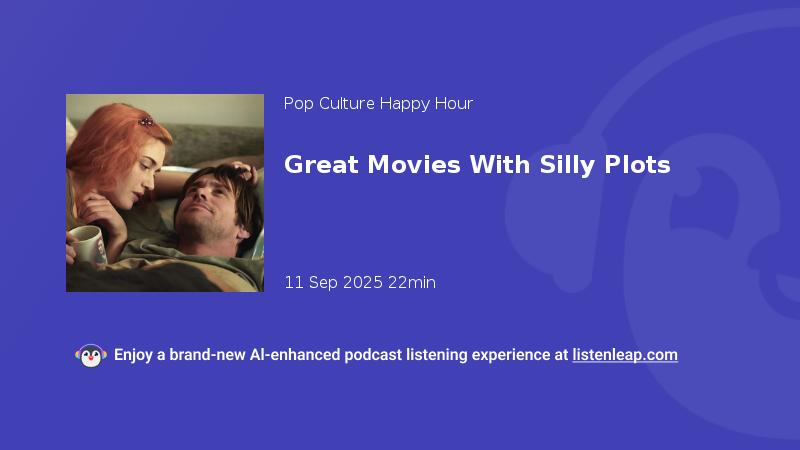
I chose Eternal Sunshine of the Spotless Mind, which is...
A brilliant movie with, in my opinion, a very silly plot in a lot of ways.
This is a 2004 Michelle Gondry directed and Charlie Kaufman scripted movie.
Story of these two people who have been in a relationship and the foundational piece is first she decides and then he decides to erase their there's a procedure you can go through to erase your memories of another person.
And it has this very soulful, very sad, very moving story.
Mm-hmm.
And it has this enormously spiritual quality, I find.
And it's all about the nature of love.
And it is really one of, I think, the best movies very specifically about the nature of love and the nature of relationships.
But it is all built around this idea that scientists can come to your house while you are asleep and do a procedure on you while you are asleep that gradually erases your memory of another person.
Here at Lacuna, we have a safe technique for the focused erasure of troubling memories.
Is there any risk of brain damage?
Technically, the procedure is brain damage.
It's on a par with a night of heavy drinking.
Nothing you'll miss.
That is a silly idea.
If you heard that outside the context of this incredibly spiritual film, if you heard like oh, this is about these people who they have a bad breakup.
And so a scientist comes to their house in the middle of the night and erases their memories of each other.
It sounds very silly.
So this one I chose because it's really to me an example of transcending a plot that sounds whimsical in a way right.
To make a film that is profound in a lot of ways.
And so...
I think also it has details that are funny, right?
Because you do have details about the scientists and how they do their work.
But foundationally it is such an example of how you take something that sounds like a very odd idea and make something brilliant and incredibly resonant to me.
It's interesting that we approach this in such radically different ways, because the word you're tossing out here sad spiritual, profound nature of love.
I would not find them in the same ballpark as silly.
And yet you make the case for silly.
Talk to me about the difference between a silly plot and a science fiction plot, because to me I put this into a box of.
Oh well, I say this is a profound film blah blah blah, blah blah.
But it's a science fiction film.
So I just – I give it –
I don't even question it.
That's interesting.
You're making such a good point because in a sense, a science fiction plot that is by its nature.
I mean, there's a reason why they refer to this bucket as speculative fiction.
Yes, sure.
Exactly.
It is to imagine something that is not currently true, right?
It's one thing to have a science fiction film where, you know, like Alien, for example, right?
I can imagine...
You know, an alien is a thing that I think a lot of people have thought about, right?
There could be aliens.
That makes sense to me.
And it doesn't sound like it would be a thing they would do on the Jetsons, you know what I mean?
Like a menacing alien.
But the thing that's fascinating about Eternal Sunshine to me is it sounds like something that would happen on the Jetsons right.
Sure to this execution of it.
I mean, in a way, when we say great movie with a silly plot, it has a an internal tension, because if the movie is great, Then by definition, in a way, the plot isn't silly.
The plot is beautiful in its own way.
Maybe not the plot of Mr. Limpet, but, you know, but it is, right?
You talked about how this is about.
Somebody trapped in a loveless marriage and, you know, finds a place to be accepted.
And no matter how silly the plot.
Once it is part of a movie that you think really works and that you think is really moving, it sort of ceases to be a silly plot.
But I think I thought about silliness in terms of like if you sit down to tell somebody what the movie is about, it sounds silly.
You know what I mean?
Yeah.
No, I get that.
I get that.
It's just such a fascinating – divergence of approaches here.
So that is Eternal Sunshine of the Spotless Mind.
Great picks.
And I think now when we do the call out, you know we want to know what your favorite films of the silly plot are.
I also want to know from folks how they're approaching it.
Are they approaching it like silly in execution or are they approaching it like silly in concept?
Right.
In theme maybe.
Because I mean you could say Star Wars is silly.
Sure.
You could certainly say Indiana Jones.
Yep.
Basically everything Indiana Jones has ever done is in its way silly, and I mean could you put whimsy in there?
Could you substitute for your definition of silly here as it's working here?
Would you substitute words like whimsy and fantastical or not quite?
Yeah.
I mean, I think both of these, the plots for the two that I picked have whimsical elements.
Certainly.
I mean, I think in a way, especially with The Martian, that's like what the appeal of it is, right?
Yeah, of course.
Is that it's this very simple, very kind of semi-goofy idea of like, you know, I'm alone on Mars.
I mean, that's a thing that you would think of as a five-year-old, right?
Yeah.
I'm all alone on Mars.
No one here but me.
I'm going to run my own planet.
I'm the king of Mars.
And there are times when he talks in the narration about that kind of feeling.
And it's something you could think of as a little tiny kid.
And that's what I love about it, you know?
Yeah.
Yeah, and certainly that's – this is a different topic.
That's the power of superheroes.
That's the power of fantasy science fiction.
It's taking something rooted in reality and saying, what if?
Well, we want to know not only what your favorite film with a silly plot is, but how do you define a film with a silly plot?
Find us at Facebook.com slash PCHH.
That brings us to the end of our show.
Linda Holmes, thank you so much for being here.
I'm glad this wasn't just like a list, right?
Yeah, me too.
Me too.
I'm glad we got into this.
Kind of had a conceptual back and forth.
Fascinating.
This episode was produced by Isabella Gomez Sarmiento and Rommel Wood and edited by Mike Katziff.
Our supervising producer is Jessica Reedy and Hello Come In provides our theme music.
Thanks for listening to Pop Culture Happy Hour from NPR.
I'm Glenn Weldon and we'll see you all tomorrow.
Shortwave thinks of science as an invisible force showing up in your everyday life.
Powering the food you eat, the medicine you use, the tech in your pocket.
Science is approachable because it's already part of your life.
Come explore these connections on the Shortwave podcast from NPR.
The news is saturated with coverage of President Trump, but it is easy to get overloaded.
So, on Trump's terms, we bring you short, digestible stories, five minutes or less, about the 47th president.
Listen for same day developments on tariffs, the economy and all of the ways that Trump is governing like no president ever has before.
Trump's Terms.
Listen on the NPR app or wherever you get your podcasts.
Maybe you're wondering, how do I escape quicksand or how do I break up with my dentist?
Well, season two of NPR's How to Do Everything podcast is launching this fall and we will attempt to answer your questions.
Sometimes we'll actually succeed.
Send us your questions at howtoatnpr.org.
That's howtoatnpr.org.