Every single work by the great German Romantic artist Caspar David Friedrich was based around a complex idea, which he articulated very simply.
A picture must not be invented, he said.
It must be felt.
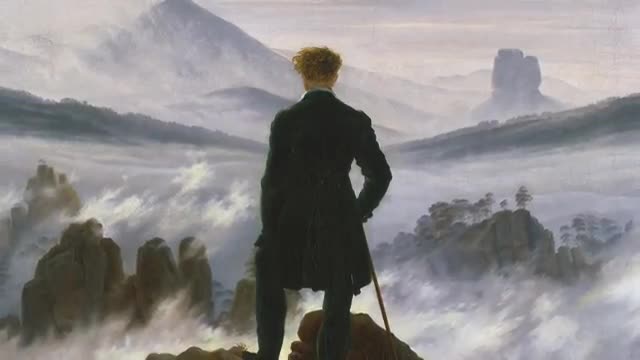
This is his masterpiece, Wanderer Above the Sea of Fog.
At first glance, it seems to be a landscape painting, but it's not really.
Despite the fact that most of the canvas is taken up by the spectacular scenery, the painting is in portrait orientation and everything is designed to draw the view towards the man with his back to us.
And yet, it's not a portrait either.
As with all the great German romantics, Friedrich was interested in exploring the natural world and connecting the individual with it.
This is a painting about the overwhelming feelings that are felt in the presence of such a vast and spectacular landscape.
It is a feeling that we cannot comprehend.
Something so immense in every way, so ominous, and something that sometimes threatens to overwhelm us, what Friedrich and the Romantics called the sublime.
This is the site of the great German victory over Rome.
Just over 2000 years ago, in the Teutoburg Forest, a superior Roman army was defeated by the warrior Arminius, leading an alliance of different German tribes who ambushed the Romans by hiding behind the trees, leading to a belief that the Teutoburg Forest, or the land itself, was firmly on the side of the Germans.
The victory became an important part of the mythology of German nationalism, and many patriotic Germans see it as the birth of the German nation.
In 1806, Friedrich saw Germany, still a group of disparate states, shamefully defeated by Napoleon, just as Goya had experienced Napoleon's violent march into Spain.
A renewed interest in Arminius and his struggles against the Roman occupiers led to Friedrich producing this painting, just as the military resistance to Napoleon was gathering strength.
It depicts the tomb of Arminius guarded by soldiers, dwarfed in an immense landscape.
It is a theme of Friedrich's, and here again we see a human figure dwarfed by the landscape in this patriotic image of a solitary French soldier lost in a wood that he will obviously never escape from.
And the deathly forest was seen as a vengeful Germany that will swallow up its enemies.
Like many of the Romantics after the Napoleonic Wars, Friedrich was a strong supporter of a unified Germany.
And in this way, it could be said that his work is nationalistic.
There is a deep-seated attachment to the landscape in Germany, and Friedrich understood that.
As did the Nazis.
A full century after Friedrich's death, the Nazis would co-opt the German landscape to represent their version of nationalism.
And Friedrich unwittingly became part of that nationalism, even though the artist, a liberal, anti-authoritarian and a passionate advocate of political change, would have been everything Hitler despised.
Caspar David Friedrich was born in 1774 in Greifswald, Pomerania.
His father was a soap and candle manufacturer.
His mother died when he was seven years old, and a year later his sister Elizabeth died, followed by a second sister Maria, who died of typhus.
But the greatest tragedy of his childhood happened when he was 13 and he witnessed his brother Johann, fall through the ice of a frozen lake and drown.
These early losses had a lasting impact on Friedrich, and throughout his life he suffered many bouts of depression, and we can see themes of melancholy and loss reflected in his art.
In 1790 he began his art studies in Greifswald, where he was introduced to the theological concept of seeing with one's inner eye, that of the imagination.
Friedrich was taught that what we see has as much to do with what is inside us as what is outside us, and it would lead to the artist conveying in paint those subconscious thoughts and emotions that transcend language.
In the early 1800s he met the most influential man in his life, the theologian Ludwig Gotthard Kurzergarten, who would really help to shape the aesthetic attitudes of German romantic art and install in Friedrich a belief in the spiritual capabilities of landscapes.
Up until this point, landscape painting was seen as just the background to more important history paintings or portraiture.
But Friedrich's generation was the generation that said landscapes could be just as much about ideas, emotions and experiences as figure painting.
But this got him in trouble with his first major commission in 1808, painted at the age of 34.
It was an altarpiece which shows a cross in profile at the top of a mountain alone and surrounded by pine trees.
Hard for us to understand now, but it caused a huge scandal.
For one thing, its composition lacked traditional perspective, and this would be reflected in many of his future works, which were criticized for their lack of boundaries.
With nothing to hold on to, just a sense of floating.
His rolling mists and fogs and ominous landscapes are an aesthetic representation of the sublime spirit that characterized the Romantic age.
But most of the outrage over the painting was because landscape had never been considered a suitable genre for overtly religious themes.
And, of course, normally the crucifixion is shown as a human narrative populated by human figures, not Christ dying alone.
Friedrich's use of landscape in a religious context reflected his own belief in Kurzergarten's teachings that we should see landscape as Christ's Bible.
But it was just too radical for the times.
The scandal did, however, bring Friedrich to the attention of a wider public.
The Age of Enlightenment was a European intellectual movement of the 17th and 18th centuries, and it focused mainly on the power of human intelligence to explain the natural world.
Romanticism emerged as a response to the cold science of the Enlightenment, with Romantics maintaining that art emerges from divine inspiration and the artist's role is as a mediator between the creative and the divine.
The Romantic Age was characterized by a sense of drama and by the sublime spirit.
A philosophical tradition where a power or a force, an event or even beauty is so overwhelming, so awe-inspiring and infinite that it is beyond our comprehension.
Nature, wild and uncontrolled, became a major subject and the focus shifted to reconnecting with emotion and spirituality.
Romanticism had a far-reaching impact with lasting consequences both intellectually and artistically.
After Napoleon's defeat, Friedrich would move away from landscape as a patriotic symbol to creating almost what you might call a spiritual landscape.
For Friedrich and the German Romantics, landscape was a representation of a divine world order, and man was an individual who watches, contemplates and feels more than he calculates and he thinks.
Friedrich completed this oil painting in 1818.
It was based on his extensive sketches of the Elbe sandstone mountains on the border of Germany and the Czech Republic.
His landscapes though don't exist as such but are idealized scenes.
An amalgamation of different features that he would sketch on his travels around Dresden and then construct his own interpretation of the landscape in his studio.
They are the product of the artist's personal vision, what he called his inner eye, the vision of the soul.
It's worth discussing his methods of working.
Friedrich led a hermit-like existence for much of his life, and his studio was completely bare with nothing except a few instruments on the wall.
Like his parents, he was a strict Lutheran, and this was reflected in his austere, monk-like lifestyle and Spartan studio, more reminiscent of a meditation cell.
A visitor described him as a mystic with a brush, just the type beloved by the romantics.
He kept the studio shutters closed and would shut himself away from any distractions that would disturb his inner vision.
We even have stories about him painting in the nude to get this completeness of the self.
He was a fastidious technician and the set square and rulers would be used to adhere to strict proportions.
One third of the composition depicts the sky, another third features the figure and the final third showcases the rock on which the subject stands, directly on the central vertical axis and with his waist on the horizontal.
Along with the classic pyramid structure, these elements create a painting with a powerful sense of space.
Friedrich often used what is known as a Ruchenfigure, but Wanderer Above the Sea of Fog is perhaps the most famous Ruchenfigure in art.
And it is a challenge to the traditions that have us reading the face of the figure first rather than read the landscape first.
When you have a figure that faces you straight on, there are very few questions to be asked.
But because we can only read the back of the man, we have so many questions.
He looks over a vast panorama of clouds, mountains and thick mist.
And because Friedrich chose a point of view on the same level as the man's head, we feel like we are floating in space.
An impossible position that encourages us to consider the perspective from the protagonist's point of view.
We are looking with the figure, not at the figure, and we have to consider our own emotional response to the view.
I think one of the reasons for the painting resonating so powerfully is that the figure's strength of pose at the very edge of the mountain is a curious combination of loneliness and empowerment at the same time.
We've all known that same feeling, standing in front of a vast landscape.
We don't know who the actual figure is.
Some say it's a self-portrait of the artist who shared the same red hair.
But it's more likely to be Colonel von Brinken of the Saxon army, who fought in Germany's Wars of Liberation wearing the green uniform of the volunteer Rangers, which would support this interpretation.
Despite the wind lightly blowing, the fog and the man's hair caught in the breeze, there is a stillness to the painting.
We feel the man really contemplating the void before him, a tiny interloper in an infinite world.
And we can easily inhabit and understand those thoughts of feeling insignificant.
As with all art, there are many ways of interpreting, and I'd like to look at two of them.
In a post-Napoleonic age, Germany was still struggling to forge its identity.
And if we accept that the man portrayed is Colonel von Brinken, then we know he was killed in action in 1813 or 1814, which would make The Wanderer Above the Sea of Fog completed four years later.
A patriotic epitaph to a brave soldier.
But there is also the religious or spiritual interpretation, specifically Lutheran.
That cannot be dismissed.
We don't know if the wanderer is about to embark on a journey or if he has just finished one, but the rocks can be interpreted as the bow of a ship.
A commonly used symbol in religious art to illustrate the church as a whole making safe passage through stormy waters.
Luther translated the account of God's creation of earth in the book of Genesis as a fog arose from the earth and moistened the entire land, which could suggest a creation-esque slant, with the figure overlooking unknown possibilities.
There are so many ways of seeing this painting, but really it's taken on a larger cultural significance and it could be seen as you or me in a private moment of contemplation, perhaps experiencing loneliness or elation, or a feeling of the sublime, standing on the edge where one more step could be our last.
The Wanderer was not well received and marked the gradual decline of Friedrich's fortunes.
Always fighting depression.
He started to be seen as an eccentric, melancholy man and overly religious.
His patrons stayed away and he gradually slipped into obscurity.
Then, in 1835, he suffered a stroke that left the left side of his body paralyzed, effectively ending his career.
His legacy was tainted by Hitler's use of his imagery for Nazi propaganda.
And it wasn't until 1975 that art historians re-examined his work and reinstated him as one of the most important figures in German Romantic painting.
Of all the great painters of the Romantic age, Friedrich is one of the most enigmatic.
He expanded the possibilities of landscape painting, enriching it with meaning and a symbolic significance of a particularly modern kind.
He strove to show that landscape painting must at least attempt to convey something beyond mere observation and communicate something of the spiritual, something of the divine.