Just a quick reminder that you can support this channel by joining my Patreon, where you can find all my videos from this channel and Great Books Explained ad and sponsor free, as well as the original version of my videos that have been censored and exclusive content.
Please remember to like and leave a comment today.
It's another way of supporting the channel.
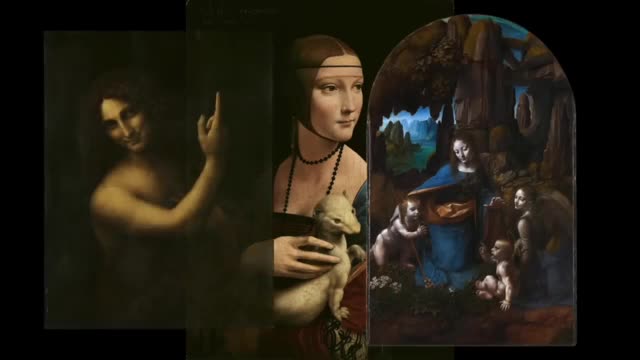
Leonardo da Vinci is believed to have produced less than 20 completed paintings over his lifetime that we know of.
This relatively small number reflects his meticulous working process, his perfectionism and his tendency to leave projects unfinished or abandon them entirely.
And yet he did finish the world's most famous painting, the second most famous painting and the most famous drawing in the world.
Few works carry the weight of history, emotion and technical brilliance, like Leonardo's The Last Supper.
The artist understood the rules of painting, but he also knew how to break those rules.
And his radical use of perspective, light and anatomy created a lifelike, immersive experience unlike anything we'd seen before.
Leonardo's Last Supper is a total break with tradition that shifts away from static symmetrical arrangements of holy figures and towards a psychological drama, a scene alive with emotional intensity and brilliant storytelling.
This is not merely the story of a painting, and it is much more than a depiction of Jesus Christ and his disciples' final meal.
It is also the story of an idea that gives us a glimpse into the mind of a Renaissance genius who used science, mathematics and theatre to explore universal themes of betrayal, faith and redemption.
Leonardo da Vinci was an exceptional man, and everyone who met him described him as a genius.
And yet he was now 42 years old, a middle-aged man, in an era when life expectancy was 40 and he still hadn't produced anything that would be considered a masterpiece by his contemporaries.
Many of his works were unfinished or in private collections.
There were no great public works that people could see, no architectural marvels and no distinguished altarpieces for cathedrals.
Nothing that could be considered worthy of his potential.
His career, which began in Florence and later continued in Milan, was marked by several major commissions that remained incomplete or were abandoned.
His dream when he came to Milan was to create war machines for the Milanese army, but despite several proposals, nothing came to pass.
A project he had worked on since he arrived in Milan was a monumental equestrian statue to be erected in honour of Francesco Sforza, the founder of the Sforza dynasty.
Leonardo was as usual ambitious.
It was going to be the largest equestrian statue ever built 23 feet or 7 meters high, three times life-size, rearing on its hind legs, and cast in bronze weighing 80 tons.
An incredible, if not impossible, task.
It would be one of the great wonders of the Renaissance and would need a miracle to pull it off.
By 1494 he had already worked on it for 12 years, made hundreds of studies, a full-size clay model, and had worked out an innovative method to cast the statue in a single pour of molten bronze, a technique never attempted at this scale.
But sadly, the statue would be yet another Leonardo project that was never completed.
Milan was facing increasing threats from French forces under King Charles VIII, and Ludovico had no choice but to redirect the bronze originally allocated for the statue to produce cannons and weapons for the city's defense.
It was a major disappointment for the great artist who dreamt not only of constructing war machines, but of performing great feats of hydraulic engineering, creating colossal statues or topping off Milan's new cathedral with a great dome.
The very last thing Leonardo expected was to be asked to paint a wall.
Leonardo had arrived in Milan 12 years earlier, in 1482 at the age of 30.
He came to work for the city's Duke, Ludovico Sforza, and he would stay for 17 years until the Duke's fall from power in 1499.
Ludovico, like many rulers at the time, was engaged in constant military conflict and he believed that Leonardo could help develop new weapons and war machines that would give his forces an advantage in battle.
But in a Renaissance court, a talented individual like Leonardo was expected to contribute to a wide range of activities, from art and architecture to engineering and entertainment.
Courts were places of grandeur and spectacle, and the ruler's ability to put on lavish entertainments was an important sign of status, and so Leonardo was given the job of organising the court entertainment.
Something that is rarely discussed or celebrated with Leonardo is his theatrical work, and yet it is vitally important when discussing his paintings.
Leonardo, as the Duke's master of festivities developed, organized and directed productions for festival pageants, triumphal processions masques, jousting tournaments and plays, for which he choreographed performances, engineered and decorated stage sets and props, and even designed costumes.
He collaborated with poets, playwrights and musicians to bring these grand visions to life, applying the same comprehensive observation skills, knowledge of light, movement and perspective to the stage as he did to the canvas.
Many Renaissance artists and other historical painters took on additional roles beyond their primary artistic work, especially when serving in royal or noble courts.
Michelangelo, like Leonardo, was also an architect.
Peter Paul Rubens served as a diplomat, representing the Spanish Netherlands.
Diego Velázquez was the court chamberlain which involved the day-to-day running of the palaces making sure the royal family had the correct bedding, hiring staff and coordinating royal banquets.
Gian Lorenzo Bernini staged operas for the Papal Court.
Leonardo left us with more than 10,000 pages of notes and drawings.
We know he was a polymath who covered a wide range of disciplines, and today this might seem unusual, but for him and other Renaissance artists he would have seen them not as separate specialities but as deeply connected.
We may consider the Mona Lisa as a great work of art, but he would have seen it equally as a work of science, geometry and ideas.
He strongly believed that the study of one discipline enriched the understanding of the others.
For Leonardo, theatre was a natural arena to blend art, mechanics and design.
He created elaborate rotating stage sets, mechanical devices and props that showcased his engineering brilliance.
He designed mechanisms that allowed characters to fly or appear to rise from the ground, adding a magical element to performances.
He developed devices that could stimulate natural phenomena, such as thunderstorms and waves.
He understood not only how perspective worked on a three-dimensional stage, but how it worked from different vantage points.
And all of this work and all of these skills informed what would be the greatest theatrical staging of his career The Last Supper.
The Last Supper is in the refectory or dining room of the convent of Santa Maria della Grazia in Milan, Italy.
The refectory was long and narrow, 35 metres by 9 metres, or 116 feet by 29 feet, and was lined with two long tables where the monks ate in silent contemplation, lined up on the outside facing in.
The only light was from the high-up windows on the west wall.
Apart from a crucifix on one of the plain plaster walls that they would pray to before eating, there was no decoration, which was standard for the Dominican order's austere lifestyle.
From around the middle of the 14th century, monasteries and convents started to commission frescoes on refectory walls to be enjoyed whilst eating in silence.
The theme of these frescoes was usually food, which is not surprising given the location.
Often it was the miracle of the loaves and fishes, but more often than not it was the Last Supper, giving the monks and nuns the chance to break bread in the presence of Jesus and his disciples doing the same.
Leonardo painted the Last Supper over three years on the north wall of the refectory between 1495 and 1498.
On the south wall, directly opposite the Last Supper, is a fresco the Crucifixion by Giovanni Donato Montorfano.
It aligns thematically with the Last Supper, creating a powerful juxtaposition between the sacrifice foretold in the meal and its fulfillment on the cross.
In fact, if we look at the crucifixion from Christ's viewpoint, he is looking directly at the continuation of the story after the Last Supper.
He is looking at his own crucifixion the following day.
Montorfano started working on his crucifixion at the same time as Leonardo, but was probably finished within months, as he used the traditional fresco technique, unlike Leonardo.
It is why Montorfano's work has not only survived for over 500 years, but looks as if it was painted yesterday.
What we are looking at when we look at The Last Supper is a ghost of the original painting.
The exact percentage of Leonardo's original work in The Last Supper is difficult to determine, but some art historians estimate that only about 20-25 of the original painting by Leonardo remains intact.
The majority of the painting has been heavily damaged, overly restored or lost over the centuries due to Leonardo's experimental technique, environmental factors and poor preservation conditions.
Usually, these kind of works were created using the fresco technique, where designs were quickly painted onto wet plaster, hence the term fresco, which means fresh, in Italian.
Then, as the plaster dries, the pigments absorb into and chemically bond with the wall's surface, creating a highly durable finish that can last for centuries without restoration, under proper conditions.
The disadvantage is that artists must work extremely quickly while the plaster is still wet, typically completing sections within a single day.
This limits the amount of details an artist can create within each session.
Corrections or changes are difficult to make after the plaster has dried.
Another disadvantage is that there were certain colours you couldn't use because the plaster contained lime, and some pigments like ultramarine azurite and others couldn't withstand the alkalinity.
Leonardo's teacher in Florence.
Verrocchio was a sculptor, painter and goldsmith, but he wasn't a frescoist.
His painting technique was limited to working with tempera on wooden panels, and that's what Leonardo learned as his pupil.
Tempera is a fast-drying paint medium made by mixing pigments with a water-soluble binder, typically egg yolk, as discussed in my Botticelli video.
Leonardo was never known for his speed, which is why The Last Supper took three years.
The fresco technique was too limiting for his detailed and subtle style and his slow, thoughtful approach.
It did not allow for the precise blending and layering of colours or Leonardo's signature interplay of light and shadow, or chiaroscuro.
So he used an experimental technique for the Last Supper combining tempera and oil paints on a dry plaster surface.
In effect, Leonardo tried to do an oil painting on the wall, and this was a big mistake, because the dry plaster did not absorb the paint as well as wet plaster would in true fresco.
It didn't help that the wall's surface was vulnerable to environmental factors such as humidity and temperature changes from the kitchen behind the wall.
If it was a true fresco, it would have allowed water to exit through the wall, but as it was, it couldn't breathe, and so the paint began to flake off.
Within just 20 years, the Last Supper began to badly fade, requiring extensive conservation efforts over the centuries.
Fortunately for us, several canvas reproductions of The Last Supper were created during Leonardo da Vinci's lifetime by his pupils and contemporaries.
These versions play an important role in helping us understand Leonardo's original design and are vital tools for art historians and conservationists.
They capture details, colours and elements of the composition that have disappeared from the original work over time.
This is known as the Giampetrino copy, believed to have been painted around 1515 by one of his pupils for the Duke's eldest son.
While it is missing the top third.
This near life-size copy shows details no longer visible in Leonardo's work, as we shall see.
Leonardo's in-depth exploration of optics gave him a thorough understanding of perspective.
The rediscovery of a mathematical system for representing three-dimensional objects and space on a two-dimensional surface had revolutionized Italian art in the 15th century, and Leonardo quickly became a master of it.
We should start with Leonardo's famous use of single-point perspective in The Last Supper, which converges precisely at Christ's right temple.
And the centrality of Christ is important as a technical device, a psychological one and as a liturgical focus that will be perpetuated in the Christian mass.
To achieve this, Leonardo first painted a base coat of lead white.
Then he hammered a nail into the wall, attached a piece of string to the nail and made marks where the lines extended, to be used as a guide when planning the painting.
In fact, we can still see the mark where Leonardo hammered the nail into the wall.
Everything is designed to make you look at Christ, who anchors the scene.
If we take the cornice above Christ, the only curved line in the architecture, we can draw a circle which turns out to be the dead center of the painting and encircles Christ perfectly.
He is the centre of everything.
It is a clear spiritual message conveyed through mathematics.
Due to its enormous size, it will be seen differently from different vantage points in the refectory.
Leonardo places the vanishing point 15 feet or 45 meters above the floor of the refectory, which clearly aligns with the perspective lines of the dining room, and extends the frame out into the refectory, as if Jesus and his disciples are in the room dining with the monks.
This was especially impactful in the relatively narrow dining hall, where the illusion of extended space would have been very striking.
How you saw the perspective of the imagined room also depended on which door you entered.
It works from this viewpoint too.
It's clearer if we look at this pre-WWII photo with the old wall markings, which no longer exist, as the wall was destroyed during a bombing raid.
You can see how the perspective of the painting from here also extends seamlessly into the real room.
These effects are designed to make The Last Supper an extension of the monk's dining room, blurring the boundary between art and reality.
Leonardo uses tricks as well as a solution to the challenge of creating a three-dimensional space on a flat surface.
The table is far too narrow to be able to have 13 people seated around it eating a meal, and it's far too long for the room.
But it just works visually as a separation between the earthly world, the refectory, and the heavenly one, Christ and his disciples.
Leonardo was not a very religious man and yet would produce one of the most significant representations of the Last Supper of Jesus and the Twelve Apostles.
We should start with the Bible story to see what is represented here.
The Last Supper appears in all four Gospels of the Bible Matthew Mark, Luke and John in more or less the same order of events.
Leonardo shows the moment of Christ's announcement that one of the disciples is a traitor.
Truly, I say to you, one of you will betray me, setting into motion events that will lead to the crucifixion.
But Leonardo also creates a liturgical message, with Christ reaching towards the bread and wine, about to declare that the bread represents his flesh and the wine his blood.
And in so doing establishing the institution of the Eucharist, the Christian celebration of the sacrifice of the body of Christ.
The betrayal of Christ by one of his disciples is only the most obvious part of this painting.
The genius of Leonardo is that he in fact shows not only a moment in the narrative, nor just a liturgical message, but he also interweaves so much more into the story.
The earliest Last Supper goes back to the 6th century, and Leonardo had seen many interpretations of that story back in Florence.
Most of those depictions follow the Gospel of Saint John, which is the only Gospel of the Four that mentions John on the bosom of Christ, which will become a major part of the iconography for Last Supper depictions for centuries, until Leonardo.
It is a difficult scene to get right, to show 13 characters around a table in a cohesive manner.
Often they are squashed in together in order to fit them all in, making it difficult to see them as individuals.
It was always obvious who Christ was, and John next to him.
And then Judas was easy to spot among the twelve disciples, as he was the only one without a halo, but the other disciples were sometimes interchangeable, lacking in emotion and personality.
This Last Supper from Florence, created 50 years before Leonardo began his, has a wonderful sense of three-dimensional space, but lacks any sense of drama.
The apostles look extremely relaxed, and one of them is even reading a book.
Other representations followed a static, regimented arrangement, with Christ once again blocked in and the apostles lined up one by one like chess pieces, separated and lacking individual emotional expressions.
Leonardo decided to strip the scene back by setting it in a fairly austere room, in keeping with Dominican aesthetics, and making it a story of human drama, elevating it from a religious narrative a psychological study of human beings grappling with fear confusion, guilt and betrayal.
He is not creating drama for drama's sake.
In the bible, it is a very dramatic scene 13 friends sit down to a meal in an occupied city whose guards are waiting to arrest and execute their charismatic leader.
One of their group is working with the enemy to betray their friend, about to set in motion a devastating series of events.
It is a scene charged with the knowledge of what is to come.
If we compare these two Last Suppers, which are only 20 years apart, we can see just how Leonardo injects the scene with the appropriate dramatic flair it deserves.
In this early sketch the artist is trying to work out the logistics, but is still considering a standard layout with Judas clearly on the other side of the table.
But in the end, he rejected the usual formula and created something new.
He did this by applying both mathematical ideas and theatrical knowledge to a clear, well-organized structure.
He first applied perspective and then divided the Apostles into four groups of three to create a harmonious and uncluttered base.
Their overlapping forms also add spatial planes to give more depth to the painting.
This clear structure allowed him to add dynamic interaction to the scene, portraying the Apostles reacting emotionally and physically to Christ's announcement of betrayal.
In a painting With half of the characters obscured behind a large table.
Faces and hand gestures is all we have.
It became a perfect embodiment of what Leonardo called movement of the soul.
In other words, how external manifestations of the human body, such as facial expressions, gestures and posture, reflect internal emotions and psychological states.
How do we know who is who in this painting?
Usually, saints are recognised by their distinctive attributes, a symbol of some kind.
For example, St Peter holds the keys to heaven, or sometimes it is their eventual fate, like with St Sebastian who was killed with arrows by the Romans.
So he'll be shown with arrows, sometimes a lot of arrows.
Saint Catherine of Alexandria is a popular subject and she'll be shown with a wheel, as she was tortured on a wheel.
But Leonardo is not interested in all that and the only signifier here is Judas holding the bag of coins.
So how do we know which saint is which?
We are very lucky in that in 1807, in a small church in Switzerland, a 16th century fresco was found.
A copy almost certainly done by someone who knew Leonardo or his circle.
And conveniently, all 13 names were painted underneath.
The first thing we notice that differentiates Leonardo's version from others is the lack of halos.
Leonardo's unusual and unprecedented decision to omit halos in The Last Supper reflects his innovative approach to art and storytelling.
By removing traditional markers of divinity, such as halos, Leonardo created a scene that was realistic and grounded in human emotion, emphasizing the humanity of Christ and the Apostles.
Stripped of their religious signifiers.
Each figure within the four groups is fully fleshed out and uniquely characterized, creating a sense of narrative and movement that was unprecedented in earlier works on the theme.
The goal was to focus on the faces and the reactions.
We can read the four groups of three, from left to right, not as a snapshot, but as ripples of reactions emanating from Christ's announcement, starting from the group of three to the left, who are James, the Miner, Andrew and Bartholomew, all of whom are reacting to what Christ has just said and exclaiming, as it says in the Bible Lord, is it I?
Much of their emotion is understood by their expressive hands.
And, of course, Leonardo comes from a country where hand gestures are an intrinsic part of its culture.
He devoted countless hours to studying the structure and movement of hands in preparation, understanding their muscles, joints and bones.
He did numerous life drawings, of which only around 20 to 30 sketches related to the Last Supper have survived.
The sketch he did of the hands of Saint John has his hands interlaced which, Leonardo noted, indicated sorrow, and it is a clear reference to other depictions of Saint John, including in Monterfano's crucifixion on the opposite wall.
By referencing what people know already, using familiar iconography, he is freeing himself up to experiment.
The next group along are pivotal, Judas, Peter and John.
Peter is clutching the knife and asking John, who is it of whom he speaks?
And here, he is ready for action.
The knife in Peter's hand alludes to the Gospel account of his impulsive act later in the Garden of Gethsemane, where he drew a sword to defend Jesus being arrested and cut off the ear of the high priest's slave.
This act demonstrates Peter's loyalty, but also his impetuous and aggressive nature, captured perfectly by Leonardo.
The position of the knife is interesting too, as it's pointing to Bartholomew, who later will be skinned alive by barbarians and is often shown holding a knife, the instrument of his torture, as well as his flayed skin.
Judas in this scene is nearly always on the other side of the table from the rest of the group to signify his betrayal and separation from other apostles.
An obvious villain.
But by including Judas amongst the others, Leonardo underscored his humanity, showing that betrayal comes not from an outsider but from within, the close circle of Christ's followers, intensifying the drama.
This nuanced reading of Judas and the complexities of moral choices is a precursor of something we will see later with Caravaggio.
Leonardo's depiction reflects a shift in theological focus, artistic styles and cultural attitudes towards Judas's role in the narrative.
Rather than having his position separate from the group.
It is Judas's posture and demeanour that sets him apart in Leonardo's version.
He leans back, clutching a small bag containing the 30 pieces of silver he received for his betrayal.
And his face is the only one in the group turning away, literally and figuratively, from the light which comes from the left, casting his face in shadows to convey guilt and secrecy.
This subtle differentiation achieves the effects of isolation without physically separating him from the group.
Judas's neck turned towards us is a reminder that he will hang himself, full of shame and remorse.
Leonardo's handling of light and colour is of course masterful.
He uses light in the same way he uses perspective to make it look as though the two dining rooms were one and the same.
The way light is painted in The Last Supper and the direction it is coming from, mimics how light naturally entered through the real windows of the refectory.
The shadows and highlights on the figures correspond to the direction of light in the actual room.
One example is Judas's left arm.
As it reaches towards the bowl, his hand is illuminated and his sleeve catches the light.
And the change of shade reflects this.
All of this enhances the realism and coherence of the scene, connecting the monk's dining experience with the sacred narrative.
Salt appears many times in the Bible, both in the Old and New Testament.
And in the painting we see that as Judas recoils, he knocks over a salt cellar, a detail which is lost in the original but we can see in the copy.
Spilled salt was often associated with bad luck, betrayal or misfortune, which aligns with Judas' role as the betrayer of Christ.
It is still considered a bad omen in many countries, but it is a myth that the tradition came from this painting.
Leonardo's painting, however, almost certainly popularised the superstition.
John, Christ's favourite, is traditionally thought to be the youngest of the Apostles.
This is a fourth-century portrayal of him, shown as always without a beard, to denote his youth.
He is often shown with soft, delicate features that were culturally associated with youth and, by extension, femininity.
During the Renaissance, many artists stylised male and female figures with similar androgynous characteristics as a way to highlight idealised beauty.
As discussed in most of the previous Last Suppers, John is depicted resting his head on the Saviour's chest, as written in the Gospel of St John, and to emphasise his special status as Christ's favourite disciple.
Leonardo changes that and instead he is shown almost like a mirror image of Christ, but leaning away from him, towards Peter who, from the next part of the story, is whispering in John's ear.
Who is it of whom he speaks, causing Judas to recoil?
The artist wanted Christ to be separate and the centre of the painting to be clearly demarcated.
This composition adds tension by further isolating Christ, and if John was leaning towards him, it would have weakened the composition.
Christ is the spiritual heart of the scene, alone and calm as the emotional turmoil swarms around him.
This makes it a much more powerful message in a clear visual, rather than how he is often portrayed, crammed in with the others.
He has just spoken the words of betrayal, his mouth is still slightly open and he bows his head in silence.
He is calm and his hands are in a familiar pose that foreshadows his wounds on the cross.
The hands of Christ are crucial to how this painting is read.
They form an equilateral triangle something I have talked about before and Leonardo uses it here to draw our eyes towards the focal point of the painting.
The triangle, an inherently stable shape, gives a sense of order and balance to the central figure.
In contrast with the other gesticulating characters, his left hand reaches out for the bread, drawing our focus along the diagonal of his left arm and back towards his downturned gaze.
Looking towards the bread.
Our eyes go exactly where Leonardo wants them to go.
This little vignette with the bread and wine is aimed at the Dominican friars, who understood it as a celebration of the Eucharist.
In a wonderful theatrical touch.
The hand was one of the first things the monks would have noticed as they came in through their appointed door to dine, seeing Christ as if he is reaching out to them.
In its original state it would have been more obvious, as the aforementioned light which hit Judas' robe also hit the hand of Christ as he reaches out.
As there are no halos in this painting, Leonardo instead uses light and composition to emphasize Christ's divinity, with the natural light from the three windows behind him.
If you squint you will notice it is the brightest part of the painting and contrasts with the darker tones of the interior, creating a stark visual separation between the earthly and divine realms.
Leonardo links Christ metaphorically to the light, symbolising divinity, purity and salvation.
Then there is the pediment, highlighting his spiritual importance without resorting to overt symbolism.
In the biblical story, after Christ's announcement, each of the disciples asks, Lord, is it I?
Philip can be seen pointing to himself in the painting.
Jesus responds by saying, He that dippeth his hand with me in the dish, the same shall betray me.
And the painting depicts just two people reaching for things at the table.
Jesus reaches for the wine and Judas reaches for the bread.
The group to the right of Jesus is James the Greater, Thomas and Philip.
The intense-looking Thomas is raising his index finger.
It is a gesture we have seen in other Leonardo paintings and it could be to indicate Christ's heavenly authority, but is also a foreshadowing of Thomas' later role in the Gospel narrative, where he doubts Christ's resurrection until he sees and touches the wounds, aligning with his biblical persona as Doubting Thomas.
There is also an argument that this is possibly a self-portrait of Leonardo, and the artist's known cynicism of faith, combined with a later portrait of him by Raphael, supports this possibility.
The final group show Matthew, Simon and Thaddeus.
Having already digested the declaration, they are now having an intense discussion about what Christ has just said.
Thaddeus and Matthew seem to be gesturing down towards Judas at the other end of the table, and both are turning to Simon for advice, whose calmness suggests a figure of stability and reason within the group.
Simon at one end and Bartholomew at the other seem to bookend the scene while at the same time contain the energy and emotion that is emanating from the centre of the composition.
Leonardo's knowledge of theatre, his technical mastery and his meticulous observation of human behaviour inform every aspect of the painting.
From the expressive gestures of the figures to the architectural precision that frames the scene like a proscenium arch.
It is a remarkable convergence of art theology, storytelling and theatricality.
In 1499, the French army, led by Louis XII, invaded Milan, overthrowing Ludovico Sforza, who had been Leonardo's primary patron, now for 16 years.
Throughout its history, the Last Supper has faced numerous threats.
Leonardo's experimental painting technique led to rapid deterioration shortly after its completion.
And in 1652, thinking the mural was ruined, the monks of the monastery decided to cut a doorway through the wall to create direct access between the kitchen and the refectory, destroying the lower central portion of the mural, which included the feet of Christ and part of the table.
Restoration attempts that began in the 18th century often had mixed results.
Remarkably, the mural survived a World War II bombing thanks to protective reinforcements around the refectory wall.
In the 20th century, a painstaking restoration project aimed to take the painting back to its original.
Spanning more than two decades.
The process sparked debate, with some criticising the extent of intervention.
Despite the controversies, Restoration has allowed contemporary audiences to rediscover the work, offering at least a partial insight into the brilliance of Leonardo's original masterpiece.
The Last Supper invites us to pause, observe and connect with the humanity in each of the figures, and it transcends its religious context to offer a lens through which we can examine the complexity of human emotions.
Leonardo, ever the visionary, had turned a routine commission into one of the greatest artistic achievements of all time.
In 1500.
Leonardo eventually returned to Florence at the age of 48, where he reestablished himself as an artist and an intellectual.
Three years later he was given a small commission, a portrait of the young wife of a Florentine merchant.
Although the portrait was eventually completed, it would never be delivered.