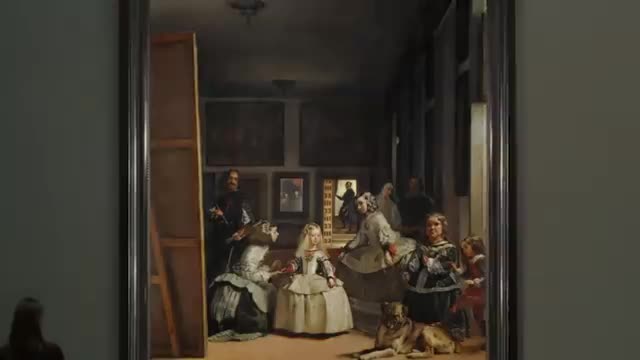
Las Meninas.
Diego Velázquez's portrait of a Spanish princess and her entourage is one of, if not the most widely discussed painting in Western art.
Every viewing raises more questions, and every answer is followed by a dense network of meanings.
It is not only a high point of realism in painting, a perfect, lifelike depiction of the Spanish court, it is also a complex meditation on painting itself.
It is a spellbinding work that is concerned with how we view a painting and how the subjects in a painting view us.
Velázquez was 57 years old when he painted this and had been the court painter for over 30 years.
But in this painting, for the first time, he includes himself among the courtiers, painting a monumental canvas, ten and a half feet tall by nine feet wide, the same size as the actual painting that the painted canvas is shown within.
But who is he painting?
The Infanta?
The King and Queen of Spain?
Or is he painting you, looking at him?
Early in his career, Velázquez produced several of these kitchen or tavern scenes, known in Spanish as bodegones.
They showed ordinary people in ordinary settings, often with hidden allegorical meaning.
When he was just 18, he painted this extraordinary work, which shows a precocious talent for capturing the everyday moment and clearly shows his immense skill in depicting different materials and textures, as well as his mastery of light and shadow on both opaque and reflective surfaces.
The detail of the eggs frying in hot oil is a masterclass.
This painting, which was probably painted to show off his skills, became his calling card to the royal palace.
Here, the water dripping down the jug demonstrates his astonishing ability to create an almost photographic reality.
Common people were always treated with dignity by the artist, and his early paintings not only showed a supremely confident technique and attention to detail, he gave workers a gravitas in his paintings.
Diego Rodriguez de Silva y Velazquez was born in 1599 in Seville to a family with plenty of intellect but little financial means.
Precociously talented, he began a six-year apprenticeship when he was 12 years old with the painter Francisco Pacheco, learning classical techniques of painting.
But the young artist quickly moved away from Pacheco's old-fashioned stiff style towards a new dramatic naturalism inspired by Caravaggio and his followers.
There is no evidence he saw Caravaggio's work in person, but he knew the work of Pieter Oertsen, a Dutch painter accredited with the invention of the monumental genre scene, which combines still life and genre painting and often includes a biblical scene in the background, almost like a split-screen effect.
Velázquez painted several of these types of scenes, and he is clearly already experimenting with illusion, with the picture within a picture, something he will perfect later in Las Meninas.
In 1623, two years after Philip IV came to the throne in Spain at the age of 16 Velázquez, who was already being talked about in the right circles, was summoned to Madrid to paint a portrait of the king, which we think is this one
It was an immediate success and he was pronounced official painter to the king on the spot, with a promise that no one else should portray the king without his permission.
A remarkable achievement for such a young man, and one which awakened jealousy from the other court painters.
Philip IV of Spain and Velázquez were linked together like no other patronage in art history.
He first painted him at the age of 24 and, 33 years later, this painting would be his last of the king.
Their relationship was unusually close, for a monarch and his painter, and the king often came to Velázquez while he was painting in his workshop, just for a quick chat.
It has been said that the principal motivating force in Velázquez's life was the desire to be a nobleman, and he would remain attached to the court for the rest of his life where, step by step, he would ascend through the hierarchy of court appointments, working his way up to a knighthood, and he used Las Maninas to prove that he should be considered as a noble.
At the same time he is painting his masterpiece, a committee are deciding whether he can be made a Knight of the Order of Santiago, in other words, be ennobled.
There is a reason he has put himself in one of his paintings for the first time, on an equal footing with Spanish royalty.
It is so important to understand that a painter in 17th century Spain and elsewhere was considered as just another craftsperson, like a carpenter, in other words, a manual worker.
And like most court painters, he had many other jobs.
Velázquez was also the royal chamberlain, a job that involved looking after the palace, buying firewood, bedding and crockery.
He had a key to every room in the palace and we can see here, hanging from the painter's belt, the symbolic keys of his court offices, of which he was inordinately proud.
He was also the curator of the King's galleries, responsible for negotiating the purchase of hundreds of works.
In fact, almost every Titian you see today in the Prado was bought by Velázquez on trips to Italy.
The artist had a long life, but only produced between 110 and 120 known canvases.
He produced no etchings or engravings, and only a few drawings are attributed to him.
This all ties in to his two enormous but mutually exclusive ambitions.
He wanted to be seen as the greatest painter of the Spanish court, but he also wanted to go down in history as a great gentleman.
The problem was that throughout his time in the palace, his close friendship with the king meant he had his enemies in the court who were determined to stop his rise through the ranks.
Felipe became king in 1621 at the age of 16 and heir to the Habsburg art collection in Madrid, in a court that commissioned not only paintings but poetry and theatre too.
We often talk about the Golden Age of Spain, and it was a time when great palaces were being built and culture was flourishing with, among others, El Greco Velázquez Zurbarán, Murillo and Cervantes.
But Philip IV was in trouble for much of his rule, mainly because of long-drawn-out, expensive wars revolts, revolutions and trouble in the colonies, but also because of genetics and inbreeding.
For two centuries, the Habsburg kings had married first cousins, nieces and aunts, resulting in an onslaught of physical and mental ailments because of their limited gene pool.
The distinctive Habsburg jaw we see on Philip IV was inherited from earlier Habsburgs and likely the result of the royal family's inbreeding.
Despite the Spanish colonial empire, the country was almost continuously in financial difficulties and had declared bankruptcies in 1647 and 1653.
The Spanish royal family was so broke that they often couldn't afford firewood to heat the palace or bread for the tables.
In fact, when Velázquez died, the crown still owed him 17 years of salary payments.
And yet, what does Las Meninas portray?
A wealthy family dressed in the finest clothes money can buy, surrounded by gloriously attired servants in an ornate and sumptuous setting.
Like all royal portraiture, it is a form of propaganda designed to show a courtly audience dynastic stability and imperial wealth.
But one thing Philip IV can't disguise is the lack of a male heir.
He is on his second marriage by the time of this painting.
He had ten children with his first wife, Isabelle de Bourbon, but only one son and heir.
His wife died in 1644, and then in 1646, their son died.
A year later, in a hurry to create a new son and heir, he married his 14-year-old niece, Maria Ana, when he was 44.
She gave him five children, but only two survived to adulthood a daughter, Margarita Teresa, born in 1651, the Infanta in Las Meninas, who sadly would die in her teens, and the future king Charles II of Spain, who was born five years after Las Meninas.
Charles however, was severely disabled thanks to inbreeding, and he would be the last of the Spanish Habsburgs.
Velázquez's position at the court gave him unique access to the royal collections, and he would naturally be influenced by the works he saw every day.
He also visited Italy at least twice on extended trips to buy paintings for Philip IV and to study the great masters.
He was accompanied on these trips by his enslaved assistant, a notable painter in his own right, Juan de Pareja, who would be given his freedom by Velázquez shortly after he painted this beautiful and dignified portrait in 1650.
The work's extraordinary lifelike quality so astonished the papal court that he was asked to paint Pope Innocent X, one of the painter's best and most psychologically insightful works, which has been described as a symphony in red.
It is said that when the Pope saw his portrait completed, he exclaimed somewhat bewildered troppo vero, too truthful.
The influence of contemporary Italian artists can be seen in Velazquez's mastery of perspective and his rendering of the male nude in this large canvas he painted while in Rome.
It was Titian and Peter Paul Rubens who would have more influence than any other artist on the development of his style and, in particular, his royal portraits, where in some cases we can clearly see stylistic similarities between the great masters.
This early Titian painting hung in the Spanish royal palace when Philip IV came to power and was used as the standard by which all other royal equestrian portraits would be judged.
And this spectacular, life-sized equestrian portrait by Velázquez of Philip IV was clearly influenced by Titian and Rubens, not only in its simplicity of pose, but also in its depiction of the king as a restrained and powerful ruler.
Velázquez's portrait however, is livelier, more elegant and uses a lighter palette and doesn't rely on a highly charged background.
The Flemish painter Rubens even visited the Spanish court of Felipe IV in 1628.
He was actually on a diplomatic mission, but still managed to paint five portraits of Felipe while he was there.
He became great friends with Velázquez and encouraged him to go to Italy to study the Italian masters, to move away from chiaroscuro, to be looser in his brushwork and to adopt a brighter palette colour.
Rubens was not only a successful painter, but he was also an important diplomat who had been knighted, despite his humble background.
The ambitious Velázquez saw Rubens as a role model and through him he found someone he could identify with.
It was Titian's late works that inspired both Rubens and Velázquez.
Titian used sketchy and loosely applied brushwork, and he would drag and smudge paint over the canvas to suggest the form, rather than using definitive strokes.
He also used a very thick, rough weave for his canvases that gave texture to his surfaces.
Velázquez would do the same.
Maybe less well known is the influence of Sanchez Coelho and Antonis Mor, who were in the royal collection and would also be important to how Velázquez helped Philip IV forge a calculated image of power and piety.
Probably the biggest influence on Las Meninas though, was a painting from two centuries earlier the Arnolfini portrait by Jan van Eyck that I discussed in my earlier video.
This too was in the collection of Philippe IV, and Velázquez would pass it every day on the way to his studio.
Like Las Meninas, the Arnolfini portrait also has a mirror positioned at the back of the pictorial space, reflecting two figures who would have the same point of view as we do.
It also plays with pictorial space, reflections and illusion, not only in art, but also in literature.
For example, Don Quixote by Miguel de Cervantes, is itself a complex, multifaceted picture of the relationship between reality and illusion.
Velázquez used a very coarse canvas and he didn't use many preliminary sketches that we know of, but rather he painted directly onto the canvas.
As we can see with these x-rays, he often changed his work as he was painting it, and these changes are known as pentimento.
Velázquez was so experienced by the time of Las Meninas that the work has very few changes apart from his self-portrait, which initially turned his head more towards the Infanta.
For much of his early career, the artist used a red ground for underlayer, good for building up contrast and tonal values, the lights and the darks.
But by the time of Las Meninas he had a much looser style and diluted his pigments to make them more translucent and fluid.
And he painted quite thinly.
So this necessitated using a neutral grey ground which allowed for a much wider tonal range, greater luminosity and a general silvery range of colour.
This was unusual at the time as most canvases were primed using dark colors.
He would paint a la prima or wet on wet, where layers of wet paint are applied to existing layers of wet paint, often finishing his paintings in one session.
With a painting of this size and complexity that would not be possible.
And we can see one example in the Infanta's sleeve where, although it is mostly wet on wet, areas of highlights have been dabbed on later in thick impasto to create texture.
With Velázquez, you are always aware that you are looking at paint.
He doesn't try to hide his brush marks, quite the reverse.
By the time he came round to painting Las Meninas, his technique was at its freest and most fluid.
It is often called a precursor to Impressionism, but it's more than that.
Here, the silver of the tray on which the menina holds the ceramic container is achieved with a couple of flicks of white paint, and the flowers are just a few slashes of red.
We often talk about chiaroscuro, the extreme contrast of light and dark, when we talk about Velázquez, and comparisons are often made with Caravaggio.
He painted his most technically Caravaggio-like picture, Christ After the Flagellation, early on, but later he used a more subtle variation of chiaroscuro, still using light to direct our vision, but more subtly as we can see when we look at Las Meninas in greyscale.
Velázquez uses a dark colour palette for Las Meninas, mostly neutral colours and quite limited, and yet he manages to get a broad range of tones, with just whites blues yellows, ochres and small touches of red that help draw your eyes around the painting towards key points of interest.
Velázquez even lets us know which colours he used, as the palette that the painter holds in his left hand has the very pigments he used on Las Meninas.
Between 1640 and 1660 Velázquez mostly painted single portraits.
The composition and structure of Las Meninas was extremely complicated and with so many characters, it's really like the staging of a piece of theatre or performance art.
It needed to be carefully planned out, with every character seen as well as being seen.
In Velázquez's hands they are fully realised individuals.
Thanks to the 18th century art historian, Antonio Palomino, who wrote a 1724 book on Spanish painters, we know quite a lot about the people in Las Meninas, including their names.
Palomino spoke to Velázquez's colleagues after his death, as well as four of the nine people pictured in the painting.
Most of the members of the court are grouped around the five-year-old Infanta Margarita Teresa. who is attended by two meninas, or maids-in-waiting, Maria Augustina Salmiento, who is passing her water in terracotta pots, so it could be summer, and Isabel de Velasco, who seems to be in mid-courtsy.
Velasquez had painted the princess many times, but unfortunately she would die before she was out of her teens.
She is in the center of the painting with the central axis passing between her eyes.
Her face is spotlit by light coming from an unseen window top right and her white satin dress glows as she is bathed in the sun.
It is the princess's presence that makes this a political painting, as at the time, the Infanta was the only child of Philippe IV, with the dynastic succession resting on her tiny shoulders.
Showing her as a healthy and beautiful princess is important for future marriage prospects.
We don't know the name of the dog, but we know the breed is a Spanish Mastiff, which were bred as guard dogs.
There are few artists with such skill in painting animals as Velázquez.
The dog is being nudged awake by Nicolás Pertusato, an Italian dwarf and court jester.
Next to him is the Austrian dwarf, Maria Barbola, who is depicted in an unusual way for a person in her position at the time.
People with dwarfism were considered curiosities as little more than pets, but Velázquez always gave dignity to characters who, due to their profession or condition, were treated as lesser beings.
He shows Maria standing upright beside the princess.
She has a thoughtful and controlled expression and is looking directly at us or the royal couple.
Velázquez entered the service of the palace as a royal servant and initially was considered a worker, just like the dwarves of the court or the jesters, and so he treated them with an empathy not seen before in royal portraits.
He never mocked them or caricatured them and often made them the focal point as fully fleshed out humans.
In the shadows.
This woman is Doña Marcello, the Infanta's chaperone, and she is in mid-conversation with an unidentified bodyguard.
At the rear is Don José Nieto Velázquez, brother of the artist and the Queen's Chamberlain.
Velázquez had possibly painted him before.
He is paused at the door, pulling back the heavy exterior curtain, with one foot resting on a step while his weight is on his other leg, on a different step.
As the queen's attendant, he was required to be at hand to open and close doors for her.
We don't know however, if he is coming or going, but the light certainly pulls us in and it looks as if he will usher all of us out from the created world and into the real world.
In this masterpiece of illusion, Velázquez clearly goes beyond the physical confines of space by playing with implied spaces.
In this case, the rest of the palace.
Velázquez himself is pictured emerging from behind the canvas, moving into our gaze, from the shadows into the light, as he looks at us in the implied space, looking at him in the pictorial space.
He is supremely self-confident and certainly no subservient courtier.
He is proudly holding the tools of his trade.
His palette is turned towards us, showing its colours.
He also holds a marl stick, used for steadying the hand when doing close work, and the long round brushes we know he used, which created soft edges rather than hard lines.
His brush is dipped in paint and perhaps he is considering whether to add some finishing touches, but it is also possible that the first stroke has not yet been applied.
His hand is just a flurry of rapid brushstrokes, and it would appear to be metamorphosing into his brush as his flesh becomes instrument.
It is audacious that a servant, albeit a courtier and royal favourite, has given himself greater prominence than his master.
But it is also inconceivable that Philip IV did not give the concept his blessing in advance.
In the same way, the Queen's Chamberlain is opening up the implied space beyond the picture frame.
The mirror here is reflecting the opposite direction, forward into the viewer's space.
The reflection is of King Philip IV and Maria of Austria, the King and Queen.
We know it is a mirror and not a painting, as everything else is muted and fuzzy, whereas the image of the king and queen is bathed in light in the beveled mirror, giving them an almost divine presence.
That is, if we believe the king and queen are in the same room as the other characters.
The aforementioned historian Palomino noted that the mirror which shows the royal couple was actually a reflection not of the real monarchs in the room, but of the canvas Velázquez is working on.
In other words, the couple are not in the room.
This idea is disputed though, as the reflection is not logical.
It has to be said though, this is not the first time Velázquez has painted an image which explores the relationship between reality, reflection and image, and which flouts the laws of optics.
Here too, we see the mirror with this rather blurred reflection.
The constant speculation as to what is happening in this painting who is where and why is absolutely intentional on the part of Velázquez.
Whatever the study of perspective or reflection tells us, the royal presence is still the most plausible explanation for the outward glances of the characters.
And I think that the king and queen are in the room and the mirror is a reflection of them at the far end of the room, sitting for Velázquez.
The fact that the Queen's Chamberlain is opening the curtain to the palace suggests that the royal couple are preparing to exit.
This would also explain the Infanta's gaze towards her parents Velasquez, who seems to be peeping out of the darkness realizing his time is up, and the Menina to the right of the Infanta who is beginning to curtsy as she looks towards the couple.
There is a palpable sense of anticipation in the air.
If the king and queen are there, and I think they are, then Velázquez has one more trick up his sleeve.
He has placed the king and queen outside of the pictorial space, standing exactly where we, the commoners, would stand when we view the paintings.
We are standing right next to King Philip IV of Spain.
With this painting, Velázquez was out to prove that painting was a noble intellectual art and Las Meninas would be evidence.
It is in fact a portrait about the painting of a portrait.
Let's start with the physicality of the space.
The building was destroyed by fire in 1734, but the historical plans still exist.
Las Meninas was painted in the Cuarto del Principe, or the King's Quarters in the Alcazar in Madrid, which is the room depicted in the work.
It was once part of the apartment occupied by the Crown Prince, Don Balthazar Carlos, who had died in 1646.
Once the painting was finished, it was planned to be placed in that same room.
An inventory of the room proved that everything Velázquez painted was really there, apart from the mirror in the back.
The illusion starts with the almost life-size figures.
The painting is enormous, coming in at over 10 feet by 9 feet.
The room had these wonderful high ceilings, and the shutters have been placed by Velazquez to reveal slivers of light exactly where he wants it.
The main light source is from an invisible window to the right, and another source is the door at the back that illuminates the figure and sends a pencil-thin beam across the floor.
While Las Meninas is clearly a royal painting, it stands out from other court paintings because the piece was intended to hang in a private room rather than displayed publicly.
It may look formal to us nowadays, but compared to other royal portraits, Las Meninas is fairly spontaneous, casual and relaxed.
There is a lot in this painting.
People animals reflections, paintings on the wall textures, other objects and movement.
And yet there is a cohesion to the canvas because it is organised in an orderly composition.
It is balanced perfectly with the relatively quiet top half against the busy bottom half.
The figures occupy a clear horizontal strip across the painting, but it isn't frieze-like as they are at different depths into the view.
The first layer is the canvas, the dwarf and the dog.
Then we have the infanta and her maids, and then Velázquez, the chaperone and the bodyguard.
The layering continues throughout the picture and beyond the picture frame.
The painting features several frames.
The frame of the room in which they are all standing, the frames of the paintings on the wall, the frame of the canvas Velázquez is working on the frame of the mirror and the frame of the door in the background.
These frames provide a strong linear and geometric theme to the painting.
You get a feel of structure and organization.
But a perfect perspective is not essential to our understanding of this painting, any more than a perfect understanding of optics.
What is the focal point?
Well, there are several possibilities.
Just look at the picture as a whole and you notice your eye scans around the canvas, as it would do in any large space.
We ricochet from one figure to another.
Possible focus points are the man in the doorway, the infanta or the reflection of the king and queen.
It seems at first glance that Velazquez is drawing all our attention to the Infanta, and he has used some clever and subtle techniques to draw attention to her in such a busy scene.
There is the dress, of course, but also she faces towards the main light source, coming from the right, while most of the other figures are facing away from the light.
Maria Augustina is looking directly at her and the characters to the left nudge us towards the Infanta.
We do know that this painting was not intended to be on public view and was really considered a private possession of the king for an audience of one, which would suggest the focal point is the reflection of the king.
The focus is still highly debated and always will be, but the vanishing point is not.
It comes from José Nieto as he stands in the staircase.
More specifically, the crook of his arm is the exact vanishing point.
This is the key.
Velázquez's mastery of illusion uses realism, light and structure to pull together the disparate elements in an exquisitely balanced painting.
It is an image so complex that he could only have achieved it at this later stage of his life, with the extensive knowledge he has picked up from a lifetime of painting.
The two paintings on the back wall are important symbolically and represent two oil paintings by Rubens Velázquez's role model and show scenes from Ovid's Metamorphoses.
There is a good reason they are there, if we remember that Velázquez wants desperately to raise his profession from tradesman to artistic nobility.
They tell the tale of the superiority, the nobility and the divine calling of the artist, in which mortals prove themselves more skilled than even the gods.
Rubens was the most influential Flemish artist of the 17th century, so by linking himself with Rubens, Velázquez is showing that he had reached the highest tier in European art.
One of the great enigmas in the portrait of Velázquez is the red cross on his tunic.
It is the heraldic symbol of the Order of Santiago, a religious and military order founded in the 12th century.
He had petitioned the king to make him a Knight of Santiago for years to secure noble status, citing the link between artistic nobility and social nobility.
But the committee of the Order of Santiago refused, due to his bloodline.
It was rumoured that his grandparents were Jewish converts.
Luckily for Velázquez, as well as being employer and employee, he and Philip IV were close friends and he was finally inducted into the Order in 1659, a year before his death, after the King obtained a dispensation from the Pope to overrule doubts as to the artist's blood and trade.
Diego Velazquez in many ways was unremarkable, apart from the fact he was appointed court painter.
He had one wife, one friend the king and one studio the palace and spent his whole life climbing the social ladder.
His knighthood is the culmination.
What makes this cross in the painting interesting is that he was knighted a full three years after Las Meninas was finished and a year before he died, which means that the cross was painted on the artist's tunic years after the painting was created.
Tradition had it that after the artist's death, Philip IV himself painted the Red Cross of the Knights of Santiago on the tunic.
But that's unlikely.
After the painting was cleaned in the early 1980s, it was revealed that the brushwork of the cross is uniform with the rest of the surface.
So it was almost certainly Velázquez who painted the cross.
We can only imagine the immense satisfaction the artist got from adding the cross to the painting and therefore rubbing the snobby courtier's noses in the fact that he was now one of them.
Velázquez, who was in essence born a tradesperson, died a wealthy noble.
On his death, it is said that the king was heartbroken, and the great friendship that had united them is evident in three words that the monarch wrote in a memorandum after his death.
I am shaken.