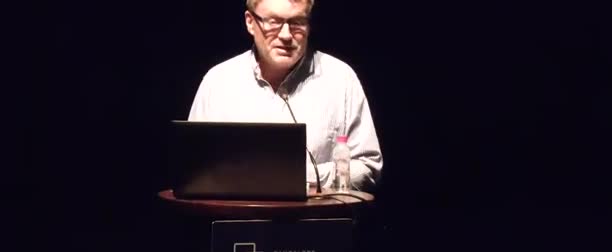
Hi, my name is James Payne.
Just to say thank you, first of all, for turning out.
And thank you to the BIC for being so welcoming.
It's been a joy working with these people, really has.
I would say Bengaluru is probably my favorite city in India now at the moment.
So the last time I was here was 28 years ago.
So it's slightly different.
So just one thing before I start is that I have had a bit of a cough, so you're going to have to forgive me.
Or as they say over here, adjust Mahdi.
So I'm going to talk about my journey, my weird journey, my very strange journey to YouTube and how I became an overnight sensation, really.
So it's very, I wake up every day, even now, five years later, going, what happened?
So this is what it's like.
So I'm going to be reading some excerpts as well from my book.
And this is my introduction.
But I do believe I think I spent more time.
The book was very difficult for me.
Really, I come from a non... a non-intellectual background.
I left school at 16 with no qualifications and I just bummed around Europe for a very, very long time.
France, Italy, learning languages, and I'll talk to you about what happened after that.
And so I spent a long time working on this introduction, and I'd say my very first words are really important for me, which is knowing what we know about Van Gogh's life doesn't make Starry Night a better painting, but it does make it more interesting.
That's my opinion.
OK, so I spend my whole time on YouTube in my book saying it's not the correct answer.
It's my opinion as well.
So I think knowing what we know about Van Gogh makes it more interesting.
That's my opinion.
I'm going to read. going to read an excerpt.
So I'm not used to standing still so much.
I'm a bit of a fidget arse, as we're saying.
So I'm going to read an excerpt from my book.
As we go, I'm going to read about four or five excerpts.
And this is from the end of the introduction, which, as I say, was really important to me.
One of the guiding principles of Great Art Explained has always been accessibility.
Art history should not be the exclusive domain of scholars and critics.
I've written this book for those who have ever stood before a painting or sculpture and felt a deep emotional connection, an inexplicable pull.
I've written it for the curious, the sceptics and the dreamers.
I've written it for anyone who has ever wanted to see beyond the surface and understand the layers and meaning that art can offer.
So this is my channel, Great Art Explained, and I'm going to talk to you briefly about how I did become a YouTuber.
I was not really even that interested in YouTube before.
I watched it a few times, and this was my job for 25 years.
I was a tour guide.
So I was a tour guide taking Americans and Canadians around the world.
So I used to have up to 52 people following behind me, asking lots of questions.
And I took them to Paris.
I took them to London.
I took them to Rome.
And I do think a lot of my life has been very accidental.
I love this job, by the way.
I loved working with North Americans.
I love taking them to sites because North Americans when they see the Eiffel Tower, they go, ah when, when Brits see the Eiffel Tower, they go, oh yeah.
Eiffel Tower, you know, and I love the enthusiasm of North Americans.
And I found that over here as well in many of the galleries that I've been to.
So I spent my whole life talking to these people.
And, you know, I really could talk about the Mona Lisa for two hours easily.
I could spend the whole two hours here, whatever, talking about the Mona Lisa.
But I suddenly I realized that people's eyes start glazing over after a while a bit.
They're not as interested as I am, which I'd never understand that, you know.
So I realized that 10 to 15 minutes was enough, that that was enough information.
I could get a lot of information about the Mona Lisa, about the Renaissance out within 15 minutes.
And my videos, have you seen my videos at all?
They're very action packed, you know, so there's a lot of information in them, but they don't feel rushed.
OK, they're calming, which is what I wanted.
So I learned how to say what I wanted to say in 15 minutes without that boy on the right hand side falling asleep.
Then, when I was 30, my mid-30s, I decided you know what?
I left school at 16 and at the time we had free education in the UK, not anymore.
And I thought I want my free education that I've paid my taxes for, you know.
So I decided to go to college to become an artist at Central Saint Martins, which is the most famous art school.
And because I was a mature student, or I thought I was, it meant that I could go for free.
It also meant that I could get in without qualifications.
So I went to Central St.
Martin's wanted to become an artist.
I spent five years at art school getting a degree and then a higher degree and I must say, within three years I realized I was the worst artist in the whole school.
So and I realized I didn't want to be an artist.
I didn't even like being an artist at all, but I loved organizing people so I loved I had a show.
Within two years I organized a show with 130 artists in London, including some from India.
And I realized I was good at it.
I realized I could work with artists rather than be an artist myself.
So I gave up being an artist and became a curator.
While I was at school, I was learning all these classic texts, like Deleuze, you know, Roland Barthes,
Even if I hear the name Baudrillard now, I shiver.
You know, I just learned all this word and I understand it because I did five years of it.
I understand the language, but that's not what I'm interested in now.
This is something we call international art English.
I'm afraid you suffer from this in India as well, as I've noticed going around galleries with this very obtuse language, very difficult language.
International Art.
English was supposedly invented in England because we love making language inaccessible.
So I'm going to read this very, very quickly.
In this new body of work, the artist interrogates the liminal tensions between presence and absence, destabilizing entrenched hierarchies of seeing.
By activating the viewer's embodied subjectivity, the installation proposes a radical rethink and a spatial politics.
This was a gallery in London a month ago.
This is not made up.
Okay.
And this is when I can read that and understand it after a while.
You know, when I was in the museum in Mumbai two weeks ago, I was reading the text on the wall and I was thinking this is difficult to read, you know.
So I wanted to open that up.
I've always wanted to open that up.
Then I started a gallery in East London called Payne Chavelle.
I loved having a gallery because I love working with artists, who are the most difficult people in the world.
Yes, the most difficult people in the world, for sure.
And I love working with them.
I love the relationship.
And I had this gallery.
And one of the first things I used to do when we had an art show, we had an artist come in.
I'd say, write your press release for me.
And I'd read their press release.
And it was full of all this gobbledygook language, which I studied at art school.
And I'd say, no.
Go away.
Rewrite this starting with there are 35 paintings in this show.
Just be clear.
Be simple.
Explain to people what it's about and be direct because that's what I've always been.
My whole life is direct, sometimes to my detriment.
So what I was doing just before lockdown was this.
I was a guide for very wealthy people in UK private galleries.
So I did this.
And when I say wealthy people I'm talking about.
I would take 20 women, usually women whose husbands funded the galleries.
And as we came out of the gallery to go to the next gallery, there was lined up, lined up limousines to take them, maybe 50 yards up the road.
So it was super enjoyable because I'm English and I can be quite rude.
And so they're used to it, you know.
So I actually enjoyed that job.
And then, of course, this happened.
And this is lockdown.
Lockdown happened.
London closed.
And, of course, my main income was tourism.
And that job died.
That job completely died for me.
And I was freelance.
You know, I was at the point in my life when I had enough money I could last out lockdown which I thought would last for two or three weeks.
And then a year or so later, I'm thinking, what do I do now?
Hey, I'm going to start a YouTube channel.
Never even thought about it before in my life.
I just woke up one morning.
I'm going to start a YouTube channel.
And I started this channel, which is Great Art Explained in 15 minutes and with the aim of what I've always been doing, which is trying to explain art very clearly.
You know, the funny thing about me is, though, is that my book, it has chapters on mental health.
It has chapters on gender politics.
It has chapters on race.
It has chapters on class.
But I deal with it in a very different way.
I deal with it as storytelling.
And I feel like I'm very direct when I deal with these things.
And so I'm not dealing with simple things.
I'm dealing with extremely complicated things.
But I'm taking away some of the language.
That's all I'm doing.
So this is what I did here.
I started this channel.
Then I started another channel called Great Books Explained.
Of course, this is James Joyce here in this picture, and this is Ulysses.
I must admit, I wake up every day, as I said, surprised at the fact that some of my videos have 7 million views.
There's 7 million people out there.
Oh, by the way, before I forget, my most popular audiences are North Americans, around 64%.
My second most popular audience are Indians.
So India is my second biggest audience, followed by the Brits, who are always a bit casual about this stuff.
So this is James Joyce.
Believe it or not, do people know the book Ulysses?
We call it the most unread book in history because everyone buys it but nobody actually reads it because it's unreadable.
But I met this wonderful 23-year-old scholar and we wrote the script together and that video now has had 14 million views.
For a very complicated, difficult book, that's what I'm doing.
I'm making these things accessible.
This is my channel now.
With both channels, I have over 2 million subscribers.
These are the important things I'm interested in.
First of all, language.
I think language is a barrier for a lot of people.
I come from a very working class background.
My father's a truck driver.
My mother was a cleaner.
And I do know that galleries were very intimidating for my family.
Never for me.
I was never intimidated from a child onwards.
But, you know, language can put people off.
And I think, you know, we can open up that language to make it accessible for everyone.
Storytelling.
I believe we're all storytellers.
You know, if you sit with your friends and your family.
Everyone's a storyteller and you can make this art more accessible with storytelling.
It's okay to have an opinion.
I'm going to say that again.
It's okay to have an opinion.
We're terrified of having opinions, you know?
And I tell people, I'm not correct always.
Don't patronize.
I have this on my desk.
Don't patronize.
Don't dumb down and don't assume.
Let's say, for example, you know, I know what I'm talking about.
I know what chiaroscuro is.
I know what the technique of chiaroscuro is.
But not everyone does.
So I explain what that means.
I explain what chiaroscuro is.
My work is not anti-intellectualism.
It's anti-exclusion.
That's the other thing I have by my desk.
These are my people I'm interested in.
I've always had these people in my mind, always from the beginning.
When I started this YouTube channel, I assumed my friends, their friends, my family, their friends would watch my videos and I'd have 100 200 views.
I had no idea that it would explode in such a way.
But even from the beginning, even before I thought it might be a success, I thought about these two people.
One is this man on the left-hand side.
Who is me?
Who is you?
Who is anyone who knows about art, who understands about art and understands what Kiaroscuro is?
I'm aiming at him.
I'm aiming at curators.
The other is a 15-year-old kid from Wisconsin, okay, or Mysore.
You know, a kid who doesn't have access so much to museums that we can open up their lives as well.
And I think that's what I've succeeded at.
It's one thing I've succeeded at is appealing to both those types of people.
And that's what I think about all the time.
I have them in my head when I write my scripts.
The way I look at work, there's lots of different ways I look at work.
Let's say, for example, the one on the left-hand side.
Now, if you go to the museum in Vienna, they have this painting on the wall.
And then by the side of that, there's a room with another painting, a copy of this painting.
And that's where couples have their picture taken.
So they have their picture taken with selfies.
And it's where men often propose to their wives.
My suggestion is this is nothing to do with romance.
This is my suggestion.
My suggestion is they're friends.
So Gustav Klimt slept with every woman he ever met, basically.
So he was a philanderer.
He had no romance in him at all.
He had eight children by different women.
And there was one woman he was in love with called Emily Flerger.
And Emily Flerger was a radical, radical woman.
And I believe that's her in the painting.
And my suggestion is this is unrequited love which doesn't really appeal to someone wanting to propose to their partner.
But anyway, so my point is there are lots of ways of looking at things.
Claude Monet, we sometimes think of him as a chocolate box artist.
By that, I mean images you see.
Do you say that term over here?
Images you see on chocolate boxes, you know, beautiful flowers and things like that.
But in fact, he was so radical.
I'm going to talk about him more.
And my suggestion is that some of these later paintings between 1900 and 1926 were about war.
He was very much involved in the First World War.
Look at this painting here.
And this is Night Walks by Edward Hopper.
This painting was done during World War II.
This painting was done before America entered World War II.
However, there had been two air raids in New York, two practice air raids in New York and one practice air raid in Los Angeles.
So they knew war was coming.
They had these practices.
And this is, some people see this as a painting about loneliness.
Some people see this as a painting which is very, very comforting.
We're going to do a test.
How many of you see this painting as a painting about loneliness?
Show of hands.
And how many of you see this as a painting which is comforting?
And how many of you see it as a mix of both?
So it's pretty much 50-50.
I'm not making any point here.
All I'm thinking is that we've all got different opinions what painting means, because we bring our own personality to it.
And that's what my whole ethos is with my channel.
So really, what is this about?
We can make our own minds up as well.
All I do is, my aim, is to give you the tools, for example, the technique, the story of the artist, the story of how this painting came about.
Give you the technique, those tools, to go on and do your own research and your own thinking, not telling anyone ever how to think.
My channel is called Great Art Explained.
One thing I never do is actually explain art.
Why did I choose that title?
Because everyone got annoyed when I told them about it.
And I thought, yeah, let's go with it.
So we're going to talk about some art as well.
And these are, as you probably know, these are in the center of India.
This is Madhya Pradesh.
And I'm obsessed with cave art.
And these are from 10,000 BCE.
And I just really want to talk about cave art and how it works, because you've got roughly about the same time.
This is in Australia.
This is also in Argentina, sorry.
You're also getting these in Spain.
I saw some great caves in Spain recently.
Now, the interesting thing about this is this is people wanting to make their mark.
They want to show art.
These caves, most of these caves, to get to them, you have to go underground.
You have to crawl underneath, get to a very dark space.
Remember, no lights.
They're holding these burning pieces of fat to do this light.
And they're painting here.
And they're showing their story.
They're telling their story just through art.
And no one is necessarily seeing it.
Why didn't they do it just outside where the caves are?
Why are they way deep inside? because they wanted a space to show their art.
These, by the way, they do this with a reed and they get ore colors and they spray on their hands like that.
That's how they make them.
And this is all what art is about, is making your mark and finding your space to make your mark.
This is what Alberto Giacometti is doing.
This is his brother, Diego Sita, one of my favorite artists.
He's doing the same thing as those cave artists are doing in India 10,000 BCE.
Look at these balls here, 16,000 to 14,000 BCE.
Look at Picasso.
Picasso is the man who said, all artists borrow, but great artists steal.
And he did.
Now I'm going to talk about some specific works of art as well.
So this is the Arnolfini portrait.
I think this is in my top three paintings of all time, which is why I wanted to talk about it.
When I was a kid growing up, we called this the Arnolfini marriage.
Because it looks like a marriage.
I do understand that he looks like Putin as well.
So if I hear that one more time, I'll scream.
But this painting is interesting because it's, you know, this is why I love history so much.
This painting is at a time, this is from Bruges.
It's from Bruges.
When the middle classes were growing, this huge middle classes, these nouveau riche people.
And these two are Italians.
So this is Giovanni Arnolfini and his wife Costanza.
And he was a merchant and the merchant classes were growing.
This is a new thing.
And we see this all again and again throughout the world of these new classes coming and people stamping on them, telling them what to do.
So they were told what they were allowed to do and what they weren't allowed to do.
They had things called sumptuary laws, and sumptuary laws were governed by the kings and queens told people how much luxury they were allowed to have.
These nouveau riche people.
So is she pregnant, do you think?
I would say so, right?
But she's not.
So this is by Jan van Eyck, the great master.
By the way folks, this is happening the same time as you know, the Renaissance is just about to happen.
He is known as the first oil painter.
He's not really, but he was one of the men who perfected it.
This is his Eve.
So that's his Eve from the Ghent altarpiece, which is one of the most beautiful works of art in the world.
And Eve looks pregnant.
In this painting, guys, Eve is not pregnant.
So in this painting, this is before.
So it was a way of showing that women had fecundity.
So they were able to give birth.
Now, the most interesting thing about this painting.
The most interesting thing about this painting is it was painted in 1434.
Costanza died in 1432.
She was dead. by the time this was painted.
We know that now for a fact.
We know that he never married again.
But everything in this painting is about showing off.
First of all, the most important thing, Jan van Eyck was incredibly famous.
To have a painting by Jan van Eyck on your wall in your house was pretty much like having a Porsche parked outside your house today.
So it was a way of showing off.
The other way of showing off is the clothes they're wearing.
To get that green would have taken about 18 to 19 processes to get that deep color because you're using plants to dye fabric.
To get that black as dark as that his hat is straw, by the way, to get his clothes as dark as that was also many, many processes.
Look at the lining of her fur, the fur lining.
That comes from the white fur.
This comes from the white fur of squirrels, the belly fur of squirrels.
2,000 of them.
2,000 squirrels died in the making of that dress.
So this is a lot of money.
They're showing off.
Look on the windowsill to his left-hand side.
You see oranges.
Very expensive to import oranges to Bruges in this period of history.
Look at that mirror.
Mirrors were very expensive.
In fact, that mirror is a lie, because at the time, the biggest mirrors they could produce were around this size.
They couldn't produce mirrors that size.
So that means Jan van Eyck has made a choice to make that bigger, to make it more central.
And I'm going to show you why.
And also, it almost looks like the eye of God looking over them.
So how do we know she's dead?
This is all my suggestions as well, which are in my book.
First of all, on the mirror itself.
On her side, on the right-hand side of the picture, It starts with the crucifixion at the top.
And then it's the deposition, which is Christ being taken.
Then it's Christ being laid in the tomb.
Keeps going down to the resurrection.
But really, the five roundels on her side are about death.
They're all Christ's death.
The five roundels on his side, starting from the Last Supper, are all about life.
So that's reflecting the way they're standing in the picture.
In the mirror is a reflection of them.
There's a rumor that they're not holding hands, but we can't be sure about that.
Who are the people in the painting welcoming them in?
Because interestingly, that room looks like a bedroom because it's got a big bed in it.
It's 100% not a bedroom.
They would not be welcoming people into their bedroom.
It was standard in the 15th century in Bruges and other places that you would have this huge, luxurious bed in your welcoming area that no one ever slept in.
It was just to say, I can afford a bed and I can just have it here sitting around when I want it.
Most people, 99 of people in the world at this point had next to no furniture in their bedrooms, in their rooms.
Look at that room.
It's packed with furniture.
It's all about showing off what we've got.
So there you've got the mirror on that side.
Now, folks, I would like you to look at your small fingernail.
You look at your small fingernail.
Those roundels are half the size of your small fingernail.
They are tiny.
Really small.
Imagine painting that.
Look at that crucifixion which I've blown up there on the right-hand side.
That's done with one single hairbrush.
With a paintbrush with one hair.
It's so small.
It's tiny.
It's a masterpiece.
The whole painting is this big.
The details are extraordinary.
And oil paint, a new thing.
Oh sorry, I just want to go back to If we look just to the left of that mirror.
By the way, those are rosary beads.
The funny thing is which I love about this painting is 80 of the products in that room are things which he imported.
So he's really like an advert for his business.
So those rosary beads if you look at the cord holding the rosary beads together again, that's one single hairbrush that he uses to paint that.
Look at the reflection.
Every single one reflects the room.
Look at the candelabra above them.
On his side, there's one lit candle.
On her side, you can see that candle at the top is snuffed out.
You can see the slight bit of wax at the top.
That's on her side.
So everything represents death on her side and life on his side.
All of these are just ways of looking at painting.
That text there says Jan van Eyck was here.
So he's signing.
It was unusual for people to even the Renaissance artists didn't sign their paintings.
So everything on her side.
And then I think the killer for me is that at her feet, there's the little dog.
And it was very common in medieval tombs for women at that time to have dogs at their feet.
It showed fidelity.
But I think that's the thing that really adds the last moment to it.
And this is Jan van Eyck, my chapter, A Love That Transcends Death.
And I'd like to read a second extract.
The true mystery of this painting lies in its unparalleled use of space depth, color and texture, creating the illusion that we could walk through the flat wooden panel of the painting into a mirrored universe.
Jan van Eyck's contemporaries dubbed him an alchemist, but while he may not have invented oil painting, as early historians suggested, he undeniably refined the medium.
Understanding that some pigments become almost transparent when mixed with oil, he applied numerous thin layers, almost a wash, which gave the work a luminous quality and a finish so smooth that it suggests the Arnolfini portrait has been untouched by human hands.
Everything in art is a message.
That's a message as well, that people would have looked at that painting, not even seen a brushstroke.
I've seen that painting probably more than the Mona Lisa even.
And what we do know through science is that in some parts of that, particularly around her green dress, which would have weighed so much as well around that green dress, is that Sorry, I've lost my train of thought.
I've lost my train of thought, sorry.
Anyway, so around that green dress, we know, oh yeah, sorry, here we go.
There are 26 layers of paint that he used.
So thin washes.
They used it so thin that by the end of it, you can't see any markings on there.
So 27 layers.
By the way, the Mona Lisa, one part of the Mona Lisa has 38 layers of paint.
A thin wash again.
So they're just miraculous paintings.
I want to look at a more modern artist, which is Francis Bacon, one of my heroes.
And this is the one that I look at in the book.
So this painting is called Three Studies for Figures at the Base of a Crucifixion.
The most important word in that sentence, in that title, is a.
It's not the crucifixion.
It's a crucifixion.
And that's a really important distinction because there was more than one crucifixion in history.
And this is what Francis Bacon's looking at.
Now, you would have thought Francis Bacon comes from a Catholic background.
He was an atheist by the time he's a painter.
And this is his triptych.
Now, we have a tradition in Europe of triptychs and these were taken.
If you look at this one at the bottom, these were the two outer leaves folded in and you would carry it around with you.
Or sometimes, if it was something like the Ghent altarpiece, which was enormous, the two panels were closed and it would only be opened up for special people, for exclusive people.
So you would think, wouldn't you, that Francis Bacon based a painting about a crucifixion on one of these triptychs.
But in fact, he didn't at all.
He based it on this. which is a famous film.
He was obsessed with cinema.
And this is how I like to look at things in a different way.
Jan van Eyck, he had to work with other artists and other impressions.
He had to work with other influences.
Francis Bacon was very influenced by cinema.
So we think we're looking at religious art.
Francis Bacon didn't intend it as religious art at all.
And he based this on this film, which is by Abel Gance, which is a silent film on Napoleon from 1929.
And this film splits into three screens at the end.
So it's interesting how artists can base their work on other mediums.
I'd like to ask you, what do you think these eight figures are doing?
Screaming?
I think that's the most obvious one, right?
Screaming.
We think they're screaming.
Yeah.
So many different ways of looking at this.
I'm really interested in something else, which is another area of Francis Bacon.
So Francis Bacon during the Second World War.
That's him on.
You can see the A pointing towards him, looking very unhappy.
But he was a volunteer Air Force warden.
So after all the bombings in London, he would go around picking up the bodies.
He would pick up those bodies.
That's what he's seeing, limbless bodies.
And he was also extremely asthmatic.
So he had very, very bad asthma.
And the dust from the World War II meant that quite often he was hospitalized and he had to give up his job.
So quite often he was struggling for hours.
Remember, this is the 1940s as an asthmatic.
And is he gasping for breath? are these figures gasping for breath?
This is something I suggest.
Are they screaming or are they gasping for breath?
And we can look at it both ways.
This is another one that he based it on, and this is Sergei Eisenstein's a battleship Potemkin from the 1930s, and he used these images.
He also lied.
He lied a lot.
He lied about two things.
One was, I don't do preparatory drawings.
That's not true at all.
The other thing was, I don't use photographs.
He pretty much only used photographs.
So, but you know he come from an era where, as a homosexual, he had to hide himself.
You know he had to hide what he was.
The interesting thing about him, I find, is that he was an interior designer.
So he comes from that background as an interior designer.
He never told anybody.
We didn't find out until he died that he was a very famous interior designer.
He was too embarrassed.
He thought, that's not art.
So he had to hide himself quite a lot.
These are images we found.
This is from my book again.
These are images we found where he would use photographs and he would rip them up.
And he would use that as his sketchbook, a way of ripping things up and moving things around.
So I'm going to read another excerpt.
And I'm talking here about the crucifixion painting, which is the chapter in my book.
Bacon strips away any sense of spiritual redemption or salvation, making it a subversive piece that embodies the dehumanizing violence and the brutal realities of human suffering during the war.
But it's more than an exploration of personal and collective trauma.
Bacon's investigations into pain and suffering remain strikingly relevant today.
The painting's universal themes of suffering and psychological depth transcend historical context.
Speaking to us as we continue to grapple with alienation identity trauma, conflict and the fragility of life.
Francis Bacon had painted that painting just during World War II.
It was put on show just after the end of World War II.
And in those days, when people came to a gallery, they came in their tuxedos.
Women came with their jewelry and their long dresses.
They had to climb over the rubble.
They had to climb over the rubble of London.
Also, what's being released in the UK at this time while he's painting this?
The images coming from Auschwitz.
When people say to me, why do you talk about the history of the artists?
Why do you talk about their lives?
It's because how can we not be affected by what's going on in the world?
And I think that painting, that particular painting, The Crucifixion, speaks to us of war now.
It will still continue to speak to us about war.
This is Amrita Sher Gill, as you know her.
This is an artist I'm looking at the moment.
And how do I talk about her to a Western audience, for example?
As you probably know a lot about her, she was born in Budapest in 1913.
She's a daughter of a Sikh aristocrat and a Hungarian opera singer.
And so I'm looking at her at the moment as a way, as a bridge across Western and Indian art.
And that's how I'm looking at her.
And the only reason I'm saying this is because there are so many different ways you can look at these artists.
Can you look at her as a young painter when she was influenced by Gauguin?
So that's another thing I'm looking at.
She was very much influenced by Gauguin and also Cézanne as well.
And another way of looking at her is the fact that she had this incredibly tragic life.
And does that work reflect that?
But it certainly does reflect the attitude towards women in this period in history.
And that's what I'm looking at with her.
Claude Monet, again, chocolate box artist.
I think he's the most radical artist of all.
I like to look at the impressionists.
I'm going to make this nice.
I love thinking in this way.
The impressionists, when did the impressionist movement come about?
Claude Monet, of course, is the father of impressionists.
I think there are three factors.
I think factor one is the Franco-Prussian War, which is on the left-hand side.
Franco-Prussian War was 1870 to 1871.
So many big art movements come from anguish and come from pain, and they come from war.
Think about Cubism and the First World War.
Franco-Prussian War was one year only, and it was so violent, so aggressive.
People like Monet saw his best friends killed in that war. saw them murdered in Paris.
Are these artists going to paint pretty pictures anymore?
They're angry, you know, so life changes.
And the Impressionist movement came out of that.
The next thing is the invention of the camera, and we'll talk more about that in 1839.
You're talking about the first Impressionist exhibitions are in the 1870s.
And then the invention of portable oil paints.
So when the Franco-Prussian War happened, Monet went to London and he studied J.M.W.
Turner.
And J.M.W.
Turner, we call the godfather of Impressionism.
So he was the man who was, again, a huge radical, working class kid, made good.
His dad was a barber.
Such an amazing guy.
And later on, he became more and more experimental.
And Claude Monet adored him.
Claude Monet studied him.
And he came up with his first painting, which is Impression Sunrise.
And Impression Sunrise was shown in 1872 at the very first Impressionist show.
An art critic walked in.
I'm sure you know this.
An art critic walked in and was laughing at the work.
People were rioting in Paris.
Well, people are always rioting in Paris.
But people were rioting in Paris because the Impressionists were so shocking.
They were so, so shocking, so new and so radical.
They were painting things like trains.
You know, nothing romantic.
They were painting modern day objects.
They were painting the Eiffel Tower.
And then Claude Monet paints this and a critic walks in and says, what's this work?
That's the right title for this work because that's all it is.
It's just an impression.
It doesn't mean anything.
And Claude Monet, when he read the review, said, that's a great title for a group.
And so he called himself the Impressionist.
So he took that and ran with it.
Next, photography is invented.
Look at the picture on the left.
That's an apple.
Taking a picture of an apple is done.
Why do you want to paint an apple anymore that looks like an apple?
You know, what's the point?
What's the point of making this beautifully realistic apple?
And so people start thinking of new ways of working, new ways of thinking.
Everything is changing in France and changing in Europe.
That's Renoir in the middle.
Absolutely stunning.
Beautiful.
But more importantly, that's Cézanne.
That's Cézanne.
Cézanne was Monet's best friend.
He's really started the Impressionist movement, but kind of moved on in a way.
Monet was very friendly, very good looking, good with the ladies.
Cézanne was very, very difficult.
But this is a painting he did of apples and a quince.
And he said the most famous expression in art, which he picked up an apple, and he said with this apple I will astonish Paris.
And he did.
He astonished Paris.
So this is Cezanne here.
People started thinking differently once the camera was invented.
Portable oil paint.
That meant you could paint outside.
You could paint outside with paints.
Because what happened before?
Let's say, John Singer Sargent?
He would have sketched outside with his sketchbook, gone into his studio and then he would have painted.
Because paint dries very, very quickly.
The paint dries too quickly.
And it was kept in animal skin.
So you had these huge animal skins.
So you're taking these massive things around with you.
People couldn't do it.
But when portable oil paints were invented, that means, you could go outside paint outside, what the French call en plein air.
And that meant that the Impressionists could paint outside for the very first time, because their paints wouldn't dry.
And that meant they could get the impression of the light.
And light, there's one thing you want to think about with the impressionists, is light.
They understood how light works.
It's why Monet is going to paint the cathedral in Saint-Gouin over 30 times at different times of the day, because they want to see how light works.
And that simple invention by an American changed everything.
There are three things.
This is Claude Monet's most famous.
I want to stick on Claude Monet for the moment.
I've still got time.
My chapter on him is called The Sistine Chapel of Impressionism.
This, of course, is the famous Water Lilies paintings he did between 1914 and 1926.
Now, I love coincidences.
I love coincidences in art because, you know, Sometimes these art movements wouldn't have happened.
So Claude Monet was pretty much retiring.
He was retiring by the time he came around to 1916.
And he had cataracts.
He had cataracts in two eyes.
And he was a bit of a scaredy cat.
But who wouldn't be in this period of history having cataract operations?
And so he only had one done.
So apparently he used to paint with one eye like this.
So this is his best friend.
And this is his best friend is Georges Clemenceau.
You wouldn't expect them to be best friends.
Georges Clemenceau was the French prime minister during World War II.
He's the one who's going to cause lots of problems by signing in Versailles.
But anyway, he was also a very famous politician, very aggressive, very super aggressive, but he loved art.
Claude Monet was.
You know, he was about to retire and Clemenceau wanted him to do one more work.
Just one more work, he said, not realizing that was going to take 14 years.
So he is going to create the Orangerie in Paris.
I'm going to show you some pictures of that in a minute.
But why did he do that and how did he persuade Monet?
Monet was kind of.
By the way, Monet was one of the few artists in history who was very, very famous as a young man.
He was one of the first people in the world to own a Rolls Royce.
He was the first person in France to get a speeding ticket for driving 21 miles an hour. in Giverny.
So he was a very interesting man.
And so they were both speed freaks.
They both went up to 22 miles an hour one day.
So they were best friends, but really unlikely best friends.
Now, Georges Clemenceau was an art collector, a very famous art collector, and he was best friends with Rodin.
He was very good friends with Rodin.
And Rodin did the sculpture of him on the right-hand side.
That's by Rodin.
Georges Clemenceau saw it and said, oh my God, that's the worst thing I've ever seen in my life.
And he said, I am Auguste Rodin.
And he said, I don't care who you are.
Destroy it.
I look miserable.
I look grumpy.
I look really imperious.
And Rodin refused.
So the end of the story is that Clemenceau hated Rodin forever.
Now, Rodin, who was born the same year as Claude Monet, they were frenemies at best.
They were born the same year.
And Rodin, they were both very famous.
Rodin.
As he was coming to the end of his life, he decided to give all of his works to the city of Paris and make a museum dedicated to him.
And that museum is going to become the Musée Rodin, which is in Paris to this day.
So he made this museum.
And for one minute in history, Rodin was the king and Monet was nothing.
Just for one minute in history.
And so everyone loved Rodin because he gave all his work to the city and it became this incredibly important museum.
And Georges Clemenceau said to Monet I want you to paint one final work which is a monument to the war dead, a monument to the war dead of the First World War.
People don't even think about this.
Monet said, I'm retired.
I'm retired.
I have cataracts still.
I'm too tired to do this.
And he said, have you heard what Rodin has been doing?
And he said, no, what's he been doing?
Well, he's given his entire collection to the state.
Have you not read the newspapers?
Pulled out the newspapers with all the headlines in them.
And Monet thought about it for about three seconds.
And he said, OK, I'll do it as well.
I'll build a monument to myself.
So he does that.
He lives a lot longer than Rodin, almost 30 years longer than him.
So he builds his own monument to himself.
The French are very good at building monuments to themselves, as Napoleon tells us.
So this is the monument built.
You know this place.
So this is the Orangerie where his last water liza took nearly 14 years.
And these are huge, enormous, long pieces of works of art.
I'm going to read you a second to final excerpt.
Now, what most people don't think about is about Monet is how he was affected by World War I.
I'm going to talk to you about the relatives he had in World War I, And he's in Giverny, in the north of France, while he's painting this.
And he can hear the bombs in the distance.
You know, he can hear the cannons going off in the distance.
And everything is radically changing.
Monet was deeply affected by the grim realities of war.
His stepson engaged in frontline combat and his own son, Michel, enlisted in 1915.
The paintings recall the haunting imagery of the landscape of the Western Front.
Battlegrounds that seemed to stretch endlessly, with no beginning or end and with no discernible horizon.
Soldiers found themselves submerged in vast seas of mud, surrounded by surreal waterlogged vistas that obliterated any sense of time and space.
There is a clear sense of mourning in the paintings, with Monet's use of foreshortened, weeping willow trees that seem to sweep you up in your embrace.
Since ancient Greece, the willow tree has been used as a symbol of mourning and grief in art due to its drooping branches, and was often planted in French series as a form of memorialization.
That's something which I think people have almost forgotten about, that these were actually done for war.
These were actually done as a memorial to war.
And then, of course, you know, the saddest thing I think this is really the saddest thing about the entire story is Clemenceau was so dedicated to Monet.
He adored Monet.
And when the museum opened?
Go back here.
When the museum opened here in 1927, Monet had died the year before, the year before it opened.
And thank God he died the year before because people hated it.
People didn't like this at all.
They thought it was old school.
It was old fashioned.
Clemenceau was heartbroken and he died heartbroken as well because critics hated it.
They thought it was over.
The impressionists were something else.
Modernism had already come in by this point.
And everyone forgot about this.
And the interesting thing is that building was designed by Monet and an architect.
He designed the building himself.
And what's so interesting is that for two decades they covered up his paintings with other people's paintings.
And it became an exhibition center.
At one point, for one and a half years, it became a dog show.
So with these paintings covered up until the 1950s.
And that's when artists like Jackson Pollock, by the way, that's Monet at the top.
Look how radical that painting is.
He really could hardly see by this point.
Jackson Pollock and all those people like Rothko, they'd come to Paris and they discovered Monet.
And it changed everything.
Now to this day, it's the second most visited museum in Paris.
Thanks.
And then we can also look at it as prototype art that we're going to see by Yayoi Kusama, installation art as well, because it surrounds you.
You feel like you're surrounded by it.
I look at eight women in my book.
So we have Gentileschi, Vigée Lebrun, Hilma af Klintz, Suzanne Valadon, Georgia O'Keeffe, then we have Frida Kahlo, we have Faith Ringgold, and then we have Yayoi Kusama.
So it's really important to me that I looked at the history of women in art as well.
I'm going to briefly, I'm going to close up soon.
I want to talk about Yayoi Kusama because she's a chapter in my book.
She's still working now.
She's in her 90s.
She came to New York when she was very young.
She sewed money into her kimonos because it was illegal to bring money into New York at the time, or so much money.
And she wrote to Georgia O'Keeffe and said, I'm coming to New York.
Can you help me?
And Georgia O'Keeffe said, yes.
Super generous woman, helped her to meet all these people.
Yayoi Kusama got to know everybody.
She's very sociable.
And she had these incredible shows.
Guess what happened?
No one came.
Guess what else happened?
No one wrote about them.
No one was interested in that.
A woman in the early 1960s.
It was very, very rare for an artist, particularly modern artists, to do this work.
Look at that show at the bottom there, Accumulation.
That work is very radical.
Those are kind of penises made out of stuffed soft material, making a chair impossible to sit in from 1962 onwards.
Imagine the shock in those days.
Look at the one above it, 1,000 boat shows.
She covered the entire gallery in wallpaper, in wallpaper of images of her own work.
It was a radical show.
No one came.
No one was interested.
No one wrote about her at all.
So she struggled.
But her work got seen in a different way by people ripping her off.
And that is someone like Andy Warhol.
Six months after her show closed, he also had a show where he covered the entire gallery in wallpaper of his work.
His show was a huge success, sold out everything.
Klaus Oldenburg at the bottom, he had always worked with aluminium, hard material.
Suddenly he's working with this soft material, the soft stuffed material, the same as her.
His work sells out.
He becomes a huge success.
So, of course, she's not seen at all.
We all know Yayoi Kusama.
I believe there's one in Mumbai, an infinity room by her.
We all know her work.
This is how we know her today.
A lot to do with Instagram as well.
And these are her infinity rooms.
She did this infinity room.
One critic wrote about her.
Happened to be her boyfriend.
So one critic wrote about her.
She wasn't seen.
What happens?
One year later, Lucas Samaras has exactly the same idea. miraculously.
Do you know the interesting thing about Yayoi Kusama is she doesn't give a damn.
Her autobiography, she actually says, they ripped me off.
It's very unusual for artists to say something like that.
And they did.
They ripped her off.
Now I want to finish.
Got four minutes, i can do this in maybe six okay, so this is my favorite work of art of all time.
I'm an atheist okay, and i love not this work, the one i'm going to show you next um, and i want to talk to you about how this work is seen.
So this is la pieta.
This is we're going to be talking about this work in a minute okay, by michelangelo.
It's my favorite work of art of all time.
So this is a work of art which is really interesting because, only 100 years before he does this work, the Germans are doing it.
They call it a Vesperbild.
And it is the subject of Jesus dying in his mother's arms.
OK, that subject is not in the Bible.
That's interesting enough on its own, because you only did religious paintings of subjects which are in the Bible.
This is not in any of the four gospels.
Jesus dying in his mother's arm.
Radical already in Germany.
Vespa build.
And how do you portray a woman holding a fully grown man on her lap? like you do here.
He's very, very stiff.
The whole thing is stiff.
There's no real emotion here as well.
You have to do it by someone supporting them.
John the Evangelist on the left-hand side, Mary Magdalene on the right-hand side.
They're kind of propping him up because she can't manage him.
It's too big, you know?
Then, 10 years after that painting by Perugino, along comes this guy 23, 24 years old.
Between 23 and 24 years old, he creates this incredible masterwork.
It really is the masterwork.
This is the chapter in my book as well.
And how does he do it?
How does he make that look?
You can see how different, right?
Everyone can see how different those two images are.
How does he make it look so beautiful?
He does it by cheating.
This is the Renaissance.
This is the period when people are not, it's not just about art, it's about science.
These people understand science.
They're studying scholars from Muslim culture from a thousand years before.
These artists are all studying these great artists, these great scientists, and they understood how the eye works.
This is the shape you're going to get in Renaissance art again and again, which is the triangular shape.
It pulls us up.
Think about the Mona Lisa.
It pulls us into her face.
It's pulling us up all the time.
That's what this image is doing.
It's pulling us up into the Virgin Mary's face.
But he's tricking us because if the Virgin Mary stood up, she would be over seven feet tall.
And Jesus would be under six foot tall.
But that's a trick.
But once you know it, have a look at it now.
And do you see it differently?
She's big.
She's a big woman.
And what else does he do?
He does something.
How does she support him?
By spreading her legs and supporting him in her legs.
Now, guys, no artist would ever show the Virgin Mary with her legs like that.
It's just not done.
So he covers it up with this voluminous material.
And so that's how he does it.
He tricks our eyes.
Look at the Virgin Mary.
Does she look old enough to have a 33-year-old son?
No.
And he didn't care.
The critics attacked him for that.
He said she represents purity.
That's why she's young.
It's all symbolic.
Look at her hands when she's holding Jesus Christ.
He's holding cloth.
She's not touching his body.
He's a holy body.
This is when we move.
This is when we move from a saint holding a dying son to a mother holding a dying son.
This is why I love this painting.
It's about motherhood as well.
Look at this, the most beautiful touch, the way, the way his arm flops down.
He's going to do this with David as well.
The vein is exactly as it would have happened how our veins work.
Those veins are going in exactly the position they would be in if you were holding your hand down.
You can see the marks of the crucifixion.
And look at this last this is the last thing I'll say this touch of Jesus Christ grasping onto his mother's cloth for the very last time.
That's the last time he's going to hold his mother as he's dying.
And to me, that represents everything about art and not necessarily about religion.
I'm going to read one final excerpt and then I'm going to take questions.
Sorry if I've run over.
So by the way, he's 23, 24 when he does this.
And if we go back here, You can see the sash across her chest.
It's the only sculpture he signed.
Most sculptures didn't sign their work.
It's the only one he signed, and that's because he heard a story.
Someone went to see it and said, it's impossible.
This work is actually impossible.
There's no way a 22, 23-year-old could have done this.
So he sneaks back in at night, and he signs Michelangelo across her sash.
So that's why he's only signed one.
It was his first work that catapulted him to the forefront of the great Renaissance artists, a work that masterfully combines technical brilliance with deep emotional and spiritual resonance.
A work that seems almost uncanny for a 24-year-old.
The young Michelangelo turned a religious subject into a moment of human experience the sorrow of a mother mourning her son.
Intimate portrayal of Mary cradling the body of Christ conveys a deeply personal moment of loss which transcends religious context to resonate with anyone who has experienced grief or love.
It is this universal emotion.
It is this universal emotional pull that makes the sculpture timeless.
And I do believe that's what we're all trying to do is make our mark.