Just a quick reminder that my other channel, Great Books Explained, can be found in the link below.
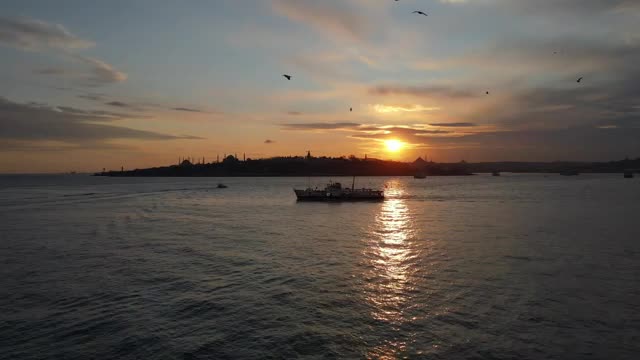
Istanbul, once known as Byzantium and later as Constantinople, is a city of such diverse culture and history.
It was the capital of three great empires, Roman, Byzantine and Ottoman.
Both ancient and modern art blend elements from Europe, Asia and the Middle East, reflecting its geographical and historical positioning as a bridge between the East and the West.
It is the only city in the world that straddles two continents, Europe and Asia.
Constantinople became Istanbul in 1930, following Turkey becoming a republic.
The city's art is a visual embodiment of its complex history.
In this episode we look at the cultural highlights of one of the most dynamic cities in the world, from Hellenistic art, Roman sarcophagi and the spectacular ancient cisterns that lie beneath the city of Istanbul.
From the grand Byzantine-domed church Hagia Sophia, to Ottoman tiles, carpets and detailed mosaics in the city's famous Blue Mosque, to contemporary art in Turkey's first modern art museum.
Alexander the Great invaded Asia Minor in 335 BCE, leaving behind an artistic legacy, as did Emperor Constantine when he shifted the capital of the Christian Roman Empire to the east in 330 CE and renamed it Constantinople.
The Muslim Ottomans, whose Sultans were some of the greatest patrons of the arts, created many great monuments when they took over the region in 1453.
A reign would last right up until 1922.
And modern-day Turkey is now creating its own artistic legacy.
The Archaeology Museum holds 60000 artifacts from the Greek Egyptian, Phoenician and Hittite periods, and it's packed with Roman sculpture and sarcophagi, including its artistic masterpiece, the Alexander Sarcophagus, a 4th century BCE Hellenistic stone tomb found in the late 19th century near Sidon in today's Lebanon, then part of the Ottoman Empire.
The sarcophagus is a lavish tomb which depicts two battle scenes and two hunting scenes in incredible detail.
It is not, despite the name, the coffin of Alexander the Great, but probably that of Abdullonimus, king of Sidon, who died in 311 BCE.
He was made king by Alexander immediately following the Battle of Issus, and both men are pictured on this tomb.
The sarcophagus is remarkable in that it holds the only existing depiction of Alexander the Great, created during his lifetime.
The battle took place in 333 BCE, where Alexander overpowered King Darius III and his much larger Persian army and marked the beginning of the end of Persian power.
Alexander created one of the world's largest empires from Greece to India by the age of 30.
And we know it is him on the sarcophagus as he wears a lion skin on his head.
He is shown rearing triumphantly on horseback, preparing to throw a spear at the Persian cavalry.
Holes and hand placements in certain figures tell us that the frieze would have been embellished with bronze weaponry, which has since been lost.
Once all the horses even had bridles and reins made out of bronze, which went through the drilled holes you see here.
The material is pentelic marble from Greece, which is softer and easier to carve than other natural stone materials, resulting in an astonishing level of detail.
It represents a perfect combination of Greek and Persian style, Greek in its origins and aesthetics, and Persian in the concept of such an ornate funerary monument on this scale.
It is in the shape of a Greek temple and it looks very architectural.
It even has many of the details seen on the temples, like the egg and dart motif on the top edge above the freezers.
This sarcophagus is also considered to be one of the best preserved examples of polychrome.
Most of the Roman sculpture that is so familiar to us was not monochromatic raw marble, but was originally painted in bright colors.
And over the centuries, the paint has worn off.
Because the tomb is so remarkably preserved.
We can see clear traces of yellow red, purple and blue in many of the scenes.
And if we look at this side of the tomb, we can see in this reconstruction how it once looked.
It seems bright and lurid to us. but it is a totally accurate historical portrayal.
The Greek warriors are shown nude, with colourful hair, helmets and shields, while their opponents, the Persians, are painted with bright, vibrant clothes and armour.
Nudity in ancient art was used as a deliberate way to imply heroism or even divinity.
The other motif of the sarcophagus is a hunting scene.
Alexander the Great is shown once again on horseback with a flowing cape.
Beside him, we see Abdelonimus, whose horse is being attacked by a lion.
The hunting scene is a clear political statement, as the Persians and Greeks, who we saw at battle in the other frieze, are now working together in pursuit of the lion.
It is underlying the unifying symbolism of the royal hunt, bringing together the two cultures after a period of warfare.
The reliefs are truly astounding.
They are carved deeply and the figures are overlapping and tumbling out of the frame, creating dramatic scenes.
In the garden of the museum are further ancient artifacts, including this spectacular Medusa head, which may have been removed from the ruins of the Forum of Constantine, where similar relics have been found, as we shall see later.
The Byzantine style rejected the realistic forms of classical Roman art in favour of a more symbolic approach with highly stylised, flattened designs, often decorated with gold.
While Western Europe was going through the Dark Ages, the Roman capital of Byzantium flourished in the East and became a glorious gem of art and architecture.
However, one of the most incredible structures in Istanbul, built during the Byzantine era, is actually underground and features upcycled early Roman sculptures.
The eerie and beautiful Basilica Sistan.
Deep below the city is a reservoir built in the sixth century under the reign of Emperor Justinian I, who also rebuilt the domed church Hagia Sophia.
It took a genius piece of Roman engineering to create the major water reservoirs of Constantinople.
The water was transported to the city from up to 200 kilometers away by these immense Byzantine aqueducts which are still standing.
The reservoir, the largest of 209 ancient cisterns that lie beneath the city, is an enormous space, roughly the size of two football fields, containing 336 marble columns recycled from the ruins of older buildings, each 9 meters high, holding up the vaulted ceilings, and it once held 100000 tons of water.
This masterpiece of engineering far exceeds, in both scale and design innovation, even the largest of the Imperial Roman systems reflecting the value of water in the Byzantine city.
It was constructed by more than 7000 slaves as a place to store water for the great palace of Constantinople and continued to provide water for the Topkapi Palace for a short while after the Ottoman conquest in 1453.
Records show that the Basilica cistern continued to be used by locals for drinking water and fishing.
In 1565 a French traveler described how the cistern was full of fish and locals were out on boats.
And you can still see the fish in there today.
In modern times, the cistern was a location in the James Bond film, From Russia with Love.
007 takes a boat in the cistern so he can spy on the evil members of Spectre in their lair above.
An intriguing highlight of the cistern for today's visitors are these strangely positioned heads of Medusa at the base of two columns.
In Greek and later Roman mythology, Medusa was a Gorgon monster usually depicted with a head of snakes.
The popular myth about the cistern is that the Medusa heads were placed sideways and upside down to negate the power of her gaze that would turn men to stone.
But the truth is more practical.
It is 1500-year-old upcycling.
These Medusa stones were taken from their original location and used as building material in the cistern, in this case for bases of support columns.
The Ottomans introduced the hammam, or Turkish bath, as a way for people to cleanse themselves, both physically and spiritually.
Over time, Turkish bars became a social hub for people to relax, socialize and even conduct business.
Zerekçenili Hamam is in Istanbul's Faith District, Old Constantinople, and was built 500 years ago during the reign of Suleiman the Magnificent by the greatest Ottoman architect Sinan, often referred to as the Michelangelo of the East.
It reopened recently after a 13-year restoration and excavation, during which they found hundreds of fragments of the 10000 tiles in 37 unique patterns that would have lined the Hammam walls.
The superb, recently opened tile gallery in the attached museum has a collection of 16th century blue and white Iznik tile remnants manufactured exclusively for the Hammam, five centuries before all, in a purpose-built museum that also showcases artifacts associated with the Hammam ritual.
Turkey has its own particular form of modern art, influenced by both tradition and Turkey's desire to open up to the West, which began with the Ottoman Empire's westernization process.
And contrary to popular belief, Islam does not forbid the depiction of human and animal forms.
Figurative representation has been part of Islamic cultural production from the earliest sites of archaeological excavation to the contemporary era.
A famous example of figurative art is by the founder of Istanbul's archaeology museum, Osman Hamdi Bey, also a painter whose girl reading the Quran recently sold for 63 million British pounds a record for a Turkish painting.
Istanbul Modern Turkey's first contemporary art museum, is a great introduction to modern Turkish art, with a collection that includes both figurative and abstract works.
The striking new building is designed by the architect Renzo Piano.
Here we look at three Turkish artists in the collection.
Cihat Burak uses a triptych, a very European art form, for Death of a Poet, a portrait of Nazim Hikmet, who spent 14 years in prison for his leftist sympathies, whose poetry we see here was banned and who was exiled in Russia, where he died.
The painting includes lines from some of Hikmet's most famous poems bursting forth from his prison cell.
The birds symbolises the International Peace Prize.
Hikmet was awarded in 1950 and the central panel showing his dead body echoes his impact on a new generation of protesters.
Farhanisa Zayed is a fascinating artist.
She was one of the first women to go to art school in Istanbul.
She was a Muslim princess who became an important figure in the Turkish avant-garde in the early 1940s.
She created radical work inspired, she said, after seeing Baghdad from a plane, and by using geometric forms in Islamic art and architecture mixed with influences of European abstraction.
She was the first female artist to have a solo exhibition at the Institute of Contemporary Arts in London in 1954.
And one of the works she showed then was this kaleidoscopic immersive work, five metres wide, which is now in the collection of the Istanbul Modern.
Bedri Baykam, still working today, was a pioneer of neo-expressionism in Turkey, and he created this painting in 1987.
The left side of the work was adapted from Ingres' Turkish Bath of 1862.
The right side came from Jérôme's Grand Bath at Bursa of 1885.
The painting has been interpreted as a critique of Orientalism, the style of art where Western painters like Jérôme and Ingres romanticise the East as an exotic and erotic fictional land full of baths and harems that, in reality, Westerners had no access to.
There are so many layers of history in Istanbul Roman Byzantine, Ottoman and First Republic and each layer adds to the artistic backdrop of this incredible city.
It is currently having a moment of cultural rebirth, with new galleries and museums and art fairs like Istanbul Contemporary and the Biennale, showing the rise of the city as a cultural power.
There is a vibrant art scene in Istanbul, And art is vitally important in Turkey because it uses a language that critically engages with the country's long and complicated past and can help towards creating a better, more inclusive future.