Taxes was taxing. Now taxes is relaxing when you file for free.
I can file for free.
TurboTax Free Edition.
Roughly 37 % of filers qualify.
Simple form 1040 returns only.
See if you qualify at TurboTax .com slash free.
Hmm. I can file for free.
Now this is taxes. File for free with TurboTax Free Edition and get your maximum refund.
No schedules except for earned income tax credit, child tax credit, and student loan interest.
See if you qualify at TurboTax .com slash free.
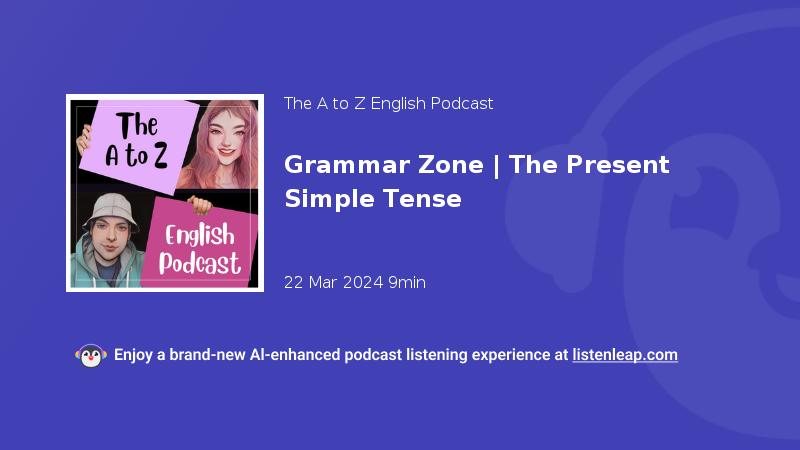
Welcome to the A to Z English Podcast.
My name is Jack and I'm here with my co -host, Sochul.
And today we are in the grammar zone and we are going to talk about the present simple tense.
And Sochul, I think that the present tense, the present simple tense is a little bit misleading because it doesn't necessarily mean the present like right now it it has more to do with our habitual daily routines and so i'm wondering if you could think of like some give us like some examples of like
the present simple and then we'll kind of just like break it down a little bit and just explain what what it means exactly like what's your daily routine yeah i i think it's i think it's interesting because we because we well i'll tell my daily routine and we can break it out from there but let's say
um i wake up at eight in the morning i eat breakfast i brush my teeth um and then i get ready for work jack what do you do in the morning I get up at seven o 'clock in the morning.
I brush my teeth first.
I've gotten into that practice.
That's interesting.
There's like the debate.
We'll have to make that a topic another time.
Yeah, yeah. Do you brush your teeth before you eat breakfast or do you brush your teeth after you eat breakfast?
So I brush my teeth.
I wash my face. I get dressed and then I go to work.
I teach at my university.
I eat lunch. I teach a little bit more.
I go home. I eat dinner.
I watch Netflix with my wife, and then I go to bed.
And so that's my daily routine.
Now, I think where students get confused about what we're talking about here is we're not talking about today.
We're talking about every day.
Yeah, yeah. So things that we did in the past, things that we do now, and things that we most likely will do in the future.
Like I don't see my routine changing anytime soon.
And so because it's a habitual thing, we would put that in, we would use the present simple tense to describe that.
and I think it's the easiest like grammatically it's the easiest of the tenses because there's only really one rule that you have to remember and that's when you use he she or it as the subject what happens to the verb when you when you change it to like he or she you add that s on the end because you're
saying he brushes she brushes they well you you change it slightly for brushing teeth you know i brush my teeth versus he she brushes wow what's up i just bought and financed a car through carvana in minutes you the person who agonized four weeks over whether to paint your walls eggshell or off -white
bought and financed a car in minutes they made it easy transparent terms customizable down and monthly didn't even have to do any paperwork wow Mm -hmm.
Hey, have you checked out that spreadsheet I sent you for our dinner options?
Finance your car with Garvana and experience total control.
Financing subject to credit approval.
To everyone who loves the taste of tradition, come enjoy a classic Wisconsin fish fry at Culver's.
I'm Genesis from Culver's in Claremont, Florida, and here, family fish fry is a part of who we are.
We've been serving up fish fry favorites for over 40 years, All thanks to the Culver Family Roots and Wisconsin Supper Club, the place where the fish fry was perfected.
If you're craving something crispy on the outside and flaky on the inside, you've got to try our hand -battered North Atlantic Cod.
It's perfectly seasoned and my personal favorite.
Or, if you're in the mood for a little extra crunch, our lightly breaded butterfly jumbo shrimp hits the spot every time.
Whatever you order, I promise it will be made with love by a team who cares.
because we want every guest to feel like family that's just how we do it in wisconsin dive into delicious with all your fish fry favorites at culver's from wisconsin with love welcome to delicious they're here i'm okay jack i'm gonna let you take over because i'm getting no no i know exactly what you're
saying so you're like yeah so if we use the subjects uh i you we they you would say like I brush my teeth we brush our teeth um it brushes its teeth although I don't know what that means um uh they brush their teeth um but if you use he or she so he brushes his teeth he gets up you add an s there um
he washes his face he goes to work yeah he watches Netflix he eats dinner her she takes hour so it just kind of changes a little bit yeah we call that a inflection a verb inflection where basically the verb changes a little bit and the inflection is just with an s or an es what about study how would you change
that to the present simple um i study every day or he she studies every day right so you change the y to i e s there you go yep y becomes i e s what about the verb have um i have breakfast she or he what would you use there Has, has, she or he has breakfast.
A common mistake that some, you know, beginners will make is that they'll overgeneralize the rule.
So they'll say haves like H -A -V -E -S.
But that one's an irregular one.
So we have to use has.
And so just be careful with the verb have when it's using he or she, we use has.
and that's that one you just have to memorize there's just a couple of strange ones like that yeah yeah all right listeners I think this one is a pretty simple one why don't you practice by writing your daily routines for us in the we chat and whatsapp groups shooting us an email at a to z english podcast
at gmail .com or leaving a comment down below on our website at a to z english podcast .com and we'll see you guys next time bye -bye bye -bye I love you.
what is dax are you tracking all our cars on carvana value tracker on all our devices yes Yes, Kristen.
Yes, I am. Well, I've been looking for my phone for— In Dax's domain, we see all.
So we always know what our cars are worth.
All of them? All of them.
Value surge. Trucks up 3 .9%.
That's a great offer.
I know. Sell? Sell.
Track your car's value with Carvana Value Tracker today.
When you get the Planet Fitness Black Card, you can bring a friend any time you work out.
And now, through March 13th, get your first month free when you join.
You heard that right.
Conquer the stair climber with your partner in Climb.
Enjoy a post -workout recovery session in the hydro massage and do it all again with access to any of our 2 ,700 convenient locations.
So, you coming? Get your first month free and all the perks with the PF Black Card for just $1 down, $24 .99 a month.
Cancel anytime. Deal ends March 13th.
See Club for details.