I mean, I think it's pretty unique at OpenAI to be able to work on something that's so generally useful.
I mean, it's like everything they tell you not to do at a startup is just like your user is anyone.
You just kind of take it for granted that you literally have this like wizard in your pocket.
We're trying to make the most capable thing and we're also trying to make it useful to as many people as possible and accessible to as many people as possible.
I think we hear this with GPT-5 internally when people are testing it.
They're like, oh, I thought I asked, like, a really hard question.
I feel, like, a little bit insulted that it got for, like, two seconds.
Or, like, when it doesn't even want to think at all.
Today's episode was recorded the day GPT-5 launched, a major milestone not just for OpenAI, but for the entire AI ecosystem.
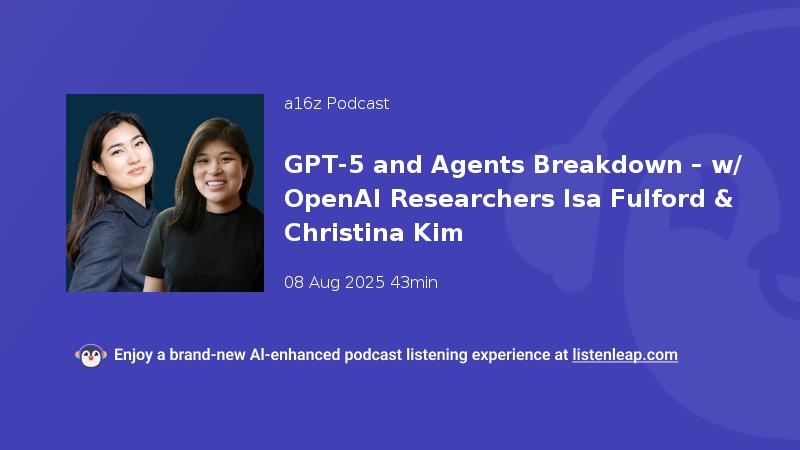
Joining me in the studio fresh off the launch live stream were three people who were instrumental in making this model a reality.
Christina Kim, researcher at OpenAI, who leads the core models team on post-training.
Isa Fulford, researcher at OpenAI, who leads deep research and the chat GPT agent team on post-training and A16Z General Partner, Sarah Wang, who's helped lead our investment in OpenAI since 2021.
We talk about what's new in GPT-5, from major leaps in coding and creative writing to meaningful improvements in reasoning, behavior, and trust.
We also get into training, RL environments, and why data quality is more important than ever.
We also cover agents.
What that word actually means, the paradigm shift for async workflows and the golden age for the idea guys.
Let's get into it.
As a reminder, the content here is for informational purposes only, should not be taken as legal business tax or investment advice or be used to evaluate any investment or security, and is not directed at any investors or potential investors in any A16Z fund.
Please note that A16Z and its affiliates may also maintain investments in the companies discussed in this podcast.
For more details, including a link to our investments, please see a16zcom forward slash disclosures.
So slow news day, not much going on for you guys.
Thank you for uh.
Thank you for coming.
I know obviously, uh.
You know tina, you were just on the on the live stream.
We're recording uh day of congratulations.
Thank you, um.
For those who are unfamiliar, why don't you introduce uh what you guys do at open air?
Yeah uh, i'm christina.
I lead uh the core models team on post training.
I'm isa um, i lead the deep research like chat gpt agent team on post training.
And Tina, you've been here for, or you've both been here for a while now.
Do you know what would be a little bit of your history at the company?
Yeah, I've been at OpenAI for about four years now.
I originally worked on WebGPT, which was the first LLM using tool use, but it was just one question.
So the model learned how to use the browser tool, but you only ask one question, you don't answer back.
And then we kind of just had this realization like oh, normally when you have questions you have more questions after that.
And so we started building this chatbot, and then that eventually became ChatGPT.
And what have been the reactions so far?
It's only been a few hours, but in your live stream, any reflections?
What can you tell us a day of?
I'm honestly really excited.
I think that obviously we have some great eval numbers, and numbers are always really exciting, but I think the thing I'm like really excited about this model is just it's way more useful, like in cross, like all the things that people actually use chat for.
Um, and it's not just like, and it's, I think, the eval numbers look good, but then also like the way when people use it.
I think we'll they'll notice that quite a bit big of a difference when the utility of it.
I mean, this is my personal use cases.
I use it for coding and writing all the time and it's just a huge step change.
Yeah.
Sarah, you've been involved in helping lead our investments since 2021.
Why don't you either share more or tee up how you've been thinking about sort of this as it relates to coding or more broadly?
Yeah well actually, just on the topic of coding, it was a huge deal to have Michael Trull come on there and not only showcase the capabilities but also say this is the best coding model in the market.
And so just curious, to the extent that you can share what did you do differently to get these results?
Yeah, I think huge shout out to the team, especially Michelle Pokrus.
I think to get these things right like eval numbers is one thing, like I said, but to get the actual usability and how great it is at coding, I think it takes a lot of detail and care.
I think the team put a lot of effort into data sets and thinking about the reward models for this.
But I think it's just literally just caring so much about getting coding working well.
And maybe actually just to double-click on front-end web development.
I mean, we've seen as sort of investors in the ecosystem that's obviously taken off in the last six to eight months.
If you could pinpoint the improvement to that piece specifically.
Is it more around aesthetics or is there sort of another capability leap forward in terms of what we can do with front-end web development?
I think there's going to be a lot more we can do with front end.
I think the way we've gone, this big leap.
I mean, if you compare it to O3's front end coding capability, this is just totally next level.
It feels very different.
And I think it kind of just goes back to what I was saying.
The team just really cared about like nailing front end.
And that means like getting the best data, like thinking about the aesthetics of the model and all of these things.
I think it's just all those details that are really coming together and making the model like great at front end.
Really exciting to see.
Loved the demos in the livestream too.
I wanted to ask about model behaviors, because I know you worked on that too.
But how did you guys think about that for GPT-5?
And there are a lot of things that you know we've talked about in prior models of syncophancy and characteristics like that.
How did you guys think about it for this?
What did you guys change or tweak?
Yeah, the design of this model has been very, very intentional for model behavior, especially with the sick and fancy issues that we had like a few months ago with 40.
And we've just spent a lot of time thinking about like, yeah, what is the ideal behavior?
And I think for post-training what's really, or one of the reasons I really like post-training is it feels more like an art than maybe even like other areas of research, because you kind of have to make all these trade-offs right.
Like you have to think about, like for my rewards, like all these different rewards, I could be optimizing during the run.
How does that trade off against it?
I want the assistant to be super helpful and engaging, but maybe that's a bit too engaging and getting too engaging gets to the overly effusive assistant that we have.
I think it's really a balancing act of trying to figure out what are the characteristics and what do we want this model to actually feel like.
And I think we were really excited with GPT-5, because it's kind of a time to like reset and rethink about, especially since it's so easy to make something I think very engaging in the sense that in an unhealthy way, how can we make this like a very healthy helpful, assistant?
Say more about how you received such a kind of reduction in hallucinations, but also deception.
What's the relation between those?
I guess for me, I find hallucinations, deceptions pretty related.
So the model... And we kind of saw this a lot with the reasoning models.
The reasoning model would understand that it didn't have some ability, but then it still really wanted to respond.
I think we really baked it into the models that they want to be helpful.
And so they're like, whatever I can say to be helpful in that moment.
And that's kind of what we consider for deception.
Versus hallucinations, sometimes the model literally... It seems that they...
We'll just say something quickly.
And we kind of see a lot of this reduction with the thinking.
When the models are able to think step by step, they actually can pause before blurting out an answer is kind of what it feels like with a lot of the previous models for hallucinations.
Over the next few weeks, as you're evaluating usage, what are the biggest questions that you're having or that you're sort of anticipating being potentially answered?
I'm just really curious to see how all of these things reflect in usage.
I think coding is way, way better.
What does this actually unlock for people?
And I think we're really excited to be offering these models at the price points that we have, because I think this actually unlocks a lot more use cases that really weren't there before.
Maybe previous competitor models are good at coding, but the price point is not as exciting.
And so I think, with this number of capabilities that we have in this model and the price point, i'm kind of excited to see, like all the new startups and like developers like doing things on top of it.
Yeah, we're excited too.
But, by the way, just on the topic of usage um, you obviously have a lot of products with a ton of usage already, and since we have one of the uh, deep research gurus here too um, how did deep research chat, GPT operator, sort of your existing products inform how you went about approaching GPT-5?
One thing that's interesting is with reinforcement learning training a model to be good at a specific capability is very data efficient.
You don't need that many examples to teach it something new.
And so the way that we think about it on my team is we're trying to push capabilities and things that are useful to people.
So deep research was the first model to do very comprehensive browsing.
But then when O3 came out, it was also good at comprehensive browsing, and that's because we're able to take the datasets that we've created for the frontier agent models and then contribute it back to the frontier reasoning models.
We always want to make sure that the capabilities that we're pushing with agents makes it into their flagship models as well.
Yeah, that's great.
Very self-reinforcing.
You mentioned all the startups that you're excited to see come.
Flush out what you think that could look like, or even just high-level, some opportunities you're more excited about because of this.
I mean, people always say vibe coding.
I think basically non-technical people have such a powerful tool at their hands.
I think really, you just need some good idea and you're not going to be limited by the fact that you don't know how to code something.
You saw two of our demos which were front-end coding or in the beginning, and That's just literally took minutes.
I think that would have honestly taken me like a week to actually build like fully interactive.
And so I think we're just going to have a lot more.
I would expect, like maybe a lot more like indie type of like businesses built around this, because of the fact that like, you just need to have the idea, write a simple prompt and then you get the full fledged app.
It's the world of the ideas guy.
Yeah, it's our time.
Finally yeah um, how about in the in the broader sort of uh agi discourse, like what is this um, what does this mean?
Or accelerate or not, or like how do we think about sort of the broader um ai discourse in terms of what does gbt5 mean here?
Or change the conversation in any sort of way?
I think with gbt5 um, it kind of sets like a new, it's obviously state of the art and like all the things we talked about.
But I think if you're showing that like, you know, we can continue pushing the frontier here.
And I feel like there's always people like, oh, we're hurting a wall.
Like things aren't actually improving.
And I think that Interesting thing is I feel like we've almost saturated a lot of these evals and the real metric of how good our models are getting is, I think, going to be usage.
What are the new use cases that are being unlocked and how many more people are using this in their daily lives to help them across multiple tasks?
I feel like that's actually the ultimate usage that I'm excited about in terms of, are we getting to AGI?
Yeah, actually I think Greg made this comment about how he was comparing the last model to this model and the benchmark went from 98 to 99.
He's like clearly we've saturated the benchmarks, at least on that front, which I think is instruction following.
What benchmarks do you pay attention to?
Like, how do you guys think about evals, right?
What actually gets you to push the frontier?
Is that before the?
I mean so usage would be kind of post the model release.
But before you get there, what are you guys looking to internally to help guide you?
Is it a lot of internal evals that you created?
You know, is it early access to startups, seeing what they think?
Maybe it's a combo of all the above, but how do you weigh all those things?
Yeah, I mean I think on our team we really work backwards from the capabilities we want the models to have.
So maybe we want it to be good at creating slide decks or something or good at editing spreadsheets.
And then if evals for those things don't exist, we try to make evals that are representative measures of that capability in a way that's actually going to be useful for users.
And then we'll, a lot of those are internal, we'll collect them maybe from human experts or, you know, try and synthetically create examples, or we'll actually look at usage data.
And then for us, we'll just try and hill climb on those.
Yeah.
I think we make this joke a lot internally, that like if you want to nerdsipe someone into working on something, you just need to make a good eval and then people are going to be so happy to try to hill climb that.
Yeah.
I like what you said about starting with the capabilities first.
How do you prioritize what you actually are shooting for?
Let's say there's this dimension of maybe deeper into everyday use, versus getting much deeper into the expert use cases.
How do you think about that trade-off?
What does that trade-off mean, practically speaking?
And what do you guys prioritize when?
I mean, I think it's pretty unique at OpenAI to be able to work on something that's so generally useful.
I mean, it's like everything they tell you not to do at a startup is just like your user is anyone.
Like for deep research, we wanted it to be good across, like every single domain someone might want to do research in.
And I think you only have the privilege of doing that if you work at a company that has, like huge distribution and like all different kinds of users.
So Yeah, I mean, I think if you choose a capability that's quite general, like online research, you just have to make sure that you represent a distribution of tasks across loads of different domains if you want to get good at all of them.
But then, yeah, sometimes it's hard to decide to focus on one specific thing because...
There are just so many different verticals you could choose from, but I think in some cases maybe coding will be really important, so then a specific team will focus on coding.
But I think in general, because the capabilities are so general, usually the next model improvement just kind of improves performance on a pretty broad range.
Yeah, I think we've kind of seen this with the progression of even the models that we've had in ChatGPT.
As the model gets smarter, it's better at instruction following.
It's better at tool use.
And just more things get unlocked as we just continue to make smarter models.
So I think a good chunk of our team also does focus on just getting general intelligence up, because I think the wins that we get from there are, like Issa was saying, pretty great.
Whenever we get a new base model, it's just seeing like, oh, wow, suddenly this clicks.
It works and i think we kind of saw that moment with like operator, because we had been working on computer usage, but i think it was hard to finally get the model to actually without like the multimodal capabilities to really support it, like you couldn't have something like operator when it launched.
Yeah, it's the same thing with.
Everyone was talking about agents, but we didn't really have a way of actually training useful agents.
I mean, i think um, Everyone was talking, there were all these agent demos, but nothing that actually really works.
But I think when we saw the reinforcement learning algorithm working really well on math and physics problems and coding problems, it became pretty clear just from reading through the chain of thought okay, this thing's actually thinking and reasoning and backtracking.
And to build something that's able to navigate the real world, it also needs to have that ability.
So we realized, okay, this is the thing that's going to actually let us get to useful agents.
And so I think it's interesting at OpenAI because you have people pushing, like you know, foundational algorithms, getting really good at math, getting a gold medal in the IMO.
And then on post-training, we'll often take like those methods and try and figure out how to make things that are most useful and like usable to all of our users.
How much of the improvements are coming from the architecture versus the data versus the scale?
How do you sort of think about that?
My opinion, I'm very data-pilled.
I think data is very important.
I think deep research was so good because Isa put so much thought and careful attention to the data curation that they did and thinking about all the different use cases she wanted to have represented.
So I'm on team data.
Yeah, I mean, I think all are very important, but especially like especially now that we have such an efficient way of learning data is even high.
Quality data is even more important.
Maybe on the data topic, we've been talking a lot about RL environments.
It's a popular space for startups who all want to work with you guys.
And I was curious just to get your thoughts on this since you're data-pilled.
But what are the bottlenecks that you see for the next stage?
Is that?
I mean maybe tying it to RL environments.
Is there sort of a lack of good, realistic rl environments that that's sort of the next frontier which maybe creates an opportunity for these startups, um that once you, you know sort of are able to really work within a environment that takes a long time to build these are not, you know, sort of built in um in a day or two that you can actually automate labor, um to the full extent of like compute, you know the way that you would need computer use to do.
Yeah, I think, in my opinion, I do think there is a lot of value in getting really good tasks.
And getting really good tasks requires really good RL environments.
I think the more complicated, the more realistic, the more simulated we can make them, I think, the better, And I think we're kind of seeing that tasks matter more at this point, given the fact that we have such a strong algorithm.
So I think creating data and figuring out the best tasks to train on is one of the big questions we have.
Yeah, there's some generalization from training on one website to another.
But if you want to get really, really good at something, the best thing to do is just train on that exact thing.
So yeah, I think we're definitely just constrained by things that we can represent in a way that we can train on.
Like the ChatGPT agent, for example, has such a general tool.
It has a browser and a terminal.
Between those two things, you can basically do most of the tasks that a human does on a computer.
So in theory, you can ask it to do anything that you can do on your computer.
It's obviously not good enough to do that yet, but with the tools it has in theory you can push it really really far.
So now we just have to make it really good at all those things by training on way more things.
Let's talk about creative writing.
Maybe you can talk about the improvements there, how you think about it.
That's one of my favorite improvements in GPT-5.
The writing.
I honestly find it's very tender and touching, especially for a lot of the creative writing that we want to do.
We were thinking through like a bunch of different samples for the livestream and like every time I was like oh, that's like actually like that, like hits.
It's, like, good.
And it's, like, spooky.
And I'm just like, oh, this feels like someone, like, someone should have written this.
But I think it's really cool because you can actually really use it for helping you with things.
My example that I did in the livestream was helping me write the eulogy, something that's kind of hard to write, especially since writing isn't really something a lot of people are good at.
I'm personally a very, very bad writer.
That's not true.
But it makes a better story.
Compared to maybe the other things I'm better at.
But it's so great to have this tool to help me craft whenever.
I use it literally for as simple things as Slack messages to figure out how to phrase this well.
It'll help me give me some iterations on how to say something to the team.
I want to see those prompts.
Yeah.
We're now all just looking for em dashes.
That was a good save.
We're like, where do you stand on the em dash discourse?
I like em dashes.
I do that normally.
Now people think I'm just using it.
I know, I know.
I know, me too.
Going back to the discourse for a second, Sam said in his interview with Jack.
He said if you had said 10 years ago that we would get models at the level of sort of PhD students, I would think wow, the world looks so different.
And yet we've basically taken it for granted.
Do you think basically the improvements are similar?
Like as soon as we get them, we're just going to be like, oh, yeah, now this is the standard.
Or do you think at some point there's gonna be like, oh my God, this is like...
Um, how do you think about sort of people's ability to um sort of uh, acclimate or adjust, or Yeah, I mean it seems like people adjust really quickly, don't you think?
Yeah, like, whatever happens, basically.
I feel like Catch VT got released and everyone was like wow, that's so cool.
But then you just kind of take it for granted that you literally have this like wizard in your pocket.
You can like ask it whatever, whatever random thought you have, and it just pops out like a good essay and you're like, oh okay cool, that's what's happening.
I guess people adapt to things rather quickly, in my opinion with technology, and it is really easy.
And I think because the form factor is so easy.
Even with new tools like deep research and ChatGPG Agent, it's presented in such an easy way that people already know how to interface with.
I think as long as that's true, even with the models getting much smarter than us, I think it's still going to be quite approachable to people.
Do you think the jump from GPT-4 to 5 was bigger or 3 to 4, or maybe 3.5 to 4?
I mean at least one thing for me and my usage of it is sometimes I'm wondering if I have hard enough questions to ask it, to actually highlight the difference.
Because when it gets to a point where it's just answering what you need so well, it's almost harder to tell the difference in some areas.
But with writing.
Yeah, I've been using it for a few weeks and it's just kind of blown me away in a way that models previously haven't.
Maybe i'm biased recency bias but i think the jump to four to five is most impressive for me because i guess with 35 when we first released it, the most common use case for me then also was still just for coding.
And but now like, even though four was better at coding, i feel like the jump between four and five in terms of, like breadth of ability to do things is just way different and way more um And you can just handle a lot more complex things than before, with the context length being much longer as well.
I think the jump to four to five to me is much bigger.
Is there anything the model categorically can't do?
I guess for five, we don't really take action in the real world yet.
We're going to team up with Agent for that.
Yeah, as I said, you could ask the Agent to do anything, but it's not capable enough to do everything you want it to do yet.
We take a conservative approach, especially with asking the user for confirmation before doing any kind of action.
That's irreversible.
So like sending an email or ordering something, booking something.
So I think I can imagine quite a number of tasks where you'd want to take bulk actions which you might not be able to do right now because it would last you every single time.
But I think as people get more comfortable using these things and as they get better and you trust them more, you might allow it to do things for you without checking in with you as much.
Maybe just to build on that question in terms of what it can't do today but what you would sort of direct future research toward.
If you look at coding something like end-to-end DevOps, for example, that feels like the logical next set of capabilities.
Do you guys think we'll get there in, I don't know what you'll name it, but 5.5 or GPT-6?
How far are we from something like that?
Yeah, I don't know about the exact thing of DevOps, but I do feel like with the models getting much smarter.
One other thing that came to my mind when you asked me the question is longer running tasks and things like that.
I think GPT-5 is great because within a couple of minutes maybe you get a full-fledged app.
But then what would it look like if you actually gave it an hour a day a week?
What can actually get done?
And I think there's going to be a lot of interesting stuff.
We're interested to see what will happen there.
Yeah, I think a lot of it is not just about the model capability, but it's actually how you set it up in a way to do things.
I'm sure that you could build something that's monitoring your Humio or Datadog whatever, with these current models.
It's just setting up the harness to make that possible.
And same for...
For agentic tasks.
I think a lot of things that will be quite useful will be when the agent proactively does something for you, which I don't think is impossible today.
It's just not set up that way.
But eventually, as it proactively does things for you, then we might get feedback on whether that was useful and we can make it even better at triggering.
Agent is probably the most overused word of 2025.
That being said, your agent's launch was extremely exciting.
What does that word mean to you in the context of capabilities that you'd like to build in the near term or have already built?
And what is sort of most important that the agent is able to do on behalf of your users?
I guess my very general definition would just be something that does work, useful work for me on my behalf with, I would say, asynchronously.
So like you'd kind of leave it and then come back and either get a result or like a question about what it's doing and then, in terms of, i guess, roadmap for agents, i mean longer term, you want it to be able to do anything that you know a chief of staff or assistant or something like that would do for you.
Um, but i think in the more immediate term we there are a lot of new capabilities that we launched in chat, gbt agent that we just want to to improve.
So one of the main capabilities is um, deep research, so just being really good at synthesizing information from the internet.
But also, I think we can improve capabilities on synthesizing information from all of the services that you use and private data that you have.
And then also being better at creating and editing artifacts like docs or slides and spreadsheets, because I think so much of the work that's useful that people do in their jobs is basically just research and making something.
But then also I personally love all the consumer use cases like making it better at shopping or planning a trip, and those kinds of things are also really fun.
And so that also involves taking an action which is interesting because it's kind of the last step often of a task.
And it's the... maybe a task that would take less time for a human.
And it's actually a very hard research question to get it to do something or book something or use a calendar picker.
But yeah, once you have the end-to-end flow working really well, it can basically do anything.
Yeah, that's incredible.
On the shopping piece.
I now do not make a single large ticket purchase without having ChatGPD put all the options in a table for me along the dimensions I care about.
It's incredible.
But I want to push on the async piece because I don't know if you would agree with this, but it felt like a revelation to me, at least at the beginning of the year, that people were willing to wait.
So you kind of think about, oh, we want it faster.
Like the value prop of this tool is that it gives me the answer fast, right?
That was sort of very 2024.
Clearly, this paradigm has shifted.
People are willing to wait for high-quality, high-value answers and work.
How do you think about the trade-off between how long something takes, how long you take to get something back to the user, versus what you're actually, the value that you're providing?
And like, what do you think is the ideal frontier for something like that?
Yeah, it's interesting because I built the retrieval on ChatGPT and was on the browsing team before this.
Tina was also on the browsing team.
And we were always making these trade-offs and optimizations for latency.
And so we were thinking how can you best fill the context with information you've retrieved so that the answer is pretty good in a few seconds?
And so I think with deep research, I was just very excited to remove latency as a constraint.
And since we were going for these tasks that are really hard for humans to do and would take humans many hours to do, I think we felt like if you asked an analyst to do this and it would take them 10 hours or two days, it seems reasonable that someone would be willing to wait like five minutes in your product.
So I think that was the, we just kind of made that bet.
And luckily it seems like it's the case.
But I do also think that, you know, initially people were like, oh, this is amazing.
It's doing all this work.
That would have taken me so long.
And now people are like, okay, but I want it, now I want it in 30 seconds.
Right.
To the point of the bar changing.
Because, yeah, I was going to say, is there any sort of rule of thumb?
I'm sure it's constantly shifting where, as long as you're 10 times faster than it would take the human to do, they're willing to wait for it.
Or is that just constantly shifting sand?
I think with these launches, people's expectations keep getting changing.
Yeah, I do think we have a specific number.
One thing that's interesting is, I think sometimes people just bias to thinking that the longer answer is more thorough or has done more work for it, which I don't necessarily um think is the case.
Like deep research, for example, always gives you a really long report um, but sometimes for me, i don't want to read this whole long report.
I actually don't don't like that, since so agent like it will only give you a long report if you ask for it.
But i think sometimes people, since now that you're still always getting a really long report, they're like wait, i've been waiting, like where's my long report?
But sometimes it's like really hard to find a specific piece of information and would have also taken a human a long time because it's in like page 10 of the results is where it finds this information.
So I think it's interesting also how you can condition people's expectations with a product so that when you change, or like with deep research, it always thinks for a really long time, which again I don't necessarily think is a feature.
But I think now people are, like really used to the amount of time that they wait.
Definitely.
I think we hear this with GPT-5 internally when people are testing and they're like oh, I thought I asked like a really hard question.
I feel like a little bit insulted that it's not for like two seconds.
Or like when it doesn't even want to think at all.
It's like the Mark Twain line.
I didn't have time to write you a short letter, so I wrote you a long one.
Yeah, yeah.
Why don't you talk about the bottom, like why don't we have reliable agency IOs?
What are the main bottlenecks as you see them?
Yeah, I think a big part of it is the things that we train on we're often really good at.
And then sometimes with the things outside of that, it can be a bit.
Sometimes it's good at those things, sometimes it's not good at those things.
So I think, yeah, creating more data across a broader range of things that we want it to be good at.
I think also what's interesting with agents is we have this...
When something is doing something on your behalf and it has access to your private data and the things that you use, it's kind of more scary the different things it could do to achieve its final goal.
In theory, if you asked it to buy you something and make sure that I like it, it could go and buy five things just to make sure that you liked one of them, which you might not necessarily want.
So I think that there's definitely having oversight during training is also an interesting area.
I think there's just new things that we have to develop to, you know, push these agents even further.
So, yeah, I think that's part of it.
And then also, like every time we have a smarter like base model or something like this, it improves every model that's built on top of that.
So I think that will also help, especially with like multimodal capabilities, as Tina said, with like computer use.
Because it's like just literally looking at screenshots of a web page and it's like it's a little interesting because the way that humans like focus on specific things, it's like it's a lot to expect a model to just like take a whole image and be able to like know everything about the image.
When, like when we're looking at something, we'll like focus on a specific thing.
Yeah, i think that there's lots of room for improvement and lots of in lots of areas.
Sorry, that was kind of a general answer.
No no well, actually i was gonna.
Maybe that last example um, gets into something that we were curious about, which is and this ties back to training data as well.
But what sort of?
I guess what specific categories of browsing tasks are challenging for agents today?
And like I don't know if you have thoughts on how you'd overcome this for sort of the next iteration of the model.
And so I think, when we've done these free training, there's not much data out there to begin with with people using computers.
Like computer usage is not really a thing that like there's lots of like data out there.
And this is something we actually have to like seek out now that this is a capability that we want.
So I think that's actually probably a big one just for general improvements of, like computer usage.
Do you think you'll lean more heavily on human data vendors to help collect that?
Or given it doesn't exist, to your point, like recorded in the way that maybe it's most helpful for training, like how do we?
But it is probably the most useful application of the models to you know, at least knowledge work um like, how do you overcome that?
I mean, i think one cool thing is for, for example, for initial deep research there's not really any data sets that exist for browsing, in the same way that you have a math data set that already exists.
So we have to create all this data.
But once you have good browsing models or good computer use models, you can like bootstrap them to help you make synthetic data.
So I think that's a pretty promising area.
Christina, can you explain what mid-training is and how it sort?
Of what does it achieve that pre or post doesn't?
So I think with your pre-training runs, these are the big runs.
These are the massive ones, like what we're building all these giant clusters for.
So you can kind of think of mid-training as literally for middle.
We do it before, after pre-training, but before post-training.
You kind of think of a way to extend the model's intelligence without having to do a whole new pre-training run.
So this is mostly just focused on data and off of the pre-training models.
So this is a way for us to do things like updating the knowledge cutoff of these models, right?
So when you pre-train it you're kind of like okay, shoot now.
We're kind of stuck in this date and we can never update it again.
And it doesn't quite make sense to put all that data into post-training.
And so mid-training is just a smaller pre-training run to help expand the model's intelligence and up-to-dateness.
Christian, did you work on WebGPT?
Yes, I did.
Okay, so you're basically like an AI historian.
Yes, yes.
She also works on computer use.
I'm an elder.
So can you like reflect back a little bit to you know, four years ago, five years ago, and sort of reflect on, like what are the biggest thing?
Like, if you were to predict the five years out, like what are the inflection points or biggest things, that would have surprised you.
Honestly with WebGBT, the main thing we were just excited about was trying to ground these language models.
We had so many issues with hallucinations and the model just saying random things.
And the fact of we didn't really do any training then.
So the fact of how do we make sure the model is actually up to date, most factually up to date?
So then that's kind of how we thought about, oh, let's give it a browsing tool.
I think that makes sense.
And then yeah, like I said, that kind of went on from like oh, I actually want to keep asking questions.
So what a chatbot would look like.
But at this point, I think there had been a few chatbots by a few other companies.
And I feel like a chatbot is also like a very common AI thing to think of.
Um, but they're quite unpopular at the time.
So we weren't really even sure that like this is actually something useful for people to work on or like people to use, or will people be excited about this?
Is this really like a research innovation that we like are remaking the Turing test here?
Like, um...
But I think it kind of clicked into me that like maybe there was actually something interesting happening here.
We gave early access to about 50 people.
Most of those people being like people I lived with at the time.
And there are two of my roommates just used it all the time.
They just like would never stop using it.
And they would just have these long conversations and they...
I would ask for, like, quite technical things because they're also AI researchers.
And so I was just like, oh, this is, like, kind of interesting.
Like, I don't know.
And at the time, we're kind of thinking, like, okay, we kind of have this chatbot.
Should we make this, like, a really specific, like, meeting bot type of thing?
Do we, like, make it a coding helper?
But it was interesting to see my two roommates just use it like for anything and everything and just like literally be chatting with it like the whole workday, as they were using it.
So I was like, oh, this is kind of interesting.
But then it was also interesting to see, like the majority of the people that I gave access to on that 50 person list, like didn't really use it that much, but I was like oh, it's like there's clearly like something here, but it's like not quite maybe for everyone yet.
Um, but there's something.
When did you realize, like, I'm working at one of the most important companies of this generation?
Like, like when, when was the moment where you were like Hey, this is something that I obviously believe is important.
That's why I joined, but that you realized like the scale and significance.
Honestly, I kind of had this moment before I joined OpenAI.
I think with the scaling laws paper, with GPT-3, it just kind of hit me that if this exponential is true, there's not really much else I want to spend my life working on.
And I want to be part of this story.
I think there's...
There's going to be so many interesting things unlocked with this.
And I think this is this is probably the next like step level in terms of like technology that it kind of made me realize like oh, I should probably go start reading about deep learning and figure out how I can get into one of these labs.
Isa, what was your moment?
I think for me it was also before I started working at OpenAI using.
I think I first learned about OpenAI in an AI class or something or some kind of computer science class.
And they were saying like, oh, they trained on the whole internet.
It's like, oh, that's so crazy.
Like, what is this company?
And then started using GPT-3.
I think I was a power user of the OpenAI playground and at a certain point like had early access to these like different OpenAI features, like embeddings and things like that.
I just became this like big OpenAI fan, which is like a little embarrassing, but you know it's fine because it got me here.
And eventually they're like okay, like you're stalking us, do you want to interview here?
But yeah, I think it was like pretty clear to me but just how much I was using GPT-3, which wasn't even compared to what we have now like just pills in comparison.
But I was like, from then I was hooked and just trying to figure out a way to, to to work here.
Maybe a question more on the company building front.
We all sort of read and reread Calvin French Owen's piece, just his reflections on working at OpenAI.
Curious and you don't have to comment on that piece unless you want to, but would love your reflections on the change that you've seen over the last four years, or even less than then, given I think that was only covering one year of change.
But what are the biggest things that you've seen change at OpenAI?
I mean, when I first joined OpenAI, the applied team was 10 engineers or something.
It's just like we didn't really have this product arm.
We had just launched the API.
It was just a completely different world.
And I think AI is in most people's mind now after ChatGPT.
But I think pre-ChatGPT, people didn't really know what AI was or really thought about it as much.
It's kind of cool working in a place that my parents know what I do now.
And it's like, that's really cool.
And I think the company obviously is just a lot bigger.
But I think with that we can just take a lot more bets.
I think when I first joined OpenAI, there were obviously way less people.
It was much, much smaller.
It was around 200-ish people, and I think we're close to A few thousand, for sure.
Yeah, when I joined, it was also a few hundred before ChatGPT.
So it's obviously yeah, very different in how you know, all of your friends have heard of you, know what you work on.
But I think culturally, obviously the company is much bigger.
I still think we've maintained um this.
It still feels very much like a startup.
I think some people who come from a startup are surprised like oh, i'm working even harder than when i was working the startup that i founded.
I think ideas can still come from anywhere and if you just like take initiative and want to make something happen, you can, and this doesn't really matter, like how senior you are or anything like that.
I think we've been able to maintain that culture, which i think is pretty special.
Yeah, we definitely reward agency.
And I think that's, like, always been true.
And I think, especially on the research side, the teams are quite small.
Like, when Isa was working on deep research, it was, like, two people still.
So, like, I think we still do that on the research side.
Like, most research teams are quite small and nimble for that reason.
And earlier you said know, we do something at openai which startups never do, which is, you know, try to appeal to every single person with the product.
What um?
Are there other things that come to mind that openai just does differently than than your peers or other startups, or things that we may not appreciate being on the mean, i think it's different for um, different teams, but um my, the my team collaborates so closely with the applied, like the engineering team and the product team and design team um, in a way that i think sometimes like research can be quite separate from like the rest of the company, but for us it's like so integrated, we all sit together.
Um, you know, sometimes like the researchers will help with, like implementing something.
I'm not sure that engineers are always happy about it, but we'll try.
They'll get out of the front-end code.
And vice versa.
They'll help us with things that we're doing for model training rounds and things like that.
So I think some of the product teams are quite integrated.
I think for post-training it's a pretty common pattern which I think just lets you move really quickly.
I guess one thing that I think is unique about OpenAI is that you're both very much a consumer company by revenue et cetera products but also an enterprise company.
How does that internally, like what would you guys consider yourself?
Or is that even just the wrong paradigm to think about?
Yeah, I mean, I guess, if you tie it to the mission, it's like we're trying to make the most capable thing and we're also trying to make it useful to as many people as possible and accessible to as many people as possible.
So in that framing, I think it makes a lot of sense.
The concept of taste has become also very widely used.
What does good taste mean within open AI?
How do you know it when you see it?
And is that something that, even in a world where everything, the cost to produce everything, just keeps going down and down, is that the one thing that's not commoditizable?
Or is that also shifting, given?
Maybe that can go into the training data?
No, i think taste is quite important, especially now that, like it is like, like i said, like our models are getting smarter, it's easier to use them as tools, um.
So i think having the right direction matters a lot now um, and like having the right intuitions and like with the right questions you want to ask.
So i would say maybe it matters more now than before.
I think also, i've been surprised by how often the thing that is the most simple, easy to explain, is the thing that works the best.
And so sometimes it seems very obvious, but it's quite hard to get the details of something right.
But I think usually good research and taste is just pretty simplifying the problem to the dumbest thing or the most simple thing you can do.
Yeah, I feel like with every like research release we do, and when people figure out what happened there, they're like oh, that's so simple.
Like, oh, I should like that.
Obviously, obviously that would have worked.
But I think it's like knowing to try that like obvious or like at the time not obvious thing that is obvious in hindsight.
Yeah.
And then all of the details around the hyperparameter and all these things like the infra.
That's obviously like very hard, but the actual concept itself is usually pretty straightforward.
Hmm.
Very cool.
Taste is Occam's razor.
Yeah.
So sort of in closing here, obviously a historic day.
You want to contextualize sort of what this means in context of the mission and where you've been, to get to now, to where you're going.
Yeah, I think with GPT-5, the word that's been in my mind throughout all of this is usable.
And I think the thing that we're excited about is getting this out to everyone.
We're excited to get our best reasoning models out to free users now.
And I think just getting our smartest model yet to everyone.
And I'm just excited to see what people are going to actually use it for.
That's a great place to wrap.
Tina, Isa, thanks so much for coming on the podcast.
Yeah, thank you.
Thank you for having us.
Thanks for listening to the A16Z podcast.
If you enjoyed the episode, let us know by leaving a review at ratethispodcast.com slash A16Z.
We've got more great conversations coming your way.
See you next time.