The DSW Black Friday sale is on.
Take 30 % off almost everything in stories and online right now.
Yep, you heard that right.
30 % off. Stock up on new shoes, bags, and extras for you and yours from all the gift -worthy brands you love.
But hurry! Black Friday can't last forever.
Get to your DSW store or dsw .com ASAP to say big.
Exclusions apply. Details at dsw .com.
So good. So good. So good.
Just in and so good.
Thousands of winter deals are at Nordstrom Rack stores now.
And that means thousands of fresh reasons to rack.
Because we get the latest trends for way less.
Because I've been looking for these.
Because the best deals go fast.
Save big with up to 60 % off.
Sam Edelman, Sorelle, Free People, Cole Hahn, and more cold weather finds.
Great brands, great prices.
That's why you rack.
Enjoying your podcast?
We'll be brief. If you're looking for the perfect holiday gift, gift scratchers from the California Lottery.
With so many to choose from, you're sure to find the right gift for anyone on your list.
Now that your holiday shopping list is figured out, enjoy this bird singing jingle bells.
Give the gift of scratchers from the California Lottery.
A little play can make your day.
Please play responsibly.
Must be 18 years or older to purchase, play, or claim.
Firstly, let me ask you something, Leo.
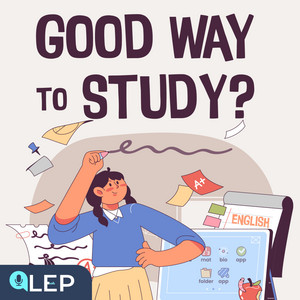
Have you found a good way to study?
That's such an important question, Gwen.
You know, when I first started learning another language, I tried so many methods.
Some worked well, while others didn't work at all.
It took me time to find out what worked best for me.
That's exactly what we're going to help our listeners with today.
If you've ever felt stressed while studying, or you want to find a better way to learn, then stay tuned.
Great. Today's episode is all about finding effective ways to study.
We'll explore different learning techniques, how to stay motivated, and how to make your study routine more interesting.
Are you ready to come with us?
Let's get started. The first step to finding a good way to study is to understand how you learn best.
You might not realize this, but everyone has their own way of learning that works best for them.
That's right. For example, some people learn better by listening.
This is called auditory learning.
They might try listening to podcasts like this one, or saying words aloud.
On the other hand, some people are visual learners.
These learners like to use pictures or videos to understand new things.
Imagine you're learning the word tree.
A visual learner might look at a picture of a tree.
Hmm, what other types are there, Leo?
There are also kinesthetic learners.
These learners like to move, touch, and practice things in real life.
For them, learning by doing works best.
So, if you're a kinesthetic learner, you might learn the word apple better by picking up an apple, holding it, and saying the word aloud.
Finding your learning style can really help.
If you're not sure what type of learner you are, ask yourself, do you remember things better by hearing, seeing, or doing them?
Your answer will show you your learning style.
Research shows that when your study methods match your learning style, you're more likely to remember things.
So, take some time to find what works best for you.
Once you know your learning style, try study methods that match it.
For example, if you're a visual learner, making colorful mind maps can really help.
These maps help you connect ideas with pictures, making learning simpler.
Exactly. I find it hard to concentrate on just reading.
So, when I studied grammar, I drew mind maps, and it worked for me.
Another helpful technique is taking notes.
Writing down what you learn, especially by hand, can help you remember it more easily.
For auditory learners, recording yourself saying new vocabulary or grammar rules is a great idea.
Later, you can listen to the recordings while walking, cooking, or relaxing.
That's a great tip.
For kinesthetic learners, using flashcards is a simple and effective method.
Write the English word on one side of the card, and then a translation or a picture on the other side, shuffle the cards in your hands, and test yourself.
It's a practical way to learn new words.
Flashcards can feel boring at first, though.
How about studying in group?
Group activities work well for all learning styles.
For example, you can roleplay everyday situations, like ordering food at a restaurant or asking for directions.
Pretend you're in the real situation and practice your answers.
It makes learning fun and feels less like studying.
That sounds great! These techniques help make your learning process more fun and interesting.
The key is to try different ways until you find what works best for you.
Alright, after finding the right study method and study partner, what do we do next?
It's important to stay active while learning.
Active learning is not just passively reading or listening.
For example, if you learn a new grammar rule, don't stop at just understanding it.
Use it to write your own sentences, or try explaining the rule to a friend.
That's a great idea.
Teaching others is a great way to learn better.
Studies show that explaining something helps you remember it.
Even if you just pretend to teach, it can really help.
Another idea is to practice speaking out loud.
Let's say you've learned a new word like gratitude.
Instead of just memorizing its meaning, say something like, I feel gratitude when my friend helps me with my homework.
Yeah, using what you learn helps you gain confidence and improve quickly.
Now let's learn some vocabulary below so you can understand the topic better before continuing to listen.
Definition Changing words from one language to another.
Several books are already in translation into other languages.
Memorize Definition To remember something by practicing it many times.
Example I memorize new words by repeating them every day.
Confidence Definition Feeling sure about yourself.
Example Speaking English every day helps me build confidence.
Technique Definition A special way of doing something to get better results.
Example Using mind maps and flashcards are my favorite study technique.
Why get all your holiday decorations delivered through Instacart?
Because maybe you only bought 2 wreaths but you have 12 windows.
Or maybe your toddler got very eager with the advent calendar.
Or maybe the inflatable snowman didn't make it through the snowstorm.
Or maybe the twinkle lights aren't twinkling.
Whatever the reason, this season, Instacart's here for hosts and their whole holiday haul.
Get decorations from the Home Depot, CVS and more through Instacart and enjoy free delivery on your first 3 orders.
Service fees and terms apply.
My dad works in B2B marketing.
He came by my school for career day and said he was a big ROAS man.
Then he told everyone how much he loved calculating his return on ad spend.
My friends still laugh at me to this day.
Not everyone gets B2B.
But with LinkedIn, you'll be able to reach people who do.
Get $100 credit on your next ad campaign.
Go to linkedin .com slash results to claim your credit.
That's linkedin .com slash results.
Terms and conditions apply.
LinkedIn, the place to be, to be.
Shuffle. Definition.
To mix things like cards in a random order.
Example. I shuffled the flashcards before using them.
Next, practice with some questions below to see how well you understand the topic.
Don't forget to type your answer in the comments section to discuss with others.
Why is teaching others a good way to learn?
Teaching others helps you remember things better because you're actively using what you've learned.
What role do group activities play in learning?
Group activities like role -playing, make learning interactive and fun, helping learners practice real -life situations.
Let's move on to the next part.
We will learn more tips to find a good way to study.
Now, let's talk about something many people forget.
Taking breaks. Studying for hours without a break can make you feel tired and stressed.
I completely agree.
During short breaks, try doing something relaxing.
You can stretch, drink water or listen to music.
The goal is to take a break and come back to studying with more energy.
I recently read a study from the University of Illinois.
It says short breaks help you stay focused and work better for longer.
Our brains lose focus if we work too long on one thing.
Breaks help us refresh and stay sharp.
The above tips are all very useful.
However, I think just studying will be boring, Gwen.
Is there a way to have a good learning method and still maintain the interest?
Technology makes learning easier and more fun.
For example, apps like Duolingo and Quizlet are great for practicing vocabulary and grammar.
Both apps are easy to use and let you learn at your own speed, whether you have a few minutes or a whole hour.
Wow! I also remember another app that helps us remember vocabulary faster.
It's because I also learned it before.
You guys can try Anki.
It's an app that helps you review words at the right time to improve your memory.
Good recommendation, Leo.
You guys can also watch English videos on platforms like YouTube.
Channels that focus on English learning often include subtitles, which makes it easier to follow along.
And there's more. Another great way to practice speaking is through language exchange apps like Tandem or HelloTalk.
You can connect with native English speakers and have real conversations.
You know what, Leo?
One mistake many learners make is not reviewing what they've learned.
I agree. To truly remember something, you need to review it regularly.
For example, if you learn a new word today, review it tomorrow, then again in three days, and then a week later.
This method helps move information from short -term memory to long -term memory.
A simple way to do this is by keeping a small notebook with you.
Write down new words or phrases and review them whenever you have a few spare minutes.
Yes, reviewing for just ten minutes a day can really help you learn more.
Finally, let's discuss about motivation.
What do you think about it, Leo?
Hmm, I think learning a language is a journey, and it's normal to lose your motivation and feel stuck sometimes.
To stay motivated, try setting small, achievable goals.
That's right. For example, try learning five new words a day or completing one lesson in your English app.
Besides, remember to reward yourself.
When you reach a goal, enjoy something you like, like watching your favorite show or having a yummy snack.
It also helps to remind yourself why you're learning English, maybe you want to travel, get a better job, or make new friends.
Keep that goal in mind, and it will keep you going.
Remember, every step you take, no matter how small, brings you closer to your goal.
We will learn the last five words for today.
Make sure to learn by heart and practice speaking all of them.
Break. A short pause from work or activity.
Example. Take a five -minute break after studying for 25 minutes.
Energy. The strength to do physical or mental activities.
Example. Drinking water helps boost your energy.
Motivation. Definition.
The reason or drive to do something.
Example. My motivation for learning English is to get a better job.
To successfully reach a goal.
Example. I achieved my goal of learning five new words today.
Journey. Definition.
A long process or experience.
Example. Learning a language is a journey, not a race.
Please continue to discuss the questions below.
I'm sure other listeners would love to read your answers, too.
Just share your thoughts with us.
How can subtitles in videos help English learners?
Subtitles make it easier to follow and understand.
How can you move information from short -term memory to long -term memory?
Review often, like after one day, three days, and one week.
That's the end of today's episode, everyone.
We hope you can use these tips to study better.
Let's keep improving together every day.
Don't forget to subscribe to our channel.
Also, leave a comment with your questions or ideas for future episodes.
See you next time. Goodbye.
You'll find the best gifts for everyone you love, including tons of ideas under $100 and gift experts to help.
Wondering what to wear?
They have everything from cozy styles to party -perfect looks, along with freestyle help from their stylist.
Plus, they'll make your shopping easy with services like in -store order pickup, gift wrap options, free shipping and returns.
Discover the wonder of the holidays today in stores and at Nordstrom .com.
Nordstrom deals with thousands of new markdowns are on now.
Get amazing deals on styles from Ugg, Free People, Tory Burch and more.
Up to 60 % off. If there's one thing that my family and friends know me for, it's being an amazing gift giver.
I owe it all to Celebrations Passport from 1 -800 -Flowers .com, my one -stop shopping site that has amazing gifts for every occasion.
With Celebrations Passport, I get free shipping on thousands of amazing gifts.
And the more gifts I give, the more perks and rewards I earn.
To learn more and take your gift giving to the next level, visit 1 -800 -Flowers .com slash ACAST.
That's 1 -800 -Flowers .com slash ACAST.
Give the gift of scratches from the California Lottery.
A little play can make your day.
Please play responsibly.
Must be 18 years or older to purchase, play or claim.