This message is from NPR sponsor, Total Wine and More.
This summer season, with so many bottles to choose from, it's easy to find your favorite and more.
Find what you love, and love what you find, only at Total Wine and More.
Drink responsibly. Be 21.
You're listening to Short Wave from NPR.
Hey Short Wavers. Rachael Carlson here.
And Emily Kuang. With our bi -weekly Science News Roundup, featuring the hosts of All Things Considered.
and today we have Elsa Chang.
Hello, hello. Boo. Welcome.
Thank you for having me.
Okay, tell me what I am learning about today.
So first, how fiddler crabs drum their mating songs into the sand.
It'll be so romantic.
And then we have a dinner for you chicken nuggets but grown in the lab.
Ew? Yum. Ew? Yum. Okay.
And a drug like LSD without the trick.
What's the point? You'll see.
It's like a very elaborate date provided by science.
All that on this episode of Shortwave, the science podcast from NPR.
This message comes from Charles Schwab.
When it comes to managing your wealth, Schwab gives you more choices like full service wealth management and advice when you need it.
You can also invest on your own and trade on Think or Swim.
Visit Schwab .com to learn more.
This message comes from Mint Mobile.
If you're tired of spending hundreds on big wireless bills, bogus fees, and free perks, Mint Mobile might be right for you with plans starting from $15 a month.
Shop plans today at mintmobile .com slash switch. Upfront payment of $45 for 3 month 5GB plan required.
New customer offer for first 3 months only.
Then full price plan options available.
Taxes and fees extra.
See Mint Mobile for details.
This message comes from Schwab.
At Schwab, how you invest is your choice, not theirs.
That's why when it comes to managing your wealth Schwab gives you more choices You can invest and trade on your own plus get advice and more comprehensive wealth solutions to help meet your unique needs with award -winning service low costs and Transparent advice you can manage your wealth your way at Schwab visit Schwab calm to learn more All right guys to start us off Tell me all about these fiddler crabs that apparently do not fiddle they drum What?
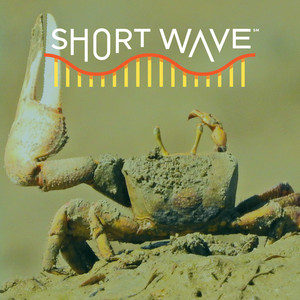
I'll explain. So, if you haven't seen a European fiddler crab before, it looks like a classic cartoon crab.
It's about the size of your palm, but its most distinctive feature is that the males have one big claw and one little itty -bitty claw.
And they use these claws as part of their courtship dance when they're looking to attract a mate.
And they do a very adorable kind of waving behavior.
So the male will sit for hours on the sand waving his claw up and down.
But we know from previous work on fiddler crabs that they can court even in the dark.
So we know that the visual component wasn't everything with that courtship, that there was a component moving through the ground and component moving through the ground.
I imagine she's talking about drumming here.
Drum roll. Yes, correct.
This is Beth Horneber, she's an associate professor of biology at the University of Oxford. And Beth was part of a team that put down geophones, so little sensors, to observe and record the vibrations these fiddler crabs were creating in the sand.
It's super dune -like sandworm -esque to me.
The team published their research last week in the Journal of Experimental Biology, and they saw that this dance had four different stages.
Wait, wait, okay, I just have to say, I'm taking bachata dance classes right now, and I am so intrigued by how few men have rhythm.
So I'm very curious how this drumming works.
Among male crabs. All right, what are the four stages of this courtship dance?
What do they sound like?
Okay, stage one, they wave their claws in the air adorably, then the male crab alternates waving and body -dropping, then they're waving and dropping at low, yeah, simultaneously, which creates this kind of thump.
And then if all of that is successful and the female crab approaches, that's when the male does this underground drumming.
That's amazing. I mean, a guy who can dance and has rhythm definitely is sexy.
So I would be drawn to this drumming crab.
I think I would too, honestly.
And in each of these courtship steps, the crabs were increasing their seismic vibrations.
So they're escalating the amount of seismic information that they're generating as they go through their courtship routine.
Beth said, though, they still don't know how females respond to that seismic information, like whether they're - Yeah.
Elsa Chang, Fiddler Crabble let them know whether they're interested in the rhythm or the loudness of the drumming.
Like what is sexy to them?
We don't really know.
But now that researchers have all of these recordings, they at least understand the steps of the routine and these invisible vibrations a lot better.
Okay. Hard transition.
We're going from seismic vibrations during crab courtship to growing chicken nuggets in the laboratory.
Why are people trying to grow chicken nuggets at all?
Lots of reasons actually.
For one, there's 8 .2 billion people on the planet more than ever and people need to eat.
So, there's been this massive effort in countries around the world to figure out if they can grow meat tissue in the lab.
So that we can reduce the pains we've generated in many of the animals, and also we can optimize the environmental impact by growing those meat in a very controlled condition.
Yeah, so it's good for the planet to figure this out, perhaps.
This is Minghao Ni at the University of Tokyo, he and a team of researchers there have successfully grown in the lab a whole cut of chicken meat, over 10 grams in weight and one centimeter thick about the size of a chicken nugget.
But the question is, is it juicy chicken meat?
Alright, well first how do they even manage to do this?
Yeah, it's so cool.
So meat is just muscle.
Like that's what you're eating when you eat chicken.
Chicken muscle. Yeah.
I'd love me some chicken muscle.
Yeah, yeah. And chicken muscle is made up of this rudimentary cell called a myoblast. So what Ming Hao and the team wanted to do is figure out how to get the myoblast to naturally fuse together and form chicken myotubes, which give the meat its aroma and chewiness.
So cool! How did they even figure this out?
Ming Hao and his team used this special machine called a holofiber bioreactor.
It delivered nutrients and oxygen to the myoblast, mimicking blood vessels in the animal body.
And after a few days, the myoblast started to grow and form this cultured meat.
The team published their results in the Cell Press Journal Trends in Biotechnology this week.
I mean, I feel like I've heard stuff like this elsewhere, I assume there are other researchers trying to grow meat in labs.
What makes these particular chicken nuggets so special?
True, there are, but a lot of lab -grown meat on the market is artificially assembled, so the myoblasts are fused together and this work demonstrates a way for labs to grow meat into one large tissue, thicker than a centimeter.
So, it does bring us closer to a world where a whole lab -grown chicken breast could be scientifically possible.
Okay, so from crab courtship to chicken muscle to drugs without the trips, such as LSD.
I mean, why, Rachel, would I ever want to take a drug like LSD but not have the psychedelic effect?
Like, what's the whole point?
I know, it sounds like an oxymoron, but you've probably heard researchers are studying psychedelic therapy for patients with depression, PTSD, lots of other things.
But people with conditions like schizophrenia are usually advised not to take psychedelics so even if it turns out that these drugs do help treat certain mental health conditions, a lot of patients would be left behind.
Yeah so given this, researchers looked at a molecule that has a similar structure to LSD and just removed the TRp, which in theory would make this kind of treatment accessible to more people, and their study was published this week in the Proceedings of the National Academy of Sciences.
Wait so I don't get it, these researchers they just like chop off the TRpy part of the LSD molecule?
kind of. One of the researchers told me that I should think of each molecule like a car.
Okay. This is David Olson.
He's the director of the Institute for Psychedelics and Neurotherapeutics at the University of California, Davis.
You could chop off the top of the car and create a convertible.
You could add a spoiler.
But you're fundamentally creating a new car.
You are changing the shape of the car.
But what we did here is we took LSD and we essentially did a molecular tire rotation.
We just moved two atoms. We swapped them.
And David says they named this new molecule JRT after the grad student who first synthesized it Jeremy R Tuck.
Aww good for Jeremy.
Okay but what are the chances people would actually start taking these drugs anytime soon?
Yeah, so the study published this week tested JRT on mice, not people.
And another researcher I spoke to who wasn't involved in the study, Anahita Basir -Nia says, while it's a promising step in the field, we still don't know how it would translate to humans, and whether it would actually be non hallucinogenic.
So there's a lot more we need to learn.
And if you want to hear more about new research in psychedelics, Rachel Carlson over here just reported this amazing three -part miniseries for shortwave, go check it out.
We love a Rachel reported series, don't we?
Thanks, Elsa, it's so fun having you here.
Yeah, good luck with those bachata lessons.
Yes, the crabs are cheering you on.
Oh, I love it. Maybe they'll dance with me and have more rhythm than the guys in my class.
Let's hope so. We can only hope.
You can hear more of Elsa on Consider This, NPR's afternoon podcast about what the news means for you.
This episode was produced by Hana Chin and Katherine Fink.
It was edited by Patrick Jaran -Watananan.
Tyler Jones check the facts.
I'm Emily Kwong. And I'm Rachel Carlson.
And thanks for listening to shortwave the science podcast from NPR.
Support for NPR and the following message come from Edward Jones.
What does it mean to live a rich life?
Maybe it's full of brave first leaps, tearful goodbyes, and everything in between.
And with over a hundred years of experience, your Edward Jones financial advisor can help.
Edward Jones, Member SIPC.
This message comes from Mint Mobile.
If you're tired of spending hundreds on big wireless bills, bogus fees and free perks, Mint Mobile might be right for you with plans starting from 15 bucks a month.
Shop plans today at mintmobile .com slash switch. Upfront payment of $45 for three month, five gigabyte plan required.
New customer offer for first three months only.
Then full price plan options available, taxes and fees extra.
See Mint Mobile for details.
Support for this NPR podcast comes from Zscaler.
Reduce infrastructure costs by 90 % and improve networking and security agility by eliminating firewalls and VPNs with Zscaler Zero Trust plus AI.
Learn more at zscaler .com slash security.