NPR.
This is The Indicator from Planet Money.
I'm Waylon Wong.
And today I'm joined by co-host of the business and investing podcast.
This time is different.
Ricky Mulvey.
Hey, Ricky.
Hey, Waylon.
Good to see you.
It's you too.
And you're here because we know that numbers and data move economic decisions, but so do stories.
Economic narratives, contagious stories that spread, and they can be singular.
Take this one from President Trump.
Tariffs give our country protection against those that would do us economic harm.
Or they can come in multiples and narrative constellations.
AI comes to mind, from Sam Altman saying AI will create new kinds of jobs.
To NVIDIA's Jensen Huang saying it's the beginning of a new industrial revolution.
To Elon Musk.
We will have the first time something that is smarter than the smartest human.
Today on the show we're diving into narrative economics how the stories you tell and hear affect your economic reality.
We'll look at how these stories gain power, the narratives that sparked a tech revolution.
And I promise it's not all AI.
We'll talk about how economic narratives lean more into power than truth and explain why they really matter in the world of investing.
Plus, we've got a Nobel Prize winning economist to help us out.
That's after the break.
This message comes from ServiceNow.
People should do the creative work they actually want to do, not boring busy work.
Now, with AI agents built into the ServiceNow platform, you can automate millions of repetitive tasks in every corner of your business IT, HR and more.
So your people can focus on the work that they want to do.
That's putting AI agents to work for people.
It's your turn.
Get started at servicenow.com slash AI dash agents.
This message comes from NPR sponsor Adobe.
Introducing the all new Adobe Acrobat Studio, now with AI powered PDF spaces.
Need to turn 100 pages of market research into five insights with a click?
Templates for a sales proposal that'll close that deal, or an AI specialist to tailor the tone of your market report.
You can do all that with the all-new Adobe Acrobat Studio.
Learn more at adobe.com slash do that with Acrobat.
Traditionally, economists only looked at data with hard numbers.
But then Robert Shiller came along and said, wait a minute.
People don't make decisions only with data.
Stories really matter.
In fact, these narratives are important economic data.
Robert Shiller is the Nobel Prize-winning economist famous for the Shiller ratio, which measures how expensive the stock market is.
But his idea on economic narratives caught on with other economists, including other Nobel laureates.
Daron Acemoglu, and I am an institute professor at MIT.
Daron won the Nobel Prize in 2024 for his work on institutions and how they affect a country's prosperity.
And one reason why Daron is interested in narrative economics is that it can help explain why some ideas catch on, changing culture and institutions, and why technology tech leaders are so influential.
In reality, of course, ideas matter.
Ideology matters.
How you present arguments matter.
They matter particularly for things like coalitions.
They also shape beliefs.
So what turns a baby economic idea into a real force?
Powerful narratives have to get their power from somewhere.
Some of it is internal.
They can be simple.
They can be catchy, like a jingle.
But ultimately, human society is built around status.
In other words, economic narratives often have powerful people repeating the same story.
So ideas that are expressed propagated, defended by high-status people are more likely to become powerful ideas.
Robert Schiller theorized that it's not necessarily about truth.
These stories can be non-factual.
They may need a whiff of truth, but as long as someone powerful is spinning it and they sound good, these narratives can influence you, how you spend save, and they especially affect investors.
One example that Daron has written about goes back more than a century.
A charismatic startup founder convinced retail investors and governments to fund a project which he claimed would change the world.
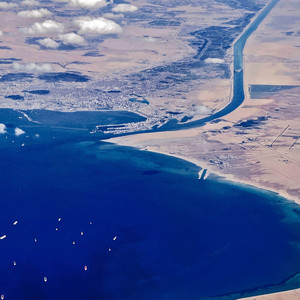
Ferdinand de Lesseps, who was responsible for the building of the Suez Canal.
Ferdinand de Lesseps was sort of a 19th century Elon Musk.
And like Musk, Lesseps was the public face of an ambitious engineering project.
He sold a future before the technology was fully proven and bent reality to fit his version of it.
Lesseps knew to change his pitch for different audiences.
For example, he promised the ruler of Egypt at the time that quote the name of the prince who opens the Great Maritime Canal will be blessed from century to century, until the end of time.
Sold.
Good pitch.
Lesseps went back to Europe to sell shares, primarily to French individuals for 500 francs.
That was roughly the amount of average annual income then.
He told them the story that global trade would benefit European manufacturers.
Also, at the time the Brits were doing their colonial thing, and he added that the canal would help the British army should they need to move their troops around the world.
These were the retail investors at the time, betting on a big vision, financially and politically.
But building the canal would take longer than Lesseps anticipated, with brutal conditions for the workers.
They slept in the open desert and moved rocks with pickaxes and baskets.
This method was not sustainable, but... He was also very lucky.
With the technology at the time, he started the Suez Canal.
The canal could not be completed.
He was banking on technological advances in digging and in machinery, at least implicitly doing so, and they came through.
French industrialists invented a more efficient way to dredge the area, a technological advance that was not a guarantee when the project started.
And he was lucky that he got cooperation from Egyptian authorities, which wasn't clear when he started the project either.
Lesseps needed a heavy amount of confidence and a few lucky breaks.
There was that narrative and persuasion power that really run a little bit ahead of reality.
The Suez Canal eventually opened in 1869 and the value of shares in the company would go on to quadruple from the time he started selling them and pay an annual dividend of 15 in the late 1800s.
Again, he was lucky, but economic narratives don't always come true.
For Lesseps, the trouble came when he sold investors the same story about building the Panama Canal.
Investors bought shares in the project, hoping that Lesseps would repeat his Suez success.
The ideas he had were clearly mismatched to the conditions in Panama.
And despite that, he was able to raise a huge amount of money because he had the status.
And he had a very simple narrative about how this could be done relatively cheaply, in the same way as in the Suez.
One problem?
Lesseps claimed that the Panama Canal did not need locks.
And locks allow boats to travel across different terrain.
The Suez Canal survived without these as its terrain was relatively level.
But around the Panama Canal, the elevation changes more.
Mountains, valleys, etc.
And Lesseps was a bit too cocky about the building environment, downplaying the tropical illnesses that killed workers and publicly claiming that there would be no future earthquakes in the area, after one did occur.
And all of that came crumbling down because the narratives had raced ahead of reality and his designs couldn't work and the money he had raised was insufficient, but there was no way to get it paid back.
Looking at history...
Every new technology, however promising it is, takes a while to spread.
Lesseps had to abandon the Panama Canal project when the company went bankrupt.
The U.S. would take over building the canal successfully about 15 years later.
The Suez and Panama Canals are good examples of economic narratives we're seeing today.
A big infrastructure build-out with huge financial and political consequences that may need a few lucky breaks.
They also show that a compelling economic narrative can create profound technological change and sometimes great returns for investors.
But these economic narratives, when they are about the future, often take longer than the promoters claim.
Looking at history, every new technology, however promising it is, takes a while to spread.
Economic narratives can change your reality.
They can even defy gravity for a time, like Lesseps-Suez success.
But eventually, reality catches up, like it did in Panama.
The good news?
We have some agency over these stories.
We can question them, test them, and choose which ones to believe.
And I have to ask, Waylon, do you have a favorite economic narrative?
Favorite is kind of doing a lot of work here, but about tariffs are paid by the other country.
Oh, that's a great one.
I've got tax cuts pay for themselves.
We're going to ride that baby out.
Okay.
Could be here all day.
This episode was produced by Cooper Katz McKim and engineered by Kwesi Lee.
It was fact-checked by Sierra Juarez.
Kate Kincannon is our editor.
The Indicator is a production of NPR.