Welcome to Spotlight.
I'm Patrick Woodward.
And I'm Gillian Woodward.
Spotlight uses a special English method of broadcasting.
It is easier for people to understand, no matter where in the world they live.
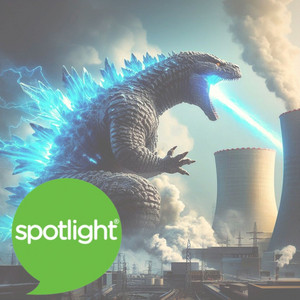
In the darkness, you hear the footsteps of the creature before you see it.
The windows of the buildings shake and crack.
Suddenly, it appears.
A huge creature as tall as the tallest towers.
Its cry splits the night.
Its backbone glows with a purple light.
Energy shoots out from its mouth, slicing the buildings in half.
Godzilla has returned to Japan.
Godzilla is one of the most famous monsters of the history of film.
Pictured sometimes as an evil force and sometimes a hero Godzilla is always a force of ruin.
But the roaring monster makes a film fun.
But the huge beast also shows the fears of those who created him.
Today's Spotlight is on Godzilla, the greatest monster of the movies.
Three men created Godzilla.
They worked for Toho, a Japanese film studio, in 1954.
Their names were Ishiro Honda, Takeo Murata, and Tomiyuki Tanaka.
Tomiyuki Tanaka, the producer of the project, originally planned for the film to be a typical monster film.
Usually a frightening creature appears that people must fight.
Usually, the people kill the monster or drive it away.
But with director Ishiro Honda's vision, this monster film became something more.
He and his co-writer Takeo Murata made the film into a metaphor of something more important.
A metaphor is a creative comparison describing something that shares the same qualities with something else.
Godzilla became a metaphor for the tragedy and horror of nuclear weapons.
Honda was no stranger to these weapons, nor was Japan.
In 1945, Japan was at war against the United States and its allies.
This war, called World War II, had been going on for many years.
Hundreds of thousands of people had died.
On the 6th and again on 9th of August, The United States dropped two nuclear weapons on Hiroshima and Nagasaki.
These bombs immediately destroyed these two major Japanese cities.
The explosion killed tens of thousands of people.
The radiation from these bombs also poisoned many more.
The ruin was terrible.
The Japanese could do nothing to stop this powerful weapon.
Their government surrendered soon afterward.
The war was over.
Ishiro Honda was an unwilling soldier in that war.
He spoke to the magazine Newsweek about the experience that would shape his film.
I was coming back from the war.
The army was returning from our final defeat.
We passed through Hiroshima.
Back then, it was said that for the next 72 years, no grass would grow there.
That picture really stayed with me, so I have a kind of hatred of nuclear weapons.
Honda's hatred of nuclear weapons shaped the plot of the first Godzilla movie.
It also included another real-life event involving nuclear weapons called the Daigo Fukuro Maru incident.
During this incident, the Japanese fishing ship Daigo Fukuro Maru was fishing for tuna near the Marshall Islands in the Western Pacific.
Near those islands, the United States secretly was testing a new nuclear weapon.
The ship was fishing in a place that should have been safely outside of the testing zone.
But this bomb was much more powerful than expected.
It sent clouds of radioactive fallout into the wind.
The dust and ash in the radioactive clouds fell on the Daegu Fukuru Maru.
The radioactive fallout from this nuclear test poisoned the ship's crew.
Several crew members died within a few weeks, and those who did not die immediately had permanent disabilities.
Later, many of those men died from cancer caused by the radiation.
The Daigo Fukuryo Maru incident directly influenced Godzilla's creators.
The film even begins with fishermen disappearing.
Nuclear testing changes Godzilla into a radioactive monster.
Eiji Tsuburaya was the film's special effects artist.
He designed Godzilla.
He made the monster's skin look like the skin of the survivors of the nuclear attacks from World War II.
Much of the film shows Godzilla attacking Japan.
The damage is like destruction of an atomic bomb.
But Godzilla is also a victim.
His unstoppable anger also comes from his own pain caused by the atomic bomb.
Godzilla also differed from other monster films in many ways.
Most of these films concentrate on the monster and the destruction it causes.
Godzilla does this too, but most of the film concentrates on people's experience of Godzilla's destruction.
In one part, the film shows a mother crying, telling her children that they all will die, but that they will be with their father, who died before.
As she speaks, Godzilla comes ever closer to their hiding place.
In another, A doctor knows a child that she is treating has been poisoned by radiation.
There is nothing that she can do to help her.
These parts purposely match events after the bombing of Hiroshima and Nagasaki.
John Rocco Roberto was an American Godzilla expert.
In his study of the effects of the atomic bomb on Japanese culture he wrote Godzilla was hidden as a normal Hollywood-style monster film.
But it made Japan and finally the world, experience the bombings of Hiroshima and Nagasaki.
The movie Godzilla was a huge success on its release.
It set a box office record in Tokyo.
Reviews of the film were mixed, but the movie was very popular.
Because so many people came to see it, It became the eighth most profitable film in Japan that year.
In the next few years, the movie was shown in Germany and the United States.
However, these films were changed a lot.
These did not include much of the original movie's anti-war message.
These also removed the nuclear weapons.
In the United States, the title was changed to Godzilla King of the Monsters.
But more people watched the film in the United States than in Japan.
The international showings of the movie helped solidify Godzilla's popularity.
The Toho Film Studio capitalized on this popularity, releasing five more Godzilla films in the next 10 years.
In these films, Godzilla is still a force of destruction, but he slowly turns into a hero who fights other monsters that threaten the Earth and its people.
Some films were more about the fights between these monsters than being a symbol for anything.
But they still considered Japanese attitudes at the time like a growing feeling of teamwork between Japan and other nations.
Ishiro Honda directed many of these later Godzilla films.
He spoke to Newsweek about this period of these films.
In parts with international meetings.
I always show people from the Soviet Union and other countries.
They helped the Japanese government with the problem it faces.
That kind of assistance somehow became the subject of these sorts of films.
Cooperation, or working together, is the most important subject.
As time went on, Godzilla became a friendly monster.
Recent films, such as the American-made Godzilla X- The New Empire, follow this example.
Here, he is a force of nature that protects the Earth from outside danger.
But Godzilla still has the power to show the fears of the Japanese people.
In 2016, Toho released a new film called Shin Godzilla.
Shin Godzilla was influenced by the tsunami, a huge wave caused by an earthquake that hit Japan in 2011.
The tsunami caused the Fukushima nuclear power plant to melt down, releasing radiation into the environment.
In the film, Godzilla is a slow-moving monster changed by radiation poisoning.
The monster is a danger.
But much of the film is about how government officials fail to address the problem.
The movie shows the danger of a natural tragedy, but it is also about the dangers of a slow moving government.
Today, Godzilla is the longest running film series of all time, with 38 movies completed and more to be released.
He is one of Japan's most well known creations.
He made people want to make other monster films and video games.
But Godzilla will always be more than just another monster.
He shows both the fears and joys that all people experience.
In that way, We are a part of Godzilla.
Our experiences and expectations make him one of the greatest monsters of all time.
Have you ever seen a Godzilla film?
Which film was your favourite?
You can leave a comment on our website or email us at radio at radioenglish.net.
You can also comment on Facebook at facebook.com slash spotlight radio.
The writer of this program was Dan Christman.
The producer was Michio Ozaki.
The voices you heard were from the United Kingdom.
All quotes were adapted for this programme and voiced by Spotlight.
You can listen to this programme again and read it on the internet at wwwradioenglishnet.
You can also get our programmes delivered directly to your Android or Apple device through our free official Spotlight English app.
This programme is called Godzilla the Greatest Monster.
We hope you can join us again for the next Spotlight programme.
Goodbye.