Hello and welcome to Women in Retail Talks, the podcast where C-suite executive women in the retail space share their stories of professional growth leadership development, personal journeys and more.
I'm Marie Albajes, Senior Editor of Women in Retail, a membership-based community of executive women at leading retailers and brands.
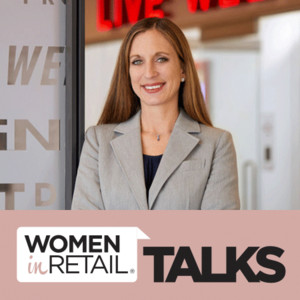
Today, I am joined by Rachel Jones, the SVP and Chief Product Innovation and Science Officer at GNC.
And Rachel and I talk about how she leads her team, how she got into retail with a nutritionist background and why it's important for her to really get comfortable with being uncomfortable.
So Rachel, I'm going to bring you in.
Thank you so much for joining me.
Oh, thank you for having me.
Yeah, I'm excited for this conversation.
I know we met what a year ago in Pittsburgh when we had an event there, and everything that you said really stood out to me, and so I'm excited to have kind of a deeper conversation about your background and your career.
So let's start with kind of what you do at GNC.
I know that you lead a team that's responsible for the branding positioning, design and development of the product brands that GNC owns, but What exactly does that mean?
What does your day to day look like?
Yeah, absolutely.
So one of the things that I love about my work is that every day is different.
And you know, at GNC we have a bunch of products that we sell, but about half of them are brands and products that we own.
And my team has the privilege and the opportunity to be a part of making sure that the branding, the positioning, the assortment, the product development, the innovation roadmap is going to surprise and delight consumers.
But every day is different.
So one day may be filled with combing through market research to form and evolve our innovation master plan.
What are we going to do next?
What are we going to do to surprise and delight the consumer?
And what concepts might we want to research?
And what concepts may we want to test and launch over the next one, two, and three years?
Another day may be full of meeting with suppliers.
We have a lot of ingredient and technology and packaging suppliers that are constantly looking for the latest, greatest things.
They're investing in research and development.
So we may be sitting through summits or meetings where they're presenting to us a lot of ideas that we could leverage in our product development roadmap.
We also spend a lot of time testing out brand and packaging and product concepts.
So sometimes we can do consumer research digitally, where we do surveys and when we review the results to help us make the consumer-centric decisions.
We also, though, can do qualitative research where we do some focus groups, and I love those.
Those are really fun because you really just sort of get to tease out the nuggets of what consumers think and what they're saying about our brand and our products, and I find that extraordinarily helpful.
Another thing though, that we have on site, which I love we had a new building built a few years ago, and we had our very first test kitchen where we could actually do concept testing.
We could do sensory evaluation, taste test.
We can mix different things up, and that's really fun as well.
So when we are trying to work on different options, we actually could engage with the products, bring consumers in, have them test the products and give us feedback.
The other thing that's really cool about our office is we have a live store on site.
So, as we're planning on how to visually merchandise and market and message some of the brands and products, we could actually set up the store and try different things and just ideate and iterate before we actually move forward with the visual merchandising and in-store marketing plans.
Lastly, I do have a very technical arm of my department of nutritionists and scientists and quality experts.
So we also spend a good bit of time working internally and with external experts to really just make sure that everything that we carry is safe.
It meets the regulations, what we say the product does can be backed by science.
So there's the behind the scenes technical stuff that we do too to just really make sure that we're providing consumers with the highest quality information and that what we are offering is backed by science.
But at the end of the day, I love what I do because I really find it a privilege to be able to help people live well through nutrition, to identify the best, most efficacious products and solutions that really can help people live well.
Yeah, what I find so interesting about that is that it's, it's such a niche product.
Well, everything you do has such a niche product specifically around nutrition and health and supplements and that sort of thing.
And obviously, you need kind of a nutrition background to do what you do.
So and you and you have that you are nutritionist by training.
So how did you get into this world?
How did your training there put you in this position at GNC now?
Yeah.
So when I decided to major in nutrition in school, it was because I was just truly fascinated about the power of nutrition and what different nutritional regimens or solutions could do to modulate your health or even help you achieve your athletic goals.
So it was just really at the center of my why.
Helping people achieve their goals through nutrition was why I studied nutrition in the I started my career.
I worked in a university for a couple of years.
I worked with division one, college athletes, and then I worked for a large healthcare system in the hospital setting.
But I knew I wanted to do something on a broader scale.
How can I help people on a broader scale, get the word out and be in an environment where I am just constantly like learning?
And I had been working in Pittsburgh, Pennsylvania for this large healthcare system.
And I found out that GNC's world headquarters happened to be based in Pittsburgh.
So I started poking around at jobs that were being posted.
And I saw a job that was for a project manager for clinical studies, not really thinking I was fully qualified for it and just applied.
Right.
And long story short, I was offered the job.
I was a little bit uncomfortable because I'm like well, I don't really know exactly what I'm doing, but I thought it was super interesting that I could take my passion for nutrition and health and see how I could apply it in a corporate or a retail setting.
And what was really cool is I stepped into that role managing some clinical studies that supported our product development roadmap.
But I sat, my cubicle was right in the middle of merchandising, marketing and these cross-functional teams that constantly were looking for nutrition information or validation, and I just forged these relationships and realized, oh my gosh, here I am working for this company right, whose really mission is to help people live well through nutrition.
There weren't any registered dietitians or nutritionists yet there at the corporate office.
And it just dawned on me in that first year of working that somebody like me, with my passion and my background, could really help this company in so many different ways.
While I started my career at GNC in a role in research and development, I could talk a little bit about how I just forged the relationships and tried different things and was able to showcase how somebody with the passion and education in nutrition can really thrive in a company and within a brand that really is centered around nutrition.
Mm-hmm.
And that's a great example of like just paying attention to the white space around you and finding a need, even when it's not necessarily in your job description.
And I think also I mean just like the physical setting that you were in speaks to, like the larger dilemma that we have now 20 something years later, of wow, if you're physically in office and sitting in between a marketing person and a merchandising person and you've got this specific skill set, but you're rubbing elbows with the same people and hearing those conversations like what value is there in that, versus having the same calls on zoom and maybe not having that experience?
Oh, yeah, that's so true.
We actually at work, we talk about that a lot.
We right now are working in more of a hybrid model, which I think is really ideal for me personally.
But there are so many members of my team that are living the experiences that I lived early in my career where just by rubbing elbows with like somebody in marketing or in training, they'll say you know what?
Would you be able to do a video up in our studio to help with the training program that we are working on right now.
And had they not had that experience, that may not have happened, right?
But it is an interesting dilemma because I also have brilliant talent that does not sit in Pittsburgh Pennsylvania.
But what we're doing to lead through that is just creating those moments virtually and then creating travel in on a frequent, regular cadence to make sure that the team members have that same opportunity, or is close to the same opportunity, to authentically create those experiences for them as well.
The other thing I felt was fascinating.
What you said was you know, back then there was no registered dietitians or nutritionists like on staff.
And I believe correct me if I'm wrong that you kind of started GNC's first team of like nutritionists and scientific experts.
And you said now you kind of, that's, that's a whole arm of what you do.
So walk us through that process.
You know, how did you get buy-in from the company to kind of bring those folks in?
What were those early meetings with the team like?
Yeah.
So obviously I was hired by somebody and I have to give them credit as well.
So there was a PhD scientist who was our I forget her title at the time Dr Susan Trimbo, but she was tasked with building out a scientific affairs team.
So she had a medical director and the two of them hired me and one other PhD scientist.
But really to focus mainly on ingredients in clinical studies.
As I alluded to earlier, when I arrived in the environment and realized wait a minute.
Somebody with a nutrition background and who has passion about nutrition could stretch beyond this defined role.
I started to just build these cross-functional relationships.
One of the very first experiences that I had that stretched beyond my role that I was hired for was I sat next to a brilliant PR manager.
And she was working through a PR plan and had the opportunity to travel to New York and do some desk sides to basically get the word out on some of the new products we were launching.
And a lot of the questions that she was getting in terms of key message points and questions that might come up in these interviews ended up being very nutrition science related in nature.
And she approached me and said you know what the head of marketing and I, we were talking and we thought maybe you might make sense to come out and do these desk sides and meet with these editors and really talk about these awesome products.
I said, okay, I have no idea what a desk side is, but willing to learn.
And you know, Luckily I had supportive department heads that were really all about employee development and also spreading the word of the power of nutrition science within the organization and saw the value of growing that expertise within GNC.
So long story short, that's just one example.
I did fly to New York.
We did a bunch of desk sides.
We ended up from there doing a lot through the PR and consumer information group that leveraged my team.
And then Also within the product development group, we suddenly would get hey, you did a really good job on this video and this press release and these message points.
Can you help us with packaging copy?
Can you help us write some claims about the products?
And it just kept kind of building to the point where I want to say, a few years in, I just decided to put a proposal together on how our group may evolve into something that was a little bigger than just a scientific affairs department.
And it was more about scientific affairs and nutrition expertise that provided support for not just product design and development, but also for marketing, for training, et cetera.
And we probably added three people initially.
And then eventually took on the actual product development team as well.
And it just gave us the opportunity to continue to build upon the expertise.
Let's see, I've been there for 20 years.
I've been at GNC now for 20 years.
When I started, I was the only registered dietitian and nutritionist.
And now we have, I have a team of 44.
Wow.
And not all of them have those exact credentials, but at least have some sort of nutrition or scientific background.
And we support product design and development, claims development, marketing, training.
And it's just been a real honor to be able to kind of create my own path.
That could help not only the company but can help consumers by getting quality products and information, but also to be able to build a team and offer opportunities to people who really just want to do something unique with with their nutrition degree has just been really fulfilling.
Yeah, that makes so much sense and there's there's still like so much potential there, I think.
But I love you know the.
This kind of leads me to my next question of.
I heard you say last year that you, your superpower, is taking complex information, simplifying it and making it relevant to get the job done, which is, I mean, exactly what you described of like.
I have all of this technical knowledge of the product and the ingredients and all of that, but I can deliver it in a way that people are going to understand and get in an instant.
And I actually took a version of what you said in your superpower and made it my own, because I too, like to take complex information and turn it into a story that's going to make an impact.
So I would love to if you could share just a little, maybe a couple more examples of how you kind of use this superpower.
Oh, definitely.
So the first time and I think in the event where we were together before, I may have used this example.
The first time it was pretty early in my career where a senior member of our department was trying to explain to our C-suite, our executives, that we found this really cool extract and we should be super excited about putting it into our products.
But of course, the way he was describing it was very technical, very scientific and something to the effect of well, we found this Boswellia extract.
That I'm sorry.
We found this Boswellia extract that really helps modulate inflammatory pathways.
And he's going on and on from a technical mechanism.
And I'm seeing the execs glaze over like, okay, what is the so what here?
And this was also one of those moments in my career where I had to dig and find that organizational courage to speak up, because I was pretty junior at the time.
And thought, well, I think he needs some help.
And this is really exciting.
So I jumped in and basically said hey guys, this is a really small dose ingredient that could fit in a one pill per day product that basically is clinically studied to help with joint pain.
And if a consumer takes it, they're going to feel better immediately and then improve their mobility and flexibility within five days.
And just kind of putting it into the context of what it meant to the consumer and what it meant to the business.
And that opened up the ability to talk about, well, what is the size of the joint health market?
What are consumers looking for?
What are those unmet needs?
Oh, my gosh, this lines right up to that, right?
So that was one situation.
Another situation more of a technical example again is we had discovered this unique technology that we could apply to some common ingredients in our industry.
So there is an ingredient called creatine that people often know to help with strength and exercise performance right.
One of the things that has always been a challenge is that you need to take big doses.
So lots of scoops of powders or lots of pills, right?
And again we had worked with a university that did some studies on a version that we set up a meeting for the university to present the findings to some of our non-technical folks at GNC.
And he's going on and on about how this polyethylene bound creatine is more bioavailable.
And Again, as I see people glaze over, it's like well basically guys, what this means is that instead of taking big scoops of powders or 10 pills, you can take two pills and you're going to have just as much of an improvement in strength and vertical jump and performance.
And it's just kind of boiling it down to the, so what, how does it apply to the consumers?
And I will say, even outside of the technical realm of things there's, There's that superpower does come in handy to when you're sitting around the executive table and you're talking about complex situations and you're just trying to get to the so what?
And what do we do next?
I tend to to leverage that strength even outside of the technical realm, right.
And I can be very direct to just basically have the organizational courage to say okay, I think what everybody's trying to say is X, so why don't we do Y?
Let's cut to the chase.
That's such a powerful lesson in the like, just get to the so what.
And I think buried in there is that like organizational courage to speak up, which we all know is very uncomfortable.
We've all been there.
It probably gets easier the more you do it.
But you've also talked about the power of getting uncomfortable or being comfortable with the uncomfortable.
So I'm sure you've experienced this throughout your 20-year career at GNC.
Do you have kind of other instances that come to mind about?
You know why it's important to stay uncomfortable?
Absolutely.
The first example I have is I had spent a little over 12 years in more of the scientific affairs, research and development realm.
And I was approached by our then CEO and head of HR to potentially move into a role where I would oversee international merchandising.
It was my first vice president role.
And my first reaction was honestly fear. well, what do I know about international merchandising?
Here.
I am a nutritionist who's done some cool things and built up this scientific affairs research and development crew, but why me right?
And as I thought about it and reached out to my support system friends family, some close colleagues of mine, one common theme was why are you doubting yourself?
Yeah.
You know, have that confidence to try something new.
This isn't you, right?
So I embarked upon it.
And you know one of the things that I did in that I was very uncomfortable but I made an immediate plan to assess the situation, get to know the team, understand what's working, what's not doing a stop, start and continue exercise with the group.
And then created a plan for myself to immerse myself in everything that the team was doing, so I can rapidly learn.
And honestly, it was one of the biggest, most important jumps in my career, because I really think that that started the trajectory for me to eventually move up into the C-suite and do different things.
And um, and honestly it, the fact that i i was lacking a little confidence it it, i believe, led me to do a better job, because that that fear and that that nervousness drove me to be hungry to learn and to really assess and dig in, versus maybe somebody who had a little more arrogance about it and thought i got this and and took maybe a little more of a lazy approach right.
Um, And in general, one of the things that I've gotten much more comfortable doing is just saying to myself what's the worst that can happen if A I advocate for myself.
There are situations where I've approached our CEO or our board about where I think I can help.
And that's led me to jump into new and more senior positions.
And had I not spoken up for myself, with some substance behind why this could help you and your vision and why this can help the company, I don't think I'd be in the role that I'm in today.
And then lastly, in a C-suite role.
Now it's funny because our current CEO he said you know, I see you in our C-suite as a source of anti-spin.
And I thought that was interesting.
He said, you're not afraid to speak up.
And when everyone's debating and spinning, you'll jump in and you kind of bring down the spin and drive us to make a decision.
And I really do think That came from a place of me reminding myself what's the worst that can happen if you speak up, even if your opinion is unpopular.
Your colleagues, even people above you, they might not see what you see.
They may not know what you know.
So if you keep those feelings and opinions that could result into a solution inside, you're not helping the company.
You're not helping yourself.
You're not helping anybody around you.
There are times where I've spoken up and I end up being the minority and I let it go.
And that's fine.
But I think it's important to create that environment to idea build and have those healthy debates to land on the best decisions that we can.
And that also comes down to who you're sharing those ideas with and who you're speaking up around.
If you have a culture where innovation is praised and failures are accepted for what they are and improved upon, then you're going to be more likely to have the courage to speak up, versus getting into a room, speaking up even though you're fearful and then having that idea not only shut down but like made fun of or, you know, going back to what's the worst that can happen.
Well, I can embarrass myself.
And if that's the worst that can happen, I think I'm going to be okay.
But hopefully you're in a culture where you're not going to feel embarrassed to speak up.
So I really appreciate that story.
I want to, in the last couple of minutes that we have, I want to talk through some of the challenges that you've faced over the years.
You've been there 20 years.
Obviously, you guys have navigated all kinds of things at GNC, bankruptcy, store closings, layoffs.
I wonder how you particularly lead during these difficult times.
I mean, you mentioned that you are direct.
You're not afraid to speak up.
I wonder how that shows up in tough times with your team.
Yeah, for sure.
So I am a transparent leader.
And so I do think communication is critical.
Especially with my direct line, we meet every week.
I do the best that I can to cascade what's going on so there aren't any abrupt surprises.
But one thing that I think is really important whether you're leading a team, coaching a team, whether you're leading a company is a constant reminder of the bigger picture.
What is our North Star?
What are we trying to do?
And facilitate an environment whereby we are all working together towards that.
How can we be a cause in the matter of that?
Because every company, every team is going to go through bumpy times, right?
And it's easy to land on maybe having a fixed mindset or getting stuck on The challenges rather than the solutions.
So I'm just constantly trying to remind everybody of the North Star.
Why are we here?
What are we doing?
Be solution oriented.
Also be complimentary and encouraging people to work together through these tough times and in reminding people that we're just people at the end of the day.
If you have a colleague that's struggling or maybe not showing up to the best of their ability, be there for them and figure out what that looks like.
And, you know, we've gone through a couple rounds of reduction in force.
And one of the conversations I recently had with my team.
Somebody asked me well, if somebody is no longer with the company, can I still talk to them?
Absolutely, you should.
We are people at the end of the day, right?
You're part of that person's support system.
So really just encouraging people to be good teammates and good colleagues, but also being a good support system for each other even outside of work, the best that you can.
Yeah.
At the end of the day, it's just business, right?
We're not saving lives.
We're, you know, we can go home at the end of the day and still be our authentic, vulnerable selves.
That's it.
That's 100% it.
The other thing that's really tough when we have a company that might not be meeting its current financial goals and you have to make the tough decisions around.
You know what are we doing to move things forward.
And we know we have to do more with less.
It's really trying that like for me personally, I try to stay true to myself and Is this something I believe in.
Do I believe in this turnaround?
Do I believe in what we are trying to do?
And at GNC, I fundamentally do.
Like, it aligns with my career, why my life's work.
And we do need people in these bumpy times that truly fundamentally believe in that North Star.
And so I do tend to be transparent as well, because if people are unhappy or they're unsure, or they're not really feeling it right, they're not thinking like this journey is right for them, or they're skeptical and thinking you know what?
I don't think we're going to make it.
Then I do also believe in having transparent conversations around like, hey, is this right for you?
What are some of the things that align to your why as a career?
And really try to work through that.
Cause, like at the end of the day, we are people and it is just business and there might be a better fit elsewhere.
And that's okay.
Right.
You don't want to be spending 40 50 hours a week in a job where that's not the case and you aren't aligned with that North star.
Yeah, exactly.
Exactly.
Okay.
So in the, I want to be mindful of your time, but I have to ask this question because it's rare that we get someone with like your caliber and your experience on here.
So yeah, Obviously, you're a nutritionist.
You work with and around nutrition and supplements all day long.
You were a competitive runner growing up, D1 cross-country athlete.
Sidebar, I also was a cross-country athlete, not D1, D3.
But you and I have that in common.
And you're also a mom of two.
So I know that folks out there listening probably have a billion burning questions for you about you know how to be proactive in their health while balancing work and parenting and all of the other things.
And so I have to ask because it's rare that we have someone like you on our podcast what are maybe like one or two non-negotiables when it comes to your health?
Yeah, that is a big question.
Again, as you've picked up through this conversation, nutrition is really through the core of what I believe in and what I do.
So for me and my family in particular, I am constantly making sure that we have the fundamentals between protein shakes and vegetables and fiber throughout our household.
There's just Doing the supersets of nutrition and making sure you've got the right nutrients throughout the day so we can perform at our best mentally and physically is just something that I'm doing.
So if you came to my house, you'd probably laugh at the protein shakes and the Brussels sprouts and the fiber powders and just some of the quirky things that we have.
But honestly, at the end of the day, you've got to enjoy life.
And not to sound like the nutritionist that always preaches moderation, but I do think it's most important to think about what's most important to you and your family.
And some non-negotiables.
For me personally is making sure that yes, I do what I do at work, but I'm there for my family.
We have meals together.
We travel together.
We vacation together.
I'm sitting in a hotel room right now because my daughter is at a recruiting camp.
Right.
And just cherish that time that we have together, because I do think, while nutrition is such a fundamental, important part of living well, really having that balance, that work life balance and spending time with the people that you love, you know it goes fast.
Life's too short.
And that speaks to kind of who you are as a leader as well, regardless of whatever industry you're in or whatever products you work with.
At the end of the day, if you've got a leader who is showing that they put value into that work-life balance, then that's someone that you want to work for right.
Yeah, for sure.
For sure.
And I've been blessed with with some leaders that the leaders that I've been working for throughout the past 20 years that share in that.
And that's been, that's been really fulfilling, because I don't know that I could remain with a company for this long without, you know, being able to, to live that way.
Well, I think this is a great place to end it.
Thank you so much for your time.
I think we could talk for another hour or two, but I want to be mindful of your time.
Enjoy your time with your daughter.
And thanks again for joining me, Rachel.
Thank you, Marie.
This was great.
Thanks for listening.
For more information on this podcast, please go to womeninretail.com slash podcasts for show notes.
Women in Retail Talks is available on Apple Podcasts, Google Podcasts, Stitcher, and Spotify.
Make sure to subscribe on our podcast channel page as well.
If you've enjoyed this episode, please take a few moments to rate and review our show.
Lastly, if you're a female retail leader interested in joining our community at Women in Retail Leadership Circle, visit womeninretailcom.
Thanks, and until next time, this has been Women in Retail Talks.