Hello, and welcome to the NVIDIA AI Podcast.
I'm your host, Noah Kravitz. We've all been hearing about self-driving cars for years now, but what about self-driving strollers?
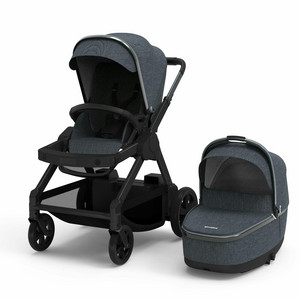
My guests today were the darlings of CES 2023 earlier this year, picking up an innovation award for Ella. their AI-powered Smart Stroller that features motorized assist, object detection, and other features meant to give parents extra pairs of eyes and an extra set of hands.
Here today to talk AI and baby strollers are the co-founders of Vancouver, British Columbia-based Gluckskind, Kevin Huang and Anne Hunger.
Kevin and Anne, welcome to the NVIDIA AI podcast.
Thank you so much for taking the time to join us.
Thank you, Nora, for having us. So, let's start at the beginning.
Why don't you tell us about the stroller, Ella, and maybe start at the beginning.
How did you get the idea for it, and how did it progress from there?
Well, the idea came pretty straightforward, similar to a lot of other startups in the parenting or baby care space.
We, Kevin and I, were actually married and we have a child together.
So when I was pregnant and we were looking at the solar market from a consumer perspective, that's when we We went a little wild with our product research and were looking for something more than what the market was offering at the time. started to explore that market and came up with the idea of a smart baby stroller. especially from a safety perspective.
Nowadays in modern day life, we take a lot of safety features for granted, like for example, seatbelts in cars. or the automated stopping when you're on a hill.
Whereas many of these safety features doesn't exist on a stroller where it's actually carrying a very important cargo, your baby.
So we thought, okay, there's gotta be something better than what was available.
And so we started tinkering and talking to other parents to see if this was actually a pain point that other people are facing and whether people are anxious going down hills when it's deep in their neighborhood.
So after talking to over 500 other parents and trying out some ideas.
Here we are two and a half years later. I'm getting flashbacks listening to you because I lived on a pretty steep hill when actually when both of our children were born and I have memories now of, you know, holding the stroller at arm's length, kind of gripping it with my hand to keep it from going too fast, that whole thing.
Absolutely. So you said about two and a half years ago, the process started.
Yeah. Yep. Our daughter just turned three and yeah, our startup is going to be three this summer.
And so, um, Walk us through what happened.
Did you build a prototype that your daughter wrote around in, or how did you go from idea and kind of verifying with, you know, you said you talked to hundreds of other parents.
How did you get into actually starting to build a stroller?
So our very first prototype, if you want to call it that, or proof of concept was an electric remote controlled skateboard that was strapped to our regular stroller.
Especially on hills, just to get that feeling of what it would be like if your stroller would actually break on a downhill or you would have that additional assist on an uphill and you have your hands free if your infant wants to be carried.
So that was our very, very first experiment, if you want to call it, to explore how we could actually make a better product happen.
And from there, as soon as we got it to kind of hover in front of us, that we realized, okay, there's something here.
There's something magical about not having to worry and struggle with the stroller going down a hill.
The next version from that was literally putting on motors on a older stroller platform, trying to retrofit some controllers out there and quickly realizing that because of all the wiring, all the sensors that we have to add, it became extremely difficult to try to create a modular platform to actually retrofit other strollers.
And so we started designing a completely new frame while trying to keep in mind what traditional strollers are like. so that people are used to it.
And that influenced our current designs.
We've went through about four iterations now overall. of what the stroller would look like to what the production unit looks like now.
And throughout the entire process, we've tested it with other... parents here locally in Vancouver, as well as we use the latest B3 not the production prototype now, but the prior version or for most of last year, as we are finalizing some of the designs and just really holding in on the user feedback to see what it feels like to have a motor-assisted stroller and as well as like-
For our early models, Kevin was the product tester.
I've been testing the stoner with our daughter very recently.
Nice. So there's a lot going on in the stroller from what I've seen and watched some of the videos and read.
Maybe you can walk us through some of the features and then we can get into how AI came into the process and what AI is doing in the stroller.
But you mentioned, you know, the downhill brake and the motorized uphill assist.
What are some of the other things that sets Ella apart from the other strollers that are around?
Yeah, we like to think of there being three modes when it comes to moving around with the stroller.
The first being exactly what you pointed out, the uphill motor assist as well as the downhill brake assist.
That's relevant when the child is inside the stroller.
Then you can think of it like an e-bike.
Parents do hold onto the handlebar with at least one hand.
But it's really more steering rather than pushing or putting in any physical effort. which makes the platform or the stroller as a product a lot more inclusive as well.
But then when parents want to take the child out of the stroller, because an infant is crying and needs that physical connection or a toddler wants to walk for a bit, but you still bring the stroller along because at some point they get tired and they want to sit.
That's when we enable hands-free strolling so that parents don't have to do the multitasking all the time.
They can focus on their interaction with their child.
They have two hands and their attention for their kids.
And the stroller takes care of itself. It's basically in standby mode until they want to use it for their child again.
And the last mode is the Rockababy feature.
So it sounds like you have quite some experience with strollers as well. often sleep great in the solar while you're out and about moving around but as soon as you stop they have their Senses in their antennas.
Bringing back more memories. So when parents want to take a break, whether that be at a cafe, at a restaurant, or when they get back home.
That's why they currently turn on rock a baby mode.
So the stroller keeps that soothing rocking motion.
Babies get the sleep that they need and parents can take never break.
How do you steer the stroller when it's in hands-free mode?
I saw a video on your site of somebody carrying the young child and the strollers kind of gliding along in front of them.
Is there a way to control the direction remotely from a phone app or something like that, or is it all physical, you touch the stroller and move it to get it to change paths.
The stroller does come with a companion app, but you don't actually use it to steer the stroller.
Imagine the stroller being just like any regular stroller.
If you're in push assist mode, you're pushing it, you're directing it with the handlebar.
But in the hands-free mode, it is tracking both the environment it is in, as well as where the parents are.
So typically, the parents are walking behind the stroller.
So then because it has cameras and other sensors all around, it's scanning their environment, it's creating a map of their environment and it would hover in front of the parent and basically it recognizes the sidewalk, follows along the sidewalk, but while keeping the parent in range.
As soon as the parent is out of range or it gets to an intersection, it would stop.
It would ask the parent to take over. Let's get into that a little bit more then because we're talking about object detection and computer vision and all these things that get into using AI.
Was that something that from the beginning you thought, okay, we're going to put a stroller on a skateboard and get it to move on its own.
And oh, if we're gonna do that, we better figure out object detection or where did did that feature set kind of come into the come into your thinking?
Definitely. I think, yes, of course, like initially we started with simply the motorization piece.
But with that, One of the things about strollers is that it should be lightweight and foldable and basically have all the features a traditional stroller have.
So when you start adding electronics, you're adding weight, right?
Therefore, any of the feature sets that you're adding must be significantly better than what is currently available.
Like it must have created so much more value than simply, I think just the, push and brake assist, even though that part is tremendous for many of our parents that have tested it.
This is where we thought, okay, if we are all about trying to create a safer product, then we should add other sensors so that it's more aware of the environment, right?
Because we see very often parents Nowadays, they're sleep deprived or it's life is full of distractions where, oh, you got a message on your phone, you're checking your phone, but you're no longer paying attention to your environment.
It'll be great if the stroller itself is also aware, is keeping an eye on the environment for you at all times.
So it might not take over. But it will warn you that, hey, there's a bike coming along the sidewalk or there's a skateboarder or something in the environment that's going to collide with you.
So imagine it being like all the advanced driver assist systems that are in cars, but adapted to the stroller platform.
So that's bold. I mean, no, that's exactly what came to mind.
I'm glad you mentioned foldability. I think as any... parent who has or has used a stroller can attest.
Being able to fold it, being light enough to be able to put it in the trunk of the car You know, these are important considerations for sure.
So when Ella detects an object, Coming into its path.
Is it auto-brake? Is there an audio alert?
How does the interaction with the parent work?
Yes. It has a multitude of interaction, just like you mentioned.
It can break if it senses that it needs to break.
It can also avoid it. In the hands-free mode, It's imagine like a pedestrian robot, right?
If there is a static or dynamic obstacle that are in the way of this coming into its path, it can avoid it.
It would also warn the user in hands-free mode but in push and brake assist in when the parent have full control of the handlebar it would only warn the parent because and that the parent has full control, right?
It's like you're driving a car. If you decide to drive it on brass.
Basically, if their car notices that you're kind of merging into another lane, you get a notification, but it's not like parking.
It corrects its past because you are control.
And no matter how fast that... that crazy teenage skateboarder, which is kind of now where my kids are at.
You're not pushing your stroller 50 miles an hour, so you'll have ample time to correct if your hands are on it.
So how many cameras, how many sensors are on board the stroller and Tell us about the process of building these smart features, the AI-powered features. into the system.
Was this was it a big challenge? Were there unexpected things or at this point and you kind of figured out sort of the heavy lift of You know, we're adding motors, we're adding brakes.
We've already kind of figured out how to keep it lightweight and foldable, so These days, AI is a tiny little embedded board.
It's not really a big deal. Yeah. No, it was definitely a big deal.
I mean, conceptually speaking, like autonomous vehicles, like a lot of the sensor suites are pretty commonplace now.
For example, we have five cameras and a multitude of other sensors, right?
Typically, the sensor stacks are pretty similar.
But for us, one of the challenges is keeping it lightweight, right?
And maintaining that foldability, having like...
Because typically a sidewalk robot or autonomous vehicle, you don't need to fold it, right?
You don't need to keep it lightweight. You don't have anyone trying to constantly lift it into a car.
So those were some of the added challenges that was different from what we were trying to build, especially trying to create a modular enough so that the typical average adult woman can actually easily lift this into a car or into their house, right?
Especially during the early days of right after pregnancy or when people are recovering.
So, yeah. I'm speaking with Anne Hunger and Kevin Huang.
Anne and Kevin are the co-founders of Gluckskind, a Vancouver British Columbia based startup where the makers of the Ella stroller, an AI powered smart stroller that took home a CES innovation award at the 2023 CES show just a month or so ago as we're recording this.
And so we've been talking about the product itself and how it got started and how it was born out of your own experiences as new parents or parents to be, I guess, shopping for strollers.
But let's kind of flip the script a little bit and talk about your own backgrounds.
Do you have prior experiences product development experience, work in AI?
Is your background in something totally different and you just saw the need and decided to... to go for it, so to speak.
Tell us a little bit about how you wound up becoming startup co-founders.
Yeah, so my background is actually in management consulting and real estate.
Okay. So it's quite different. However, I used to work in that innovation environment for quite a while as the focus of my work was how can I help big companies to create an environment that is conducive to creating innovative products.
My background is in neuroscience, but I've been working as a software engineer and solution architect for about close to 10 years now.
Prior to doing Glutzkin, we did not have computer vision experience, but the closest I got working with AI was doing any like NLP, natural language processing. from computer vision.
So for us at the beginning, it was very much learning about, okay, how do we actually do this, conceptualizing it, testing it.
The first version was literally running a object detection model on a Raspberry Pi.
That was during the very early days. So there was definitely lots of learning in the past two and a half years from going from taking some of the early learning blocks and applying it and trial and error pretty much.
So how hands-on, if you know what I'm asking, how hands-on have you been throughout the process when it comes to both the hardware and software sides of engineering?
I'd say very hands-on in the sense that we, I say we're a full stack company, not in the sense of the web, but in the sense of...
All the way from the mobile. Strollers have stacks too.
All the way from the mobile dev department down to the firmware, down to. the hardware and electrical systems.
So just before CES, we were in the shop actually putting together all the mechanical and electrical components for the demo units, the latest demo units, and it was all hands on deck.
So yeah, it's definitely been a great learning experience for us. from not just actually challenge a lot of our comfort zones and stepping into, for example, Two and a half years ago, we could not say that we made carbon fiber before.
Is the frame carbon fiber? Yes, it is. It's to offset many of the weight constraints, but also strength too.
While we definitely learned a whole lot during that process, we do have a full stack team as well here in Vancouver.
We have electrical mechanical engineers as well as computer visual engineers and other software developers.
Yeah, we've surrounded ourselves with good network of our team as well as experts in our network who has helped us tremendously to get where we are. especially in the video as well.
What if anything about working on the AI related parts of the process, parts of the product, I don't know, did you find surprising or particularly challenging or particularly satisfying for that matter?
Is there anything... you know, related to the AI development in particular that stands out.
Oh, great question. I think one of the most, it's both surprising and very satisfying is how Well, very often you hear about AI, right?
It's like AI is going to take over the world or AI can do a lot of things.
But then often you also see on the other spectrum that, oh, something, is not working.
For example, Bark recently, right? They're like, oh, it's responding with wrong answers.
But what's really satisfying and surprising is often when it does work, for example, Just in our early days, I think a year ago, most of our vision data is whether it's always transfer learned or whether we actually train the models from scratch.
It's the data sets that we collected are mostly from Vancouver.
Took it to Montreal and Toronto. The first time, sometimes it was like, OK, it didn't work very well.
But the next time we added a little bit more data and it did work.
And now it works even when we go to Seattle, when we went to Vegas.
These are environments it's never seen before.
And the fact it can self-drive in those environments, That is surprising and very satisfying.
That's very cool. Were there particular objects or other parts of the system that you were surprised at how difficult it was or, you know, detecting, I don't know, dogs running in the path or people on bicycles or something.
Was there a particular hurdle you had to get around or was it just a matter of adding more and more data to train the models on?
Yeah, I mean there are always outliers I think one of them was like, for example, scooters, right?
The cities like Vancouver doesn't really have that many scooters, but in some of the cities in the States or actually in Toronto, on the East Coast, there are scooters that were just laying in weird positions all over the place.
And that was definitely like outliers. But for us, one of the niceties is that We don't need full autonomy right away.
We're limiting the amount of spaces that parents can use the hands-free mode for mostly parks and residential areas.
But we can grow the amount of areas that we support concentrically.
And for most of our parents right away, the majority of the value add immediately. is the push and break assist, Rockababy, and all features that they can use immediately.
And the hands-free mode is a very nice cherry on top that it's better as they use it, especially when they start strolling around their own neighborhood as the model regionalizes and... it improves over time as we scales as well.
I had my current car for about a year before I even tried lane keeping assist, right?
But the, you know, crash avoidance enough from day one, you know, kicked right in.
So it's a, It's a nice analogy in my head anyway to relate to things you're talking about and I'm imagining sitting in the car and right, yeah, the object detection and everything.
So we're recording this in February. What's the current status?
Are you taking pre-orders? When are you hoping to ship the first versions, retail versions of Ella yeah so we did actually take pre-orders prior to and at CES but with the global coverage we actually had to stop as we started getting interest and paid orders from all over the world.
And because it is a certified product, every region has little bit differences in the certification.
So we had to close that down and as well as like our initial pre-order, we've hit our maximum capacity to manufacture as we're trying to make it in Canada.
So we are opening it up again in March and our first will start shipping out.
We'll be getting into parents' hands in July.
2023. Great. And I have to ask, I haven't, I used to go every year.
I haven't been in a while, but how was CES?
Was this your first CES? I'm assuming your first as a presenter anyway, but.
How was that experience? It was our first CS as a visitor and as a presenter. or how relatable our experience is.
But it's definitely been once in a lifetime experience for us.
It's been incredible in terms of the attention that we got. which we like in no way expected in that long year with.
It really was from the day before it even started that Kevin and I got inquiries from different media representatives and we've been running around with our heads on fire for like four days.
That sounds about right. I'm sure the focus now is on fulfilling those pre-orders, getting things under control with production and all of that.
So I feel almost unfair in asking you this, but if you can look beyond the initial delivery dates, Where do you see this all headed?
Do you have additional features in mind?
You have another product that you're kind of, you know, cooking in the incubator for when you have the bandwidth.
What's next for Gluckskind? Yeah, definitely.
I mean, for us, immediately, it's working on the other kind of assistive features that the stroller can have.
For example, we didn't mention it also plays white noise, but because it has a speaker system, and have alerts, it can also play like stories, right?
It can stream business stories, things like that that really augment the parenting experience.
As parents are buying all kinds of other kind of products, we're like, Why do we need to buy so many things that do very similar things when it can just be one thing?
We'd all build and win, right? Yeah, yeah.
So that's something that immediately comes to mind.
But aside from that, we are we had quite a lot of interest in for us to build like a twin stroller or other kind of assisted devices.
So we are starting to look into that and we are starting to design a kind of follow on as well as like next iteration of how we can build this product better.
How can we make it more assistive, more streamlined? lighter.
But our initial goal is for sure delivering those first units for our early adopters who have placed their pre-orders. and just the best experience that we can possibly offer.
Absolutely. Well, for listeners who might want to find out more about the company, about the stroller, about your journey, let alone. you know, bookmark the page for pre-ordering when those go back online, where would you direct them to go online?
You can find us on gluxkind.com, G-L-U-X-K-I-N-D.com or find us on Instagram on gluxkindhq.
Yeah, or TikTok, I guess. I was going to say, I'm all of a sudden now I'm excited for the influencer videos when the strollers start getting out there.
I would say the best way to stay informed about when we're opening up pre-orders is to sign up to our newsletter. or waitlist that's also accessible through our website and we Send out infrequent newsletters, but we will definitely keep everybody updated on when we're accepting pre-orders again.
Fantastic. Well, congratulations on making it this far.
I mean, this is remarkable. go shopping for something they need, can't find what they want and gripe about it.
And the two of you went ahead and built a semi-autonomous AI powered stroller.
So that's a huge achievement. So congratulations on that.
And maybe more, more pertinently for now, good luck treading water with filling all of the orders.
I haven't been through that myself, but I understand it's quite something to go through for the first time.
All the best to you on that. And I can't wait to see what's next for Gluckskind and the world of assistive technology for parents.
Again, having gone through it myself and still going through it as a parent, you see these things and then you remember like, oh yeah, Like having a break, having an auto break would really make a big difference.
Having a little assist going up that steep hill for the grandparents or, you know.
Anyone who just needs that assist is a huge thing.
So, it's fantastic. Thank you. Thank you.