is supported by ads outside the UK.
It's finally happened.
Your kid could be part of the first generation to never suffer the rough touch of toilet paper on their tender tush, all thanks to new flushable Little Dude Wipes, available in bubble bum, scent or fragrance free.
Because we know little butts can make a big mess, but with Little Dude Wipes, you can keep your kid's keister clean.
Without the burn and debris, toilet paper can leave behind on their behinds.
Experience the confident clean of Little Dude Wipes, available exclusively at Walmart nationwide.
Saks Off 5th is your secret to fashion's most wanted deals at up to 70% off.
On the hunt for designer steals that'll turn heads and leave a trail of envy?
Uncover Gucci, Valentino, Versace, Stuart Weitzman, and more.
With new arrivals dropping weekly at prices too good to stay confidential.
Luxe layers, statement boots and tailored essentials from Saks Off 5th will put your wardrobe on the most wanted list.
Head to saksoff5th.com or a Saks Off 5th store near you for a style lineup you won't want to miss.
Hey there, I'm Asma Khalid.
And I'm Tristan Redman.
And we're here with a new weekly bonus for you from the Global Story podcast.
The world order is shifting.
Old alliances are fraying and new ones are emerging.
Some of this turbulence can be traced to decisions made in the United States.
But the U.S. isn't just a cause of the upheaval.
Its politics are also a symptom of it.
Every day we focus on one story, looking at how America and the world shape each other.
So we hope you enjoy this episode.
And to find more of our show, just search for The Global Story wherever you get your BBC podcasts.
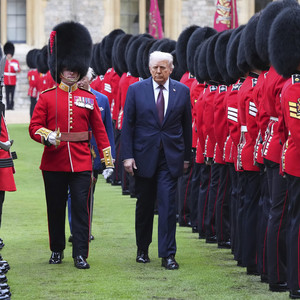
President Trump's in London today.
He had a big royal to-do yesterday.
He met the king.
And today he's meeting the British Prime Minister, Keir Starmer, somebody he's quite fond of.
I like your prime minister.
He's slightly more liberal than I am, as you've probably heard, but he's a good man who got a trade deal done.
A good man.
But there is one big issue that's become a sticking point for these strange bedfellows.
The British government seems to be cracking down on social media posts, people being arrested for tweets.
Just wondering how concerning that is to you, Mr. President.
I will just say that in terms of UK, strange things are happening over there.
They are cracking down and Surprisingly so, and I've spoken to the Prime Minister.
Free speech in the United Kingdom has become a hot-button rallying cry among conservatives in the United States.
In Britain, free speech, I fear, is in retreat.
From Vice President J.D.
Vance to Elon Musk.
My appeal is to British common sense, which is to look carefully around you and say if this continues.
What world will you be living in?
To Republican congressmen.
We're concerned about the attacks on free expression in Europe, the chilling effect it all has on speech around the world, including here in America.
From the BBC, I'm Tristan Redman in London.
And I'm Asma Khalid in Washington, D.C.
And today on The Global Story.
Why have conservatives in America become so obsessed with free speech an ocean away, especially when a crackdown on speech is kicking off here at home?
We've been wanting to do an episode on the American obsession with free speech in the United Kingdom.
So we were planning to turn to our BBC colleague to talk about this, all ahead of President Trump's state visit.
We, in fact, are going to talk to him in this episode.
But I think it's worth putting all of this debate around free speech in the context of the wild moment that we are living in here in the United States.
Because I do think this whole conversation has really turned on its head in the aftermath of the murder of Charlie Kirk.
And Tristan, I just want to talk you through exactly what has been happening around the free speech debates here in the US in the last couple of days.
J.D.
Vance here, live from my office in the White House complex in On Monday, the vice president, J.D.
Vance, went on Charlie Kirk's podcast.
Filling in for somebody who cannot be filled in for, but I'm going to try to do my best.
My dear friend, the great Charlie Kirk.
He, in fact, hosted the podcast that day.
When you see someone celebrating Charlie's murder, call them out in hell.
Call their employer.
We don't believe in political violence, but we do believe in civility.
And there is no civility in the celebration of political assassination.
You know, employers in the U.S., they can fire you for anything.
I mean, hey, BBC could fire me if I say something and I go broke.
But what he was doing and what felt very unusual was you know, he's the vice president of the United States and he seemed to be encouraging a sort of witch hunt.
Call out your neighbors, call out your friends for speech that is deemed uncomfortable in this moment.
But not actually legislating against it, almost privatizing the responsibility to do something about it, calling on employers to help with it.
Is that right?
An interest in the truth of the matter is, yes, like I, too, don't want political violence.
Nobody wants political violence here in the United States as an American.
But the reality is that the First Amendment protects civil speech and uncivil speech.
We are not in the business of inviting people to visit our country who are going to be involved in negative and destructive behaviors.
It's not the only thing that's been said.
We should not be giving visas to people who are going to come to the United States and do things like celebrate the murder, the execution, the assassination of a political figure.
That same day, we saw the secretary of state, Marco Rubio, say that the administration will revoke the visas of foreign visitors who are celebrating Charlie Kirk's death.
OK.
And if they're already here, we should be revoking their visa.
Look, what we've seen under this administration is that immigrants people who are here on green cards do not have the same rights that US citizens have.
But he made this very clear that this is a type of thing that they are looking into.
And then one of the things that raised perhaps the biggest alarm bells here in the US was when we heard the attorney general, Pam Bondi.
She went on a podcast hosted by a former Trump administration official.
Katie Miller who, by the way, also happens to be Stephen Miller's wife very top Trump administration official.
You know I already texted with Harmeet Dhillon this morning about an office depot that refused to print posters of Charlie for a vigil.
They can't do that in the world in which we live.
Can't do it.
And you're going to be held accountable and we're going to publicly shame you, too.
I saw Office Depot said they fired one of the three people who worked there.
I think all three should have been terminated.
And we should investigate.
Agree.
Office Depot.
On the podcast that day, she said there is free speech and then there's hate speech.
There's free speech and then there's hate speech.
And there is no place, especially now, especially after what happened to Charlie in our society.
That sounds actually like quite a European dynamic because that's how it would be seen over here.
I mean, it went viral and you saw free speech advocates really raising alarm bells about what does this mean?
Because historically that's just historically not how free speech and the First Amendment has been interpreted here.
She then tried to clear up her comments posted on social media that she's referring to hate speech that crosses the line into threats of violence and that that is not protected by the First Amendment.
The U.S. essentially has a kind of free speech absolutist approach.
Is that right?
And this would be dying that back.
Over the last several months in this Trump administration, in which we have seen the president crack down on opponents.
You know, you've seen people picked off the street.
I'm thinking of, for example, that Tufts University student in Massachusetts who was picked up after writing an op ed that was pro-Palestinian.
You've seen a crackdown, a systematic crackdown on a number of universities.
You've seen the Trump administration target what they see as ideologically driven language at the Smithsonian museums.
And to many folks, this is all viewed as censorship.
Well, I mean, I'm super interested by this because obviously in the United States there is this idea that there is a free speech problem in Europe.
And now we have this free speech kind of firestorm brewing in the United States just when Trump is over here.
I mean, the timing is kind of extraordinary.
I mean to that point, Tristan.
I think all of this heightens the strangeness of the Trump administration's obsession with free speech in the United Kingdom.
And that is, in fact, what we are going to be getting into with our colleague Mike Wendling.
He's been covering this all for the BBC.
Mike, it feels recently like the issue of free speech in Britain has really become kind of a touchstone in the United States, particularly amongst in right wing circles.
The first time all of this landed on my radar was much earlier this year when J.D.
Vance made his first trip to Europe as vice president.
Well, thank you.
And thanks to all the gathered delegates.
So J.D.
Vance came to the Munich security conferences, big annual conference.
The threat that I worry the most about vis-a-vis Europe is not Russia.
It's not China.
It's not any other external actor.
And what I worry about is the threat from within.
As part of his speech, he really castigated American allies about free speech.
And across Europe, free speech, I fear, is in retreat.
One of the cases that he brought up and that he mentioned was it happened outside of an abortion clinic.
A little over two years ago, the British government charged Adam Smith Connor with the heinous crime of standing 50 meters from an abortion clinic and silently praying for three minutes.
And I think a lot of people were surprised to learn that the vice president would know about something that happened in a very local court in the UK.
But this should not be surprising at all, to be honest, because this is the kind of thing that JD Vance and other people will seize upon as examples of the British government and how they are clamping down on free speech.
Was there an example of something that really galvanized the American right just in the last several months over the course of the last year?
That you think gave this movement new attention?
Yeah, so there's a few cases that have really touched a nerve amongst the right in the US.
Last summer here in the UK.
Now though, to Southport, and hundreds of people have attended a vigil last night to pay tribute to the three girls who were killed there in a knife attack at a children's dance workshop.
Three young girls who were attending a Taylor Swift dance class and somebody came in and went on a stabbing spree.
In the wake of that, disinformation and misinformation circulated about the identity of the attacker and the blame in many quarters fell on migrants.
Just hours later, violent clashes broke out close to where the girls were stabbed to death.
39 police officers were injured, with 27 needing hospital treatment.
There were riots and protests outside of hotels and places where migrants are being housed by the UK government.
Some of these protests started as peaceful protests, but then there was a number of attempted arson attacks, with people sort of throwing bottles and trying to light hotels on fire, and clashes with police in various towns all around the country.
Now, there was also police action against people who were posting things online.
And I'll point out just one particular case that really energized people here in the UK and the US.
A woman named Lucy Connolly.
She was sentenced to 31 months in prison for posting something on Twitter on X.
Her post read Mass deportation now.
Set fire to all the bleep hotels full of bleeps for all I care.
If that makes me racist, so be it.
She was visited by police and she was arrested.
She claims that she gave an apology and she deleted the tweet.
It was viewed 300,000 times.
She thought that was probably a mistake, wasn't it?
I let my anger get in the way.
She deleted it.
But the judge said her message met the legal definition of inciting violence.
Mike, was there causation between her tweet and what happened?
Or did she put this online as things were already bubbling up in the atmosphere?
Things were already bubbling up in the atmosphere.
And there's no real proof that what Lucy Connolly put online convinced anybody to go out and commit an arson attack or commit violence against a migrant or a police officer.
There's no causal link there.
But prosecutors under British law did not have to prove that.
The judge in the Lucy Connolly case referred to this in his sentencing comments as well, with the intention of stirring up racial hatred.
He said, you encouraged activity which threatened or endangered life.
In relation to harm, it's again agreed correctly that what you did encouraged activity which threatened or endangered life and therefore falls within category one.
And that is enough to get a stiff sentence in Britain in a situation like that.
31 months is a long time.
31 months is definitely a serious sentence in the British system.
And this became a big thing in the United States.
You had Elon Musk tweeting about it all the time.
You had a lot of right-wing influencers who were up in arms about people being visited by the police in the midst of this civil disorder for messages they posted online.
And I will say American to American here Mike, I genuinely do not understand what the free speech laws in the United Kingdom are and how an arrest like this can happen, because I don't think it makes sense to a lot of Americans, and not just Americans who are conservative.
It seems to run so counter to our perceptions around free expression, given the First Amendment.
So how exactly do the United Kingdom and the U.S. differ around this?
Because we can see this kindred spirits on this issue.
There's a key difference in that there is no First Amendment.
There is no sort of written rule that's set in stone that guarantees freedom of speech.
It's enshrined in law to a degree.
But when it comes to specifically the question of violence and inciting violence, British law is very different than the US.
And let me explain it like this, because the guiding law in the United States comes from a 1969 case called Brandenburg versus Ohio.
Clarence Brandenburg, he was a Ku Klux Klan leaderer.
And he made a speech and he burnt a cross and he was arrested for inciting violence.
But when his case reached the Supreme Court they threw out the conviction because they said that speech is only illegal if it's directed to or inciting or producing imminent lawless action.
So the word imminent is really important in that decision.
And there was another qualification there that said that the speech would have to be likely to incite or produce some violence.
And in the U.K., There's nothing about it being imminent or being likely to cause violence.
It simply has to be calling for violence against perhaps, certain protected groups or against a particular person.
So there is no burden of proof on a prosecutor to say we can show that your tweet resulted in, or was likely to result in, any violence.
Hmm.
Coming up next how to square this obsession with free speech in Britain with what's going on at home in the US.
Have you ever wiped with a piece of dry single-ply toilet paper and wondered is this as good as it gets?
Well, it's not.
It gets a lot better thanks to the wet, extra-large cleaning power of Dude Wipes.
They comfortably clean up whatever TP leaves behind on your behind.
It's time to stop being an a-hole to your b-hole and start experiencing the confident clean of Dude Wipes.
Available at Amazon and at major retailers nationwide.
Dude Wipes.
Best clean, pants down.
Hi, I'm Cindy Crawford, and I'm the founder of Meaningful Beauty.
When Dr Sabah and I decided to do a skincare line together, he said to me we are gonna give women meaningful beauty.
And I said, that's exactly right.
We wanna give women meaningful beauty, which means each and every product is meaningful.
It has a reason to exist.
It's efficacious.
You're gonna get results.
And then you just go out and live your life.
Meaningful Beauty, confidence is beautiful.
Learn more at meaningfulbeauty.com.
Ever start a new supplement and wonder, is this really working?
You're not alone.
Most supplements aren't easily absorbed, which means your body might not be getting the nutrients it needs.
Symbiotica takes a different approach with formulas designed for maximum absorption.
Favorites, like their liposomal vitamin C, support a strong immune system and boost natural collagen production.
And their newest standout, liquid colostrum, is essential for a healthy gut, packed with nutrients that soothe and restore the gut lining.
Symbiotica's clean, bioavailable supplements help your body actually use what you take, delivering real results.
And with a monthly subscription, it's easy to stay consistent.
Symbiotica makes wellness simple.
Ready to feel a difference?
Go to Symbiotica.com and use code IHEART for 20% off.
That's C-Y-M-B-I-O-T-I-K-A.com, code IHEART.
You won't see the engineer that slams the Nissan Rogue's door 13920 times, or the corrosive chamber that simulates 15 years of life in five months, or the Rogue heat-baked for over 300 combined hours.
What you will see is a vehicle that can take punch after punch and keep rolling.
Nissan, number one in new vehicle quality among mainstream brands by J.D.
Power.
We put it through the worst so you get its best.
For J.D.
Power 2025 U.S.
Initial Quality Study Award information, visit jdpower.com.
Awards based on 2025 model year.
Newer models may be shown.
There's also been recently the story of the arrest of Graham Linehan.
And I don't fully understand that story, how it became, came to be such a kind of reference point, and why it's taken off.
Can you talk us through what actually happened when Graham Linehan was arrested this month, please?
Also, who exactly is he?
Because I feel like I've only heard of him in the context of this arrest.
I don't think a lot of us even know who exactly he is.
Sure.
Well, Graham Linehan is a comedian, a comedy writer, and he really became famous many years ago for writing a show called Father Ted.
Dude, there were Chinese people there!
All right, yeah.
Dougal, I wouldn't have done a Chinaman impression if I'd known there was going to be a Chinaman there to see me doing a Chinaman impression.
Why not, Ted?
Certainly not politically correct and a huge hit on British television in the 1990s.
More recently though, he's turned into an anti-transgender activist, probably the second most popular figure involved in this anti-transgender activism, the first being JK.
Rowling.
So he got off a plane at Heathrow Airport and he was met there by five armed police officers, which is very rare actually.
It's rare for police officers in Britain to be armed in the first place.
And to meet a celebrity coming off of an airplane in that kind of manner is part of the reason why this has attracted so much attention.
It's highly unusual.
And he was arrested for some comments that he including one in which he said that anybody who sees a transgender woman in a female-only space should make a scene, call the cops and, paraphrasing here, punch him in the you-know-whats.
It was that as well as other messages, we believe, that led to this arrest.
I didn't know a whole lot about Graham Linehan.
And the only ways in which I have heard about him have largely been through American conservatives Republicans, who have embraced and championed his cause because they see it as a real violation of free speech.
In the story that got some attention the other week here in the United States though, is that the conservative lawmaker strong, loyal ally to President Trump, Jim Jordan Congressman.
He invited Nigel Farage to address a congressional hearing all about Europe's purported threats to free speech.
Thank you, Chairman Jordan, for inviting me.
J.D.
Vance did us all a service at the Munich Security Conference back in February this year.
He really got this debate up and running, and it's a vital one.
This has all been going wrong now for a couple of decades.
Nigel Farage is the leader of the Reform Party.
It's a party that is a right-wing party to the right of the Conservative Party, which has traditionally been the main right-wing party in the UK.
So I've come today to be a klaxon, to say to you don't allow, piece by piece, this to happen here in America.
Nigel Farage was also at the forefront of campaigns, for instance, to leave the European Union Brexit.
And if you look at the betting odds, currently is possibly the favourite to be next prime minister.
There's a long way to a general election, but through controversy over many issues, immigration and free speech included, he's gained popularity.
So Farage is actually aboard this train.
You would be doing us and yourselves and all freedom-loving people a favor if your politicians and your businesses said to the British government you've simply got this wrong.
At what point did we become North Korea?
Democrats in Congress when he appeared in that hearing, said you must be crazy if you're going to compare the United Kingdom to a totalitarian state.
You know, Mike, every year the U.S.
State Department releases an annual human rights report.
And the most recent one they released this summer, specifically criticized the United Kingdom for restrictions on freedom of expression, which really caught my attention.
And it cited grievous examples of government censorship.
That's certainly how the Trump administration sees it.
And there are a number of other Americans who would agree with that assessment as well.
Absolutely.
And there is clearly a line that the US government, driven by the Trump administration, is taking here.
They are concerned about free speech.
You can see it in the comments by J.D.
Vance.
You can see it by the comments by the U.S.
State Department.
I'm sure that later this week, Donald Trump will be meeting with Keir Starmer, the prime minister.
And I'm sure that at some point, perhaps not in front of the and the limits of it.
Now the prime minister has in the past said that he doesn't see cases like Graham Linehan's case as being free speech issues, more about inciting violence and public order issues.
But certainly the Trump administration does not agree with that perspective.
And it's become something of an issue between the two governments.
You know.
I think it's worth pointing out that as much as the MAGA right has taken issue with the United Kingdom's interpretation of free speech, you know, here at home a number of Democrats and others frankly have criticized the Trump administration for an unprecedented crackdown of free speech.
And it seems, I would argue to many here in the U.S., that the Trump administration seems impatient.
Obsessed with the idea of free speech, only speech, though, that agrees with their worldview.
And they are actually okay, content and embracing the idea of cracking down on free speech.
That is uncomfortable with their worldview.
It is ironic, and people have argued with some justification that it is hypocritical.
If you say that you're in favor of free speech, you need to be in favor of free speech that you don't like.
And you've listed a number of examples there where clearly there is not a consistency in the Trump administration policy about a blanket promotion of free speech.
In the UK context, I think there's a very interesting example.
So under the UK's terrorism laws they're able to prescribe organizations and prevent people from publicly affiliating or expressing support for their organizations right.
And a very controversial organization that has been controversially put on that list Palestine Action right.
Well-known activists for, amongst other things, they broke in and vandalized a Royal Air Force base.
And that seems to be the event that has put them onto the terrorist.
Hundreds of people have since been arrested in the United Kingdom simply for saying that they support that organization, simply for making the statement I support Palestine Action right.
And clearly, they would not be arrested in the United States.
Right.
What I'm hearing from you is that in Britain right now, there are allegations from people on the right who are saying that people are being arrested by overbearing police for supposed free speech violations.
And at the same time, there are people on the left who are saying people on their side are also being arrested.
For example, you know, members of this group Palestine Action International.
More to the point, the right wing in the United States is not at all exercised by Palestine action right.
Clearly, that's a free speech issue, right?
Now, the government of the UK will call it a terrorism issue, and that's a separate debate.
However, we do not hear the vice president of the United States saying you know, it's outrageous that people, simply for saying that they support this organization, are being arrested and prosecuted.
And that's the difference, because the key thing there is that they do not agree with the views of Palestine action.
Right.
There's very few sort of pure free speech advocates.
I wouldn't sort of say that that's a view that's confined to the right.
Clearly, people on the left are also perhaps not as worked up about Graham Linehan as they are about Palestine action.
What I'm taking from our conversation is that free speech, the free speech debate, to some extent is.
It's all in the eye of the beholder.
It's much easier to crack down on someone's free speech if you don't agree with them politically.
Is that a fair assessment?
Exactly.
Exactly.
And that applies as much in the United States as it does in the U.K.?
?
Absolutely.
Absolutely.
And the reason why people are so excited in the US about the UK has to do more with their own views, particularly about American politics and American free speech, rather than the facts that are on the ground here in the UK.
I mean, one of the things that occurs to me when I look at all this is that these are all events that we've spoken about today which are occurring in the United Kingdom.
They somehow reach the ears via social media of influential people in the United States.
They pass through a kind of US social media filter and then they come back to the United Kingdom.
And then they land in the United Kingdom in a slightly different form than the form they had when they first went over to the United States.
It's almost like a kind of amplification loop.
And that the way the United States perceives these events then changes the influence that they have on the ground in the United Kingdom.
I just wonder what you thought about that.
There is no separating something that happens in a small village in the UK from what the Vice President of the United States is saying right.
So this stuff is bouncing back and forth, and it is certainly shaping the right in the UK.
It's very difficult to sort of say, you know, the free speech idea ends at a border, right?
Thank you so much, Mike.
We really appreciate you joining us on the show.
Thanks.
So when Trump and Starmer meet today, it seems like free speech will likely come up in some format.
But I think, in the context of everything that has happened in the United States, President Trump's standing on this issue is a whole lot murkier.
And I wonder too whether in fact he actually even has the credibility amongst the Brits to be bringing this up, given the coordinated crackdowns on free speech, particularly on the speech of people he disagrees with.
It seems like the Brits might not find him to be the most reliable narrator to be pushing back against the UK's perceived threats on free speech.
Well Asma, I feel like there's another possible way that this plays out, which would be, in some ways, the most British way of all, which is when you have a guest over, like Donald Trump in this case, and there's something uncomfortable that is unsaid between you, the most British thing of all is just to say nothing.
Say nothing.
And pretend it's not there.
So I wonder if that might be what happens.
I guess we'll see.
That is it for today's episode of The Global Story.
Thank you all for listening and we'll talk to you again tomorrow.
Cheerio.
America is changing and so is the world.
But what's happening in America isn't just a cause of global upheaval.
It's also a symptom of disruption that's happening everywhere.
I'm Asma Khalid in Washington, D.C.
I'm Tristan Redman in London.
And this is The Global Story.
Every weekday, we'll bring you a story from this intersection, where the world and America meet.
Listen on BBC.com or wherever you get your podcasts.