Discussion keeps the world turning.
This is Roundtable.
You're tuned in to Roundtable.
I'm Steve today with Yushan and Yushun.
Coming up.
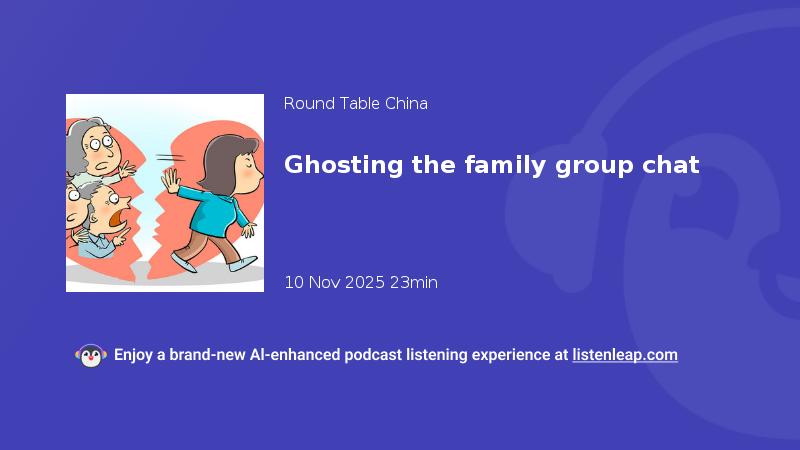
The digital family group chat is in crisis mode now.
Originally this was a tool for connection, but now it's just a common sight of friction and it's prompting a silent withdrawal by the younger generation.
But it's not a rejection of family per se, it's just a rejection of the platform's demands.
This triggers something different happening in family relationships, though perhaps maybe some of the older members of the group not so happy about the exit.
After that, if your Monday needs a kick in the pants, stick around for today's motivational monday.
Our podcast listeners can find us at roundtable china on apple podcast.
And don't forget, we love hearing from you too, so send a voice note our way to roundtable podcast at qqcom.
That's roundtable podcast at qqcom.
And now digital family group chats.
Even those words family group chat might induce anxiety, Really.
In some of our listeners.
I'm already shivering the way you say it.
Well, they were originally meant to keep relatives in touch, and that's exactly what they do.
But they're increasingly becoming spaces of stress and obligation for members, the younger members of the family.
Many youngsters are exiting from or neglecting such chat. groups, but why are they doing it?
Why are they doing it now?
And then what happens to the relationships in the family when you break up with the family through the group chat?
And, as I mentioned a moment ago, I can imagine that some of the older members of the family might not be a big fan of the younger members just quitting on the group, digitally or otherwise.
So what exactly is going on here?
Yeah, this has been happening around these kind of family group chats.
But First of all, do you guys have these family group chats?
I do.
You do?
Yeah, unfortunately.
Not in China, of course.
Okay.
But yeah, my family has a group chat.
My family kind of is divided geographically speaking.
I'm in China.
One of my sisters lives in Ottawa in Canada.
The rest of my family lives Well.
My other sister lives in one part of Nova Scotia, then my parents live in another.
So we're kind of all separated, which is what the group chat is for.
When you're separate, you don't all live together.
Then you need a tool like this.
So these kind of uh, family group chats they are originally intended to uh for members to connect right, and then family chat groups have become a source of nowadays, stress and maybe some of the obligation for young people, leading many of them to exit or ignore these groups and um, These groups or these young people are often filled with.
I mean, these groups are filled with some of these health tips articles.
Oh, yeah, that's iconic.
Oh, is it really?
Yeah, and life advice asking you questions about your career plan or something like that from older relatives.
While meaningful conversations are rare, that's a lot of these like experience of these young people that are in these family groups and then they feel pressured to respond, even also politely, or send greetings even when they would rather disengage.
Here's the thing.
Maybe we didn't even ask to be part of it in the first place, but somehow we ended up in there.
You get automatically added.
Right?
After a few family reunions, your dad polluted or your aunt polluted, and now your role in the group is basically the kid to get all the criticism.
Show the unity.
Yeah.
It's a big family.
How many people are usually?
I mean, of course, every family is going to be different, but just generally speaking, how many people are we talking about when we're talking about a family group chat?
For mine, I think there's maybe eight people, nine people, 10 people max in the family group chat.
For mine personally, that number is six the last time I checked.
That's pretty small.
Yeah, that just include instant family members and maybe the very close brothers and sisters of my parents.
So that's not very big of a group.
We used to have a much bigger group.
Oh, what happened?
Did they quit?
That involves like 20 people.
What happened?
Just nobody talking there anymore.
That's the thing.
It's like we all get dragged in after one family reunion in one spring festival season.
I think that's how it happened.
And then people just sent something per week, sent something in it per month.
And then people just gradually stopped sending health tips into those groups.
And yeah, it's there somewhere in my WeChat.
Question.
When you leave a WeChat group...
Can you do so silently?
You can now.
Back then, it was like it shows to everyone.
You should have left the group.
This giant billboard.
You see, that's one major reason why I haven't left my family group.
Because first of all, everybody's going to know.
And secondly, they don't see it as the kid leaving the group.
They see it as, oh, the daughter of my brother left the group.
So, hey, brother, what's going on?
She brought shame to the family.
Exactly.
I fear for controversies like that.
And truly, I don't really speak or do anything.
And I just lay low and remain quiet.
And that's...
Just something that's very across China, very common among young people nowadays.
They mute their family groups.
Some of them just quit them once and for all.
And what started as a sweet way to stay connected like you said Steve, to stay still digitally connected with your families now has for many, turned into a source of stress and digital phobia fatigue.
It's not just stress and digital fatigue, though.
There are other reasons for this.
There was an example of a 27 year old.
I'm not sure if it was a man or a woman who was born in Fujian, but now works in Shanghai.
So those two spots are pretty far away from each other.
Anyway, they didn't go back to their hometown very often, didn't really talk to people that often, I guess.
But people in that hometown of Fujian have a strong sense of like family, clan and they do talk to each other a lot.
But because they lived in Shanghai they found that they had really nothing to contribute to the chat.
And I kind of understand that too, because in my group chat, you know, my sister will put like a picture that shows her dog, you know, doing nothing, and And then it's like oh, the dog's name is Kaylee.
Oh, look at Kaylee today.
And then the other family members will say like, oh.
And then somebody will like heart the picture or something.
And I'm like, you know, it's 13 hours later in Beijing.
Oh, yeah.
You know what I mean?
Like it's like 6 a.m. when I get that message.
So I don't really feel the need to connect.
So what I'm saying is I understand that guy from Fujian who lives in Shanghai.
Well, another interviewee here, Xiao Kui, who is a 24-year-old student.
She described her family group as a place full of bragging and subtle comparisons, rather than distancing alone.
So she noticed that there is this invisible hierarchy inside the group chat where relatives with relatively better physical living standard or higher standard, with more money, incomes or businesses they tend to get more attention, while others were often ignored, even when they share something thoughtful.
And that kind of unbalanced situation makes her just feel like distancing away from the group actively.
Sometimes you didn't even do this intentionally.
Yeah, you just subconsciously start to...
Yeah, send a red envelope uncle, expecting that rich uncle to just send.
You know how it works on WeChat.
You can send digital red envelopes, especially during spring festival season.
What's the rich uncle doing?
Sending out digital red envelopes for everybody to- That's cash.
That's cash.
What kind of cash?
That's real money, but digitally.
What's the problem there?
It's not really like a problem, but the expectation of that rich uncle.
Always have to do that because you live a higher standard of life than the rest of us.
Sometimes it can cause misunderstandings.
People from the same generation will think, okay, wow, my brother's doing that.
Should I do that too?
Oh, yeah.
The competition.
Yeah, that kind of subtle competition and comparison is coming up.
Or sometimes it's even...
The generation's parents are comparing that.
Okay, my son or my daughter can do that now.
What about yours?
That kind of thing.
No, it's like the 15th National Games has suddenly come to your family group chat.
Yeah, your group games, that kind of thing.
No, I get the part about the humble brags like oh, I got this promotion at work or I got this grade on this test or something.
Whatever.
Right.
And then if you don't get the promotion or if you don't get that grade, not only do you feel like, oh, I guess I can't.
I have nothing to add to this group.
But you also start to feel bad about yourself, I guess because you're constantly comparing yourself to to other people in the clan in some ways.
Yeah.
But still, though, isn't it an extreme step, though?
Because the point of this story is that people are quitting.
They're not just staying silent.
They're quitting now.
I guess for those who are quitting it really hurts them in a way that it comes down to boundaries, or rather the lack of boundaries for some of them.
Here is one example, a 33-year-old lady, I believe, from Shandong province.
So she has a very big extended family back home, back home in her hometown, but she barely knows any of her distant relatives.
And a few years ago, one of her father's uncles that's like a grand uncle or something he started pressuring her to get married soon.
In the group chat?
In the group chat and just telling her well, you're getting to that age girl, you need to.
She's 33 by the time, and saying that to a lady is
Well, I've had that issue too, let's say.
I mean, saying it to another human face-to-face is bad enough.
But passive-aggressively putting it in the family group chat is brutal.
I think what this young lady in this particular case did exactly the same as I did.
We just say, thank you for the note, but I've had my plans.
Thank you very much for the note.
After that, she just quit the group for obvious reasons.
I stayed in the group for the reasons I've stated earlier.
That's polite enough, I would say.
I could have said, it's none of your business.
Like I said, it comes down to the breaking of boundaries.
So in these cases it makes perfect reasons, in my personal perspectives, that a young person choose to quit the group.
The point is that a lot of these elderlies, they will ask you these questions for...
They think that they're for the sake of caring.
And then a lot of these questions about maybe your marriage, your career plan, your salary.
And when they ask him, they're in front of the whole family.
You're the kid.
So it's your job to let us know how you are, including how much you earn, right?
You can see how stressful it can be.
I've been a victim of that for years, guys.
I'm starting to understand this a little bit more.
So people are feeling like, I just don't want to deal with this at all.
But then when you do quit... Okay, so let's go back to that point.
If you quit and you can't do it silently, but you said now you can.
But even if you quit silently, then the family members, they might be able to figure it out, right?
Because if they text you or your name comes up and then there's like radio silence there um, the older people in the family might see this as being quite disrespectful, could they not?
Yeah, many older relatives take this kind of action as a challenge to traditional family norms.
In their belief, it's just um, there's it.
Shouldn't be you quitting this conversation?
First, you're the the kids role, in which case we're doing it all out of our good wills for you.
So you should feel blessed instead of instead of rejecting.
So quitting is a clear sign of rejection, and leaving is seen not just as stepping away from the chat, but as stepping away from that expected familial duty and participation that they're trying to put on you.
So in that scenario, it's totally a disrespectful act from the younger generation.
Do you see it that way?
Do you see it as disrespectful if people leave the group chat?
Oh, no.
No?
Why?
It's their personal choice, and they are old enough to make their own choices.
So for me, as someone who has been wishing to quit the family group for a long time... Chat.
Group chat.
Yes.
For a long time, I would totally see it as reasonable.
And that's because a lot of these young people they are thinking about okay, maybe of course we want that kind of connection within our family, but we are not necessarily all focusing on these group chat.
We can have one-on-one chat if we want.
If we have a good relationship together, we can have phone calls or video calls from time to time.
Actually, my family members, they do video calls from time to time.
Well, I think the thing is, and I think this kind of transcends culture.
We can find a crossover here between Chinese and Canadian culture and just world culture.
There needs to be a little bit of a barrier, right, between the members of the group.
And when you have access to, when you're all in a group chat, there's no barrier.
It's 24 hour, seven day a week access in the sense that if you get tagged in a message, that could come at any time of day, any day of the week, as opposed to the traditional way of waiting for spring festival before you hear the questions about when you're going to get married or something like that.
True, and many young people, despite um staying muted or quitting the family groups, they still have one-on-one private chats with many of their um family members, especially in this not so distant family members.
And even after leaving group chats, many still prefer direct messages with their um, or rather uncles and grandparents or specific relatives.
It feels more genuine that way.
Sure.
Especially during holiday season.
If I'm to send out a Happy New Year note to all of my relatives, I make sure I do it differently for each person I'm wishing.
It's not like one general message, Happy New Year, everyone, and that's it.
Yeah, and this isn't a culture difference either.
I mean Americans have family group chats, Brits have family group chats Canadians, we all have family group chats.
And I think maybe the anxiety levels might be a little bit different by the sounds of things, but they still do exist.
And I would say this is probably I think this is the convenience brought by internet, but also maybe when we we are having too much of this convenience.
There's a Chinese word, it's called 物极必反.
That means something when you have something to extreme extent, and then it will go counter your initial initiatives.
So when we're having, like these kind of group chats actually make us Are all of their relatives and family members closer.
But when they're too close... Then you can push them away.
Yeah.
I remember I used to have a video chat with my parents once a week.
This was years ago.
Years and years ago.
They ask you when you're getting married?
No, no, no.
I never got those questions.
But we would have our video chats or whatever.
And then I remember these messenger services started to become really popular, right?
But mom and dad weren't aware that the messenger services existed.
So i would chat with my sisters from time to time.
You know like hey, how's it going, stuff like that.
But we didn't tell our parents about the messenger services.
Then one day on messenger i got a message from mom.
It said hi.
Two minutes later i got a message from my sister.
It said you're welcome.
And I was like oh, mom knows about the messenger now.
And then after that, it was the 24-7 access.
Welcome to the messenger family group.
Yep, exactly.
That was years and years ago.
Well, I mean, I don't know.
If you're in the family group chat and you find it annoying, I say maybe put it on silent mode.
Put the notifications on silent mode, but don't quit.
Family's family, whether you like it or not.
Just hang in there.
And one day you'll be in the position where you get to ask all the annoying questions.
Just wait it out.
Play the waiting game.
You're listening to Roundtable.
Stay with us.
Up next is Motivational Monday.
Motivational Monday.
Motivational Monday.
Motivational Monday time.
Yushan, kick us off today.
Well, one big reason why I mentioned that I tend to message my relatives privately one-on-one is because I just did that last night.
And I chatted with my aunt for a long time, a few hours until late night, 11 pm I believe because she's having a very tough time now because her very close companion in her case is a 24 or 23 year old cat is at that stage of dying.
And she is grieving while having to being forced to accept the fact that it's probably the time to say goodbye.
And that's when I read a lot of articles, both in English and in Chinese, to just kind of encourage her in a way that, Even though it is a hard fact, we can still look at the motivational side of it, which is how it helps us to grow inside and also how it teaches us to learn to say goodbye to those that's very dear to us.
You know, it's strange how quiet in a home, how it feels heavier after a pet is gone.
So the absence is so loud.
It's just there.
You can feel it every single day.
Psychologists, they say that the grief of losing a pet can actually help us grow.
It reminds us how fragile life can be and also how resilient we can be in facing these sorrowful moments.
So each time we say goodbye to a pet, we're reminded that love and loss always come hand in hand.
And we learn that grief isn't something to rush through or hide from.
It's something that we walk with.
We bear the Very happy memories that our pets has brought us throughout the years and slowly gently, until it softens into gratitude, saying thank you for spending all these years with us.
Yeah, well said.
You know they say when you get a pet you are going to agree to have the best day of your life and the worst day of your life because of the life expectancy.
But, you know, the joy that they bring to the family far outweighs the pain of losing them.
No, sorry.
Did you say that's your aunt?
Yep.
Sorry, your aunt's going through that now.
Thank you.
Yushim, what do you have for us today?
Yeah, my motivational Monday is actually inspired by the National Games.
So, athletes across...
China are training with one mindset show up, push forward and also keep improving.
You don't need to be preparing for a like major competition to live with that same spirit because, as we have already mentioned that, you don't have to be a professional athlete, can still take part in the national games.
But what stands out is not just the scale of participation, but the spirit behind it, right?
Every athlete, whether a seasoned champion or a first-time contender, arrives there because they've endured years of early mornings setbacks, maybe some self-doubts, and also countless repetitions and exercise and training that no audience ever sees.
So their presence on the field is a Such a big reminder that true progress is forged through relentless effort and the courage to keep pushing, even when no one is watching.
So these athletes show the depth of China's sports talent and the powerful momentum of its next generation.
And, more importantly, they embody a simple truth, that is, strength is built day by day, step by step, and through the grit to pursue your goals and the heart to never give up.
Yeah, these athletes are amazing because, you're right, they train, and train, and train.
Some will spend their whole lives preparing for that particular moment and the pressure that must come when you're finally on that stage.
The audience is there cheering and screaming and the TV cameras are all around.
That's a lot of pressure for one moment right, that you spend a long time preparing for, But it's kind of a cool thing for them to be there at all.
And if they win, well, just that's the cherry on top.
Yeah, that's really cool.
So what about you, Steve?
For me, also sports related.
This is from an Olympic gold medalist from London from 2012.
Her name is Jessica Ennis Hill.
And she said she was a heptathlon champion.
She said, the only one who can tell you that you can't win is you.
But that's not my favorite part of this quote.
The last part is my favorite quote.
And you don't have to listen.
So the full quote the only one who can tell you that you can't win is you.
But you don't have to listen to yourself.
Meaning when you have self-doubt and you say, I can't win.
I can't do this.
I can't be successful.
Turn to yourself and say, yes, you can.
You don't have to listen to that opinion in your brain.
Yeah, kind of cool, right?
Yeah.
All right, well, there you go.
That'll do it for today's roundtable.
Thank you very much for sharing your time with us.
For Yushun and Yushan, I'm Steve.
Have a good one, and we'll see you next time.