

[The Dynamics of Parental Attention and Sibling Rivalry]-[Georgie Feels Neglected by His Dad | Young Sheldon]
📋 Summary
Navigating Familial Tension and the Burden of Expectations
The Intellectual Divide and Parental Favoritism
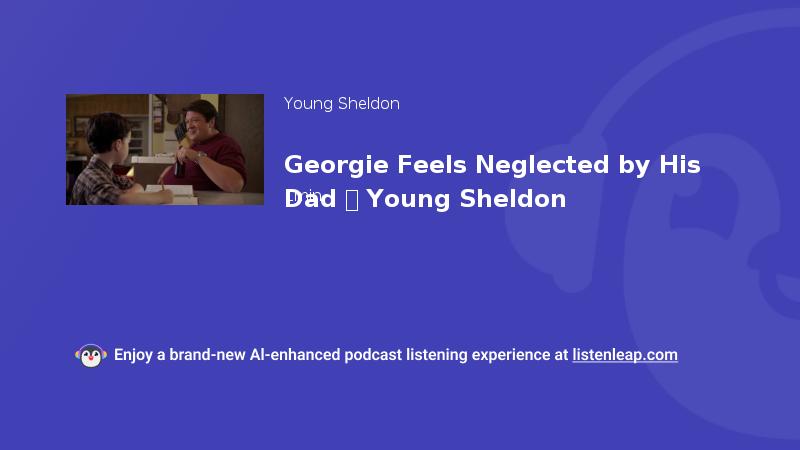
The podcast snippet highlights a palpable tension within the household, primarily centered around the disparate ways the father interacts with his two sons, Sheldon and Georgie. The father’s attempt to bridge a gap with Sheldon by inviting him to "knock around a few ideas for the Freeport gang" establishes a collaborative intellectual bond. However, this interaction immediately alienates Georgie, who feels sidelined. When the father offers a "solar powered" pocket calculator to Sheldon, he ignores Sheldon’s arrogant retort—"I don't need a calculator, Dad. I am one"—showcasing a specific kind of indulgence toward Sheldon’s intellectual superiority that is clearly absent in his interactions with Georgie.
The Conflict of Discipline and Resentment
The domestic friction escalates when the father attempts to enforce order in Sheldon’s room. The interaction serves as a microcosm of their power struggle: the father demands, "You need to clean this mess up," while Sheldon displays blatant defiance by stating, "I'll get to it later." The father’s frustration manifests in an authoritarian outburst, leading to the punishment: "You are grounded." This moment captures the exhaustion of parenting a child who views himself as intellectually superior to the rules. The father’s subsequent admission, "I feel bad about yelling at Georgie," reveals a complex internal conflict, as he recognizes that his disciplinary actions are inconsistent and perhaps influenced by the emotional turbulence created by his focus on Sheldon.
The Mother’s Perspective: The Need for Balance
The mother plays the role of the observant mediator, pointing out the underlying issue of sibling rivalry. She sharply reminds the father, "I think he's feeling left out now that you and Sheldon are spending so much time together." Her intervention highlights the father’s hypocrisy; he is criticized for his selective attention, despite having previously urged the father to "find something in common with Sheldon." This dialogue underscores the difficulty of parenting multiple children with vastly different needs and capabilities, where the pursuit of a connection with one child inadvertently leads to the neglect of another.
Sibling Dynamics and the Pursuit of Inclusion
The conclusion of the snippet reveals the resilience and opportunism inherent in the sibling relationship. Despite being grounded, Georgie seeks a way to remain relevant to his father’s world. When the father asks, "You want to join me?" Georgie’s response, "I'm grounded," is met with the father’s complicity: "I won't tell if you won't." This secret alliance suggests that the father is attempting to rectify his previous coldness. However, the mention of Sheldon as a "little snitch" and the reference to his "little Asian friend" who can handle the math indicates that the competitive nature of the household remains unresolved. The family is trapped in a cycle where intellectual capability is the currency of value, and those who lack it—or are perceived to lack it—must resort to circumventing the rules to earn the father's fleeting approval.
Deep Learning with ListenLeap


