This is Eric Glass.
On This American Life, we specialize in compelling stories from everyday life.
I was like, wow, you've literally just died and came back.
And the first thing you ask is, do you need any money?
Your Life Stories, really good ones in your podcast feed, This American Life.
In the recent flurry of Cabinet nominations Donald Trump has been proposing, one name stood out to us.
Trump's pick for Treasury Secretary Scott Besant.
And that's because Scott Besant has worked in finance for decades, including for George Soros' hedge fund back in the 1990s.
And it just so happens that when the announcement came out, we were most of the way through making an episode about George Soros' hedge fund back in the 1990s.
Our show about something that happened three decades ago turned out to be way more topical than we thought it would be.
Now, what we made is not exactly the Scott Besant origin story, but, you know, come for the Treasury Secretary backgrounder.
Stick around for the epic finance story.
Or just come for the epic finance story.
Either way, here is the show.
This is Planet Money from NPR.
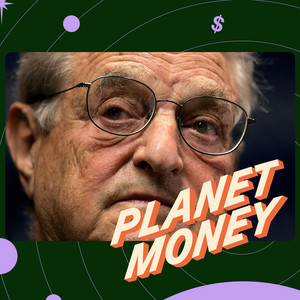
The name George Soros means a lot of different things to a lot of different people.
For some folks, he is primarily known as a philanthropist for his support of human rights and democracy around the world.
Here is Soros on Fresh Air in 2006 talking about the foundations he funds.
Basically, the function is to support civil society in holding governments accountable.
Soros has also become kind of a boogeyman and scapegoat to folks on the right for his support of progressive policies.
Often this has a fairly overt anti -Semitic tinge.
For example, this 2010 clip from Glenn Beck.
You have to see who's behind the puppets.
Who is choosing the puppets and the players?
Who's the puppet master?
George Soros. Today, we are going to go back in time before all of those versions of Soros to the story of how George Soros made his name in the first place, which was in finance.
In particular, we are going back to this one trade that his hedge fund made that was so big and so bold that it became the stuff of legends.
While we did not finagle an interview with George Soros himself for this show, we did get to talk to one key member of his team who was right at the center of the whole thing.
Go ahead and just say your name.
A .B .C .D., Robert Johnson, time and time again.
Hey, you're sounding good.
All right. This story takes place in 1992.
At the time, Rob Johnson was in the process of leaving his job at an investment bank to join Soros' hedge fund as a managing director.
Back then, Soros was running his fund out of an office in Midtown Manhattan, which Rob remembers as surprisingly unimpressive.
It had a nice view of the central park, you know, the foliage and that kind of stuff, but it wasn't set up to be intimidating and glorious and grandiose at all.
Boxy, 1990s computers, piles of paper everywhere.
There's like duct tape on the floor where the carpet's worn out.
It was like, you know, how do you say, the elbows are worn out on the sweaters and people were just working hard.
What was impressive to Rob were the people who worked there, in particular, George Soros and the man in charge of running the hedge fund day to day, Stan Druckenmiller.
Every now and then, the two of them would invite Rob over to pick his brain about Rob's area of expertise, which was foreign currency markets.
I felt like I was going to piano lessons and listening to Beethoven and Mozart.
These two guys were really, really extraordinary.
Earlier that year, Druckenmiller had been talking to the analyst who covered Europe for the fund, Scott Besant.
Besant had told Druckenmiller about all this trouble the British economy was having, and Druckenmiller had realized that this trouble had created an opportunity to go against the British currency, to essentially short the pound, which he thought was overvalued.
And he put down some big bets over $1 .5 billion of the $5 billion the fund managed.
The idea was that the UK Central Bank was vulnerable and that at some point, they'd have to let the value of the pound go down.
Soros and Druckenmiller wanted Rob's take on when he thought that would happen.
Well, how long do you think they can hold out?
And we talked about it among the three of us, and these aren't things you know for sure, but I said, I don't think they can last three months.
Rob, what do you think the probability is that they're going to devalue in three months?
And I said, about 95%.
They get Scott Besant on the phone.
He is in complete agreement.
And he said, well, no, these guys are really under strain.
I don't think this is going to last either.
And Soros is sitting there looking at Druckenmiller and Rob.
He's like, if you guys really think this is such a great idea, bet the whole fund.
In fact, use leverage.
Borrow even more than all the money the fund manages.
So yes, make the bet.
But don't do it for $1 .5 billion or even $5 billion.
Do it for $15 billion.
And I'm thinking, the permission I just got is bold.
It's enormous. It's like, oh man.
It was like an adrenaline rush to say we have this much confidence and we just got licensed to go after this, this aggressively.
And while Rob is processing this, he remembers Soros uttering a phrase that would become legendary in the world of finance.
There comes a moment when you have to go for the juggler, which is you have to decide you're right and go for it.
Hello and welcome to Planet Money.
I'm Keith Romer. And I'm Alex Goldmark.
The trade that Stan Druckenmiller and George Soros wanted to make would go down in history as one of the most audacious bets any traders have ever made, one in which a single hedge fund took on the full economic might of the British government.
Today on the show, we deconstruct that famous trade, what Soros, Druckenmiller, Besant and Rob Johnson saw that made them think they could pull this off and what their bet can teach us about what happens when markets and governments go to war.
From the online trends that dominated 2024.
On the spectrum of Brat to Demure, where are you right now?
To spicy TikTok viral reads.
These romance fantasy books about dragons.
NPR kept you up to speed on pop culture all year long.
Give back to the news source that just hits different by donating today at donate .npr .org.
And thank you. Hi, it's Marielle Segara from Lifekid.
There's a first time for everything, including giving to NPR.
Whether you're a brand new listener or a long time fan, please join the community of NPR network supporters today.
Make your gift at donate .npr .org.
And thank you. Support for NPR and the following message come from the Walton Family Foundation, working to create access to opportunity for people in communities by tackling tough social and environmental problems.
More information is at WaltonFamilyFoundation .org.
So on one side of this massive potential bet we have sources hedge fund.
And on the other side, we have the United Kingdom.
And we are going to start by focusing on the UK side of things.
Okay, so back in 1992, the UK had gotten itself in kind of a tight spot.
A couple of years before, they had signed up to be a part of what was essentially a precursor to the euro.
It was called the exchange rate mechanism, or ERM for short.
The countries involved weren't ready to share a currency.
Instead, as a kind of baby step, the ERM just said they had to keep their exchange rates more or less fixed against each other.
So central banks all over Europe had to really stay on top of the value of their currencies.
With a tiny bit of wiggle room, a French franc had to trade for this many Italian lire, a lira had to trade for this many Spanish pisetas, and so on.
The UK's prime minister, John Madre, he had been a big advocate for joining the ERM.
He was convinced that if the Bank of England could keep the British pound locked in line with these other currencies, it would help stabilize the British economy and bring down inflation.
It would keep the British economy disciplined.
That was the idea, but things didn't exactly work out that way.
Well, unfortunately, at the same time as the UK decided to join, Germany started to reunify East and West Germany.
That is University of Michigan professor of economics and public policy, Catherine Domingues.
Catherine says Germany started spending gobs and gobs of money.
Part of the reunification involved a lot of transfer payments to the East, a lot of new investment to try to bring the East closer to the West.
And all of that spending at the German economy running pretty hot.
Meanwhile, the UK was in recession.
So people looking to invest were like, why would I keep my money in the struggling UK when I could invest it in booming Germany instead and make more money?
But to do that, the first thing those investors would need to do is trade in their British pounds.
If they want to invest in Germany, they have to move out of whatever currency they're currently holding into marks.
And a currency works like any other asset.
It follows the law of supply and demand.
If people want a currency more, the price goes up.
If people want it less, the price goes down.
Okay. So it's like people want to get their hands on German marks and they are buying them and that's driving the price up.
Exactly. That's exactly what was happening during this time period.
The mark was strengthening.
And that meant on the flip side that all the other currencies were losing value.
And here's why that matters.
Remember, when the UK joined the ERM, it agreed to fix its exchange rate to the other currencies in the group.
The lowest the value of the pound could go in relation to the Deutschmark was one pound to 2 .778 marks.
But all that money flowing out of the UK and into Germany was pushing the value of the pound down and down and down.
So much so that people were starting to wonder, maybe the UK should just quit the ERM.
Or if the British didn't want to do that, maybe they could at least renegotiate their deal, lower that 2 .778 threshold and essentially devalue the pound.
The British government was very clear.
There's no way we are not doing that.
Just in case there is the slightest scintilla of doubt, there are going to be no devaluations, no leaving the ERM.
British Finance Minister Norman Lamont went out on the steps of the Treasury and basically drew a line in the sand.
We are absolutely committed to the ERM.
That is our policy.
And we will do whatever is necessary.
And I hope there is no room for any doubt about that at all, that the government is determined to maintain our position.
Now to understand the options on the whatever is necessary table for the UK, we're going to have to talk about interest rates.
It is frankly amazing.
We've managed to avoid talking about them until now in the show.
But yes, it is time.
Okay. For this story, what you need to know is that other things being equal, people tend to move their money from countries with low interest rates to countries with higher interest rates, like moving from a savings account that offers 3 % to one that offers 5%.
Germany, remember they were spending all this money because of reunification.
So they were trying to keep their rates high because they were worried about inflation.
Meanwhile, the British, they were trying to get out of a recession.
So for them, it would have been really nice if they could have lowered their interest rates to juice their economy.
But if the British did lower rates, then even more money would have flowed from the UK to Germany.
Unless Germany was willing to bring down its rates too.
So at this big meeting of European finance ministers and central bankers, the British start really pushing the Germans, the UK's finance minister, Norman Lamont, he just lays into the head of Germany, central bank, the Bundesbank Lamont is banging his fist on the table.
And he is like, why won't you lower your interest rates?
The German central banker who got yelled at, his name was Helmut Schlesinger.
He talked about this moment to the BBC for a documentary they made.
As a member of the Bundesbank, one is an independent person.
One cannot be treated as an employee.
It's not possible. One cannot accept it.
And I thought, he's not my master.
I must bring this exercise to an end.
And I said to finance minister Weigle on my side in Bavarian dialect, I think I should go now.
Safe to say the Germans are not convinced to lower their interest rates.
So if prime minister John Major really wants the UK to stay in the ERM, the British government has pretty much just one option left.
It can keep the value of the pound up by buying pounds.
That is how they can try to prop up demand.
Yeah, like any central bank worth its salt, the Bank of England does have a fair amount of foreign currency on hand.
Dollars and French francs and Deutsche marks.
And because of the ERM, it is committed to spending those foreign currency reserves to keep the pound above that 2 .778 threshold.
But there is a limit to this strategy.
The Bank of England has billions and billions worth of dollars and francs and Deutsche marks.
But not like infinity dollars and francs and Deutsche marks.
They could theoretically do so much buying that they run out of all of their foreign currency reserves.
And this is where our story turns back to Rob Johnson and Stan Druckenmiller and Scott Besant and everyone else at George Soros's hedge fund.
It's early September.
Druckenmiller, Soros and Rob have just had that conversation where Soros told them to bet three times the funds value $15 billion against the pound.
And it is worth sitting for a second with the mechanics of the bet they were going to make.
All right, let's do that.
They've been paying very close attention to the UK's attempt to prop up the pound.
And what they noticed is that when the Bank of England did manage to move the value of the pound up, it only moved up the tiniest bit.
But if the UK were to come under so much pressure that they had to abandon those fixed exchange rates, devalue the pound, the pound would just fall and fall and fall.
All of which sets up this kind of rare dream scenario for an investor.
Rob says, think of how the British government is propping up the pound as a system.
Where if the system holds and you're betting against the system, you lose about 1 % or something like that.
And what happens if it breaks?
Well, it'll probably go down 18 to 20%.
So you have a 20 to 1 bet.
So a lot of upside if Soros's fund is right and very little downside if they're wrong.
Now, there is not some casino somewhere where you can roll up with $15 billion and say, I would like to bet that the British pound will go down in value.
Instead, the way you make a wager like this is you go to a bank or I guess lots of banks and you borrow as many pounds as they will lend you.
And then you turn around and use those pounds to buy Deutsche marks.
If the value of the pound does in fact go down when it comes time to pay back those pounds you borrowed, you will owe less than what you borrowed and you will get to pocket the difference.
So by this point, the fund is already borrowed enough pounds and bought enough Deutsche marks to a massive position north of $1 .5 billion.
But in that quiet period at the beginning, it was about little bits everywhere so nobody could see that you were becoming a tsunami.
They just thought there were little ripples on the water.
To avoid tipping off other traders to what they're up to, they make sure to spread their bets all over the place.
So all around the world, there's a lot of accounts now that say Soros on them that just are filling up with Deutsche marks.
That's right. Over the course of a week, their bet grows and grows.
And Rob says, so does the pressure on them personally.
When you're involved in an intense episode like that physiologically, the kind of adrenaline makes it pretty hard to get a good night's sleep.
You're on edge, you're checking currency prices.
It's like, is it right at the boundary?
Is it a half percent off what's going on in the other currencies in the system?
Rob would get up at around 3 a .m., go into the office at around 5 a .m., and stay there until the U .S.
markets closed. Even when he goes home, he's watching markets around the world.
And he is in constant contact with the fund, which is complicated by his domestic arrangements.
My wife was a New York Fed official.
I didn't want to talk in proximity to her.
Because at the time, if your wife had heard, she'd have a responsibility to inform the people at the New York Fed and the Federal Reserve System.
What Soros's fund is up to is perfectly legal, but Rob doesn't want the Fed telling their buddies at the Bank of England what they're doing, you know, give the British a chance to get out ahead of it.
So when he wants to talk to folks at the office, he sneaks out to his car and calls them on his car phone.
The size of the fund's bet against the pound starts to creep up, past $2 billion, an incredible amount of money, but still nowhere near the $15 billion that Soros authorized.
And this is by design.
They are super confident that at some point, the British are going to have to devalue the pound, but they don't know when it's going to happen.
And if they are going to risk another, you know, $13 billion, they want some very clear sign that things are about to go down.
Then on Friday, the 11th of September, they get their first glimpses of that sign.
The Italian lira, like the pound, is a currency in the ERM that has been struggling to keep up its value.
And the lira ends up coming under so much pressure that over the weekend, Italy is forced to devalue it relative to the Deutsche Mark by 7%.
That doesn't necessarily mean the pound is done for.
Italy's economy is in pretty rough shape.
And Italy has devalued a bunch of times before.
But Rob and Soros and Druckenmiller, they start to move.
Rob Bamberger Part of what we try to do is be kind of gentle until we had enough of a position on and then had, how you say, press it.
But as we got into the 13th, 14th of September, you could feel the pressures and you could feel the market building up like it could get away from us.
So the fund accelerates their plans, borrowing even more pounds to buy even more Deutsche Marks.
We could be right. But if we were too gentle, we wouldn't get a big enough position on.
So we started pressing.
On Tuesday the 15th of September, their sign to take action turns into a flashing neon billboard.
The head of Germany Central Bank, Helmut Schlesinger, the guy from the meeting who didn't want to be pushed around, he makes a comment to a journalist.
He says that he thinks more countries than just Italy might need to adjust the value of their currency.
He doesn't mention the UK by name, but he doesn't need to.
Robert Bamberger And what that did was it fortified our confidence that, oh boy, the Germans aren't going to let them out of this pickle.
And now the whole world's going to see this.
They're all going to dive on the pile.
Michael Schlesinger The news of Schlesinger's comments comes out in the afternoon New York time and the Soros fund goes for the jugular.
Robert Bamberger That's when we just started banging it every few minutes, 500 million pounds, boom, boom, boom, right at the boundary.
And it basically went through the night and into the next day.
Michael Schlesinger It's not clear when exactly it happens that night, the next day, but at some point the role of Soros's fund in this drama shifts from a player that is just betting on the outcome of events to one that starts to actively shape those events.
Robert Bamberger When markets open in the morning in the UK, the Bank of England intervenes twice in quick succession, each time buying at least 300 million pounds, trying to move the price up from that 2 .778 Deutsche Mark threshold.
Michael Schlesinger But remember, Soros is trying to sell $15 billion worth of pounds.
300 million? It's not going to do anything.
And this really is the fund's plan to sell so many pounds that the Bank of England has to give up on that threshold and just let the market drive the value of the pound down.
Robert Bamberger By 11 in the morning, the British government announces that it is doing the unthinkable.
Despite the recession in the UK, the Bank of England tries to juice demand for the pound by using its one other big policy tool.
It raises interest rates by a full 2%.
Again, it doesn't matter.
The pound won't move up.
The Soros fund keeps selling pounds and selling pounds hundreds of millions at a time, testing how deep into its foreign currency reserves the Bank of England is willing to go.
Michael Schlesinger Rob, watch as the whole thing play out from the fund's offices in Manhattan.
Robert Bamberger It felt like it was in slow motion to me.
And it felt like this is exactly what I expected to see unfold.
And there's nothing that's contradicting that we're on the right path.
The Bank of England started the day with over $40 billion worth of foreign currency reserves.
But they are sending out billions an hour buying up all the British pounds everyone is selling off.
Robert Bamberger And by now, all these other banks and hedge funds, they've also jumped in on this trade.
Robert Bamberger The tsunami of the whole world is going after this now.
We've got a pretty good -sized position on.
This is looking good.
Robert Bamberger In desperation, the UK announces that it will raise interest rates again, go up another 3%.
But it's too little, too late.
Stan Druckenmiller At 4pm London time, without making any kind of official announcement, the Bank of England just stops buying pounds.
They stop trying to prop up the exchange rate.
And the pound goes into free fall.
Robert Bamberger Stan Druckenmiller heard the news first.
Stan Druckenmiller He was in the next room, and he just came to me and he said, they just let go.
They just let go. And we kind of smiled.
But it wasn't like a locker room, big high fives and bouncing around.
It wasn't euphoric.
Robert Bamberger A little while later, a phone call came in from George Soros.
Stan Druckenmiller There was just kind of a little chuckle.
This is very good. It was quite serene.
Robert Bamberger That night, the British finance minister, Norman Lamont, went out into the courtyard at the Treasury building and officially waved the white flag.
Norman Lamont Today has been an extremely difficult and turbulent day.
Massive speculative flows continue to disrupt the functioning exchange rate mechanism.
The government has concluded that Britain's best interests are served by suspending our membership of the exchange rate mechanism.
Robert Bamberger The British were out.
They were leaving the ERM.
From here on out, the value of the pound would be set by the market.
Robert Bamberger The United Kingdom, once the most powerful empire in the world, had in one day been forced to change its entire economic policy because of a handful of hedge funds and banks.
The pound fell by about 15 % against the Deutschmark.
In the UK, September 16th, 1992 came to be known as Black Wednesday.
Stan Druckenmiller After the break, the world figures out who was responsible for breaking the Bank of England.
And now, over 30 years later, we try to get our heads around what exactly we're supposed to think about that giant bet that the Soros fund made.
Laurel Wamsley Hi, I'm Laurel Wamsley, and I cover personal finance for NPR.
That means I report on some of the questions that might keep you or your loved ones up at night.
Like, will I ever be able to buy a home?
What about retirement?
As interest rates drop, where should I put my money?
Economic headlines can be confusing, but NPR is here to help you make sense of them.
To support this coverage, please give today at donate .NPR .org.
Holiday travel is stressful, especially if you're dealing with family baggage on top of your actual baggage.
Robert Bamberger I'm going home, I'm going to revert back to old family rolls that are stressful.
And so this traffic jam is the straw that's breaking the camel's back.
Laurel Wamsley But don't worry, we're here to bring you some relief.
Listen to the Life Kit podcast.
We'll help you out this holiday season.
Tamara Kress You might have heard this song on TikTok blow up this summer.
Laurel Wamsley I'm looking for a man in finance.
Tamara Kress Trust fund.
Laurel Wamsley Six five.
Tamara Kress On It's Been a Minute, we're asking the big questions about dating.
Like, is it okay to date with money in mind?
And what are we really looking for from a man in finance?
To find out, listen to the It's Been a Minute podcast from NPR.
This message comes from the Kresge Foundation.
Established 100 years ago, the Kresge Foundation works to expand equity and opportunity in cities across America.
A century of impact, a future of opportunity.
More at Kresge .org.
Erica Barris Hey, it's Erica Barris.
A quick word to talk about this year and all the different kinds of stories you heard on Planet Money.
This year, we brought you stories about inflation, disinflation, stagflation, skinflation, dynamic pricing.
What is Teemu? Banking apps, rum taxes, the main potato war of 1976.
So many stories about so many different things semiconductors.
And the one thing they all have in common AI trade fraud is we work really hard on each of them.
International shipping so that they make you smarter.
And they're fun to listen to.
Tiny soda cans, zombie mortgages, why flying sucks.
And another edition of Planet Money Summer School.
So this is the time of year when we say, Hey, if that stuff was useful to you, if you made us a part of your day in the car on the train while you were doing dishes, chip in and help keep us going.
Your support matters so much that NPR basically invented an entire new product that we will give you to incentivize your donation.
We're talking about NPR plus.
Maybe you're already a plus supporter.
If so, thank you. If you're not and you sign up today, you get perks for more than 25 different NPR podcasts, sponsor free listening to all of them.
And bonus content for some of our biggest shows, including this one and exclusive access to special Planet Money merch in the NPR shop.
You get all that as a thank you for investing in NPR and our work at Planet Money.
So go to plus dot NPR dot org to sign up plus dot NPR dot org.
That link is in our episode notes and thank you.
Outside the financial world, nobody really knew at first who the big mover behind the collapse of the British pound had been.
Rob Johnson says that was by design.
We talked about not being communicative, like stay away from cocktail parties, no black tide dinners.
You know, just go quiet for a while.
It worked pretty well.
While the fund unwound its position and cashed in its profit, the public had no idea how big a role the Soros Fund had played until a little over a month later.
Gianni Agnelli, who is the owner of Fiat Motor Company, was in a dinner in London and announced something in the press that he had made more money being a George Soros investor than his motor company made that year.
The day after that dinner, the cover of the British paper, The Daily Mail, was a picture of Soros with the headline, I made a billion as the pound crashed.
That number, by the way, a billion, it seems to be right.
And if you take into account the additional bets that Soros fund made on British stocks and bonds and how they would behave after devaluation, the profits go well above a billion dollars.
The world of finance has a pretty easy to interpret scorecard.
How much money did you make?
And in that sense, Rob and Stan Druckenmiller and George Soros did very well.
This trade made their names, especially Soros.
But for Rob, he says it's more than that.
Many people said to me in the aftermath of that, well, we saw that coming too.
And the answer is probably right, because there was sort of what I'll call macroeconomic fundamentals.
But these things are always about timing.
And George Soros, Stan Druckenmiller, myself, Scott Besant, saw it just like other people, but we acted.
At the same time, Rob totally gets how some people outside of the world of finance view what happened.
He feels it too. What is this when small groups of people can take on large governments and prevail in this open, deregulated capital market system?
Years later, the British government did a study.
It calculated that the UK spent the equivalent of around five billion dollars trying to defend the pound.
Five billion dollars that they basically took from British taxpayers and gave to all the speculators betting that the pound would have to devalue.
And understandably, that made some folks a little salty with the headline name, George Soros.
And sure, if Soros's fund hadn't attacked the Bank of England so suddenly and so intensely, the British probably could have found a way to devalue the pound that wasn't so costly.
But Catherine Dominguez, the economist from before, she says even so, the impulse that some people have to be mad at George Soros, it's a little misplaced.
You know, we can blame George Soros or say that he made money off governments, but I guess I wouldn't really put it in moral terms.
It is one of the fundamental costs of a fixed exchange rate.
You're setting yourself up for the potential of a run.
I would say economic incentives were such that this was largely inevitable.
The British were probably going to have to devalue the pound one way or another.
It was just too far out of line with economic reality.
And in the years that followed devaluation, British goods got cheaper for the rest of the world, exports started to tick up, and the UK saw real economic growth.
Also, Catherine says it's worth keeping in mind that it wasn't George Soros who set up the rules of the currency game he played.
It was the European governments.
If you didn't want hedge funds to come in in this way, then you could have restricted their ability to do so.
If you have basically free mobility of capital, then I think you have to assume that if a price doesn't seem like the appropriate price, that there is going to be an attempt to make money off of that mispricing.
So, fine. This is how markets work.
People poke at the prices of things.
They make bets. This price is too high.
This price is too low.
And if they're right, they get to profit.
That incentive is what makes the whole thing go.
But every now and then, someone like George Soros and his hedge fund will come along and book a profit so massive that the system just seems absurd.
Not bad. Not evil. Just absurd.
Like, why should these people in Manhattan get a billion dollars from British taxpayers because they could see the UK was being too stubborn about its economic policy?
But on the other hand, why shouldn't they?
They are the ones who made the bet.
Three decades on from the trade, Rob Johnson says, yeah, he shares that ambivalence.
If I go to the equivalent of St.
Peter someday and try to get into heaven, we're not going to be talking about the British pound evaluation.
I mean, we won't be in the plus column.
It might be in the minus column, and I don't even care about that.
This episode was produced by Willow Rubin and edited by Martina Castro.
It was fact -checked by Sierra Juarez and engineered by Cina Lefredo.
Alex Goldmark, you are our executive producer.
I am. And I will say some of the archival audio we use today came from our friends at the BBC from a documentary they made titled Black Wednesday.
I also feel like I have to say the best way to support Planet Money and the work that we do is to become a member of Planet Money Plus or NPR Plus.
You get sponsor -free listening and bonus episodes.
And it really, really does mean a lot to us.
Please sign up at plus dot NPR dot org.
And thank you to everyone who already has.
I'm Alex Goldmark. And I'm Keith Romer.
This is NPR. Thanks for listening.
It's cuffing season, the cold months where we might look for a warm somebody to cuddle up to.
But dating isn't always warm and fuzzy.
And this year, there were so many big debates about how we love.
On It's Been A Minute, our cuffing season series will help you answer some big questions.
Like, what is the ick really about?
Or is it okay to date for money?
To find out, listen now to the It's Been A Minute podcast from NPR.