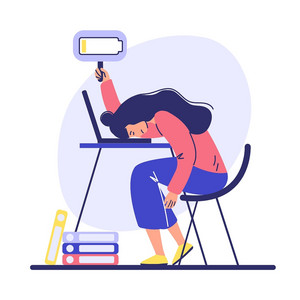
Hello, welcome to Roundtable, where we serve up piping hot debates on the issues that sizzle in China and beyond.
I'm Yeo Hong -il. You know, when I was a kid, especially in kindergarten, taking a nap was punishment.
Now it's a luxury, and it seems like today's young adults are nap pros.
But why do some of them claim that they feel tired all the time?
Whether it's the stress of work or too much TikTok, we are diving into the mystery of millennial and Gen Z fatigue.
Let's just hope we don't need a nap halfway through the episode.
For today's show, I'm joined by Yu Sun and Steve Hatherly.
Now grab your virtual compass and follow us to the heart of the discussion.
We live in a world of endless connectivity, where the line between work and rest has all but almost disappeared.
October 10th marks the World Mental Health Day.
This year's official theme is, it is time to prioritize mental health in the workplace.
I mean, it makes a lot of sense because for today's young people, exhaustion is a common companion.
But is this tiredness a symptom of something deeper, like societal pressure, a rebellion against the hustle culture, or just the natural result of our hyper -connected lives?
Let's explore why so many are feeling worn out and what that says about the modern life.
I have to ask this to the youngest member in the studio.
Okay, fine. I'll answer.
Yes, please go. Okay, you should.
What are you laughing at?
You should. What do you think?
Do you feel tired a lot, or how do you assess your level of tiredness, especially in working days?
To be honest, when I was looking through the paper for this topic, I can totally feel the same, that a lot of these interesting comments are commenting.
They're saying, they're feeling tired all day.
And whenever there's going shopping, they'll just sit in the shop, and then stand up going to another shop, and then sit down.
This is not - This is not young people.
They're just men, company, in their spouse, going to shopping.
Yeah, right. But anyway, I can feel the same, and I do feel constantly tired.
When you say constantly tired, though, I'm curious about that actual definition.
Are you speaking of your body feeling fatigued, like you don't have any energy, or are you speaking like your brain is just fried, you can't think straight, or are you speaking emotionally exhausted, or is it a combination of all those things?
I think most of the time, it could be both mentally and physically.
You will not feel excited to do a lot of things, and then you don't want to go out, but when you're staying at home, it's still not giving you energy to reboot, or something like that.
This is actually something quite interesting and quite delicate to discuss, because there are so many nuances.
We are going to definitely discuss whether or not this phenomenon is common enough so that it deserves the attention for people.
Because when we say we're tired, there's always a choice in front of you.
For example, if currently I say you shouldn't, you do not have to stay in the studio.
Now you have the day off.
You do not have to work anymore.
You - The woohoo is coming already.
But you're going to have to go to Universal Studio from this moment and enjoy the rest of your day.
You cannot do anything else.
You might still find the choice quite interesting and you'll welcome it.
You'll see I see the light in you -should's eyes right there, as if it's happening, it's not happening.
I'm so gullible though.
When I say there is a matter of choice here, I'm talking about you can always choose whether or not you're going to gather the energy in your body to face the task.
You're looking at right now.
Sometimes that is the situation.
In some other occasions, it's an actual fatigue that you cannot control, that you do not have choice over.
So there are so many different situations and so many different layers.
Yeah. Do you know what they call Gen Z by the way?
This isn't a joke. They're called the tired generation.
Yeah. This isn't just Yushin's opinion.
This is a shared global opinion.
I think this is an important thing to talk about on World Mental Health Day, according to a recent article by Life Lab.
That's a sub column under Life Week, a lifestyle magazine.
Young people born in the 2000s share this common, whatever you want to call it, this common mentality, this common feeling, which is always feeling tired.
Let's look to the internet to see what some people are commenting on this topic.
One netizen said, I don't do anything, but I still feel exhausted every day, just like I ran five kilometers.
For example, I start to feel sleepy after I click open a PowerPoint document at work.
And no matter how many hours I sleep, my muscles still feel weak when I wake up.
I have to lie in bed for at least two hours to barely get myself out of bed.
And even when I'm eating, this comment is particularly scary.
Even when I'm eating, I may lose the energy to continue eating halfway through dry meals.
This is already quite serious.
It is serious, but because I think it depends on different situations, I think the last one, you know, you feel tired when you're even eating.
It's most, in most cases, it's because the food is not that good.
See, that's what I'm saying.
For different symptoms, actually, there are different reasons behind it.
So maybe we should, well, to start with, look at some reasons why people are feeling tired.
To start with, we get to see that some people are feeling quite tired because their job requires them to have a lot of, you know, mental brain activities.
For example, if you are a programmer, you're a new programmer in a new company, and you're dealing with all of these codes that you're not that familiar with, and this high intensity debugging, of debugging.
Yes, for sure. Of programming would definitely make you feel tired.
Same goes with physical situations for those who are, for example, delivering food, delivering the parcels that we got online, they would have to, it's kind of like their city is their huge workout gym, and they workout eight or even longer than that hours a day.
And that would lead to fatigue.
And apparently, this hyper -connectivity, blurring the line between work and rest is another very important factor.
Yeah, always being connected to the internet, things like social media.
Sure, that plays a part.
Yeah, you know, I think the widespread use of all of these kinds of social media makes it difficult for a lot of people to fully relax, I would say, outside of their work, as they need to keep an eye on maybe messages in work -related groups at all times.
And in fact, many jobs now require you to be on standby 24 -7.
And for some people, maybe, you know, taking a quick five minutes to handle work during their, you know, relaxing time seems fine.
But for others, this can lead to some very significant stress.
Yeah, I think stress is stress and fatigue.
And the reason I asked you to kind of define or try to define where that tiredness was coming from is because I think it's related to an emotional exhaustion combined with the physical exhaustion.
The physical exhaustion of having to wake up early in the morning and having to get to the office or get to school and spend many hours there and then maybe some overtime work as well.
There's a website called alive .com, A -L -Y -V -E, if you want to look that up.
They interviewed or they surveyed Gen Z's and they found that 65 percent sleep less than seven hours per day.
So that means that Gen Z, generally speaking, is not getting enough sleep.
That's one aspect of it.
But the other aspect of it, that's the physical fatigue.
But then there's the emotional fatigue where they're constantly connected to the Internet like we mentioned, but they're constantly scrolling through negative feeds where you're seeing things like military conflict.
You're seeing things like natural disasters.
There's a terrible hurricane happening in America right now.
That's all in the news feeds.
And I'm not a professional psychologist or anything like that, but I assume that seeing those things on a daily basis combined with your physical fatigue of not sleeping enough, we learned that from the statistic just a moment ago, put all of that together.
And I think that's where we're getting this burnout, this emotional and physical exhaustion from.
Speaking of, you know, psychological effect or this emotional effect, I think it's more about work related.
Of course, if you are getting too much of negative information, you will feel tired.
But I think when young people are constantly feeling tired and that's because of their work, I think mostly it's because their work cannot bring them joy.
I think it happens a lot.
A lot of people, they're not doing the job they really like or they think it is not bringing them any encouragement or fulfillment.
And that is an area that you will feel tired because we have a word in Chinese, fei qing wan shu.
It is that you are so focused on something, you forgot to sleep and eat.
That is the moment that you like to do this thing.
But, you know, when you are not liking this thing, you will easily get tired of this.
I wonder if that is money related.
Researchers say that the younger generation deal with an ongoing wealth inequality.
They see their seniors at the office.
They see executives at the office get bonuses and higher wages while the average worker wage has remained stagnant.
They did a survey from Deloitte in 2023 and they found that nearly half of Gen Z's and four in 10 millennials feel that they are stressed all or most of the time.
That's all or most of the time they feel stressed from their work.
And I wonder how much of that is money related.
I mean, that's a big deal if executives are making a lot of money and it's not to say they don't deserve their income as well.
But when the average worker salary is staying stagnant and they're not, the average worker is not getting bonuses.
They're not getting any sort of financial incentive to work harder to to at least feel good about what they're doing.
I wonder how much of a role that plays.
On top of that, we already mentioned that when we are hyper connected, when we see news feed all the time, the negative stories would definitely bring some negative feelings to our mental status.
But at the same time, actually, I feel like the quote unquote happiness is also very instant.
The this this different type of happiness in the form of short videos, in the form of mobile games, in the form of live streams come into your life so easily.
Instant gratification.
The instant gratification would definitely destroy or at least harm the ability to work on something that would give you the delayed gratification that would somehow temper your ability to find meaning in work.
And if the money is an issue and you find it hard to find joy at work, definitely working long hours, well, or even just working regular hours around eight hours a day would make you feel like you're exhausted.
So you're suggesting that perhaps because work is an ongoing long project, you're not getting any sense of instant gratification like you do from short form social media, things like that, where we know attention spans are getting shorter and shorter these days.
So perhaps a little bit detox from the Internet, a little bit of looking well actively into your work to find the things that make you feel happy.
I think on Roundtable I've shared this on one of the Motivational Monday segment that is instead of finding the work -life balance, finding a way to see work as something evil and find joy in life, that is something make you happy, maybe you should consider work part of life and find the positive things
at work and enlarge that part and find the negative things in work that you do not like and eliminate them as much as you can so that work instead of being something that you have to do every day can be something that also bring you a lot of joy, fulfillment, achievement.
That's fair. That's fair for you to say, but I'm just not so sure that it's that easy.
It's not easy. It's never because I think that there's a change in perspective.
Right. And I think the pandemic had a lot to do with this, where people look at the great resignation, where people made a decision, if I'm not enjoying what I do on a daily basis, I'm not going to do it anymore.
I'm simply not going to do that anymore.
Whereas perhaps my parents' generation, their perspective would have been different.
Well, I don't love my job, but I don't need to love my job.
Why? Because it gives me a paycheck and I can feed my children and I can take care of my family, pay my bills, pay for my house with that paycheck.
Doesn't matter if I'm passionate about it.
Feels like these days, young people, if they don't feel that passion or that gratification, feeling good about what they do, not just to make money, then that leads to some dissatisfaction.
What do you think? Sorry.
But anyway, I was trying to say, you know, because we're talking about young people are constantly feeling tired and we're not here to solve the problem of they need to work or this problem of work will bring us fatigue because it is, I think, inevitable that you will feel tired because of work.
But and then we're saying that we need to strike a balance between life and work.
And does that mean young people, they don't rest?
Of course they do rest.
Right. But maybe they're not.
I think they're not resting in the right way.
Yes, that's what I was trying to say.
What does that mean, though?
Because, you know, perhaps this kind of mindset that, you know, after an tiring week, they feel the need to fully rest on the weekend and then resulting in spending the entire day lying in bed or just staying at home.
I've experienced this, too.
You know, these two extremes in lifestyle may not recharge you effectively, actually.
So, you know, but instead make you feel even more sluggish, I would say, because if you just laying bed like more than eight hours a day, you will not feel energetic.
Maybe you will even feel more tired.
I don't know how many people sleep eight hours a day anymore anyway, because I did a quick survey around the office and I asked about 20 people, how many hours do you sleep during the day or at night?
And I didn't ask people's age, of course, because I want to keep my positive reputation in the office if I have one.
Anyway, the average answer was six to seven hours.
The majority of people, only one person answered eight hours.
That was our our Leigh, who said eight hours.
We're going to have to chat about that.
She's very well rested.
But most people said six to seven hours.
So, yeah, the comment about, you know, sleeping too much, staying in bed, I don't know if that's a valid one because I'm not sure that many people sleep that much anyway anymore.
But people can stay in bed and not sleep.
That's what they do.
They scroll their phones and watch the short videos for three hours and four hours.
So sometimes that happens.
And one other point that might make me feel like the devil's advocate here is that people are saying that they're tired all the time, but they're not really that tired.
They're just, you know, using it as a way to complain a little bit, share some, you know, negative gossip with colleagues alike or friends alike, so that you can have something that you complain about together.
It's a way to release the pressure on one hand.
And on the other hand, building a persona or a public image of someone who gets tired easily would also give them some excuse to say no to things that they do not want to accept.
So do you think that could also be the situation for some people?
Creating a negative self -image at the office so that you're not given extra tasks.
Possibly. It's a bit depressing to think if that's a reality or not.
Some people might be doing it unconsciously while they are doing it, but they didn't realize what kind of impact it has.
That is why I am bringing about this FS14.
It's 14 items with two dimensions, physical fatigue and mental fatigue.
You can look it up.
It's called FS -14. Look it up to see.
You can try to answer some of these questions to see whether or not you are actually suffering from this kind of fatigue that needs you to maybe change your lifestyle, find a way to actively and positively take some rest and make you feel more energetic, both mentally and physically.
So the questions include, do you have problems with tiredness?
Do you need to rest more?
Do you feel sleepy?
And do you start things without difficulty?
But get weak as you go on.
Are you lacking in energy?
Do you have difficulty concentrating?
Do you think as clear as usual?
Do you find it more difficult to find the correct word when you're talking to others?
Is your memory as good as usual?
Some questions like this would actually help you assess your real situation.
So some people might have the tendency to complain about work a little bit, but they work hard.
And when they're given a very important task, they would put all of their energy and time in it.
It's just a way of saying, but I think words have powers.
So if you are really the kind of person who sometimes complain about feeling tired, take this test to see whether or not you're really suffering from the situation.
They call this a quarter life crisis, by the way.
They do. We've heard of midlife crisis, right?
In your 50s or something like that, but they call this a quarter life crisis or an early life crisis.
And it's a type of identity crisis that happens to people in their mid 20s to early 30s, where they start to question the quality and direction of their life.
And the traits can include sadness or feeling unfulfilled or anxiety.
There's a viral TikTok video that asserts that Gen Z is the most difficult generation to work with because of, quote, a lack of motivation.
They're easily distracted.
They're easily offended and they're dishonest.
But I think that's low hanging fruit to blame an entire generation for all of those things.
Tess Brigham is a California based life coach and therapist.
And Tess says that Gen Z's early life crisis is characterized by exhaustion and a deep sense of feeling overwhelmed.
She said, I think part of what you're feeling isn't necessarily that older generations want to call you lazy or being entitled or things like that.
I just think you're truly, truly exhausted for some of the reasons that I mentioned before.
It's not just not getting enough sleep at night.
That's too simple an explanation.
There's a deeper problem here.
And in my opinion, the deeper problem is a lack of motivation.
To use Yushin as that example again about, oh, you can take the day off and go to the theme park.
And you said, oh, I saw his eyes brighten up.
Well, if he's here all day, maybe he feels tired.
But when he's doing something that he actually feels motivated to do, that tiredness suddenly disappears.
And I think that's why, Honglin, you made a very fair point when you said, oh, I'm tired.
That's the feeling that people think they're feeling, when in fact it might simply be a lack of motivation.
So we have already provided something, a way for you to test out whether or not you really are suffering from the situation.
So if, for example, after taking the test, you feel like you are being troubled by this fatigue in life or at work, what are some suggestions we can have for those who wanted to change the current situation to make the status quo a bit better?
You know what, actually, I also saw some of the research online saying that these kind of fatigue may caused by some quite stable and actual reasons like amenia, depression and nutritional deficiencies, or too much caffeine.
So change that, change that.
Or I was thinking we had a discussion on that kind of theory, 20 minute park theory.
You go to a park under the sunlight, you embrace yourself into that green and comfortable environment for only just even 20 minutes a day.
It could be beneficial for you.
I think it is like physically or just biologically helping you to produce some beneficial elements in your body and then you will feel better.
And I do experience some of these kind of actions.
And yeah, I can feel better with that kind of.
Yeah. So adding something to your life that makes you feel better or identify the things in your life that don't make you feel good.
Maybe it's something within the office culture at work, but maybe not.
Maybe it's something outside and try to identify individual things and maybe remove those baby steps.
Just try one, removing one of those things and then try another one and try another one until you get to a good headspace.
Actually blaming an entire generation or call them the generation lazy or the generation tired.
It's just too easy and it doesn't make sense.
It doesn't make sense.
And actually as life moves on, sometimes you would feel like you're going to have to bite the bullet.
You're going to have to work really hard, especially the reason we're talking about young people feeling tired all the time.
I think one tiny reason behind it is also that young people still now have the I'm not going to say luxury, but also some time to complain about feeling tired when you get a kid, when you have to take care of the elder in the family, mama's coming with her mama's saying, don't say anything.
What I'm saying here is when life gives you more, sometimes you suddenly find the strength in yourself to actually take more.
You find a stronger motive to make changes.
Guess what? You can make that change.
Now, you're not starting a family.
You don't really have a kid yet.
You can still make the change in your lifestyle.
You can exercise a little more, you can spend a little less time watching short videos.
You can say no to certain tasks in your work that you do not want to do and actively take on the mission that you actually enjoy that can bring you the sense of fulfillment that you need and get the motivation you really do need with your own hands.
Do not wait for the life to give you more hope or give you more burden because you can actually create your own life and that is actually a better way to go.
Well said. So is it all doom and gloom for our tired generation?
No, not necessarily.
With awareness comes change.
By recognizing the importance of rest and balance, young people can reshape what it means to work hard, not through endless hours, but through efficiency, self care and knowing when to take a break.